
The History Book Club discussion
HEALTH- MEDICINE - SCIENCE
>
GEOLOGY
date newest »
newest »
 Mod
Mod
 The Man Who Found Time: James Hutton And The Discovery Of Earth's Antiquity
 by Jack Repcheck (no photo)
Synopsis:
There are three men whose contributions helped free science from the straitjacket of theology. Two of the three-Nicolaus Copernicus and Charles Darwin-are widely known and heralded for their breakthroughs. The third, James Hutton, never received the same recognition, yet he profoundly changed our understanding of the earth and its dynamic forces. Hutton proved that the earth was likely millions of years old rather than the biblically determined six thousand, and that it was continuously being shaped and re-shaped by myriad everyday forces rather than one cataclysmic event. In this expertly crafted narrative, Jack Repcheck tells the remarkable story of this Scottish gentleman farmer and how his simple observations on his small tract of land led him to a theory that was in direct confrontation with the Bible and that also provided the scientific proof that would spark Darwin's theory of evolution. It is also the story of Scotland and the Scottish Enlightenment, which brought together some of the greatest thinkers of the age, from David Hume and Adam Smith to James Watt and Erasmus Darwin. Finally, it is a story about the power of the written word. Repcheck argues that Hutton's work was lost to history because he could not describe his findings in graceful and readable prose. (Unlike Darwin's Origin of the Species, Hutton's one and only book was impenetrable.) A marvelous narrative about a little-known man and the science he founded, The Man Who Found Time is also a parable about the power of books to shape the history of ideas.
Reading the Rocks: The Autobiography of the Earth by Marcia Bjornerud (no photo)
Synopsis:
To many of us, the Earth’s crust is a relic of ancient, unknowable history. But to a geologist, stones are richly illustrated narratives, telling gothic tales of cataclysm and reincarnation. For more than four billion years, in beach sand, granite, and garnet schists, the planet has kept a rich and idiosyncratic journal of its past. Fulbright Scholar Marcia Bjornerud takes the reader along on an eye-opening tour of Deep Time, explaining in elegant prose what we see and feel beneath our feet. Both scientist and storyteller, Bjornerud uses anecdotes and metaphors to remind us that our home is a living thing with lessons to teach. Containing a glossary and detailed timescale, as well as vivid descriptions and historic accounts, Reading the Rocks is literally a history of the world, for all friends of the Earth.
Earth: An Intimate History by
by
 Richard Fortey
Synopsis:
Beginning with Mt. Vesuvius, whose eruption in Roman times helped spark the science of geology, and ending in a lab in the West of England where mathematical models and lab experiments replace direct observation, Richard Fortey tells us what the present says about ancient geologic processes. He shows how plate tectonics came to rule the geophysical landscape and how the evidence is written in the hills and in the stones. And in the process, he takes us on a wonderful journey around the globe to visit some of the most fascinating and intriguing spots on the planet.
Mod
T. Rex and the Crater of Doom by Walter Alvarez (no photo)
Synopsis:
Sixty-five million years ago a gigantic comet or asteroid as big as Mount Everest slammed into the Yucatan Peninsula, creating an explosion on impact equivalent to the detonation of a hundred million hydrogen bombs. It produced a cloud of roiling debris that blackened the sky for months as well as other geologic disasters--and triggered the demise of Tyrannosaurus rex.
We know what happened largely because Walter Alvarez--synthesizing the findings of experts from a variety of scientific fields--has written a gripping story of the decades-long search for the cause of the dinosaurs' extinction. Painstakingly assembling clues from the Italian Apennines and the depths of the Pacific and presenting them with the excitement of a great novel, T. rex and the Crater of Doom is a book of undeniable importance and irresistible appeal by a major figure in contemporary science.
Gold: A Field Guide for Prospectors and Geologists by Eric J. Hausel (no photo)
Synopsis:
Few other geologists in history have been as successful at finding gold and other mineral deposits as the authors. The senior author discovered hundreds of gold anomalies and was on the discovery team of one of the largest gold deposits in North America in the Kuskokwim Mountains of Alaska and made the initial discovery of an entire gold district in the Rattlesnake Hills of Wyoming, which is being touted as another Cripple Creek. Although the book focuses on Wyoming; gold is described in other western States in this first volume of two on gold in the West. The authors provide the reader with information on where to find gold, how to find gold and give four decades of combined experience to help the reader understand what to look for and how to read the geology and rock outcrops.
Mod
Hubbert's Peak: The Impending World Oil Shortage by Kenneth S. Deffeyes (no photo)
Synopsis:
Geophysicist M. King Hubbert predicted in 1956 that U.S. oil production would reach its highest level in the early 1970s. Though roundly criticized by oil experts and economists, Hubbert's prediction came true in 1970.
In this revised and updated edition reflecting the latest information on the world supply of oil, Kenneth Deffeyes uses Hubbert's methods to find that world oil production will peak in this decade--and there isn't anything we can do to stop it. While long-term solutions exist in the form of conservation and alternative energy sources, they probably cannot--and almost certainly will not--be enacted in time to evade a short-term catastrophe.
Plate Tectonics: An Insider's History Of The Modern Theory Of The Earth by
by
 Naomi Oreskes
Synopsis:
Can anyone today imagine the earth without its puzzle-piece construction of plate tectonics? The very term, "plate tectonics," coined only thirty-five years ago, is now part of the vernacular, part of everyone's understanding of the way the earth works.The theory, research, data collection, and analysis that came together in the late 1960’s to constitute plate tectonics is one of the great scientific breakthroughs of the 20th century. Scholarly books have been written about tectonics, but none by the key scientists-players themselves. In Plate Tectonics, editor Naomi Oreskes has assembled those scientists who played crucial roles in developing the theory to tell - for the first time, and in their own words - the stories of their involvement in the extraordinary confrimation of the theory.The book opens with an overview of the history of plate tectonics, including in-context definitions of the key terms that are discussed throughout the book. Oreskes explains how the forerunners of the theory, Wegener and du Toit, raised questions that were finally answered thirty years later, and how scientists working at the key academic institutions - Cambridge and Princeton Universities, Columbia University's Lamont Doherty Geological Observatory, and the University of California-San Diego's Scripps Institution of Oceanography – competed and collaborated until the theory coalesced.
Windows Into the Earth: The Geologic Story of Yellowstone and Grand Teton National Parks by Robert B. Smith (no photo)
Synopsis:
Millions of years ago, the North American continent was dragged over the world's largest continental hotspot, a huge column of hot and molten rock rising from the Earth's interior that traced a 50-mile wide, 500-mile-long path northeastward across Idaho. Generating cataclysmic volcanic eruptions and large earthquakes, the hotspot helped lift the Yellowstone Plateau to more than 7,000 feet and pushed the northern Rockies to new heights, forming unusually large glaciers to carve the landscape. It also created the jewel of the U.S. national park system: Yellowstone. Meanwhile, forces stretching apart the western U.S. created the mountainous glory of Grand Teton National Park. These two parks, with their majestic mountains, dazzling geysers, and picturesque hot springs, are windows into the Earth's interior, revealing the violent power of the dynamic processes within. Smith and Siegel offer expert guidance through this awe-inspiring terrain, bringing to life the grandeur of these geologic phenomena as they reveal the forces that have shaped--and continue to shape--the greater Yellowstone-Teton region. Over seventy illustrations--including fifty-two in full color--illuminate the breathtaking beauty of the landscape, while two final chapters provide driving tours of the parks to help visitors enjoy and understand the regions wonders. Fascinating and informative, this book affords us a striking new perspective on Earth's creative forces.
Supercontinent: Ten Billion Years in the Life of Our Planet by Ted Nield (no photo)
Synopsis:
To understand continental drift and plate tectonics, the shifting and collisions that make and unmake continents, requires a long view. The Earth, after all, is 4.6 billion years old. This book extends our vision to take in the greatest geological cycle of all--one so vast that our species will probably be extinct long before the current one ends in about 250 million years. And yet this cycle, the grandest pattern in Nature, may well be the fundamental reason our species--or any complex life at all--exists.
This book explores the Supercontinent Cycle from scientists' earliest inkling of the phenomenon to the geological discoveries of today--and from the most recent fusing of all of Earth's landmasses, Pangaea, on which dinosaurs evolved, to the next. Chronicling a 500-million-year cycle, Ted Nield introduces readers to some of the most exciting science of our time. He describes how, long before plate tectonics were understood, geologists first guessed at these vanishing landmasses and came to appreciate the significance of the fusing and fragmenting of supercontinents.
He also uses the story of the supercontinents to consider how scientific ideas develop, and how they sometimes escape the confines of science. Nield takes the example of the recent Indian Ocean tsunami to explain how the whole endeavor of science is itself a supercontinent, whose usefulness in saving human lives, and life on Earth, depends crucially on a freedom to explore the unknown.
How Los Angeles plans to survive the Big OneBy Andrew Romano
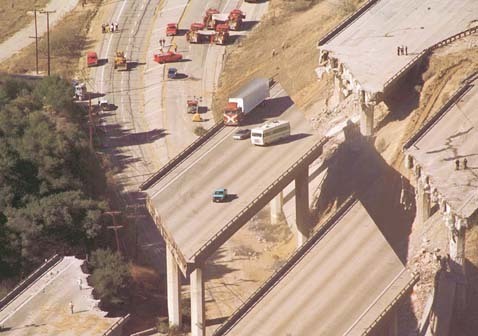
Everyone knows that a really big earthquake is going to hit Los Angeles sooner or later. L.A. is as little as 35 miles from the San Andreas Fault, which isn’t just the longest fault in California — it’s the longest in the Lower 48. Historically, the average amount of time between quakes on the most dangerous part of the southern San Andreas is 100 to 150 years. The last one ripped through L.A. more than 300 years ago.
There’s a reason, in other words, why the City of Angels was recently ranked the most vulnerable metropolis in the world outside of Asia.
But knowing that L.A. is overdue for a Big One and understanding what a Big One would actually do to L.A. are two different things — and that difference was on vivid display at City Hall Tuesday morning, where Mayor Eric Garcetti was releasing a report with the buzzwordy title “Resilience by Design.”
The product of a yearlong collaboration between scientists and stakeholders, the 126-page package of earthquake safety recommendations focuses on fixing the three weakest elements of L.A.'s urban infrastructure: its pre-1980 buildings, its creaky, convoluted water system and its vulnerable telecommunications network. All in all, the report represents a “tectonic shift” in the city’s thinking, according to Garcetti.
“For a long time, Los Angeles has been at the epicenter of seismic risk,” the mayor declared Tuesday. “Today we are going to be at the epicenter of seismic preparedness.”
Source: Yahoo! News
Mod
 Mod
Mod
 by
by
 Simon Winchester
Synopsis:
In 1793, a canal digger named William Smith made a startling discovery. He found that by tracing the placement of fossils, which he uncovered in his excavations, one could follow layers of rocks as they dipped and rose and fell—clear across England and, indeed, clear across the world—making it possible, for the first time ever, to draw a chart of the hidden underside of the earth. Smith spent twenty-two years piecing together the fragments of this unseen universe to create an epochal and remarkably beautiful hand-painted map. But instead of receiving accolades and honors, he ended up in debtors' prison, the victim of plagiarism, and virtually homeless for ten years more.
The Map That Changed the World is a very human tale of endurance and achievement, of one man's dedication in the face of ruin. With a keen eye and thoughtful detail, Simon Winchester unfolds the poignant sacrifice behind this world-changing discovery.
Mod
Krakatoa: The Day the World Exploded: August 27, 1883 by
Simon Winchester
by
Simon WinchesterSynopsis:The legendary annihilation in 1883 of the volcano-island of Krakatoa -- the name has since become a byword for a cataclysmic disaster -- was followed by an immense tsunami that killed nearly forty thousand people. Beyond the purely physical horrors of an event that has only very recently been properly understood, the eruption changed the world in more ways than could possibly be imagined. Dust swirled round die planet for years, causing temperatures to plummet and sunsets to turn vivid with lurid and unsettling displays of light. The effects of the immense waves were felt as far away as France. Barometers in Bogotá and Washington, D.C., went haywire. Bodies were washed up in Zanzibar. The sound of the island's destruction was heard in Australia and India and on islands thousands of miles away. Most significant of all -- in view of today's new political climate -- the eruption helped to trigger in Java a wave of murderous anti-Western militancy among fundamentalist Muslims: one of the first outbreaks of Islamic-inspired killings anywhere.
Simon Winchester's long experience in the world wandering as well as his knowledge of history and geology give us an entirely new perspective on this fascinating and iconic event as he brings it telling back to life.
You're welcome, Skeetor. I hope you may enjoy the books.
The Seashell on the Mountaintop: A Story of Science, Sainthood, and the Humble Genius who Discovered a New History of the Earth by Alan Cutler (no photo)
Synopsis:
It was an ancient puzzle that stymied history's greatest minds: How did the fossils of seashells find their way far inland, sometimes high up into the mountains? Fossils only made sense in a world old enough to form them, and in the seventeenth century, few people could imagine such a thing. Texts no less authoritative than the Old Testament laid out very clearly the timescale of Earth's past; in fact one Anglican archbishop went so far as to calculate the exact date of Creation...October 23, 4004, B.C.
A revolution was in the making, however, and it was started by the brilliant and enigmatic Nicholas Steno, the man whom Stephen Jay Gould called "the founder of geology." Steno explored beyond the pages of the Bible, looking directly at the clues left in the layers of the Earth. With his groundbreaking answer to the fossil question, Steno would not only confound the religious and scientific thinking of his own time, he would set the stage for the modern science that came after him. He would open the door to the concept of "deep time," which imagined a world with a history of millions or billions of years. And at the very moment his expansive new ideas began to unravel the Bible's authoritative claim as to the age of the Earth, Steno would enter the priesthood and rise to become a bishop, ultimately becoming venerated as a saint and beatified by the Catholic Church in 1988.
Combining a thrilling scientific investigation with world-altering history and the portrait of an extraordinary genius, The Seashell on the Mountaintop gives us new insight into the very old planet on which we live, revealing how we learned to read the story told to us by the Earth itself, written in rock and stone.
One of the greatest classics in the History of Geology.Principles of Geology
 by
by
 Charles Lyell
Synopsis:
Influencing Darwin, Tennyson and Dickens among others, Lyell's Principles was an ambitious attempt to forge links between observable causes - volcanoes, earthquakes, rivers, tides and storms - and the current state of the earth.
The Mountains of Saint Francis by Walter Alvarez (no photo)
Synopsis:
Walter Alvarez and his team made one of the most astonishing scientific discoveries of the twentieth century--that an asteroid smashed into the Earth 65 million years ago, exterminating the dinosaurs. Alvarez had the first glimmer of that amazing insight when he noticed something odd in a rock outcrop in central Italy. Alvarez now returns to that rich terrain, this time to take the reader on an distant past. We encounter the volcanoes that formed the Seven Hills of Rome; the majestic limestone Apennine mountains that started to develop millions of years ago under water; the evidence that the Mediterranean Sea completely evaporated to a sunken desert, perhaps several times; and the proof that continental plates once overran one another to form telling, all major geologic episodes are as dramatic as the great impact that killed the dinosaurs, even when they happen over eons and without huge creatures to witness them.
The Guide to Yellowstone Waterfalls and Their Discovery by Paul Rubenstein (no photo)
Synopsis:
Join three Yellowstone National Park experts in their remarkable discovery of the park's 200-plus new waterfalls, most of which the American public, and even Yellowstone park rangers, have never before witnessed. These trailblazers are the first to document the existence of these spectacular natural features -- at least 25 of which tower to heights of 100 feet or more -- and the authors do so through striking photographs, engaging text, and detailed maps. The book also features the park's 50 known waterfalls and reveals the untold stories surrounding many of them. For nature-lovers, adventure-seekers, and Yellowstone aficionados alike, Yellowstone: The Discovery of its Waterfalls is a landmark work, combining natural and human histories with unbelievably rare geographical discoveries.
Evolution: What the Fossils Say and Why It Matters by
by
 Donald R. Prothero
Synopsis:
Over the past twenty years, paleontologists have made tremendous fossil discoveries, including fossils that mark the growth of whales, manatees, and seals from land mammals and the origins of elephants, horses, and rhinos. Today there exists an amazing diversity of fossil humans, suggesting we walked upright long before we acquired large brains, and new evidence from molecules that enable scientists to decipher the tree of life as never before.
The fossil record is now one of the strongest lines of evidence for evolution. In this engaging and richly illustrated book, Donald R. Prothero weaves an entertaining though intellectually rigorous history out of the transitional forms and series that dot the fossil record. Beginning with a brief discussion of the nature of science and the "monkey business of creationism," Prothero tackles subjects ranging from flood geology and rock dating to neo-Darwinism and macroevolution. He covers the ingredients of the primordial soup, the effects of communal living, invertebrate transitions, the development of the backbone, the reign of the dinosaurs, the mammalian explosion, and the leap from chimpanzee to human. Prothero pays particular attention to the recent discovery of "missing links" that complete the fossil timeline and details the debate between biologists over the mechanisms driving the evolutionary process.
Evolution is an absorbing combination of firsthand observation, scientific discovery, and trenchant analysis. With the teaching of evolution still an issue, there couldn't be a better moment for a book clarifying the nature and value of fossil evidence. Widely recognized as a leading expert in his field, Prothero demonstrates that the transformation of life on this planet is far more awe inspiring than the narrow view of extremists.
 Geomorphology: Earth Landforms
 by Sanjit sen (no photo)
Synopsis:
Geomorphology is the study of landforms and landscapes, including the description, classifiation, origin, development, and history of planetar surfaces. During the early part of this century, the study of regional-scale geomorphology was termed "physiography"(Salisbury, 1907).
Unfortunately, physiography also became synonymous with physical geography, and the concept became embroiled in controversy surrounding the appropriate concerns of that discipline.
Some geomorphologists held to a geological basis for physiography and emphasized a concept of physiographic regions (Fenneman, 1938). A conflicting trend among
geographers was to equate physiography with "pure morphology," divorced of its geological heritage.
In the period following World War II, the emergence of process, climatic, and quantitative studies led to a
preference by many Earth scientists for the term geomorphology" in order to suggest an analytical approach to landscapes rather than a descriptive one.
In the second half of the twentieth century, the study of regional-scale geomorphology -the original physiography- was generally neglected. Russell (1958) attributed the decline of physiography to its elaborate terminology and to its
detachment from evidence acquired by other disciplines, chiefly geology.
Although the concept of physiographic regions endured among geologists (Thornbury, 1965; Hunt, 1967), geographers became
much more interested in the details of man/land interactions and in the applications of modeling and systems analysis (Chorley and Kennedy, 1971) to geomorphology.
In the exploration of planetary surfaces by various space missions, the perspective of regional geomorphology has been the required starting point for scientific inquiry. Global studies of Mars (Mutch et al., 1976), the Moon (McCauley and Wilhelms, 1971), Mercury (Strom, 1984), and Venus (Masursky et al., 1980) resulted in the identification of "surface
units" or physiographic provinces.
The Colorado Plateau (Plate I-1) is an excellent example of a terrestrial physiographic province. Plate I-1 illustrates the use of a large-scale perspective to focus on this naturally defined region.
The term "mega-geomorphology" was introduced in March 1981 at the 21st anniversary meeting of the British Geomorpholgy Research Group. The proceedings of that meeting (Gardner and Scoging, 1983) reveal that the concept was not well defined. It clearly involves a return by geomorphologists to the study of phenomena on large spatial scales, ranging from regions to continents to planets. It also involves large time scales. Nevertheless, mega-geomorphology is merely a
convenient term, unencumbered by past philosophical trappings, that emphasizes planetary surface studies at large scales.
The interrelation of temporal and spatial scales in geomorphology is illustrated by the tentative classification shown in Table 1-1 . Of course, such a hierarchial ordering
of geomorphic features is far from satisfying.
Early Earth Systems: A Geochemical Approach by Hugh R. Rollinson (no photo)
Synopsis:
Early Earth Systems provides a complete history of the Earth from its beginnings to the end of the Archaean. This journey through the Earth's early history begins with the Earth's origin, then examines the evolution of the mantle, the origin of the continental crust, the origin and evolution of the Earth's atmosphere and oceans, and ends with the origin of life.
Looks at the evidence for the Earth's very early differentiation into core, mantle, crust, atmosphere and oceans and how this differentiation saw extreme interactions within the Earth system.
Discusses Archaean Earth processes within the framework of the Earth System Science paradigm, providing a qualitative assessment of the principal reservoirs and fluxes in the early Earth.
"The book would be perfect for a graduate-level or upper level undergraduate course on the early Earth. It will also serve as a great starting point for researchers in solid-Earth geochemistry who want to know more about the Earth's early atmosphere and biosphere, and vice versa for low temperature geochemists who want to get a modern overview of the Earth's interior." "Geological Magazine", 2008
The Story of Life in 25 Fossils: Tales of Intrepid Fossil Hunters and the Wonders of Evolution by
Donald R. Prothero
by
Donald R. ProtheroSynopsis:
Every fossil tells a story. Best-selling paleontology author Donald R. Prothero describes twenty-five famous, beautifully preserved fossils in a gripping scientific history of life on Earth. Recounting the adventures behind the discovery of these objects and fully interpreting their significance within the larger fossil record, Prothero creates a riveting history of life on our planet.
The twenty-five fossils portrayed in this book catch animals in their evolutionary splendor as they transition from one kind of organism to another. We witness extinct plants and animals of microscopic and immense size and thrilling diversity. We learn about fantastic land and sea creatures that have no match in nature today. Along the way, we encounter such fascinating fossils as the earliest trilobite, Olenellus; the giant shark Carcharocles; the "fishibian" Tiktaalik; the "Frogamander" and the "Turtle on the Half-Shell"; enormous marine reptiles and the biggest dinosaurs known; the first bird, Archaeopteryx; the walking whale Ambulocetus; the gigantic hornless rhinoceros Paraceratherium, the largest land mammal that ever lived; and the Australopithecus nicknamed "Lucy," the oldest human skeleton. We meet the scientists and adventurers who pioneered paleontology and learn about the larger intellectual and social contexts in which their discoveries were made. Finally, we find out where to see these splendid fossils in the world's great museums.
Ideal for all who love prehistoric landscapes and delight in the history of science, this book makes a treasured addition to any bookshelf, stoking curiosity in the evolution of life on Earth.
Almeria (Classic Geology in Europe) by Adrian Harvey (no photo)
Synopsis:
Almeria exhibits superb structural geology (especially the fault system), a complete Neogene sedimentary sequence (itself rare) involving an enormous range of sedimentary environments, and classic dryland geomorphology. Exposure of the sedimentary sequences is excellent. The area is spectacular and the landform assemblage includes a wide range of erosional and depositional landscapes. Furthermore, the region enables linkages to be made between the several disciplines of geodynamics. The Neogene sequence cannot be interpreted without considering the evolving tectonics nor the contemporaneous geomorphology. Neither may the geomorphology be understood without considering the modern landscape as a development from the Neogene tectonic and sedimentary sequences. This guide is an essential companion to geologists and physical geographers visiting this province in SE Spain to view its range of unique features, made famous as a spectacular location for a host of popular films. GPS coordinates are provided for the locations discussed.
Mod
Structural Geology by Haakon Fossen (no photo)
Synopsis:
Lavishly illustrated in color, this textbook takes an applied approach to introduce undergraduate students to the basic principles of structural geology. The book provides unique links to industry applications in the upper crust, including petroleum and groundwater geology, which highlight the importance of structural geology in exploration and exploitation of petroleum and water resources. Topics range from faults and fractures forming near the surface to shear zones and folds of the deep crust. Students are engaged through examples and parallels drawn from practical everyday situations, enabling them to connect theory with practice. Containing numerous end-of-chapter problems, e-learning modules, and with stunning field photos and illustrations, this book provides the ultimate learning experience for all students of structural geology.
 U.S. Geology Maps Reveal Areas Vulnerable To Man-Made Quakes
by CHRISTOPHER JOYCE
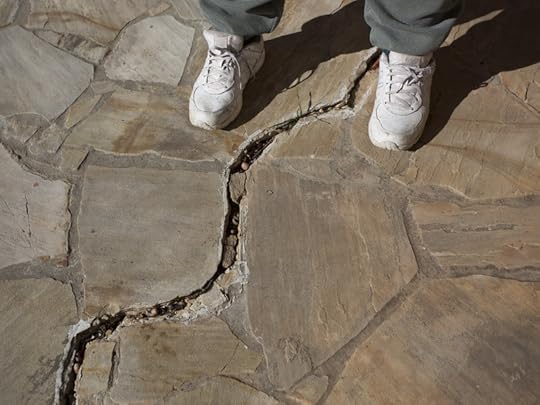
Large cracks in the sidewalk in Coyle, Okla., appeared after several earthquakes on Jan. 24. J Pat Carter/Getty Images
Some parts of Oklahoma and Texas now have about the same risk of an earthquake as parts of California, according to the U.S. Geological Survey.
The big difference is, the quakes in Oklahoma and Texas are "induced" — they're caused by oil and gas operations that pump wastewater down into underground wells.
USGS scientists have now published the first maps of these new quake zones, and they're an eye-opener. An eye-opener because 7 million people are now, suddenly, living in quake zones. There are 21 hot spots where the quakes are concentrated; they're in places where, historically, noticeable earthquakes were rare: Texas, Colorado, Arkansas, Kansas, New Mexico and Oklahoma. Ohio and Alabama have also experienced some induced quakes.
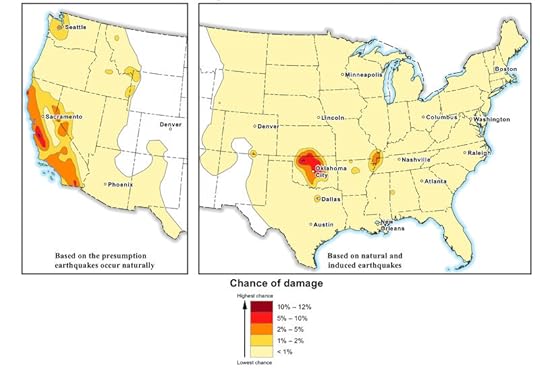
This USGS map displays potential to experience damage from natural or human-induced earthquakes in 2016. Chances range from less than 1 percent to 12 percent. USGS
A decade ago, an Oklahoman could count the number of noticeable quakes on her fingers. "In this past year, we had over 900," says USGS seismic hazard expert Mark Petersen. "So the rates have surged."
Petersen says induced quakes have become more frequent because there's more wastewater from oil and gas operations around the country that has to be disposed of. Companies pump it down into underground wells, and sometimes that water raises pressure on underground faults that then slip and cause small quakes.
Industry officials say the percentage of waste wells that pose quake risks is very low. But with the rise in hydraulic fracturing (fracking), which produces a lot of polluted water that needs to be disposed of, the overall number of waste wells around the country has skyrocketed.
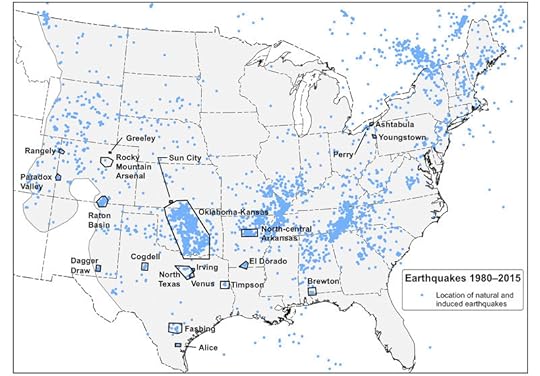
A USGS map shows 21 areas where scientists have observed rapid changes in seismicity that have been associated with wastewater injection. The map also shows earthquakes — both natural and induced — recorded from 1980 to 2015 in the central and eastern U.S. with a magnitude greater than or equal to 2.5. USGS
Read the remainder of the article: http://www.npr.org/sections/thetwo-way...
Discussion topics:
a) Have you ever experienced an earthquake?
b) What are your thoughts about fracking?
Source: National Public Radio
 Interesting article, thanks for posting.
a) I have experienced numerous earthquakes but never a major one. There were many weak ones in California that would make my coffee cup skitter across the table but that I probably wouldn't have noticed otherwise. Probably the strongest one I felt here in NC a while back (2008?). I believe the quake's epicenter was in Ohio? Anyhow, I was sitting on my couch and it felt as if someone had shoved the couch.
b) Not a fan of fracking, never have been, never will. Doesn't sound like a safe operation to me.
 Interesting article. Thanks for posting it. I knew that fracking caused earthquakes but I didn't really know in what way. I have definitely experienced earthquakes especially when I lived in Los Angeles, California. The most potent one being the one that occurred in 1994, with a magnitude of 6.7. That one was pretty scary mostly because it occurred in the middle of the night and woke most people from their bed and it really shut down the city for a couple of days. The epicenter was in Northridge and I lived in West Hollywood at the time. I was lucky that the building I lived in was not severely damaged. I have also even experienced very small earthquakes in the Midwest, due to the New Madrid Fault line. It is rare to feel an earth quake along this fault line but sometimes very small earth quakes happen.
 I am not sure how I feel about fracking. I feel like I don't know enough of the pros and cons about it to form an educated opinion. I do think man made earth quakes no matter how small they are, are a potential recipe for a much larger catastrophe.
Hi Skeetor, I've never experienced an earthquake, and am pretty fearful of what that would be like. Did you have an "emergency earthquake kit" or things you knew to do to prepare for this type of natural disaster?
Mel, that 1994 earthquake was a pretty potent one for sure! Do you remember there being any advanced warning? Do you feel an earthquake is the scariest natural disaster?
Regarding fracking, from what I've read, the process itself does cause minor earthquakes, but it's the disposal of the toxic wastewater that can contaminate our water supply, threaten our wildlife, and can induce more disruptive quake activity.
Betty wrote: "Mel, that 1994 earthquake was a pretty potent one for sure! Do you remember there being any advanced warning? Do you feel an earthquake is the scariest natural disaster?"Hi Betty, I can't remember if there were any smaller earthquakes before that one. There usually are small ones right before so there probably was a small warning a few days before, but everyone in Los Angeles is always waiting for the "big one" so I don' t think anyone thought that if there were smaller ones that they meant a much bigger one was coming in the very near future. It happened very, very, early in the morning, so to be awoken to the sounds of all the transistors and things on the light poles and electric poles popping etc. was not a fun way to wake up. It was pretty scary. Then it was also pitch black as there was NO electricity so that was very confusing but also really scary. Then collecting yourself enough to figure out what was happening, locate pets who were hiding etc. was scary. Anyway, to answer your question, there was no obvious warning at least that I remember.
In my mind, I think tornadoes and hurricanes (any wind events) are way scarier than earthquakes, but really they are all terrifying in their own ways. As far as earthquakes go, I think if you aren't on the freeway and can get outside of the building or under a doorway and there isn't gas leaking and a danger of explosion or collapse you really are okay. It really is over in a few seconds. Cities like Los Angeles are mostly designed to withstand earthquakes and has a fairly good infrastructure to deal with it. The aftermath of having to pick up the pieces, sometimes having to boil water and no electricity etc is usually the worst part. If you are in the epicenter like Northridge was in the 1994 earthquake, it was much much more terrible for people located at the epicenter and some buildings collapsed, people were trapped etc. So I guess in the case of an earthquake you don't want to be near the epicenter and you want to get outside of the building or at least under something like a doorway that wont collapse on you.
The midwestern New Madrid fault scares me a lot worse because I feel the midwest isn't really equipped to deal with a large earthquake if it should ever happen and the effect on the Mississippi river would also make it a worse disaster.
Interesting about the fracking. I definitely don't think anything that has the potential to cause those kinds of environmental problems is a good idea.
Funny, I have experienced more wind-related weather events than I can possibly count, and they don't scare me all that much ... which makes me wonder if we are just afraid of the things we don't know!
Mel wrote: "Betty wrote: "Mel, that 1994 earthquake was a pretty potent one for sure! Do you remember there being any advanced warning? Do you feel an earthquake is the scariest natural disaster?"Hi Betty, I..."
There is probably a lot of truth to that. I have experienced high winds and the threat of tornado is real where I live but I haven't experienced a tornado or an actual hurricane and I don't want to.
Betty wrote: "Hi Skeetor, I've never experienced an earthquake, and am pretty fearful of what that would be like. Did you have an "emergency earthquake kit" or things you knew to do to prepare for this type of n..."Hi, Betty - I do prepare for natural disasters but not necessarily for a particular one. I think most of the prepping is the same for all of them. (flashlights, food, full tank of gas, important papers in one place, etc.)
I do agree with you and Mel that events you've not experienced are always a lot more frightening. I do think tornadoes (which I have been near but not had one actually hit my building) are the ones that frighten me most.
I've been through a few Hurricanes. They aren't quite as frightening since you have an idea that you might get hit by one at least a day in advance so you can prepare. You may only get an hour's warning (if that) from a tornado heading your way.
As for earthquakes, I am in a mostly rural setting (no tall buildings) so they don't seem as dangerous here. I do think an earthquake would be a lot worse in a large city.
Mod
 by
by
 Diane Francis
Synopsis:
For 2 years, BRE-X was the darling of the world's stock markets. Millionaires were created over night; until the scam was uncovered.
This is a great story of fraud, lies, gold, promotion, scandal and the stock market. For anyone in the mining industry, I think this is a great read. It should be mandatory for those involved with reporting of Resources & Reserves or tasked with promoting a junior miner. To give you a sense of urgency on this read, the movie “Gold” is set for release in early 2017 and is based on the Bre-X scandal.
Mod
 by
by

Synopsis:
Robert Macfarlane's Mountains of the Mind is the most interesting of the crop of books published to mark the 50th anniversary of the first successful ascent of Everest.
Macfarlane is both a mountaineer and a scholar. Consequently we get more than just a chronicle of climbs. He interweaves accounts of his own adventurous ascents with those of pioneers such as George Mallory, and in with an erudite discussion of how mountains became such a preoccupation for the modern western imagination.
The book is organised around a series of features of mountaineering--glaciers, summits, unknown ranges--and each chapter explores the scientific, artistic and cultural discoveries and fashions that accompanied exploration.
The contributions of assorted geologists, romantic poets, landscape artists, entrepreneurs, gallant amateurs and military cartographers are described with perceptive clarity.
The book climaxes with an account of Mallory's fateful ascent on Everest in 1924, one of the most famous instances of an obsessive pursuit. Macfarlane is well-placed to describe it since it is one he shares.
MacFarlane's own stories of perilous treks and assaults in the Alps, the Cairngorms and the Tian Shan mountains between China and Kazakhstan are compelling.
Readers who enjoyed Francis Spufford's masterly I May Be Some Time: Ice and the English Imagination will enjoy Mountains of the Mind. This is a slighter volume than Spufford's and it loses in depth what it gains in range, but for an insight into the moody, male world of mountaineering past and present it is invaluable. --Miles Taylor
Awards:
Guardian First Book Award (2003), Somerset Maugham Award (2004), Boardman Tasker Prize Nominee for Mountain Literature (2003), Sunday Times/Peters Fraser + Dunlop Young Writer of the Year Award (2004)
Review:
Robert MacFarlane being interviewed by FiveBooks:
The underlying narrative of much landscape writing is man’s relationship and interaction with the natural world.
There are many versions of that question or preoccupation. Some of the books I have chosen are about connection with nature, and some are about its terrifying disinterest. The wilderness can be a very welcoming and miraculous place, but it can also be fatal in its complete indifference to human presence. The wild – that extreme manifestation of nature – is both exhilarating and, sometimes, murderous.
Your most recent book The Old Ways touches on this question of the connection of between man and landscape, doesn’t it?
Yes it does. I have written three books which together form a loose trilogy about landscape and human thought. The first, Mountains of the Mind, was about why people might be willing to lose limbs or even life for their love of mountains – which are, after all, nothing but geological structures
More:
https://fivebooks.com/best-books/robe...
Source: FiveBooks
Mod
 by
by
 John McPhee
Synopsis:
This is about high-country geology and a Rocky Mountain regional geologist. I raise that semaphore here at the start so no one will feel misled by an opening passage in which a slim young woman who is not in any sense a geologist steps down from a train in Rawlins, Wyoming, in order to go north by stagecoach into country that was still very much the Old West.
So begins John McPhee's Rising from the Plains. If you like to read about geology, you will find good reading here. If, on the other hand, you are not much engaged by the spatial complexities of the science, you could miss a richness of human history that has its place among the strata described. Sometimes it is said of geologists that they reflect in their professional styles the sort of country in which they grew up. Nowhere could that be more true than in the life of a geologist born in the center of Wyoming and raised on an isolated ranch. This is the story of that ranch, soon after the turn of the century, and of the geologist who grew up there, at home with the composition of the high country in the way that someone growing up in a coastal harbor would be at home with the vagaries of the sea. While Rising from the Plains is a portrayal of extraordinary people, it is also a history of the landscape around them, where, with remarkable rapidity, mountains came up out of the flat terrain. Gradually, the mountains were buried, until only the higher peaks remained above a vast plain. Recently, they have been exhumed, and they stand now as the Rockies.
Rising from the Plains is John McPhee's third book on geology and geologists. Following Basin and Range and In Suspect Terrain, it continues to present a cross section of North America along the fortieth parallel—a series gathering under the overall title Annals of the Former World.

The History Book Club
Books mentioned in this topic
Rising from the Plains (other topics)Mountains of the Mind: A History of a Fascination (other topics)
BRE-X: The Inside Story (other topics)
Structural Geology (other topics)
Almeria (other topics)
More...
Authors mentioned in this topic
John McPhee (other topics)Robert Macfarlane (other topics)
Diane Francis (other topics)
Haakon Fossen (other topics)
Adrian Harvey (other topics)
More...
"Geology (from the Greek γῆ, gē, i.e. "earth" and -λoγία, -logia, i.e. "study of, discourse"[1][2]) is an earth science comprising the study of solid Earth, the rocks of which it is composed, and the processes by which they change. Geology can also refer generally to the study of the solid features of any celestial body (such as the geology of the Moon or Mars).
Geology gives insight into the history of the Earth by providing the primary evidence for plate tectonics, the evolutionary history of life, and past climates. Geology is important for mineral and hydrocarbon exploration and exploitation, evaluating water resources, understanding of natural hazards, the remediation of environmental problems, and for providing insights into past climate change. Geology also plays a role in geotechnical engineering and is a major academic discipline.'
Source: Wikipedia