
Victorians! discussion

This topic is about
The Old Curiosity Shop
Archived Group Reads 2021
>
The Old Curiosity Shop: Week 2: Chapters 10-18
date newest »
newest »
 I really enjoyed this second segment of the story. I was nervous at first with the performers, thinking that Nell sewed the money in her dress to save it from them, but now I lean towards her doing that to keep it from her grandfather!
My heart went out to Kit, he cares so much for Nell. I hope we continue to see how he gets on and perhaps gets more regular employment (maybe from the elderly couple he met, he did promise to be back on Monday!).
 The caged linnet was in many ways a metaphor for Nell whilst held in Quilp’s terrible grip. What a relief to see that Kit could reclaim at least a memento of his lost love. Will he be able to reunite the bird with Nell in the future? I hope so.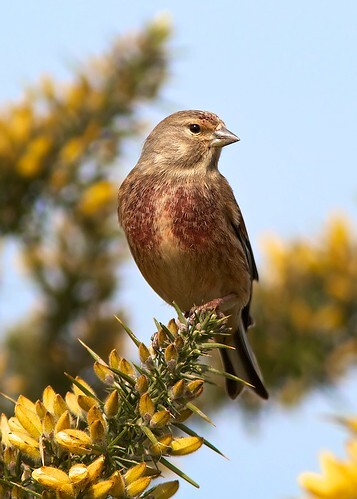
A linnet, now on the red list for endangered species in Britain, is a small, insignificant bird with a melodious call, mainly reliant on the leftover seeds found in farmers fields, originally the linseeds. The overuse of chemicals and modern farming techniques have reduced its numbers dramatically.
The fact that Quilp took over Nell’s room and bed was almost too horrific and had dark forebodings. I was so relieved when Nell and her Grandfather managed to escape. Nell showed tremendous bravery to creep close to the sleeping Quilp and acquire the key to the locked door.
Their meeting up with the Punch and Judy troupe was indeed a relieving distraction. Short may be concerned for Nell but I was less than impressed in the way Codlin sees her grandfather as a burden to them all. I had the same worry about the race meeting with grandfather’s gambling addiction and the fact that Nell would be so vulnerable as a beggar. Another thought I had was about the tumbling boy. Could he be in any way connected with these travelling artistes and somehow lead Quilp back to Nell?
 Mod
Mod
Glad to hear that Sarah; the performers I thought added a fun element to the story--th dancing dogs in particular, though I felt bad for the one that had to go without his supper.
I hope that Kit gets some proper employment soon as well; I enjoyed the picture of his family we saw.
Mod
Glad you brought up the linnet analogy--I didn't think of it that way; I really felt for Nell having to put up with Qulip's ominous presence--one kept hoping he wouldn't do anything--luckily he didn't.
Grandfather to me was like a rather typical character from books of that period or even earlier when I find usually the father takes a bad decision or makes a mistake and almost 'conveniently' falls ill or dies leaving the poor wives and daughters to bear the burden; Margaret in North and South for instance found herself in a similar predicament; Nicholas Nickleby is another I can think of. Its sad that women in such situations had such limited opinions and yet the responsibility fell on them. Here it is even worse for Nell is still a child. Grandfather I felt was even worse than Quilp for her pretends (even to himself) to care for Nell and yet seems not the least bothered to be placing all the burden on her.
Lady Clementina wrote: "Trev wrote: "The caged linnet was in many ways a metaphor for Nell whilst held in Quilp’s terrible grip. What a relief to see that Kit could reclaim at least a memento of his lost love. Will he be ..."Thanks for reminding me of North and South. The way Margaret remains supportive of her father despite his actions (which make life so difficult for both her and her mother) is very reminiscent of Nell’s loyalty to her grandfather. Both Margaret and Nell, young as they are, are leant on heavily by the people who should be looking after them. I wonder if Nell can build up the resilience and worldly awareness that Margaret did?
Trev wrote: "The caged linnet was in many ways a metaphor for Nell whilst held in Quilp’s terrible grip. What a relief to see that Kit could reclaim at least a memento of his lost love. Will he be able to reuni..."I hadn't even thought about the tumbling boy connection! I hope that is not the case.
 Dickens' writing is of-the-day in that most bad people are ugly and wear ridiculous clothes, and most good people are attractive and well-dressed. Lord have mercy, don't we wish life actually gave us signposts making it that simple to navigate.
 When Nell and Grandfather join in with the puppeteers, I was reminded of another pair of literary travelers who are joined by an entertainment troupe while on their journey - Huck and Jim - who meet up with the Duke and the King. I always laugh when Twain has other characters refer to the Duke of Bridgewater as "Bilgewater".
Good to see Quilp get some of his own medicine from Swiveller.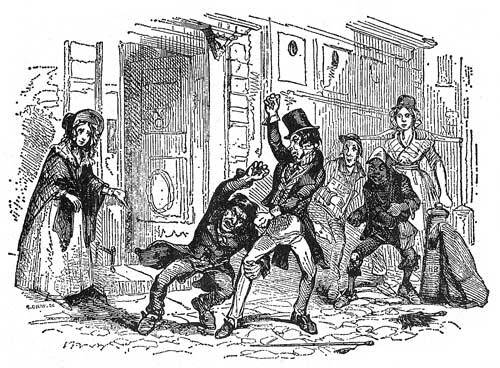
But the bullying coward that Quilp is then takes it out on his wife. How she must regret her mad impulse to marry the man. Or maybe she was just too frightened to say no. Quilp thinks he is God’s gift to women when in fact he is an unrelenting, sadistic monster.
Mod
But the bullying coward that Quilp is then takes it out on his wife. How she must regret her mad impulse to marry the man. Or maybe..."
I was happy to see him at the receiving end but sadly right after was the pinching; Like you say, it may well have been a case of Mrs Quilp being too scared to say no.
Mod
His 'heroes' and 'villains' do tend to be black and white no doubt, but the supporting cast does show interesting variety (even if still classifiable in the same categories.)
 Brian: I'm always curious at Dickens' black and white visual portrayal of "bad and good" characters this way, respectively. For someone who seems that he was so interested in human character and motivations, it's an interesting choice to use this trope. Dickens is my favorite author, so this is no criticism, just a curiosity. Do you think it has more to do with the social and economic extremes of the time and place than with anything intentional on his part? Dickensian London does seem like a place of extremes, where you're either wealthy or poor, kind or cruel, good or bad, etc. Is he playing to his readers, who would understand these cues?
All that said, there are exceptions as Lady Clementia pointed out. Kit may be a bit of an exception. A pure and kind soul who was also "a shock-headed shambling awkward lad with an uncommonly wide mouth, very red cheeks, a turned-up nose, and certainly the most comical expression of a face I ever saw."
I'd bet dollars to donuts Nell won't end up marrying him though! haha.
A good bunch of chapters, love the characters. Definitely some foreshadowing of challenges to come at the races.
I feel sorry for the performing dogs, and the poor bird!
Mod
Mandy, I do believe that form of storytelling was prominent during his lifetime. I'm more struck by his correlation of outward appearance and soul, than by any lack of gradation on a "goodness / evil scale".
 I am really sad that Kit was misunderstood by both Nell and her grandfather. I hope he finds a steady job and continues taking care of his family. I would love to see Nell and Kit get together again.
I don't like the grandfather at all as he doesn’t care if the little Nell is tired or not. I also hate to see that he wants Nell by his side as he is falling asleep because Nell doesn’t have much time to sleep. I was relieved that the kind woman treated Nell’s foot before they hit the road.
I am glad that Nell hid that coin. I hope the grandfather doesn’t gamble again now that they have so little. I don’t want to see them begging.
I like the new characters but at first, I was a bit skeptical. I was worried that they might trick Nell and her grandfather. However, when I read Harris’ worries about Nell, I liked them even more. I hope they can bring the grandfather to his senses and take care of Nell.
 Beril wrote: "I am really sad that Kit was misunderstood by both Nell and her grandfather. I hope he finds a steady job and continues taking care of his family. I would love to see Nell and Kit get together agai..."
I agree with you. I like Kit so far, but Nell’s grandfather seems completely selfish.
But I didn’t like the section about the travelling entertainers - it seemed very similar to part of another of his books (Nicholas Nickelby, I think).
Trisha wrote: "But I didn’t like the section about the travelling entertainers - it seemed very similar to part of another of his books (Nicholas Nickelby, I think). "I haven't read Nicholas Nickelby yet. Thank you for the information. I am happy that we're on the same page about the grandfather. I totally agree, he is really selfish.
Mod
I agree on Nell's grandfather, Beril and Trisha; I bein to question his avowals of affection for her, for it seems to me that he doesn't seem to care about her at all.
Re the travelling performers, you're right, Trisha, they are reminiscent of Nicholas Nickleby; and my guess was that they are inspired by the Tobias Smollett novels Dickens liked. I quite enjoyed it though because they did bring a bit of colour into the story.
Lady Clementina wrote: "Trisha wrote: "Beril wrote: "I am really sad that Kit was misunderstood by both Nell and her grandfather. I hope he finds a steady job and continues taking care of his family. I would love to see N..."That’s interesting about the Tobias Smollett novels - thank you. That explains it. I think that I dislike the performers mainly because they seem to be completely irrelevant to either story & I sometimes wish Dickens would keep to the point!
@Trisha. Dickens really likes to paint a full picture, and that can result in long tangents. It can definitely be annoying though he is still my favorite author. The environment is as much a character as any person in his stories.
Mod
Thank you Mandy & Lady Clementina - it’s interesting to get other opinions & information. I especially like your idea that the environment is another character in the stories.
@lady clementine, yes absolutely! I think we talked about that when reading Nicholas Nickleby too.


Meanwhile the grotesque Quilp has taken possession of the shop and the house, in fact claiming poor Nell’s room for himself. And it is Nell who must put up with his presence as grandfather is conveniently too ill to realize this. Quilp with his attorney Brass and the tumbling boy from the wharf (it is interesting how he is the one person whose cheek Quilp is willing to accept) make the place unliveable with their presence and incessant smoking to keep infection at bay.
When grandfather recovers a little, he and Nell set off before anyone realizes, attempting to get as far away as possible from Quilp and his band. While this is all well in theory, here again, it is Nell who must take charge, who must even worry about the expenses and make plans to take to begging when what little they have will run out. The old man, for all his claims of caring for Nell, does not even notice when the poor child is tired or in need of rest, with only the lady at the farm trying to treat her blistered feet. Grandfather is wearing the little girl out and I felt he is in many ways worse for her or at least as bad as Quilp.
Meanwhile Quilp and company discover their disappearance; and with Dick Swiveller’s visit, it was nice to see Qulip get some well-deserved punches (though not near as enough as he should have gotten). Sadly, in this scene we also see more of his mistreatment of poor Mrs Quilp whose arms we see are blue with Quilp’s pinches. No wonder he is so sure, she won’t last 5 years.
In a thread of relief from all this heaviness (though it is still playing out alongside), our story takes on some shades of a picaresque novel as Nell and her Grandfather begin their journey way from London. They meet some colourful characters, including Codlin and Harris (‘Short Trotters’) who run a Punch and Judy show; Grinder’s lot who perform on stilts, and Jerry and his troupe of dancing dogs. The atmosphere at the Jolly Sandboys inn is warm and inviting, and one is glad to see our travellers get some rest. Harris/Short also feels for poor Nell and wants to tell their ‘friends’ so that Nell may be rescued from this life; while his intentions are good, one knows Nell has no friends (except perhaps poor Kit), and any telling will only get them into further trouble.
The mention of Codlin and Harris and the other performers heading to the racers did have me see red flags going up. Poor Nell has put away safely the one gold coin they have, but one can only hope grandfather isn’t tempted to try his ‘luck’ once again with what little they have bringing on them further ruin.
What did you think of this week’s developments? What do you make of Grandfather? Of Kit? And the various performers we met?