
The Pickwick Club discussion

This topic is about
David Copperfield
David Copperfield
>
Copperfield, Chapters 01-03

 The Second Chapter once more shows Dickens's skills as a writer: With a few strokes of his brush, the first person narrator gives us an impression of the world of his childhood describing, from a child's view, the inside of the house, the church services, the outside of the house and the churchyard where his father's body lies. All this is done by jumping from one association to another and by giving minute details. It's simply great writing!!! [I am normally very stingy when it comes to using exclamation marks, as I think them bad style, but here my enthusiasm got the better of me.]
Quite aptly for an autobiography, David also muses on the workings of memory:
" This may be fancy, though I think the memory of most of us can go farther back into such times than many of us suppose; just as I believe the power of observation in numbers of very young children to be quite wonderful for its closeness and accuracy. Indeed, I think that most grown men who are remarkable in this respect, may with greater propriety be said not to have lost the faculty, than to have acquired it; the rather, as I generally observe such men to retain a certain freshness, and gentleness, and capacity of being pleased, which are also an inheritance they have preserved from their childhood.
I might have a misgiving that I am 'meandering' in stopping to say this, but that it brings me to remark that I build these conclusions, in part upon my own experience of myself; and if it should appear from anything I may set down in this narrative that I was a child of close observation, or that as a man I have a strong memory of my childhood, I undoubtedly lay claim to both of these characteristics."
This is probably done with a view to forestalling criticism as to how a mere child could remember all those vivid details; at another point David concedes that he is not too sure about the dates, though.
For all the idyllic peacefulness, yet there is trouble ahead in the form of Mr. Murdstone, the new suitor of his mother. David gives a very impressive description of Mr. Murdstone, dwelling on his memories from a ride with him, when he had time to study his face from very near:
"Mr. Murdstone and I were soon off, and trotting along on the green turf by the side of the road. He held me quite easily with one arm, and I don't think I was restless usually; but I could not make up my mind to sit in front of him without turning my head sometimes, and looking up in his face. He had that kind of shallow black eye—I want a better word to express an eye that has no depth in it to be looked into—which, when it is abstracted, seems from some peculiarity of light to be disfigured, for a moment at a time, by a cast. Several times when I glanced at him, I observed that appearance with a sort of awe, and wondered what he was thinking about so closely. His hair and whiskers were blacker and thicker, looked at so near, than even I had given them credit for being. A squareness about the lower part of his face, and the dotted indication of the strong black beard he shaved close every day, reminded me of the wax-work that had travelled into our neighbourhood some half-a-year before. This, his regular eyebrows, and the rich white, and black, and brown, of his complexion—confound his complexion, and his memory!—made me think him, in spite of my misgivings, a very handsome man. I have no doubt that my poor dear mother thought him so too."
Not very reassuring. It also becomes clear that David's mother, Clara, is very vain and easy to influence, as when she takes obvious pleasure in being called "bewitching", "pretty" or a "little widow" by Mr. Murdstone's friends. Now, being called "a little widow" is quite respectless, I should say, and it reminded me of Sir Mulberry Hawk's going on about "Little Kate Nickleby".
Obviously, Peggotty does not savour the prospect of seeing Mr. Murdstone as Clara's new husband, and she even takes the liberty to expostulate with her mistress. Mrs. Copperfield's reaction to these expostulations are very conclusive as to her character.
Finally, Mr. Murdstone seems to have reached his aim since one day Peggotty invites David to visit her brother in Yarmouth for a fortnight. Clearly, this is a scheme in order to get David out of the way for the wedding between Murdstone and Mrs. Copperfield, who seems to have fallen for Murdstone's good looks.
In Chapter 3, the scene is set in Yarmouth, which David calls "the finest place in the universe" - Dickens himself spent some weeks in that town when he was working on the novel.The narrator argues with a child's logic when he says
"and I could not help wondering, if the world were really as round as my geography book said, how any part of it came to be so flat. But I reflected that Yarmouth might be situated at one of the poles; which would account for it",
and his introduction into Peggotty's family - her brother Mr. Peggotty, is a fisherman, and then there are his nephew Ham, his niece Emily and his late partner's widow Mrs. Gummidge, and they all live in an ancient boat - also breathes the enthusiasm of childhood, but also Dickens's infatuation with fairy tales and an exuberant imagination:
"If it had been Aladdin's palace, roc's egg and all, I suppose I could not have been more charmed with the romantic idea of living in it. There was a delightful door cut in the side, and it was roofed in, and there were little windows in it; but the wonderful charm of it was, that it was a real boat which had no doubt been upon the water hundreds of times, and which had never been intended to be lived in, on dry land. That was the captivation of it to me. If it had ever been meant to be lived in, I might have thought it small, or inconvenient, or lonely; but never having been designed for any such use, it became a perfect abode."
David gives us a good idea of the dangers that beset the lives of the fishermen at that period, for we hear a good deal of relations being "drowndead" by the sea, and there is one scene in which Little Emily shows David her fearlessness with regard to the sea that has claimed the life of her father, and David - with a view to what is yet in store for Emily - says,
" The light, bold, fluttering little figure turned and came back safe to me, and I soon laughed at my fears, and at the cry I had uttered; fruitlessly in any case, for there was no one near. But there have been times since, in my manhood, many times there have been, when I have thought, Is it possible, among the possibilities of hidden things, that in the sudden rashness of the child and her wild look so far off, there was any merciful attraction of her into danger, any tempting her towards him permitted on the part of her dead father, that her life might have a chance of ending that day? There has been a time since when I have wondered whether, if the life before her could have been revealed to me at a glance, and so revealed as that a child could fully comprehend it, and if her preservation could have depended on a motion of my hand, I ought to have held it up to save her. There has been a time since—I do not say it lasted long, but it has been—when I have asked myself the question, would it have been better for little Em'ly to have had the waters close above her head that morning in my sight; and when I have answered Yes, it would have been.
This may be premature. I have set it down too soon, perhaps. But let it stand."
This may serve as an example of how carefully Dickens had by then come to plan his novels; apparently the destinies of his characters were already very clear to him. Apart from that, it also keeps the reader interested ...
David's stay in Yarmouth is only slightly overshadowed by Mrs. Gummidge's occasional lapses into despondency and gloom, and Dickens gives us another of his character-identifying catch-phrases - indeed some of his characters seem to consist in only one catch-phrase - when Mrs. Gummdige repeatedly calls herself a "lone lorn creetur" and protests that everything goes "contrairy" with her. However, Dickens has a good eye for people like Mrs. Gummidge in that he has her tell that she feels hardships more than other people.
There is also wonderful poetry in how David describes his happy-go-lucky days in Yarmouth when he says,
"The days sported by us, as if Time had not grown up himself yet, but were a child too, and always at play."
Eventually, however, David has to return home, and he arrives at The Rookery "on a cold grey afternoon, with a dull sky, threatening rain", only in order to find that Mr. Murdstone has become his new papa. Murdstone seems to have established firm control over the household as everything familiar to David had been changed - even his room, which was now farther removed from that of his mother -, and he also checks Clara's happiness about seeing her boy and watches the mother and son with eager eyes.
To make the fairy-tale villainy complete, David, on entering the garden, finds the always empty dog kennel inhabited by
"a great dog—deep mouthed and black-haired like Him—and he was very angry at the sight of me, and sprang out to get at me."
 It is great to dive back into a Dickens read, and so far David Copperfield is not letting me down. :)
Question - can someone tell me what being "born with a caul" means? At first I thought it was some sort of cloth, but then looking online it said it was a natural membrane from birth. But then someone bought the caul?
From online:
1.the amniotic membrane enclosing a fetus.
part of the amniotic membrane occasionally found on a child's head at birth, thought to bring good luck.
2. a woman's close-fitting indoor headdress or hairnet.
I LOVED chapter 2!!!!!! (I will up you on the exclamation points there, Tristram, as I use them quite liberally.) I underlined so many passages that I found amusing or endearing simply because it was told from a child's point of view. The falling asleep while in church, the daydreaming of "storming the pulpit", watching the sheep at the door of the church. I will record some passages here later when I have my book in front of me.
And I will have to continue my post later as it is such a sunny day today and so my yard beckons me to come and putter about.
 I took notes while reading these chapters, and those notes actually contain some pretty sharp criticism. But they also contain my honest opinion, so here they are: (I'll try to put it in italics, but this is from my phone, so I'm not quite sure if the normal procedure works. But I'll try...)
"I have a kind of impression from the first time I read DC that I didn't very well like the first part of the book, but was absolutely nuts about the last half or so. Reading the first chapters, I begin to remember the reason. These chapters have an almost morbid sadness to them. The first chapter speaks of his dead father and his gravestone, as well as the overbearingness of Miss Trotwood. And of course it goes downhill from there, with the separation from his mother, and her marriage.
There is one thing I don't like across the board with Dickens. His habit of making known from the first word he says about a person whether he/she is a hero or villain. There is no question that Mr. Murdock is not a hero, simply by the vague impressions of a very young child.
There is also one thing that I think is not very typical of Dickens, and is one of my pet peeves. That is the foreshadowing of the future in very marked terms. Especially dark predictions. In this case, he's referring to little Em'ly's future. I hate that paragraph. Please! I don't wanna know that!
But Dickens has the one overarching redeeming quality. His overall style is, in my opinion, unmatched in the English language. I don't always like what he says, or his plots, or even the way he develops them, but his micro style, if it's classifiable that way, is incredible. The way he says things is perfect."
Feel free (of course) to call me an idiot (being much preferable to a traitor, as Everyman styles me...) for criticizing so vehemently such a great man. But, as I said, this is my view, w/out any input from outside sources to bias me. There it is.
 Kevin wrote: "I took notes while reading these chapters, and those notes actually contain some pretty sharp criticism. But they also contain my honest opinion, so here they are: (I'll try to put it in italics, b..."
Kevin
There is no such thing/person as "an idiot" about us. ;-). As Pickwickians we may tilt at windmills once in a while, and fall off our horses, but all bumps on our heads just make us wiser.
Tristram wrote: "In Chapter 3, the scene is set in Yarmouth, which David calls "the finest place in the universe" - Dickens himself spent some weeks in that town when he was working on the novel.The narrator argu..."
I like you view of the opening chapters as containing much of the tone of a fairy tale, one that does not start off too well.
Reading through the posts I noticed that many of the characters and places have endings that are suggestive of nature. ... CopperFIELD; MurdSTONE; TrotWOOD; BlunderSTONE; yarMOUTH. Probably nothing, but Dickens does frequently use names that have very clear connotations
and denotations.
The opening lines of DC may not be the greatest of his opening lines (a topic we can debate forever once we read a few more of his novels) but I found DC's first lines wonderful. Who is it, and what are the circumstances that blend together to decide, or create, a hero? The question of being a hero will be one to watch and monitor as we read through the novel.
 This is my 3rd or possibly 4th time reading this novel, but I haven't read it in >20 years at least, so it is fresh once more! It is also my first time reading along with this group, and am looking forward to reading comments and observations.
I love these 1st three chapters--despite Clara Copperfield being foolish, CD pains such an idyllic albeit doomed life for David, his mother, and Peggotty. Almost an enchanted world. I must say though, Clara didn't rush into marriage, and I'm sure, in addition to her vanity being played upon, she thought she was doing the right thing to secure a good future for herself and her son.
My version has the original illustrations by H.K. Browne, which I absolutely love.

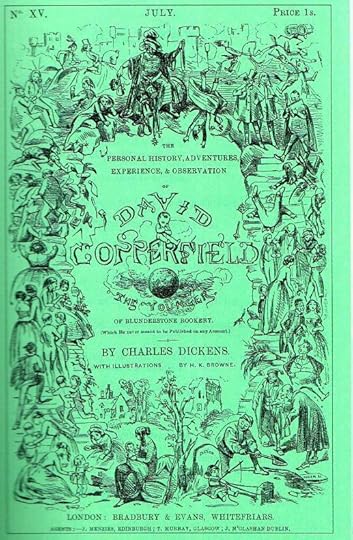
David Copperfield monthly wrapper
Kim wrote: "David Copperfield monthly wrapper"
Thanks for the postings Kim. Please keep them coming.
Linda wrote: "It is great to dive back into a Dickens read, and so far David Copperfield is not letting me down. :)Question - can someone tell me what being "born with a caul" means? At first I thought it wa..."
I had no idea what a caul was but fortunately (or unfortunately) there was a note in my book that says:
"caul: Foetal membrane covering the head. Cp. Freud on the Wolfman, also born with a caul: 'He had for that reason always looked on himself as a special child of fortune whom no ill could befall'. The caul was the veil which hid him from the world and hid the world from him. The caul suggests a further attachment to the mother; being sold, it echoes anxieties frequent in Dickens of fear of dispersal, of the body in pieces."
Now there are many things that puzzle me about this, but by far the main thing is "why in the world would anyone buy such a thing?" It sounds horrible.
Linda wrote: "And I will have to continue my post later as it is such a sunny day today and so my yard beckons me to come and putter about." It is 2 degrees here, it snowed last night and now it is windy and the snow is blowing all the roads shut. I absolutely love it. It's supposed to go below zero degrees tonight. :-}
I just realized that my copy of DC doesn't have any footnotes or illustrations, and how much I miss having them while reading. As much as I appreciate Kim posting the illustrations here, I'm seriously thinking of going out to buy either a Penguin or Barnes and Noble edition to read instead of the Signet Classics I have.
 Kim wrote: "Linda wrote: "And I will have to continue my post later as it is such a sunny day today and so my yard beckons me to come and putter about."
 It is 2 degrees here, it snowed last night and now it ..."
Can you send some here Kim. It's been in the low 30s here today and will continue as such for the next few days. I'm so over summer. I want wintertime!
I'm already detesting the Murdstone intervention on this seemingly simple, yet idyllic, life of young David. This is my first read of DC, so my head is filled with wild accusations already. Knowing Dickens too well, I can only imagine he will bring heartache.And what a carrot to dangle about Emily's future. Clever work there. It certainly has me wanting to find out what that's all about. I'm even filled with hope that I maybe wrong about David's new stepfather.
Here's to the start of another great adventure...
Tristram wrote: "Dear Fellow Pickwickians,now we have finally started with DC, which for all I know Dickens regarded as his favourite novel, or at least as his most special novel - probably because there are some..."
In Dickens the preface to the Charles Dickens Edition on 1867 wrote:
"Of all my books, I like this the best. It will be easily believed that I am a fond parent to every child of my fancy, and that no one can ever love that family as dearly as I love them. But, like many fond parents, I have in my heart of hearts a favourite child. And his name is
DAVID COPPERFIELD"
Tristram wrote: "Interestingly, the text says she adopted her maiden name again - but if she is Mr. Copperfield's sister, her maiden name should be Copperfield, shouldn't it?:I wondered about this too so I went back and reread that first part, it says:
"An aunt of my father's, and consequently a great-aunt of mine, of whom I shall have more to relate by and by, was the principal magnate of our family. Miss Trotwood, or Miss Betsey, as my poor mother always called her, when she sufficiently overcame her dread of this formidable personage to mention her at all (which was seldom),"
So Miss Trotwood was an aunt of his father's not a sister. All I had to do now was to figure out in my mind if an aunt could have a different last name and realized that all of my sister's (three of them) if they went back to their maiden names (two different names) would still have different names than my son and daughter.
Also in the first chapter when David is born the doctor in attendance is Mr. Chillip. Something about that name seemed to trigger an old memory so I went and looked it up (deal with it Kevin). Here is what I found:In the number plans for the novel, Dr. Chillip is called Dr. Morgan. The Dickens family doctor at Devonshire Terrace was a Dr.Charles Morgan, 9 Bedford Row, Russell Square, London; so perhaps Dr. Chillip was based on a real person. Charles Dickens Jr. said:
"There were, not many years ago, plenty of people...who had a close acquaintance with Mr. Chillip, the meek little doctor. And yet Mr. Chillip was sketched from our family medical attendant in the old Devonshire Terrace days and never had anything to do with Suffolk."
 Tristram wrote: " Mr. David Copperfield, Senior, must have been a very naive man since - according to his sister's words - he called his home The Rookery just because he found some old rooks' nests in the trees on the premises. "
I didn't see that as a sign of naivety, but of observation, appreciation of nature, and hope that the rooks would return.
Tristram wrote: "Quite aptly for an autobiography, David also muses on the workings of memory:"I also liked that, though actually D/D (David/Dickens) was wrong about memory.
Tristram wrote: "David gives a very impressive description of Mr. Murdstone, dwelling on his memories from a ride with him, when he had time to study his face from very near:"One has to wonder (frankly, I can't doubt) whether David's memory of that ride and his opinions of Mr. Murdstone weren't highly colored by his later experiences, though I won't say more now to avoid spoilers.
Kevin wrote: "There is also one thing that I think is not very typical of Dickens, and is one of my pet peeves. That is the foreshadowing of the future in very marked terms. Especially dark predictions. In this case, he's referring to little Em'ly's future. I hate that paragraph. Please! I don't wanna know that! "Fair enough criticism, though I think we need to keep in mind that Dickens needed to keep his readers buying issues, so it made sense to tickle them with things they want to find out about. When a reader today buys a book, he buys it and the author has the money whether or not the reader finishes the book. But for Dickens, if the reader didn't get hooked, he quit buying the weekly or monthly installments, so Dickens lost out sales. So what you see as an annoyance, Dickens may have seen as a profit center to keep the readers buying.
Linda wrote: "I LOVED chapter 2!!!!!! (I will up you on the exclamation points there, Tristram, as I use them quite liberally.) I underlined so many passages that I found amusing or endearing..."I wouldn't go so far as the exclamation points you and Tristram favor, but the opening chapters were much more enjoyable than I remembered from earlier reads. There were, as you say, plenty of amusing notes that slid by a young reader intent on getting to the meat of the story.
But I can't believe how silly David's mother is. All that false modesty when David tells her what Mr. Murdstone and his companions said of her. How stupid can a woman be?
Peter wrote: "Reading through the posts I noticed that many of the characters and places have endings that are suggestive of nature. .."Nice catch. Not sure what it means, but it can hardly be coincidental since basically all the major names except Peggotty have those suggestions. And of course Peggotty is only a servant, so perhaps she isn't important enough to merit a natural name (though Ham, of course, does).
Kim wrote: "Now there are many things that puzzle me about this, but by far the main thing is "why in the world would anyone buy such a thing?" It sounds horrible. "The folk wisdom is that owning a caul will save you from drowning. Thus, sailors especially would often pay good money for a caul, since drowning was a much more frequent fate of sailors then than now.
I have no idea how or why that folk wisdom arose, but there it is.
(There are other, more sinister, interpretations of what it means to be born with a caul, but this seems clearly to be the one Dickens was referring to.)
Everyman wrote: "But I can't believe how silly David's mother is. All that false modesty when David tells her what Mr. Murdstone and his companions said of her. How stupid can a woman be?" I agree. Hopefully no one is that stupid.
Good point, Everyman. It is hard to keep in mind that many of Dickens novels were published in serial form, and required constant "attention holding."
 Peter wrote: "The opening lines of DC may not be the greatest of his opening lines (a topic we can debate forever once we read a few more of his novels) but I found DC's first lines wonderful. Who is it, and wh..."
I agree with your statement, I felt as if I was trying to chew a mouthful of sawdust while reading the beginning of DC. It didn't hook me, I didn't find it rich like I remember thinking D&S was. Granted, they are two different books, but I thought the first chapter was rather dry.
Ami wrote: "Peter wrote: "The opening lines of DC may not be the greatest of his opening lines (a topic we can debate forever once we read a few more of his novels) but I found DC's first lines wonderful. Who..."Hi Ami
I am sorry if my post was unclear. I do think the opening of DC is very good. What I meant was the opening of TTC is certainly a classic, and the beginning of BH is very powerful. The lines in DC about who/how a hero is defined is powerful too. I also agree that D&S is a fine bit of writing.
I can't really come up with a truly poor beginning of any Dickens novel.
Peter wrote: "Ami wrote: "Peter wrote: "The opening lines of DC may not be the greatest of his opening lines (a topic we can debate forever once we read a few more of his novels) but I found DC's first lines won..."Okay, I understand. In comparison to the other titles you mentioned it wasn't as exciting to me, the first page. I wouldn't say DC's beginning is indicative to the tone for the rest of the novel, I'm rather enjoying the chapters which follow.
 In the opening I found a brilliant balance between a sense of foreboding and some comic relief. It's interesting how the aside about the caul distracts from (or compensates) the neighbourhood women's superstitions about being born at midnight on Friday. Trying to sell the caul also seems to indicate some financial hardship. I'm not sure what Dickens meant by "my poor dear mother's own sherry was in the market then" -- she was trying to sell that too? When it's raffled off 10 years later, I want to know, by who? In any event, I'm relieved to laugh at the old lady dying triumphantly in her bed at 92, never having been on the water. The caul also gives me an image of suffocation, and I'm reminded of it somehow by the shallow black eye of Murdstone.
As Tristram noted, Miss Trotwood isn't very impressed by her nephew's provision of 105 pounds/year. If Clara is under financial duress, she at least has another reason for being prone to Murdstone, other than vanity. I kept reminding myself that she was still a teenager when she married, and faced childbirth when not much more, alone except for Peggotty. If she died (pretty common), Peggotty would not be able to raise David or the baby (if it survived) as gentlemen. Clara was an orphan herself, so has some idea of what that would mean.
Despite her lack of sympathy, Miss Trotwood intrigues me. She brings to mind Miss Havisham, in seeking a goddaughter to redo her own youth, except she is the one who rejects her marriage, and to more humorous effect. She has such a vivid introduction, defying convention and pressing her face against the window. What's with stopping her ears with cotton -- to blot out hearing the pain of childbirth?
I must say that it adds a new element to Dickens' writing, having a first person narrator who is reminiscing about his childhood. Dickens is able to balance it very well, I believe, by writing in the perspective of childhood naivety whilst still making the audience aware that this is him, as an adult, telling the story. The adult narrator provides restraint, however it is evident that he gets 'lost' in his past with vivid memories, keeping in with the themes of childhood.
Everyman wrote: "I wouldn't go so far as the exclamation points you and Tristram favor, but the opening chapters were much more enjoyable than I remembered from earlier reads."Well, given the great weather on Sunday, let's just say I was in a superb mood when I wrote that post and decided to tack on more exclamation points than I normally would. :)
Vanessa wrote: " I'm relieved to laugh at the old lady dying triumphantly in her bed at 92, never having been on the water."I laughed at that part too. Too funny!
Kevin wrote: "Good point, Everyman. It is hard to keep in mind that many of Dickens novels were published in serial form, and required constant "attention holding.""There's also more repetition or back-referral in these long serial publications so that if somebody misses an issue they aren't totally lost (same thing is done with modern soap operas. Wow -- whowould have thunk I could make a connection between Dombey and Son and As the World Turns, but I just did!)
Vanessa wrote: " If she died (pretty common), Peggotty would not be able to raise David or the baby (if it survived) as gentlemen. Clara was an orphan herself, so has some idea of what that would mean. "Nice point. 105 pounds a year was a minimally amount for a widow and her son to live on, it would have been enough for basic necessities (including a servant), but not for much more. So marriage was advisable, though perhaps not financially essential.
Jane wrote: "This is my 3rd or possibly 4th time reading this novel, but I haven't read it in >20 years at least, so it is fresh once more! It is also my first time reading along with this group, and am lookin..."Hi Jane,
it is probably what Kevin meant when he said that the way Dickens put things is, in fact, inimitable. Here, somehow he manages to paint the hero's childhood in a way that leaves the impression of a fairy-tale, of something loved and lost, and that is definitely what childhood is about. The older I grow, the sadder I feel about never again being able to experience the magic of childhood, where even one's fears were breathing poetry - such as the spacious and dark house of my grandparents at night, and me having to go to the toilet and having to go down a long corridor for that ... One may revisit the places of the past, but the tragedy is that they are not the same and that one never really gets into them and that the better you remember them the more painfully one is aware of the difference between the now, and the person one is now, and the then, and the child one used to be ... That's why I actually liked that wonderful tone of sadness hanging over Dickens's first chapters.
Peter wrote: "Tristram wrote: "In Chapter 3, the scene is set in Yarmouth, which David calls "the finest place in the universe" - Dickens himself spent some weeks in that town when he was working on the novel...."
There are quite a lot of STONEs here, I'd agree: STONES over which to trip, and STONES to hurt yourself against. That's, of course, no coincidence.
Kim wrote: "I am hospitably received by Mr Peggotty
Chapter 3"
I'll second Peter in my thanks for the illustrations, Kim. My book does not have them all, e.g. the ones of Aunt Betsey and of Em'ly are missing. So it's very good of you to post them here.
Linda wrote: "I just realized that my copy of DC doesn't have any footnotes or illustrations, and how much I miss having them while reading. As much as I appreciate Kim posting the illustrations here, I'm serio..."My edition also had a footnote on the caul, and I looked the matter up on the Internet and found out that they actually rubbed the caul off on some paper, where it would dry - there are some ghastly-looking photos of dried cauls in the Net as well. Even in the 1950s the superstition of a caul preserving its owner from the death of drowning was still held in some areas of Britain, and dried cauls were sold at relatively high prices.
Kate wrote: "I'm already detesting the Murdstone intervention on this seemingly simple, yet idyllic, life of young David. This is my first read of DC, so my head is filled with wild accusations already. Knowi..."Kate,
I also found it quite clever of Dickens to have his narrator allude to some dark fate hanging over Em'ly but I can also understand that other people might not like it too much. Dark foreshadowings usually make me stick to a book.
Kim wrote: "Tristram wrote: "Interestingly, the text says she adopted her maiden name again - but if she is Mr. Copperfield's sister, her maiden name should be Copperfield, shouldn't it?:I wondered about thi..."
Thanks for getting that straight ... I had always figured Aunt Betsey as a sister of Mr. Copperfield's ... another example of how deeply-rooted assumptions simply make you read over evidence in a text, or of how opinionated fellow I am.
Everyman wrote: "One has to wonder (frankly, I can't doubt) whether David's memory of that ride and his opinions of Mr. Murdstone weren't highly colored by his later experiences, though I won't say more now to avoid spoilers. "... which raises the worrying question of how much of our memories are actually memories or conceptions tainted with later experience.
Everyman wrote: "I didn't see that as a sign of naivety, but of observation, appreciation of nature, and hope that the rooks would return."Ha! This proves that you're not as grumpy as you pretend to be. Being infinitely grumpier than you, I, of course, regard hope as an infallible sign of naivety.
Everyman wrote: "How stupid can a woman be? "Probably as stupid as a man, but that makes me remember one of my dearest Einstein quotations: "Only two things are infinite, the universe and human stupidity, and I'm not sure about the former."
In a way Mrs. Copperfield has to be stupid for otherwise she would not have married Mr. Murdstone and then the story of David Copperfield might not have developed the way Dickens wanted it to develop. In order to explain her stupidity in other terms than those of plot necessities, one could say that it is fed by two sources, the first being her lack of experience with the world. Apparently, she married very young and had a doting husband who would try to spare her the trouble of dealing with a grim world. So she had a lack of experience. And secondly, she is infinitely vain, which explains why she might fall for a good-looking man and also be taken in by his flatteries.
Everyman wrote: "Peter wrote: "Reading through the posts I noticed that many of the characters and places have endings that are suggestive of nature. .."Nice catch. Not sure what it means, but it can hardly be c..."
Yes, but Peggotty has the same Christian name as David's mother. So, in other words, she is a mother's substitute, representing the more down-to-earth qualities David's real mother is lacking.
Vanessa wrote: "In the opening I found a brilliant balance between a sense of foreboding and some comic relief. It's interesting how the aside about the caul distracts from (or compensates) the neighbourhood wome..."In fact, the digression about the caul - David reproaches himself with "meandering" here - reminded me of another famous book that starts not with childbirth but actually with the conception of a child, and also a clock - David mentions that the clock struck midnight when he was born - played a role there. Is it just me, or did anyone else think of Tristram Shandy here?
What's with stopping her ears with cotton -- to blot out hearing the pain of childbirth?
I actually like her for that as it shows what an immensely practically-minded woman she is.
Vanessa,you've got a good point there in hinting that it was probably not merely vanity but also a sense of having to provide for her son that made Mrs. Copperfield remarry. However, had she been less vane and inexperienced, she might have found a worthier husband than Murdstone.
 Tristram wrote: "Is it just me, or did anyone else think of Tristram Shandy here?"
I did think of it having finished TS about 10 days ago!

now we have finally started with DC, which for all I know Dickens regarded as his favourite novel, or at least as his most special novel - probably because there are some semi-autobiographical parallels between David's life and Dickens's.
In the first chapter, the first person narrator, David Copperfield, lets the reader know about his birth, basing his account on what his mother, her servant Peggotty and Dr. Chillip remember and later told him.
We get some information about his late father, namely that Mr. David Copperfield, Senior, must have been a very naive man since - according to his sister's words - he called his home The Rookery just because he found some old rooks' nests in the trees on the premises. He married for love, thus causing an estrangement from his seemingly hard-nosed sister, and he apparently was not too good a businessman since on his death, he could leave his widow but a meagre annuity.
Mrs. Copperfield herself does not seem to be a very determined woman, either, and makes Miss Betsey Trotwood, who visits her on the day of David's birth, repeatedly call her a Baby.
Now Miss Trotwood is the complete opposite of the young widow (and her late husband), in that on finding herself ill-treated by her husband, she paid her husband off and got a divorce. Interestingly, the text says she adopted her maiden name again - but if she is Mr. Copperfield's sister, her maiden name should be Copperfield, shouldn't it? Instead, she goes by the name of Trotwood ...
In the first chapter, Miss Trowood makes a very brief appearance: She is intent of taking the babe that is to be born under her wing, but finding that it is not a girl but a boy, she, without wasting a further word, takes instant leave never to darken the doorstep of the Rookery again.
The chapter starts with a lot of humour, e.g. here:
"The caul was won, I recollect, by an old lady with a hand-basket, who, very reluctantly, produced from it the stipulated five shillings, all in halfpence, and twopence halfpenny short—as it took an immense time and a great waste of arithmetic, to endeavour without any effect to prove to her. It is a fact which will be long remembered as remarkable down there, that she was never drowned, but died triumphantly in bed, at ninety-two. I have understood that it was, to the last, her proudest boast, that she never had been on the water in her life, except upon a bridge; and that over her tea (to which she was extremely partial) she, to the last, expressed her indignation at the impiety of mariners and others, who had the presumption to go 'meandering' about the world. It was in vain to represent to her that some conveniences, tea perhaps included, resulted from this objectionable practice. She always returned, with greater emphasis and with an instinctive knowledge of the strength of her objection, 'Let us have no meandering.'"
I also enjoyed this quite a lot:
"He went to India with his capital, and there, according to a wild legend in our family, he was once seen riding on an elephant, in company with a Baboon; but I think it must have been a Baboo—or a Begum."
It's probably also interesting that
a) David was born with a caul, since this was superstitiously believed to be an augury of good-luck;
and
b) that his birthplace is called Blunderstone, which may hint at his father's and his mother's ineptitude when it comes to taking wise decisions.
Interestingly, this is the first novel Dickens wrote from the first person perspective, and it is probably due to his friend Forster, who suggested doing this by way of variation.