
Dickensians! discussion

This topic is about
Bleak House
Bleak House - Group Read 4
>
Bleak House: Chapters 20 - 32

 This is a list of all the chapters in this thread, beginning with Bleak House's chapter 20, which is the first chapter in Charles Dickens's original monthly installment 7.
Clicking on each chapter will automatically link you to the summary for that chapter.
VII - September 1852 - chapters 20–22
Chapter 20 (Message 3)
Chapter 21 (Message 30)
Chapter 22 (Message 83)
VIII - October 1852 - chapters 23–25
Chapter 23 (Message 142)
Chapter 24 (Message 180)
Chapter 25 (Message 222)
IX - November 1852 - chapters 26–29
Chapter 26 (Message 253)
Chapter 27 (Message 283)
Chapter 28 (Message 315)
Chapter 29 (Message 345)
X - December 1852 - chapters 30–32
Chapter 30 (Message 414)
Chapter 31 (Message 461)
Chapter 32 (Message 505)
message 3:
by
Bionic Jean, "Dickens Duchess"
(last edited Mar 23, 2022 07:58AM)
(new)
-
rated it 5 stars
 Mod
Mod
Chapter 20: A New Lodger
In which we meet Mr. Guppy’s friends, Tony Jobling and Bartholomew Smallweed. And Mr. Krook gets a new lodger.
It is still the long summer vacation for lawyers and judges alike. Mr. Guppy, a law clerk at Kenge and Carboy, is still working there, while his employers are off enjoying their summer break. Mr. Guppy is spending his time idly at the office, but he is resentful of the presence of the newcomer, Richard Carstone. Mr. Guppy sarcastically remarks to his mother:
“in the confidential moments when he sups with her off a lobster and lettuce in the Old Street Road, that he is afraid the office is hardly good enough for swells, and that if he had known there was a swell coming, he would have got it painted”.
In fact he is jealous and mistrustful of almost everyone:
“Mr. Guppy suspects everybody who enters on the occupation of a stool in Kenge and Carboy’s office of entertaining, as a matter of course, sinister designs upon him. He is clear that every such person wants to depose him. If he be ever asked how, why, when, or wherefore, he shuts up one eye and shakes his head. On the strength of these profound views, he in the most ingenious manner takes infinite pains to counterplot when there is no plot, and plays the deepest games of chess without any adversary.”
The law profession is exacerbating these suspicious traits in Mr. Guppy. But to his immense satisfaction, Richard Carstone begins to busy himself “poring over the papers in Jarndyce and Jarndyce”, and the astute Mr. Guppy “well knows that nothing but confusion and failure can come of that”.
Mr. Guppy whiles away his time with his colleague, Bartholomew Smallweed, who
greatly admires Mr. Guppy. In fact he emulates Mr. Guppy in every way conceivable, including dressing like him, and wearing his hat at the same angle as Mr. Guppy does:
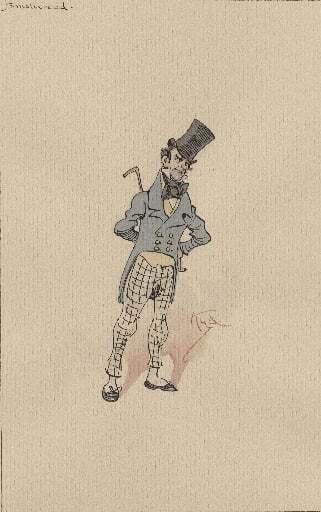
Bartholomew Smallweed - Kyd
He occasionally advises Mr. Guppy on personal matters “from the deep wells of his experience”.
One stultifyingly hot day, when both young men are lolling around, and neither can get comfortable in the stuffy office, they are joined by Mr. Jobling. We learn that this “manly whisker[ed]” friend is the hitherto unnamed gentleman, who had accompanied Mr. Guppy to Lincolnshire, when Mrs. Rouncewell was told two legal gentlemen were there to visit Chesney Wold. We learn that Mr. Jobling, is very short of money, hungry, and on the look-out for a job:
“Mr. Jobling is buttoned up closer than mere adornment might require. His hat presents at the rims a peculiar appearance of a glistening nature, as if it had been a favourite snail-promenade. The same phenomenon is visible on some parts of his coat, and particularly at the seams. He has the faded appearance of a gentleman in embarrassed circumstances; even his light whiskers droop with something of a shabby air.”
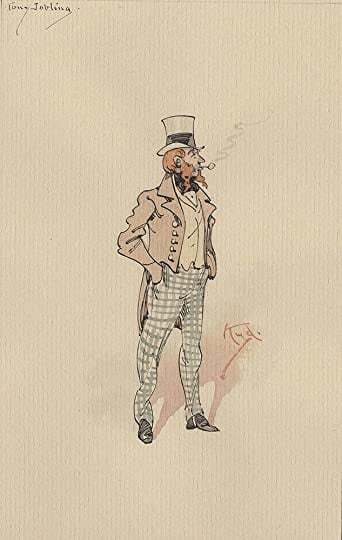
Tony Jobling - Kyd
Mr. Guppy immediately notices that his friend is in a bad way, and is keen to help. First of all he throws Mr. Jobling half a crown, as he has asked for a loan to get some dinner, but also invites Mr. Jobling to share a sumptuous meal with him. But Mr. Jobling had better not be seen he says, and they had better wait until “my enemy” Richard has left the premises. Mr. Jobling sits on the stairs to read the newspaper and eventually Richard leaves.
As the two friends now greet each other warmly, Mr. Jobling presumes to ask:
“”How is SHE?“ This Mr. Guppy resents as a liberty, retorting, ”Jobling, there ARE chords in the human mind—“ Jobling begs pardon”
and eventually, but not without asking again, he leaves the subject of Mr. Guppy’s unrequited love alone.
The three men take themselves off to a nearby slap-bang dining-house:
“where the waitress, a bouncing young female of forty, is supposed to have made some impression on the susceptible Smallweed … Mr. Smallweed leads the way. They know him there and defer to him.” He knows which dishes to order, and which to avoid. Thus, with Bartholmew Smallweed there to guide them, Mr. Guppy and Mr. Jobling indulge in “veal and ham and French beans—and don’t you forget the stuffing, Polly” and “pint pots of hand-and-half”, which are mixtures of light and dark ales.
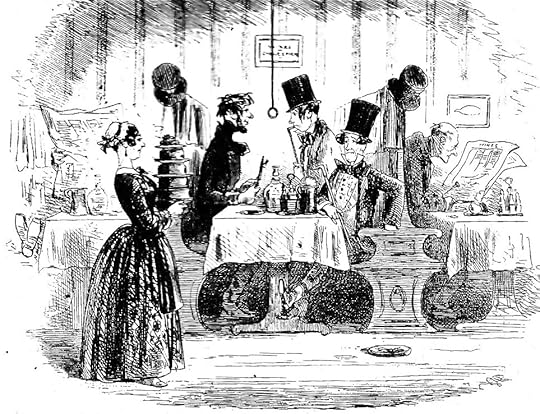
Mr. Guppy's Entertainment - Phiz (Hablot Knight Browne)
“Quickly the waitress returns bearing what is apparently a model of the Tower of Babel but what is really a pile of plates and flat tin dish-covers. Mr. Smallweed, approving of what is set before him, conveys intelligent benignity into his ancient eye and winks upon her.”
Mr. Jobling is so ravenously hungry, that when Mr. Guppy offers him the same plateful again, he agrees, and sets to:
“Beholding him in which glow of contentment, Mr. Guppy says, ”You are a man again, Tony!”
But a little more food is still needed to effect that change, so Mr. Jobling accepts summer cabbage: “with the sarcastic addition (from Mr. Smallweed) of ”Without slugs, Polly!“”, marrow puddings for all, three Cheshires, and three small rums.
Having watched his friend despatch his meal with great gusto, Mr. Guppy asks Mr. Jobling whether he has considered enlisting in the army. Tony Jobling is not sure he would think the same thing before and after eating, but says:
“I ask myself the question, What am I to do? How am I to live? Ill fo manger” (French: “il faut manger”—it is necessary to eat).
He had fully expected that that things would come round, he says. But there had been creditors making rows at the office, and complaints about “dirty trifles of borrowed money”, and Tony Jobling had had to leave without a reference.
“what’s the use of living cheap when you have got no money? You might as well live dear.”
All things considered, Mr. Jobling agrees that he will have to enlist. But after the meal, Mr. Guppy suggests another idea:
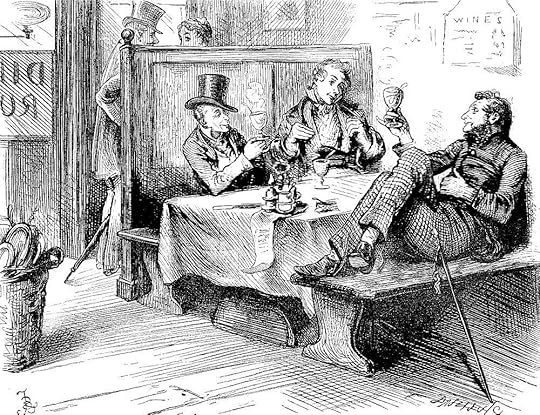
Guppy hosts a Convivial Dinner for Jobling and Smallweed - Fred Barnard 1873
He tells his friend that he could put in a good word for him with Mr. Snagsby, so that he may get some work there. The law-stationer has:
“a good deal of copying work to give out. He has all Tulkinghorn’s, and an excellent business besides … —you may say this is a poor prospect of a living. Granted. But it’s better than nothing, and better than enlistment. You want time. There must be time for these late affairs to blow over. You might live through it on much worse terms than by writing for Snagsby.”
Mr. Bartholomew Smallweed thinks this is a good idea. Also, Mr. Guppy suggests, he could also let him know about a room to let in the vicinity. He reminds Mr. Jobling about Krook, “the Chancellor, across the lane” and about “little Flite”. Mr. Jobling agrees that he knows these people by sight.
Mr. Guppy goes on to explain that he has got to know each of them quite well, because as part of his duties, he has to meet with Miss Flite every week, and pay her an allowance. He also has to deduct from it her weekly rent, which he pays to Krook himself. In this way, he has learnt of an empty room:
“You may live there at a very low charge under any name you like, as quietly as if you were a hundred miles off. He’ll ask no questions and would accept you as a tenant at a word from me … he’s an extraordinary old chap—always rummaging among a litter of papers and grubbing away at teaching himself to read and write, without getting on a bit, as it seems to me. He is a most extraordinary old chap, sir. I don’t know but what it might be worth a fellow’s while to look him up a bit.”
This last was said in a lowered voice. Krook might be a smuggler, or a receiver, or an unlicensed pawnbroker, or a money-lender; Mr. Guppy is not sure. But he says he wants to help his old friend:
“”For never shall it be said,“ Mr. Guppy adds with emphasis, ”that William Guppy turned his back upon his friend!“”
Tony Jobling is not overly keen when he learns that Krook’s last lodger died there: “It’s devilish odd that he need go and die at MY place!”, he grumbles, but all in all, he thinks it is a good plan.
They three men pay their bill at the slap-bang inn, and set off for the rag and bottle shop:
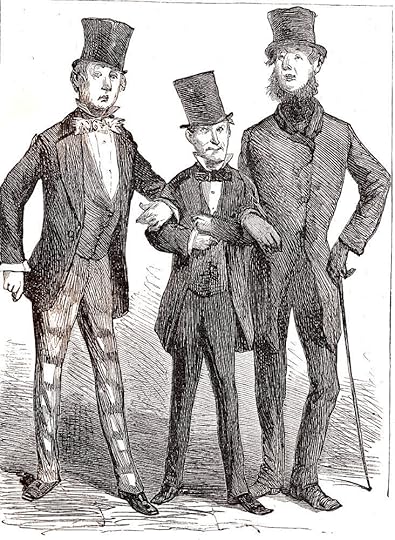
Mr. Guppy and his Guests - Sol Eytinge, Jr. 1867
They discover Krook in a drunken stupor, and have great difficulty rousing him from it. When they manage to awaken him, Mr. Krook suspiciously hints that they might have been consuming his drink, as his bottle is empty. Mr. Guppy makes a good impression on Krook by sending out to the distillery next door, to refill his bottle with a more expensive drink.
“”You’re a nobleman, sir,“ returns Krook with another taste, and his hot breath seems to come towards them like a flame. ”You’re a baron of the land.“”
Taking advantage of the moment, Mr. Guppy then introduces Mr. Jobling under an assumed name. The ploy works like a charm, and Mr. Krook accepts Jobling, who registers under the name of Weevle, as a tenant. The next day a “Mr. Weevle”, moves in to his room at Krook’s rag and bottle shop, where:
“the two eyes in the shutters stare at him in his sleep, as if they were full of wonder”.
He sews himself some makeshift curtains, and puts up a few shelves and hooks. Finally, he hangs his most prized possessions, some pictures of smiling young ladies in various positions and attitudes:
“The Divinities of Albion, or Galaxy Gallery of British Beauty, representing ladies of title and fashion in every variety of smirk that art, combined with capital, is capable of producing.”
He then spends the greater part of his days looking over the newspapers, and following the celebrities’ every movement. However, “Mr. Weevle” is a quiet lodger: quite the handyman, able to cook and clean, and quite sociable in the evenings. So much so, that another of the tenants remarks:
“Mark my words, Mrs. Perkins, ma’am, and don’t you be surprised, Lord bless you, if that young man comes in at last for old Krook’s money!”
message 4:
by
Bionic Jean, "Dickens Duchess"
(last edited Mar 23, 2022 05:58AM)
(new)
-
rated it 5 stars
Mod
According to a dictionary of Victorian slang, “slap bang” means victuals sold at a cook shop: plentiful, cheap and cheerful :)
How do we feel about Mr. Guppy? He’s certainly quick-witted and we are told he suspects everybody (of what?) and “takes infinite pains to counterplot when there is no plot, and plays the deepest games of chess without any adversary.”
This is no ordinary clerk! Mr. Guppy is clearly an opportunist, but how mercenary he might be is not yet known. What could be his ulterior motive, if any?
Does he suggest his friend taking an assumed name merely because Tony Jobling might want to lay low because of his financial situation? Is Mr. Guppy simply acting out of kindness for his friend, or is it something else? Mr. Guppy seems to have carefully orchestrated where his friend will work, and at what—plus where he will live—and moreover given him an assumed name!
Perhaps Mr. Guppy wants to employ his friend as a spy to find out more about Mr. Krook’s affairs and papers. But if so, why?
“Mr. Weevle” is a most suggestive name. It calls to mind of those burrowing, destructive insects, weevils.
And did you notice one of Charles Dickens's motifs, the shutter at the windows of “Mr. Weevle”'s room again, as ever watching eyes.
Perhaps they represent us?
Enjoy discussing the mysteries and writing in this chapter :)
 Thanks for explaining ‘slap bang’, Jean. A quick Google search tells me that this is the origin of a ‘slap up’ meal.
I can’t think what Guppy is up to. He obviously has a paranoid nature as he’s suspicious and jealous of everyone who comes to work in his offices. He is unconcerned at Richard’s interest in Jarndyce and Jarndyce though which surprises me. I wonder did he place Miss Flite in Krook’s lodgings deliberately? If so, he now has two ‘spies’ there but why? There must be some advantage to be gained by Jobling\Weevle doing copying for Mr Snagsby too. Is it because the lawyers who pass work to Snagsby have information that Guppy wants?
So many questions arise from this chapter but I enjoyed it mainly for the comedy which was brilliantly written. Krook coming around from his drunken stupor was excellent!
 Jean, Mr. "Weevle" doesn't like that someone died in the very room which he takes over. By any chance is this the room in which Nemo died? If yes, then it would seem that Guppy's recommendation of this room serves his own evil purposes and that he is using his "friend." Guppy also suggested the writing job which "coincidentally" had been Nemo's job. It seems that this job is rather dangerous. Makes me think that the writers/copiers become dangerous to certain people once they know too much and, therefore, must "go." Also like Nemo, Weevle is an assumed name. Another suggestion made by Guppy.
message 7:
by
Bionic Jean, "Dickens Duchess"
(last edited Mar 23, 2022 07:00AM)
(new)
-
rated it 5 stars
Mod
Bionic Jean wrote: "Yes, it must be. Mr. Krook only has rooms for two lodgers that we know of, and Miss Flite is still there. More possibilities :)"Not a good omen for Mr. Jobling.
Beware. A flight of conjecture ahead: Jobling erroneously believes that Guppy is helping him. In this paranoid legal world where "knowledge is power" and everyone an enemy I think Guppy wants to make sure that he has no competitors for his place with Mr. Krook. Mr. Weevle now seems to be one of his competitors as suggested by one of the tenants at the end of this chapter. Or, Mr. Weevle has burrowed in nicely (for Guppy's purposes) but seems quickly to have become an adversary for Mr. Krook's money. Perhaps, like most insects, he will have to be exterminated. If any of this is close to correct it further suggests that Nemo's death was not accidental and further suggests why and who may have done the deed.
 I found this chapter a little tough to follow but thanks to your summary, Jean, I am reassured that I got the gist of it. I agree that it seems Guppy is manipulating things for his own intents and purposes. It could simply be that Guppy doesn’t want to be swallowed up by bigger fish. But it’s also likely, given his outward appearance, that he is underestimated by those around him.
message 10:
by
Bionic Jean, "Dickens Duchess"
(last edited Mar 23, 2022 07:59AM)
(new)
-
rated it 5 stars
Mod
"Mr. Weevle has burrowed in nicely... exterminated."
"Guppy doesn’t want to be swallowed up by bigger fish."
Priceless :D And I'm so glad it helped, Donna :)
I'm now thinking of Guppy's stalking and staring at Esther in a new light. It's creepy, but keeping his "eyes" on her may be the only way he knows to get anything he desires. He's doing it right out in the open where anyone, including Esther, can see. Much more secretly, perhaps it is his eyes that are behind the shutters of Weevle's room. The name "Guppy" makes him seem so harmless. But he may not be so harmless as his name implies.
 This chapter seemed so casual and comical on the surface but I felt that there was more going on than that.
Mr. Guppy has plans, as we know from earlier chapters, and those plans have now taken a step forward. It's all a bit creepy, in a way, because he's so underhanded and secretive about his actions.
I wonder how much Mr. Jobling knows of the plan or whether he's just going along with "whatever" to get the perks of it (meals, visits, cheap lodgings). Is he aware of whatever role he's playing in Mr. Guppy's plans?
In this chapter, I think Mr. Guppy has a very definite purpose for putting Mr. Jobling in Nemo's room, and under a false name. He's a devious kind of person, it seems. He does things in secret. As said, I'm not sure that Jobling is even aware that he's being used for a purpose and the room & job is more than what it appears on the surface.
This chapter has added even more mystery and things to think about.
In the background, Richard seems to have fully immersed himself in the Jarndyce and Jarndyce case.
I wonder what he's learning and how he'll use that information. His search is for himself, so he'll perhaps use the information to twist it to his purposes for himself. He is becoming the sort of person who looks after himself first.
 Mr. Guppy is a manipulator. He is the kind of man who would use anybody to achieve his own ends. His stationing Jobling/Weavle in Krook's has certainly a purpose, although we can't exactly see what it is. My personal guess is Guppy wants to learn more about Nemo and suspects Krook of knowing more about him than he admits.
I enjoyed this chapter. It's light and amusing on the surface, but of course deeper things swim in the depths.
Along the lines of Donna's thinking - the thought that popped into my mind was Guppy wants to be a big fish in a little pond. He has his little area of the legal world in which he has connections (Snagsby and Krook), he's irritated when another fish (Richard) swims into his pond, Smallweed emulates him, Jobling depends on him, and Guppy works out solutions quickly that seem to be to his own advantage. I'm undecided if I think Guppy is an overblown busybody or if he's really up to no good.
Why is Guppy paying Miss Flite an allowance that also covers her rent? Is this proceeds of a Chancery case or is Mr Jarndyce secretly helping her?
Anne I like your flight of conjecture! Chancery does seem to be pervaded by paranoia, and you're building a case for a very evil little Guppy. Exterminated - very grim and ominous!
I find it very interesting that we now know who visited Chesney Wold with Guppy - may have no significance, but I like having that detail revealed. I'd thought it might be Skimpole posing as a lawyer lol.
Jean I love each illustration showing these legal men out and about. The description of their meal was great - a slap bang, did not know that term before. I say whiz bang to describe something in a joking way (like I'm cooking a whiz bang meal tonight, when all I did was heat up leftovers). Very interesting!
Along the lines of Donna's thinking - the thought that popped into my mind was Guppy wants to be a big fish in a little pond. He has his little area of the legal world in which he has connections (Snagsby and Krook), he's irritated when another fish (Richard) swims into his pond, Smallweed emulates him, Jobling depends on him, and Guppy works out solutions quickly that seem to be to his own advantage. I'm undecided if I think Guppy is an overblown busybody or if he's really up to no good.
Why is Guppy paying Miss Flite an allowance that also covers her rent? Is this proceeds of a Chancery case or is Mr Jarndyce secretly helping her?
Anne I like your flight of conjecture! Chancery does seem to be pervaded by paranoia, and you're building a case for a very evil little Guppy. Exterminated - very grim and ominous!
I find it very interesting that we now know who visited Chesney Wold with Guppy - may have no significance, but I like having that detail revealed. I'd thought it might be Skimpole posing as a lawyer lol.
Jean I love each illustration showing these legal men out and about. The description of their meal was great - a slap bang, did not know that term before. I say whiz bang to describe something in a joking way (like I'm cooking a whiz bang meal tonight, when all I did was heat up leftovers). Very interesting!
 I probably missed this earlier, but why is Krook the Chancellor, as I believe Guppy calls him?
 Also, Guppy seems none too happy that Richard has shut himself up in what sounds like the main office, not something that would be tolerated if the primary lawyers were not on holiday.
I noticed that Guppy seems focused on the paper that Krook accumulates. I wonder what he expects can be found there. And another premonition when either Guppy or Weevle/Jobling mentions something to the effect that Krook’s drunken stupor is really quite close to death or could be in the future.
 There was so much food in this chapter. I loved all the details of the meals, seeing what Victorians ate. The notes in my book said that the "grass" references was asparagus which I loved because when I was a kid I called it asparagrass LOL. I loved the illustrations for the same reason, seeing what a "restaurant" might have looked like at that time.
 Jobling ate like a man who hadn't had a good meal in a long long time, and all I could think about was poor little Jo, and I wished that Guppy would buy him an equally fabulous meal. On a regular basis!!
When Guppy talks about eating Lobster and Lettuce with his mother, is that a fancy meal at that time - like it is now? Or is that a more common meal?
Cozy_Pug, I'm also sitting on the fence and not sure what to think about Guppy's motivations. Is he a villain or is Dickens just alluding to that and he's actually quite harmless? I can't decide. Sue, it is in character, perhaps, for Richard to use a main office. He seems to think of himself on the "have" side of Society, so using a high priced lawyer's office for his selfish articling seems like him. He's reaching above his "station", in a way.
Of course, he's doing it subconsciously. It's not malicious. He just doesn't think about things and instinctively feels that what he needs or wants is his.
message 18:
by
Bionic Jean, "Dickens Duchess"
(last edited Mar 23, 2022 10:03AM)
(new)
-
rated it 5 stars
Mod
It's a joke in the neighbourhood, started by Mr. Krook himself; a bit of self-aggrandisement, like saying he is "the master of all he surveys". Because Krook's shop is close to Chancery, and it is stuffed with papers from the law courts, he is "in charge" of them, like the Chancellor. He is the Chancellor of his marine supplies and rag and bottle shop. Mr. Krook takes pride in knowing as much as anyone about the Jarndyce and Jarndyce case, (which is very little!) and what goes on in the courts.
Also, there is a sardonic element in this, because Mr. Krook is illiterate. He cannot read these hundreds of bits of paper he is surrounded by. It makes no sense to him, just as Charles Dickens repeatedly tells us, the cases brought to the law courts make no sense. Mr. Krook personifies the law court's blind nonsense.
 Piyangie wrote: "Mr. Guppy is a manipulator. He is the kind of man who would use anybody to achieve his own ends. His stationing Jobling/Weavle in Krook's has certainly a purpose, although we can't exactly see what..."
His purpose MUST be related to the potential proceeds of Jarndyce v Jarndyce. What other reason would he have for proposing marriage to Esther? Somehow, I doubt whether the reason is genuine affection or love.
 I made a note while listening about Smallweed(?) being dressed as a youth in clothes from blue bags? If so, all I could think of were poor girls wearing dresses made from flour sacks during the Depression.
 Chapter 20
I now realize that I’ve greatly under-estimated Mr. Guppy. Within a small pond populated with minnows, a bass is the king of fishes; Guppy surrounds himself with lesser shrimplings ready to do his bidding. He shows himself to be a schemer of the first order, utilizing his access to information passing through the offices of Kenge and Carboy to his advantage. He is suspicious, resentful and devious.
His extraordinary apparent generosity to the down-and-out Tony Jobling obviously has a darker purpose. In short order, at the cost of a dinner, he has secured the services of an agent who is greatly beholden to him, placed under a false name in position to access many legal documents let out by Snagsby and furthermore to learn what may be learned from the much-inebriated Krook and Krook’s other tenants. What further use Smallweed may become to Guppy, apart from running errands has yet to be seen.
Thanks Jean re Krook. I do wonder what Guppy is expecting to learn from or find at Krook’s “establishment.” And also what he might expect to learn from Snagsby’s papers. Perhaps he’s on the lookout for any good chance that comes along vs one particular case. I don’t think he’s on the up and up.
Petra, I agree about Richard’s behavior. He would feel it was his due since his seniors were away. And Guppy would probably never tell Richard to his face how he feels about his use of the office. But will he act against Richard in some way? That probably won’t matter as Richard appears unlikely to succeed at law either.
message 24:
by
Bionic Jean, "Dickens Duchess"
(last edited Mar 23, 2022 02:00PM)
(new)
-
rated it 5 stars
Mod
Mr. Guppy, who has worked very hard to get where he is (albeit not very far!) will resent Richard Carstone because of his position. We have been told Richard Carstone went to a good school, so will speak and dress nicely, and has now been provided for by a wealthy gentleman (Mr. Jarndyce). As well as all the points about professional jealously discussed here, Mr. William Guppy will envy Richard Carstone because of his advantages due to his social class.
Bionic Jean wrote: "There's an element of social class operating here too, I think.
Mr. Guppy, who has worked very hard to get where he is (albeit not very far!) will resent Richard Carstone because of his position...."
Jean I'm curious, in what social class would the 3 men in today's chapter be? (Guppy, Smallweed, Jobling). Guppy seems to aspire to a higher position in the legal field, I'm not sure about the other two. Would Guppy's class background work against him?
Mr. Guppy, who has worked very hard to get where he is (albeit not very far!) will resent Richard Carstone because of his position...."
Jean I'm curious, in what social class would the 3 men in today's chapter be? (Guppy, Smallweed, Jobling). Guppy seems to aspire to a higher position in the legal field, I'm not sure about the other two. Would Guppy's class background work against him?
Mod
So people can improve their social class through their work/occupational improvement. That’s something I didn’t really understand.
 I love the image of the rim of Joblings hat being a snail promenade!
message 29:
by
Bionic Jean, "Dickens Duchess"
(last edited Mar 24, 2022 04:14AM)
(new)
-
rated it 5 stars
Mod
We meet Bartholmew Smallweed’s entertaining family; also Captain George and Phil Squod.
Mr. Guppy’s friend Bartholmew Smallweed lives with his Grandfather and Grandmother Smallweed, his twin sister Judy, and their servant Charley Neckett. The area, known as Mount Pleasant, ironically belies its name. Their house is:
“in a little narrow street, always solitary, shady, and sad, closely bricked in on all sides like a tomb, but where there yet lingers the stump of an old forest tree whose flavour is about as fresh and natural as the Smallweed smack of youth”.
The whole family is obsessed with money:
“Everything that Mr. Smallweed’s grandfather ever put away in his mind was a grub at first, and is a grub at last. In all his life he has never bred a single butterfly … The name of this old pagan’s god was Compound Interest. He lived for it, married it, died of it.”
The sons of the family would go out to work as soon as they were able, like young Bartholomew, and marry later in life. Their focus is on what wealth they can acquire. The children of the family never play, but:
“discard[] all amusements, discountenance[] all story-books, fairy-tales, fictions, and fables … Judy never owned a doll, never heard of Cinderella, never played at any game. She once or twice fell into children’s company when she was about ten years old, but the children couldn’t get on with Judy, and Judy couldn’t get on with them … her twin brother couldn’t wind up a top for his life. He knows no more of Jack the Giant Killer or of Sinbad the Sailor than he knows of the people in the stars.”.
As well as all behaving alike, the Smallweeds of every generation also all look alike:
“the complete little men and women whom it has produced have been observed to bear a likeness to old monkeys with something depressing on their minds”.
The Smallweed Family is headed by Grandfather Smallweed, who is a very old monkeyish looking man, confined to a chair:
“in a helpless condition as to his lower, and nearly so as to his upper, limbs, but his mind is unimpaired”.
Concealed under his chair is a drawer, in which there is rumoured to be a “fabulous amount” of money. Grandfather Smallweed is keeping up the family tradition of acquiring wealth, and is a tight-fisted money-lender. Ludicrously, he also keeps a cushion next to him, ready to throw. Grandmother Smallweed is now senile, and any time a number is mentioned, she starts to repeat it loudly, convinced they are talking about money. This makes Grandfather Smallweed throw his cushion at her, silencing her for the time being. But in doing so, he loses whatever posture he had, and slumps down, reducing himself to a bundle of clothes that has to be shaken up by his daughter, Judy.
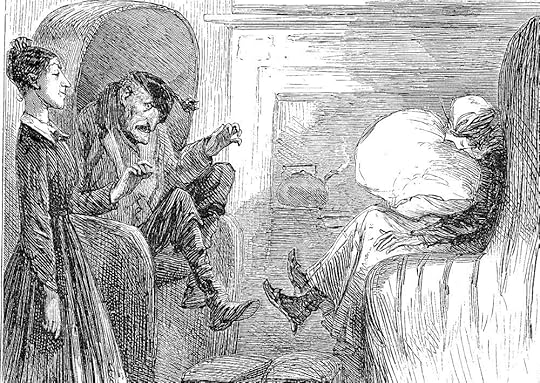
The Smallweed Family - Sol Eytinge, Jr. 1867
This farcical trio are waiting for Bart to arrive for his tea. He has an advantage over his twin sister Judy, because he can “go out” to work. We are told that it is Bartholomew’s restrictive childhood, as is that of all the Smallweed children, being empty of anything appealing to a child’s imagination, and instead based on practicalities and facts, which is why he regards the fashionable Mr. Guppy with such admiration.
Judy is putting out a meagre amount of bread and butter for their tea, and Grandfather Smallweed begins to talk about their servant Charley. He thinks she eats too much, and that it would be better to “allow her for her keep” i.e. give her an allowance, rather than let her eat their food. But Judy knows better:
“She’d want sixpence a day, and we can do it for less”
she maintains. The scraps of breadcrumbs mashed together, and dregs of everyone else’s tea Judy allows Charley, show how right she is.
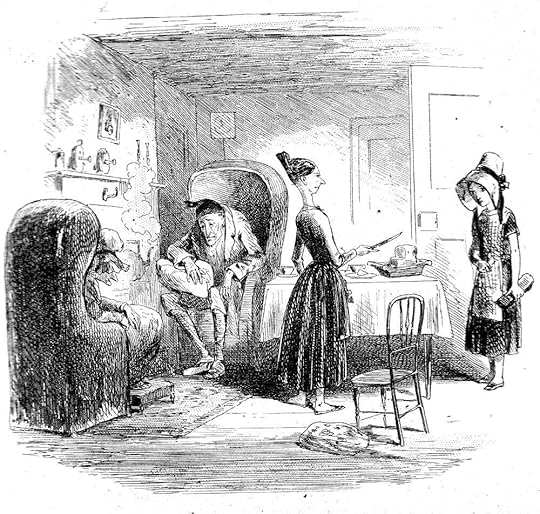
The Smallweed Family - "Phiz" (Hablot Knight Browne) 1853
Bart arrives home, and Grandfather Smallweed is pleased to learn that Bart has eaten at Mr. Guppy’s expense. His son is learning well. The afternoon continues with occasional outbursts from Grandmother Smallweed, cushion-throwing and shouted insults from her husband, and subsequent “shaking up” by Judy.
Presently, Grandfather Smallweed is visited by one of his clients, a Mr. George, who:
“is a swarthy brown man of fifty, well made, and good looking, with crisp dark hair, bright eyes, and a broad chest. His sinewy and powerful hands, as sunburnt as his face, have evidently been used to a pretty rough life.”
Mr. George has the air of an old “trooper”—a soldier—and has come to pay him some interest on a debt. The two are clearly not on very good terms, as Mr. George cleverly makes allusions to Grandfather Smallweed’s being destined for Hell:
“’Whew!” says Mr. George. “You are hot here. Always a fire, eh? Well! Perhaps you do right to get used to one.” Mr. George makes the latter remark to himself as he nods to Grandfather Smallweed.”

Grandfather Smallweed's Anger - Harry Furniss 1910
During his visit, Mr. George praises the servant Charley, whose naive innocence is at odds with the Smallweeds’ conniving money-grubbing ways. He is also shocked at the invectives Mr. Smallweed hurls at his wife, and censures him for his incessant abusive insults. Mr. George even gets roped into the duty of shaking Mr. Smallweed up after the old man has once again thrown a cushion at his wife. He is very gentle with Mrs. Smallweed, but “shakes up” her husband so thoroughly that he nearly crushes Grandfather Smallweed – or is perhaps in two minds about crushing him.
The two then have a long sparring conversation. It becomes clear that Mr. George has been a bit wild in his youth, and therefore will not rely on any financial help from any of his family members who might still be alive. We also learn that Mr. George seems to have been asked by Mr. Smallweed to help him track down a fellow-officer, by the name of Captain Hawdon. This is because Captain Hawdon owes a large sum of money to Grandfather Smallweed.
Mr. George says of Captain Hawdon:
“I have been at his right hand many a day when he was charging upon ruin full-gallop. I was with him when he was sick and well, rich and poor. I laid this hand upon him after he had run through everything and broken down everything beneath him—when he held a pistol to his head.”
Mr. Smallweed comments that he wishes he had gone through with it, but Mr. George remembers when the Captain was “young, hopeful, and handsome”. He
says that he is glad he had never been able to find out what became of Captain Hawdon, because he would not have liked to have had a hand in delivering his former friend up to his creditors. He says that he now thinks Captain Hawdon is dead:
“He was drowned long before. I am convinced of it. He went over a ship’s side. Whether intentionally or accidentally, I don’t know.”
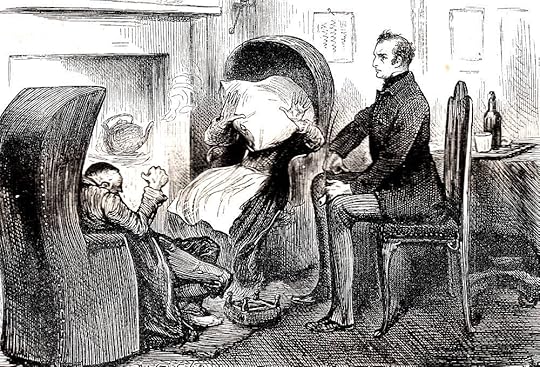
Grandfather Smallweed astonishes Mr. George - Fred Barnard
The two men conclude their business and Mr. George enjoys a pipe at Grandfather Smallweed’s expense. We learnt that Mr. George had insisted on this being part of their contract, because it makes him feel as if he is getting at least something out of Mr. Smallweed.
After his guest’s departure, Grandfather Smallweed says Mr. George is a rogue but he will “lime” him—squeeze him—and thinks about this with great pleasure.
Mr. George wanders the streets, and spends the rest of the evening watching a show at Astley’s Theatre. Then he crosses the river Thames, again and makes his way to a shabby region around the Haymarket and Leicester Square. At its heart is:
“a court and a long whitewashed passage at a great brick building composed of bare walls, floors, roof-rafters, and skylights, on the front of which, if it can be said to have any front, is painted ”George’s Shooting Gallery, &c.”
This is Mr. Geoge’s present place of business and present lodgings: a gallery where customers can practise rifle-shooting, fencing, and boxing. He is greeted by Phil:
“a little grotesque man with a large head … he is lame, though able to move very quickly. On the speckled side of his face he has no eyebrow, and on the other side he has a bushy black one, which want of uniformity gives him a very singular and rather sinister appearance.”
Phil’s hands are damaged too, but he is very strong.
“He has a curious way of limping round the gallery with his shoulder against the wall and tacking off at objects he wants to lay hold of instead of going straight to them, which has left a smear all round the four walls, conventionally called ”Phil’s mark.“”
Mr. George’s assistant has bad news. Business has been slack, and no money has been made. Resigned to this, Mr. George asks Phil to close up, and to pull out two mattresses. But before they turn in for the night, something seems to be preying on Mr. George’s mind, and he asks Phil:
“”You were found in a doorway, weren’t you?”
“Gutter,” says Phil. “Watchman tumbled over me.”
“Then vagabondizing came natural to YOU from the beginning.”
“As nat’ral as possible,” says Phil.”
And so their day ends.
message 30:
by
Bionic Jean, "Dickens Duchess"
(last edited Mar 24, 2022 06:20AM)
(new)
-
rated it 5 stars
Mod
We are told Mr. George went to a “show” at Astley’s Theatre. It was very probably a circus; the circus was a favourite Victorian pastime. Astley’s Amphitheatre was a performance venue in London opened by Philip Astley in 1773, and considered the first modern circus ring. It was burned and rebuilt several times, and went through many owners and managers, remaining the home of the circus. It finally closed and was demolished in 1893. There is no trace of the theatre today, but there is a memorial plaque at its site on Westminster Bridge Road, in Lambeth.
During the time of this novel Pablo Fanque, (real name William Darby) the black English circus equestrian and circus owner was enormously popular, having made his London debut at Astley’s in 1847.
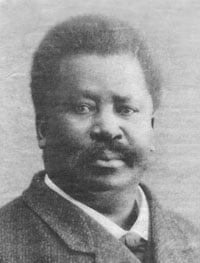
"Pablo Fanque" (William Darby)
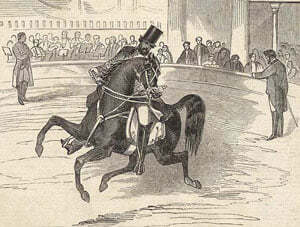
Pablo Fanque performing at Astley's Amphitheatre 1847
He performed for about 30 years, and this is viewed as the golden age of the circus. Oddly, since the 1960s, Pablo Fanque has been best known for being mentioned in The Beatles song “Being for the Benefit of Mr. Kite!” on their album Sgt. Pepper’s Lonely Hearts Club Band (1967) The song had been inspired by a poster for Pablo Fanque’s circus, which John Lennon had in his home at the time. All the lyrics were inspired by Pablo Fanque’s circus.
message 31:
by
Bionic Jean, "Dickens Duchess"
(last edited Mar 24, 2022 06:18AM)
(new)
-
rated it 5 stars
Mod
We can now pick out another theme in Bleak House—that a person’s character is determined up to a point by their upbringing.
The Smallweeds are another grotesque family of caricatures—similar to the self-righteous Mrs. Pardiggle and her obnoxious children. Grandfather Smallweed is a very old man confined to a chair (and probably sitting on a large sum of money). He’s a tight-fisted money-lender, and behaves so badly that his wife is permanently panicked by any mention of money, starting up at any figure mentioned and going on about it so that Grandfather Smallweed throws his cushion at her, silencing her for the time being and reducing himself to a bundle of clothes that has to be shaken up.
It’s very funny of course, but look what has happened to the grandchildren, Judy and Bart. They aren’t really children at all, and don’t know how to play. Do you feel dislike here—or is it pity?
Having seen the Smallweed family, it’s perhaps not so strange that Bartholomew is so impressed by Mr. Guppy. It is a hilariously dysfunctional family! But how sad that Judy never learned how to play.
The mystery thickens. For every answer that we get, there seem to be even more questions emerging. How are these characters going to wind themselves into the web of our story? This novel is probably the first true mystery story Charles Dickens wrote, and it sparked his great interest in the idea of “mystery” as a theme. He was to carry this with him for the rest of his life, until his last, incomplete mystery novel: The Mystery of Edwin Drood.
Do you have any ideas which would answer these questions? Or just more questions?
Bionic Jean wrote: "You were found in a doorway, weren’t you?”“Gutter,” says Phil. “Watchman tumbled over me.”
“Then vagabondizing came natural to YOU from the beginning.”
“As nat’ral as possible,” says Phil."
I was wondering if George is so concerned about his current financial situation that he foresees the possibility of himself "vagabondizing" on the streets as a result!
Bionic Jean wrote: "We’re getting yet more characters introduced … Charles Dickens was asking quite a lot of his original readers, who could only read one episode every month. "Funny you should say that at this exact moment. I finished the chapter last night and wondered if anyone else on the group was reaching the point where they were hoping that Dickens might get on with it You know ... begin a little actual plot development instead of just introducing characters, describing them endlessly and dropping provocative hints about some as yet undefined mystery.
What a miserable family! While I very much dislike Grandfather Smallweed, I feel pity for Grandmother, Judy and Bart. In Judy’s behavior toward Charlie, Dickens is showing us how our experiences shape how we treat others; it’s learned behavior. I’m assuming this is the same Charlie we met earlier, the eldest child of the deceased debt collector.
Donna wrote: "What a miserable family! "And I suspect we've got someone else whom we have yet to meet. Grandfather Smallweed and George made passing reference to someone outside the family who would not be pleased if George were to miss his interest payment. I'm thinking that, in modern parlance, this mystery indivividual might be termed Grandfather Smallweed's hired muscle who would call on George with some sort of physical reminder about the necessity to keep up with payments.
The theme of children behaving as adults in carried on here with Bart and Judy who were never children. We also have Charlie in this chapter to further emphasize the point. I have a feeling that Captain Hawdon is Nemo. Mr. George said he thinks he was drowned at sea but he doesn't know for sure. Mr. George knew Hawdon when he was rich and poor - so he was once rich as we all suspected.
Mod
Paul - some critics at the time did not like families such as the Smallweeds, for similar reasons to yours. But:
1. They provide essential humour as the entire novel is based on a bitter condemnation, and we can expect dark events.
2. There is not just one mystery to solve, but a myriad of them! Some are connected, like in a modern mystery novel, but we will find that even grotesque or comic characters have an essential part to play in one of the mysteries.
Contemporary critics were not to know that (and neither are we at this moment!)
3. Until we have read more, we are not to know how important any one character is to the plot. I will say that we have still not met one linking "piece" - whose role is an essential feature in any modern crime mystery - but will do shortly! I mentioned him in the introductory posts :)
Paul, I've also been wondering when Dickens will stop introducing characters and move the plot along a bit.
 I'm with Paul, ready to get on with the story, though I know these introductions are important to what will happen. I really enjoy Esther's accounts and am ready to hear more from her.
I don’t feel impatient with the slow development of the plot. Like everyone else, I wonder when Dickens will stop introducing new characters but I enjoy them so I don’t mind. When I read Dickens, I keep a notebook beside me and make a list of all the characters otherwise I’d be lost.
I'm with Paul, ready to get on with the story, though I know these introductions are important to what will happen. I really enjoy Esther's accounts and am ready to hear more from her.
I don’t feel impatient with the slow development of the plot. Like everyone else, I wonder when Dickens will stop introducing new characters but I enjoy them so I don’t mind. When I read Dickens, I keep a notebook beside me and make a list of all the characters otherwise I’d be lost.I’m thinking Captain Hawdon is Mr George himself and that there are debts going way back that he hasn’t paid off and so, in a threatening manner, he persuades Grandfather Smallweed to call off his dogs and agree that Captain Hawdon was lost at sea years ago and will therefore never be able to meet his debts. Does this sound too outlandish?
I felt bitterly sorry for the Smallweed twins when I read of their upbringing. Judy is stuck at home and is a tyrant with poor Charley Neckett but, as Donna says, this is learned behaviour and because, unlike Bart, she doesn’t have a life outside of the house, she doesn’t know any better. I’m glad for Bart that he has a role model in Guppy. Even though he isn’t a perfect role model, he makes his living honestly and without intimidating and impoverishing others.
Fiona wrote: "he has a role model in Guppy. Even though he isn’t a perfect role model, he makes his living honestly and without intimidating and impoverishing others."Hmmm ... I wouldn't be so sure about that. As a matter of fact, I'm becoming more and more persuaded that Guppy's conduct is entirely underhanded, aimed at the furtherance of his personal agenda and that his employment at Kenge and Carboy's is simply a means to that end.
Anne (On semi-hiatus) wrote: "I have a feeling that Captain Hawdon is Nemo. Mr. George said he thinks he was drowned at sea but he doesn't know for sure. Mr. George knew Hawdon when he was rich and poor - so he was once rich as we all suspected."WOW! What a brilliant conjecture. If I may take your idea one step further, you made me think that perhaps his death was something less than an accidental overdose and perhaps retribution from a money-lender for his failure to repay the loans that ruined him!!
Paul, "If I may take your idea one step further, you made me think that perhaps his death was something less than an accidental overdose and perhaps retribution from a money-lender for his failure to repay the loans that ruined him!!"I don't know. If someone "helped" Nemo die I wouldn't think that it would be the money lender. All he cares about is getting paid. How will he ever get paid if he kills the person who owes him money? But another question comes to mind... If Nemo owed so much money why wasn't he in a workhouse ?
I'm with Anne. I also think Nemo is Captain Hawdon.
What struck me particularly in this chapter is Judy Smallweed's treatment of little Charley. "Judy...begins to collect in a basin various tributary streams of tea, from the bottoms of cups and saucers and from the bottom of the tea-pot for the little charwoman’s evening meal. In like manner she gets together, in the iron bread-basket, as many outside fragments and worndown heels of loaves..." I was totally shocked!
The poor Smallweed kids (any generation)! It's such a dark upbringing, with no fun at all. It makes the family small in thought and behaviour and they have no way to grow out of this mindset. Bart is the only family member who has a chance to perhaps break through the family mold and grow. With Mr. Guppy as a role model, he at least sees more of the world and understands more than the rest of his family. For better or worse is yet to be shown. But could it be worse than what his family is already living, I wonder?
Jean, the Smallweeds make me feel more pity for them but there's also a dislike there.
The grasping of money is keeping this family in chains and, in a way, their own prison. They don't enjoy the money; it (presumably) sits under Mr. Smallweed's chair, in a box, never enjoyed or used for any purpose.
The money grabbing and the small mind sets brings dislike. These traits mean that the family doesn't see anything good or bright; not even the money they hoard.
But pity or not, this is a dislikeable family. Bart may be their only chance for change. Let's hope it's chance for more happiness and some growth. I'm not sure Mr. Guppy is a good role model, but he's at least broadening Bart's mind, and showing him what money can do when it's spent. With Bart's miserly upbringing, such a thing as his meal with Mr. Guppy must be a marvel to him (at least, at first).
Poor Charley! What horrible working conditions. She's such a strong person.
Her evening meal made me dislike the Smallweed family. They treat Charley like an animal, giving her the left-overs from their plates, and not letting her eat in peace and without their eyes on her! How awful! Poor child.
Anne, what a great insight about Captain Hawdon being Nemo!
Paul and Anne, Nemo's death may have been "helped"; his death was very mysterious. But, as Anne says, would a moneylender "help" a client to his demise when money can be wrung out of him for years ahead yet? I don't think a moneylender would go that far; it would hurt his own business.
If Nemo was "helped" into death, it was probably to keep a secret quiet, I think. But...it's a big but, what did Nemo know or who was he that it required his death? Even if he were a Jarndyce, he was no threat to any inheritance; that case is going nowhere.
Paul and Jean, the last conversation of the chapter was ominous.
Like Paul, I suspect that it means that Phil, and Mr. George, will soon be on the streets with no roof over their heads.
But could it also mean that Mr. George has a trick up his sleeve and plans to use Phil as part of that? Does Mr. George know something about one of the mysteries we've been introduced to and is planning on "getting his share", whatever that is?
..Petra., "what did Nemo know or who was he that it required his death? "Adding up a few things we think we know so far I'll put myself on the line and say that Nemo was Esther's father. He was rich at one time and loved by Lady Dedlock, Esther's mother, (we think). Lady Dedlock showed her hand when she disguised herself in order to visit and mourn over Nemo's grave.
If her were murdered why wait until he is a self-proclaimed "nobody" and seemingly no threat to anyone. To keep his secret? He could have told his secret long ago if he'd wanted. Besides, telling that secret would hurt Lady Dedlock, a woman he once loved.
I’m not sure I understand the logic that takes Captain Hawdon to be Nemo. Can someone explain it, please? I’m not saying my suggestion, i.e. that Captain H is\was Mr George is correct, but it makes more sense to me than that he is/was Nemo.The description of Mr George says that he is ‘swarthy’ and ‘sunburnt’. The way he sits forward in the chair as if he were, from long habit, allowing space for some dress or accoutrements and his step is measured and heavy, and would go well with a weighty clash and jingle of spurs. All this suggests to me that he served in the army abroad. His way of sitting suggests that he wore a sword. He keeps touching his upper lip as if he had a great moustache at one time. Has he shaved it off to change his appearance? Did he answer the advertisement on his own behalf only to discover there was only disadvantage in revealing himself? Why would he answer the advertisement for someone else?
Or - one final thought - maybe he was going to impersonate the Captain to benefit from whatever he was being sought for.
..Fiona., "I’m not sure I understand the logic that takes Captain Hawdon to be Nemo. Can someone explain it, please?"We've all been wondering who Nemo really was. The first clue that seems to have come along is George going on about his pal Captain Hawdon and making a big deal about knowing him when he was rich and poor, etc.. Why does Dickens introduce us to George now and have him prattle on about how he and Captain Hawdon were pals when Hawdon was both rich and poor? Also, why does he throw in a bit of doubt as to whether Captain Hawdon really died? (that's my reading of that part, anyway)
Some of us conjectured that Nemo was once rich and fell on hard times. Captain Hawdon is the first character described as having been both rich and poor. I may be wrong but it felt like Dickens was throwing us a clue. We, the readers, are detectives, after all. So these clues seem to string together nicely. I'm perfectly willing to admit that I'm wrong if someone has a different argument or other clues surface.
Anne - thanks for the above. You may be right and I agree that there seems to be no other reason for Dickens to introduce us to Mr George. I just don’t think it will be so straightforward somehow, nor do I think we’ve seen the last of Mr George.

Dickensians!
Books mentioned in this topic
Bleak House (other topics)Bleak House (other topics)
Hamlet (other topics)
The Prisoners' Van (other topics)
Dickens at Work (other topics)
More...
Authors mentioned in this topic
Charles Dickens (other topics)Charles Dickens (other topics)
Charles Dickens (other topics)
Judith Flanders (other topics)
Judith Flanders (other topics)
More...

Tom-All-Alone's - Phiz (Hablot Knight Browne) original drawing 1853