
The Old Curiosity Club discussion

This topic is about
Little Dorrit
Little Dorrit
>
Little Dorrit, Book 2, Chp. 12-14
date newest »
newest »
 Mod
Mod
"As a vast fire will fill the air to a great distance with its roar, so the sacred flame which the mighty Barnacles had fanned caused the air to resound more and more with the name of Merdle. It was deposited on every lip, and carried into every ear. There never was, there never had been, there never again should be, such a man as Mr Merdle. Nobody, as aforesaid, knew what he had done; but everybody knew him to be the greatest that had appeared."
Down in Bleeding Heart Yard, where there was not one unappropriated halfpenny, still people talked of this "paragon of men" Merdle. Mrs. Plornish now is established in a small grocery and general trade shop with her father and Maggy acting as assistants, she talks of Merdle with her customers. Mr. Plornish now with a small share in a small builder's business talks of Merdle from on tops of scaffolds and tiles of houses. It is rumored that Mr. Baptist has given his savings for investment in one of Merdle's enterprises. Mr. Pancks when he goes through the yard collecting - or trying to - rent is told by the tenants that they don't have the money but would pay if they were "the rich gentleman whose name is in everybody's mouth".
Mr. Pancks often visits Mr. and Mrs. Plornish when he is finished working. Mrs. Plornish tells Pancks that their store isn't doing very well. They have plenty of business, but their neighbors buy things on credit and never pay for them. They then notice the behavior of Mr. Baptist - it seems as if he has had a fright and looks pale and agitated. Coming into the shop he tells them he has seen someone - "a bad man. A baddest man. I have hoped that I should never see him again". They get little information from him after this:
'Padrona, dearest,' returned the little foreigner whom she so considerately protected, 'do not ask, I pray. Once again I say it matters not. I have fear of this man. I do not wish to see him, I do not wish to be known of him—never again! Enough, most beautiful. Leave it.'
Shortly after this Arthur stops in on his way home from the factory. He had received a letter from Little Dorrit and wanted to share the news with the Plornishes. They are all pleased and interested, Mr. Pancks is especially pleased at his being specially remembered in the letter. As Arthur leaves for home Pancks accompanies him and Arthur asks him to stay for supper. Arthur and Pancks discuss Merdle and his enterprises, Arthur says even little Altro has been taken with Merdle. Pancks says the whole Yard have got it. He goes on to tell Arthur that he has invested with Mr. Merdle and advises Arthur to do the same. He says he's made the calculations, he's worked it and it's safe and genuine. He could invest the money from their business and recompense Doyle for his work and disappointments. He tells Arthur it's his duty to be as rich as he can, for Mr. Doyce who is growing old and for his mother who depends on him. The chapter ends with this:
"At intervals all next day, and even while his attention was fixed on other things, he thought of Mr Pancks's investment of his thousand pounds, and of his having 'looked into it.' He thought of Mr Pancks's being so sanguine in this matter, and of his not being usually of a sanguine character. He thought of the great National Department, and of the delight it would be to him to see Doyce better off. He thought of the darkly threatening place that went by the name of Home in his remembrance, and of the gathering shadows which made it yet more darkly threatening than of old. He observed anew that wherever he went, he saw, or heard, or touched, the celebrated name of Merdle; he found it difficult even to remain at his desk a couple of hours, without having it presented to one of his bodily senses through some agency or other. He began to think it was curious too that it should be everywhere, and that nobody but he should seem to have any mistrust of it. Though indeed he began to remember, when he got to this, even he did not mistrust it; he had only happened to keep aloof from it.
Such symptoms, when a disease of the kind is rife, are usually the signs of sickening."
Mod
Fanny tells Amy that even though Pa is now extremely gentlemanly he is still in some respects, a little different from other gentlemen of fortune, partly on account of what he has gone through (mostly by being a Dorrit, they are all annoying.) Fanny thinks it may be up to her to carry the family through. She tells Amy that she is sure Mrs. General wants to marry their father. She says she will not stay and submit to Mrs. General, and she will not submit in any respect whatever to be patronized and tormented by Mrs. Merdle. She doubts whether she would want a clever husband and believes Sparkler will do for a husband, especially since he has been made a Lord of the Circumlocution Office. When Amy begs her not to marry Sparkler Fanny replies she has no intention of doing so to-night or tomorrow morning either, but she does not like their situation and wants to change it. While I am wondering how marrying Sparkler could possibly be a good idea knowing who his mother is she says this:
'One thing I could certainly do, my child: I could make her older. And I would!'
This was followed by another walk.
'I would talk of her as an old woman. I would pretend to know—if I didn't, but I should from her son—all about her age. And she should hear me say, Amy: affectionately, quite dutifully and affectionately: how well she looked, considering her time of life. I could make her seem older at once, by being myself so much younger. I may not be as handsome as she is; I am not a fair judge of that question, I suppose; but I know I am handsome enough to be a thorn in her side. And I would be!'
'My dear sister, would you condemn yourself to an unhappy life for this?'
I could see that actually working, so if she wants to spend her whole life making someone else miserable I guess she should go right ahead and marry the guy. Which is what is going to happen, for a few days after this Fanny and Edmund come to Amy and tell her that they are engaged. This is the end of the chapter:
"When he was gone, she said, 'O Fanny, Fanny!' and turned to her sister in the bright window, and fell upon her bosom and cried there. Fanny laughed at first; but soon laid her face against her sister's and cried too—a little. It was the last time Fanny ever showed that there was any hidden, suppressed, or conquered feeling in her on the matter. From that hour the way she had chosen lay before her, and she trod it with her own imperious self-willed step."
And now I finally get to say it, poor, poor Fanny.
 Kim wrote: "to me seemed like quite a long chapter and quite an uninteresting chapter..."
To me, too, Kim. Seemed like a long way to go, just to get to the point that Sparkler got a government appointment. And that Merdle doesn't really seem like a happy, fulfilled man, despite all his fame and wealth. I think I detect a theme here...
Kim wrote: "Chapter 13 is titled "The Progress of an Epidemic" and although we are no longer at the home of Mr. Merdle we are still very much involved with Mr. Merdle. We get to hear more and more of how wonde..."It can never be a good sign when the author/narrator equates investing with an epidemic. While I'd like to trust Pancks' research (since he did such a thorough, successful job tracking down the Dorrit fortune), one can't help but be wary that these characters we're fond of are speculating with money they may not be able to afford to risk. And now Arthur may well be considering such a move. My spidey-senses are tingling.
Kim wrote: "Fanny laughed at first; but soon laid her face against her sister's and cried too—a little. It was the last time Fanny ever showed that there was any hidden, suppressed, or conquered feeling in her on the matter. From that hour the way she had chosen lay before her, and she trod it with her own imperious self-willed step."And now I finally get to say it, poor, poor Fanny...."
Really? I think our sympathy might be better directed to poor, poor Sparkler! He's a bit of an idiot but, I think, is sincere when it comes to his affection for Fanny, misplaced though it may be.
I will give Fanny a bit of credit, though. If the narrator is to be believed, she made what she thought to be a practical, business decision in accepting Edward, and will now live with it, with no bigodd nonsense about it, i.e. no whining. I've known too many women who marry, or stay with, men knowing full-well their faults, and then spend all their time complaining about them. So, good for Fanny. She gave in to self-pity once, briefly, and now, it seems, is going to accept what is, and make the best of it.
PS It's nice that the Plornishes have stepped in to help look out for Maggy in Amy's absence.
I feel sorry for both of them to be honest, or more, for every person who has gotten married in this book up until now. So many bad choices, and wether they marry for love (like Minipet) or for other reasons, no one wins. Except perhaps Gowan, he has his pretty wife to misuse (and probably abuse), and the rich parents to buy off his debts.
Mary Lou wrote: "I will give Fanny a bit of credit, though. If the narrator is to be believed, she made what she thought to be a practical, business decision in accepting Edward, and will now live with it, with no bigodd nonsense about it, i.e. no whining. I've known too many women who marry, or stay with, men knowing full-well their faults, and then spend all their time complaining about them. So, good for Fanny. She gave in to self-pity once, briefly, and now, it seems, is going to accept what is, and make the best of it."
I do agree here, and it reminds me of that time I was just married to my wonderful autistic husband, and out of interest I joined a facebook group for wives of autistic men. I didn't know how fast I could run, all they could do was whine about how horrible their men were and how hard it was to be married to them. Basically they all thought autistics couldn't be capable of love. Meanwhile I am married to the most wonderful, loving, sweet man ever (and in my turn I love him very much, even after I got my diagnosis myself, tyvm). We both have our odds and our manual, but who doesn't?
I hope Fanny and Edmund will get to that spot where they at least respect each other, even if they are not perfect. I fear that while she is resolved to bear her burdens, Fanny will not respect Edmund and she will only see him as a burden though.
Mary Lou wrote: "I will give Fanny a bit of credit, though. If the narrator is to be believed, she made what she thought to be a practical, business decision in accepting Edward, and will now live with it, with no bigodd nonsense about it, i.e. no whining. I've known too many women who marry, or stay with, men knowing full-well their faults, and then spend all their time complaining about them. So, good for Fanny. She gave in to self-pity once, briefly, and now, it seems, is going to accept what is, and make the best of it."
I do agree here, and it reminds me of that time I was just married to my wonderful autistic husband, and out of interest I joined a facebook group for wives of autistic men. I didn't know how fast I could run, all they could do was whine about how horrible their men were and how hard it was to be married to them. Basically they all thought autistics couldn't be capable of love. Meanwhile I am married to the most wonderful, loving, sweet man ever (and in my turn I love him very much, even after I got my diagnosis myself, tyvm). We both have our odds and our manual, but who doesn't?
I hope Fanny and Edmund will get to that spot where they at least respect each other, even if they are not perfect. I fear that while she is resolved to bear her burdens, Fanny will not respect Edmund and she will only see him as a burden though.
 I agree. I would not bet on a good marriage for Fanny - to anyone. She is so selfish and so pretentious and so eager to befriend "little" sister - and helps make her little. As for Edmund - he does not even have a brain, does he? Whoever marries him marries a burden for life (or as long as they stay married). I am still betting on Clennan and Amy. What does age matter? We know by now that they both like each other. Love? Who knows? That's why we have imaginations. peace, janz
I want to say Edmund will be a better husband than Fanny will be a wife. I don't know though ... I once dated a man without a brain, and it is exhausting. Still, at least he loves her, if you can call that infatuation love.
Indeed, age should not matter, but more than 20 years is a lot. Not as much as Esther would have had with Jarndyce though. I still think Arthur is a stalking creep, but he will make her a lot happier than her family does, won't he?
Indeed, age should not matter, but more than 20 years is a lot. Not as much as Esther would have had with Jarndyce though. I still think Arthur is a stalking creep, but he will make her a lot happier than her family does, won't he?
 Mod
Mod
This week's installment begins with Chapter 12 titled "In Which a Great Patriotic Conference Is Holden" (is holden even a word?) and to me seemed like quite a long chapter and quit..."
Yes. Merdle is a rather dry and unmemorable character. He doesn’t sparkle like his stepson or project himself as being expansive or showy as his wife. He seems to be a Midas-like character. I too found he just popped up into our plot again. For what purpose?
Yes, the first line of the chapter is a warning shot across the bow of our reading awareness. At this late point in the novel it seems that the Barnacles will continue to be a part of the novel in a role of humour and social/economic frustration but will not create a final disruptive plot event that is surely still coming in the novel.
Will Blandois create havoc, will Arthur’s world remain in limbo and unresolved, will Amy find true love, will Merdle become a risk to the financial stability of England?
Dickens still has many plot threads to follow this late in the novel.
Mod
I don’t feel sorry for Fanny but Little Nell will always have my sympathy.
I liked Fanny for about a half chapter. Overall, I find her ungrateful, insensitive and too self-centred. She knows what her sparkling husband is like, and yet she marries him. Why? Well, money and prestige and a social standing. In some ways I see her as being a more successful and socially aware version of her father.
William Dorrit had to work to maintain his own facade of importance and social standing. He had to pretend to be accepted by constantly surrounding himself with the attention of others, accepting their pennies and their and cigars to validate his own existence. The harder he worked at creating and maintaining his facade the deeper he dug a psychological hole for himself.
On the other hand, Fanny was initially an actress. What a perfect beginning for a person who would then slip into the role of woman and wife. Let’s go back to the Phiz illustration for the Frontispiece of the novel. In it we see Fanny and Amy arriving at the Merdle home. Fanny is, symbolically, entering into a new environment. If we look at her head it is tilted up. Fanny’s world will, in time, ascend. Amy enters the home as well, but the reader knows the two sisters are diagrammatically different people. In the frontispiece Amy is looking straight forward. If we look at the title page illustration we see Amy emerging from the Marshalsea. Her look is directly forward. She is entering the world determined to be successful in her endeavours. If one compares the posture of Amy in the frontispiece to that of her in title page we see the same pose of Amy. Amy is steadfast. Two doors. Amy is the same no matter where she passes through.
Money to Amy is unimportant. She uses whatever she earns for the maintenance of her father. Fanny will learn to use money as well, but for her own profit.
 Mod
Mod
Mod
Mod
It's even worse, Peter: Fanny does not marry for money and social prestige. She simply marries out of spite, namely in order to be able to humiliate for future mother-in-law. She really and truly joins her own life to the lot of a man she despises - but from his behaviour towards Amy, I noticed that Sparkler is quite a nice person - just to be able to quarrel with his mother on an equal basis. How absurd can a person become?
Fanny also seems desperate to marry at all - simply because she does not like to live in a household where Mrs. General might very soon take over the role of her mother. She tells her sister that she would like to marry a cleverer man, but that there are no clever men available in her sphere of society. So, apart from her feud with Mrs Merdle, Mr Sparkler seems to be her only ticket into a realm of relative independence. This tells us quite a lot about the range of opportunities Victorian society allowed even women of higher social status.
Did you notice, by the way, Amy's romantic outburst when she tells Fanny that you ought to marry for love. I wonder if she is speaking from experience here? ;-)
Mod
Talking about the Plornishes, I am quite worried about them because it is clear that Mrs Plornish, with her readiness to give credit to all the Bleeding Hearts, is on the brink of bankruptcy. Hopefully, her husband's new job is good enough to pull them all through because otherwise, poor Mr Nandy will have to return to the workhouse again sooner or later.
Mod
If Amy is not speaking from any experience in love she is, perhaps, speaking in anticipation of love. ;-)
Mod
Ah, the irony of the characters. Mrs Plornish is willing and able to help anyone and everyone out of the kindness of her heart while the Merdle’s of the world eagerly scheme to scam their way through life. On top of that we have the Barnacles of life who are, well, barnacles of the sides of life. They cling, feed and disrupt the smooth movement of a society from moving forward.
 Tristram wrote: "I can't stop bashing Clennam, I know, but did you notice that when he paid his visit to the Plornishes in order to read Amy's letter to them, he was, once again, eager not to stay too long. When Mr..."
Clenham is kind of meh! isn't he? Nice guy, though. Shows you how far nice gets you :-) Having said that, Clenham's tour of the Circumlocution Office, along with the explanation of its mission, was worth putting up with Clenham for the entire book.
Mr. F's aunt is the breakout star, though. Flora, so agreeable with so much pent up hostility, could not survive without her puppet aunt. Flora says what's appropriate, and then auntie lets them know how Flora really feels about them. I can visualize Flora with her hand up auntie's back, throwing her voice. Nice trick if you can pull it off. Everyone should have a puppet with them while in polite company. I sometimes think Flora created auntie out of sheer will.
Love your analysis of Flora. I could only tolerate her for two minutes in the real world. Such a child. So full of nothing. But the aunt! Wow!. Thanks for the insight. peace, janz
Mod
Well thanks for giving me another reason not to like the man who has to be in the center of everyone else's lives whether he's wanted or not.
Mod

The patriotic conference
Book II Chapter 12
Phiz
Text Illustrated:
"Mr. Merdle issued invitations for a Barnacle dinner. Lord Decimus was to be there, Mr. Tite Barnacle was to be there, the pleasant young Barnacle was to be there; and the Chorus of Parliamentary Barnacles who went about the provinces when the House was up, warbling the praises of their Chief, were to be represented there. It was understood to be a great occasion. Mr. Merdle was going to take up the Barnacles.
Bar was truly repentant, and would not say another syllable. Would Bishop favour him with half-a-dozen words? (He had now set Mr. Merdle down on a couch, side by side with Lord Decimus, and to it they must go, now or never.)
And now the rest of the company, highly excited and interested, always excepting Bishop, who had not the slightest idea that anything was going on, formed in one group round the fire in the next drawing-room, and pretended to be chatting easily on the infinite variety of small topics, while everybody's thoughts and eyes were secretly straying towards the secluded pair. The Chorus were excessively nervous, perhaps as labouring under the dreadful apprehension that some good thing was going to be diverted from them! Bishop alone talked steadily and evenly. He conversed with the great Physician on that relaxation of the throat with which young curates were too frequently afflicted, and on the means of lessening the great prevalence of that disorder in the church. Physician, as a general rule, was of opinion that the best way to avoid it was to know how to read, before you made a profession of reading. Bishop said dubiously, did he really think so? And Physician said, decidedly, yes he did."
Commentary:
Accordingly, the novelist's treatment of the "patriotic" conference for bringing Merdle and Lord Decimus Barnacle together to arrange a rich bit of patronage is very much in the traditions of political caricature, if not literary allegory. Bar, Bishop, Physician, and Chorus are representative types rather than individuals, and this is consistent with all of the Barnacle imagery. Yet, except for the Bishop's collar, there is no way of distinguishing the types in Browne's illustration, The Patriotic Conference (Bk. 2, ch. 12). If we read ahead, we find that the three men shown behind Merdle and Lord Decimus are the "Chorus," while Bishop's companion is Physician, but in earlier Dickens novels one would not have to consult the text this closely in order to understand an illustration (whereas in "Sixties" illustrations the picture usually relies heavily on the text). Phiz's men are realized as individuals, not as types. One of his problems here is that Dickens has virtually dispensed with physical description beyond Merdle's habit of taking himself into custody. Yet were Phiz to label the characters with obvious symbols of their professions, the result would seem primitive, and jar with the rest of his work in this novel.
In this instance, it is difficult to dispute the argument that Dickens no longer needs an illustrator: illustrations do not work for this particular episode because Dickens chose to make use of a highly stylized, nonrealistic technique. His private imagination is still visual, however, as can be inferred from his instruction to Browne, "Don't have Lord Decimus's hand put out, because that looks condescending; and I want him to be upright, stiff, unmixable with more mortality" — an instruction Browne followed as best he could.
The only figure whose clothing suggests his profession, as Steig notes, is the Church of England Bishop, right. Above him, one of the dinner guests, presumably a connoisseur of art, with his eyeglass studies the details in a seventeenth-century Dutch painting of cattle such as those by Cuyp and Paulus Potter: "his Lordship composed himself into the picture after Cuyp, and made a third cow in the group" gave Phiz a hint as to how the powerbrokers might be arranged, and then Phiz actually incorporated such a painting into the background. However, the man at the painting is not Lord Decimus, for Merdle and Lord Decimus are the well-dressed, middle-aged businessmen in the left foreground — and in this cameo Merdle even resembles somewhat his real-life original, financier and Member of Parliament John Sadleir.
This is does not appear to be the same drawing-room ("the ladies' withdrawing-room") which forms the backdrop of Society expresses its Views on a Question of Marriage. The reception room, state-room, or grand salon is brilliantly lit and sumptuously furnished — and the middle-aged men who have just adjourned here from the dining-room are entirely undistinguished, unremarkable, and interchangeable, but, as Steig notes, they are at least individualised. Probably because he is so non-descript and a mere appendage of Mrs. Merdle, the other illustrators do not depict him."
Mod
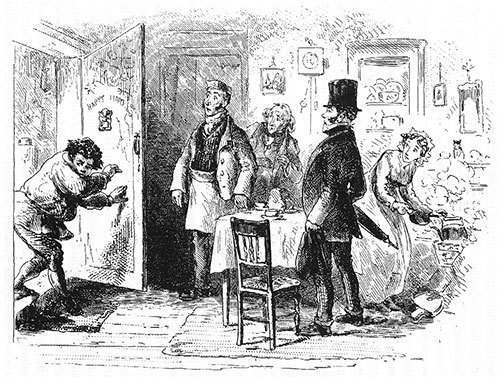
Mr. Baptist Is Supposed To Have Seen Something
Book II Chapter 13
Phiz
Text Illustrated:
"Nandy, re-entering the cottage with an air of mystery, entreated them to come and look at the strange behaviour of Mr. Baptist, who seemed to have met with something that had scared him. All three going into the shop, and watching through the window, then saw Mr. Baptist, pale and agitated, go through the following extraordinary performances. First, he was observed hiding at the top of the steps leading down into the Yard, and peeping up and down the street with his head cautiously thrust out close to the side of the shop-door. After very anxious scrutiny, he came out of his retreat, and went briskly down the street as if he were going away altogether; then, suddenly turned about, and went, at the same pace, and with the same feint, up the street. He had gone no further up the street than he had gone down, when he crossed the road and disappeared. The object of this last manoeuvre was only apparent, when his entering the shop with a sudden twist, from the steps again, explained that he had made a wide and obscure circuit round to the other, or Doyce and Clennam, end of the Yard, and had come through the Yard and bolted in. He was out of breath by that time, as he might well be, and his heart seemed to jerk faster than the little shop-bell, as it quivered and jingled behind him with his hasty shutting of the door.
"Hallo, old chap!" said Mr. Pancks. "Altro, old boy! What's the matter?"
Mr. Baptist, or Signor Cavalletto, understood English now almost as well as Mr. Pancks himself, and could speak it very well too. Nevertheless, Mrs. Plornish, with a pardonable vanity in that accomplishment of hers which made her all but Italian, stepped in as interpreter.
"E ask know," said Mrs. Plornish, "What go wrong?"
Commentary:
The chief illustrators of the book in the nineteenth century, Phiz and James Mahoney, have focused on very different aspects of the plot revealed in this chapter: whereas Phiz in the original serial illustration (and Harry Furniss in his derivative Mr. Baptist takes refuge in Happy Cottage) underscores Cavaletto's terror of Rigaud, who has suddenly appeared in London, Mahoney pursues the investment mania created by Merdle's promise of high rates of return on significant investment, a mania that has even swept up so cautious an investor as Panks, identified by his hat and bag here, as opposed to his spiky hair in Sol Eytinge, Junior's portrait of him and slum landlord Casby, and Harry Furniss's version of this group scene.
Having deployed a serious illustration as the first in the January 1857 number (Part Fourteen), Dickens and Phiz have elected to use a character-comedy steel-engraving as the second for that number, even though this installment explores a more important matter, the pernicious influence of Merdle's millions. In The Patriotic Conference (Book II, Chapter 12) artist and author had employed the rather lackluster Merdle social gathering to draw the reader's attention to Merdle's using his influence with the Barnacle clan to effect his step-son's promotion to a post in the governmental Circumlocution Office. Speculation fever based on the lure of high rates of return runs rampant throughout England. However, this second illustration for the fourteenth monthly number focuses instead upon the relatively jolly, lower-middle-class characters of Bleeding Heart Yard's "Happy Cottage," the tobacconist's shop run by Mrs. Plornish: Cavaletto nervously enters (left), startling the occupants; Mr. Plornish (identified by his plasterer's hat), Old Nandy (Mrs. Plornish's aged parent), Pancks with collection bag and umbrella in the foreground, and, in the process of making tea, Mrs. Plornish herself (right). The homey, lower-middle-class parlor is a sharp contrast to the sterile opulence of Mr. Merdle's salon in the previous plate, and each of these five figures is highly individualized, as opposed to the relatively undistinguished high society set of eight political and economic movers-and-shakers in the previous illustration. Once again, then, Phiz and Dickens utilize the "streaky bacon" principle of alternating the serious and comic scenes in the number's twin illustrations."
Mod
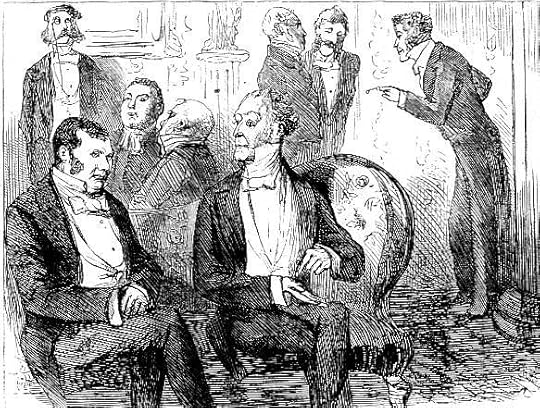
The Merdle Party
Book II Chapter 12
Sol Eytinge Jr.
The Diamond Edition of Dicken's Little Dorrit 1871
Commentary:
The Dorrits, making an upper middle class version of the Grand Tour, cross paths with Mrs. Merdle and her son by a previous marriage, Edmund Sparkler, at Martigny. Meanwhile, back in Cavendish Square, her banker-husband entertains the politically influential Barnacles to promote Edmund's interests in Book 2, Chapter 12, ""In Which a Great Patriotic Conference is Holden." The foregrounded juxtaposition of the fashionably dressed, older man with extensive shirt cuffs — undoubtedly, Mr. Merdle — seated beside a younger man in formal dress suggests that Eytinge has realised the following passage:
"Mr. Tite Barnacle, who, like Dr. Johnson's celebrated acquaintance, had only one idea in his head and that was a wrong one, had appeared by this time. This eminent gentleman and Mr. Merdle, seated diverse ways and with ruminating aspects on a yellow ottoman in the light of the fire, holding no verbal communication with each other, bore a strong general resemblance to the two cows in the Cuyp picture over against them."
The remaining six figures in the illustration are the assorted younger members of the Barnacle clan and lords of the Circumlocution Office, since the supreme Barnacle, Lord Decimus, has yet to arrive. Behind Merdle's companion is the attorney "Bar," clearly identifiable by virtue of his monocle (first introduced in Book One, Chapter 21, "Mr. Merdle's Complaint"). Whereas Dickens focuses on Merdle's inner discomfort, his feeling of being a rank stranger and utter interloper in his own drawing room, Eytinge gives us merely the placid and elegant exterior. In the absence of specific description of the financier, the American illustrator has had to improvise, giving him lean features, swept back blond hair, a double chin, and rigid posture. This pillar-like figure does not immediately suggest ineptitude or uneasiness, nor do his hands imply anxiety, but he does seem "reserved," and his head is indeed "broad, overhanging, watchful." Perhaps his skeletal thinness is intended to suggest his lack of enjoyment of expensive foodstuffs and rich meals. The emphasis on the rounded end of the ottoman in the illustration suggests that Merdle is not just seated, but enthroned.
Mod

"Mr. and Mrs. Plornish and John Edward Nandy,"
Book II Chapter 13
Sol Eytinge Jr.
The Diamond Edition 1871
Commentary:
In the thirteenth character study to complement Dickens's narrative, "Mr. and Mrs. Plornish and John Edward Nandy," Eytinge does not include the Plornishes' highly painted shop-parlour masquerading as "Happy Cottage" in Bleeding Heart Yard, located in a maze of alleyways in Holborn, but focuses on the good-natured couple — Sally, the proprietress of a small grocery store funded by the suddenly-wealthy Mr. Dorrit, and her husband, Thomas, a plasterer (as one may judge from his cap) — and Mrs. Plornish's cheerful, elderly, pipe-smoking father. Eytinge conveys their bonhomie and mutual delight in each other's company, and realizes Thomas's sandy whiskers. The relevant passage is probably this:
Mrs. Plornish's shop-parlour had been decorated under her own eye, and presented, on the side towards the shop, a little fiction in which Mrs. Plornish unspeakably rejoiced. This poetical heightening of the parlour consisted in the wall being painted to represent the exterior of a thatched cottage; the artist having introduced (in as effective a manner as he found compatible with their highly disproportionate dimensions) the real door and window. The modest sunflower and hollyhock were depicted as flourishing with great luxuriance on this rustic dwelling, while a quantity of dense smoke issuing from the chimney indicated good cheer within, and also, perhaps, that it had not been lately swept. A faithful dog was represented as flying at the legs of the friendly visitor, from the threshold; and a circular pigeon-house, enveloped in a cloud of pigeons, arose from behind the garden-paling. On the door (when it was shut), appeared the semblance of a brass-plate, presenting the inscription, Happy Cottage, T. and M. Plornish; the partnership expressing man and wife. No Poetry and no Art ever charmed the imagination more than the union of the two in this counterfeit cottage charmed Mrs. Plornish. It was nothing to her that Plornish had a habit of leaning against it as he smoked his pipe after work, when his hat blotted out the pigeon-house and all the pigeons, when his back swallowed up the dwelling, when his hands in his pockets uprooted the blooming garden and laid waste the adjacent country. To Mrs. Plornish, it was still a most beautiful cottage, a most wonderful deception; and it made no difference that Mr. Plornish's eye was some inches above the level of the gable bed-room in the thatch. To come out into the shop after it was shut, and hear her father sing a song inside this cottage, was a perfect Pastoral to Mrs. Plornish, the Golden Age revived. And truly if that famous period had been revived, or had ever been at all, it may be doubted whether it would have produced many more heartily admiring daughters than the poor woman."
Mod
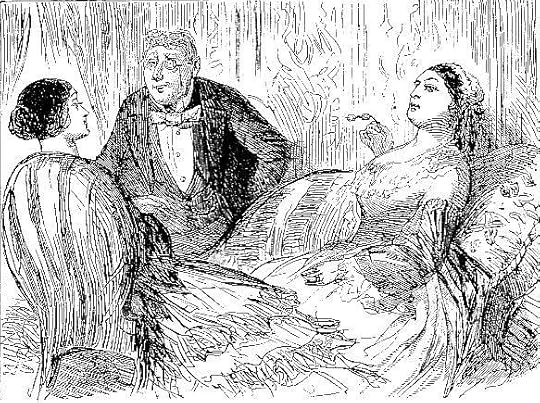
"Mrs. Merdle, Mr. Sparkler, and Fanny,"
Book II Chapter 14
Sol Eytinge Jr.
Commentary:
While Mr. Merdle entertains the Barnacle clan in London to advance his step-son's career as "one of the Lords of the Circumlocution Office", Mrs. Merdle entertains Fanny Dorrit in her apartments "on the shore of the yellow Tiber" in "Taking Advice," Chapter 14 of Book Two ("Riches"). Whereas in the text our apprehension of this translation to the upper political sphere is conditioned by the envious Henry Gowan's cutting remark "that Sparkler was the sweetest-tempered, simplest-hearted, altogether most lovable jackass that ever grazed on the public common", our assessment of his character in Eytinge's fourteenth character study is based on his youthful corpulence, fashionable evening dress, and quizzing-glass: visually, if his mother is striking a Queen Victoria like pose, then he is by extension to youthful Prince of Wales. The character whom Eytinge does not permit us to study is the rather more knowing Fanny, who has determined that she should have a husband who is not merely wealthy but lacking in intelligence so that she may dominate the relationship. Dickens notes in the twenty-first chapter of the first book that Edmund's idiocy has been accounted for by his brain supposedly having frozen during a frost in St. John's , New Brunswick, where he was born, or possibly having in infancy (in that same city where his father, Colonel Sparkler was stationed) been dropped out of window by a negligent nurse; and that ever since coming of age the "chuckle-headed high-shouldered" only child of Mrs. Merdle has been in the habit of proposing marriage "to all manner of undesirable young ladies".
Initially, Mrs. Merdle had objected to a match between her dissolute son and the daughter of an insolvent debtor (indeed, in chapter 20 of the first book she had actually bribed the young dancer to discourage her son's attentions), but in the next chapter withdraws her objection since the Dorrit family has come into a fortune. Fanny treats her imbecilic husband with contempt, despite his elevated post in the Circumlocution Office. The passage reflected rather than absolutely realized in Eytinge's fourteenth illustration is likely this:
"Amy observed Mr. Sparkler's treatment by his enslaver, with new reasons for attaching importance to all that passed between them. There were times when Fanny appeared quite unable to endure his mental feebleness, and when she became so sharply impatient of it that she would all but dismiss him for good. There were other times when she got on much better with him; when he amused her, and when her sense of superiority seemed to counterbalance that opposite side of the scale. If Mr. Sparkler had been other than the faithfulest and most submissive of swains, he was sufficiently hard pressed to have fled from the scene of his trials, and have set at least the whole distance from Rome to London between himself and his enchantress. But he had no greater will of his own than a boat has when it is towed by a steam-ship; and he followed his cruel mistress through rough and smooth, on equally strong compulsion.
Mrs. Merdle, during these passages, said little to Fanny, but said more about her. She was, as it were, forced to look at her through her eye-glass, and in general conversation to allow commendations of her beauty to be wrung from her by its irresistible demands. The defiant character it assumed when Fanny heard these extolling's (as it generally happened that she did), was not expressive of concessions to the impartial bosom; but the utmost revenge the bosom took was, to say audibly, "A spoilt beauty — but with that face and shape, who could wonder?"
The drawing-room scene, then, is one which Eytinge has imagined as having transpired when — off stage, so to speak — Mrs. Merdle had agreed to the union and Edmund had started to think of Amy Dorrit as a sister. Eytinge gives us Mrs. Merdle's ample bosom and eye-glass from the text, but must invent the rest.
Mod
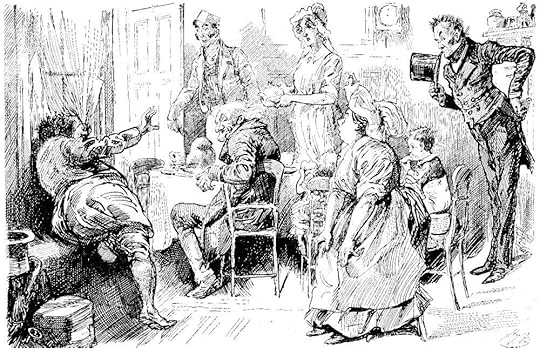
Mr. Baptist takes refuge in Happy Cottage
Book II Chapter 13
Harry Furniss
Text Illustrated:
"Padrona, dearest," returned the little foreigner whom she so considerately protected, "do not ask, I pray. Once again I say it matters not. I have fear of this man. I do not wish to see him, I do not wish to be known of him — never again! Enough, most beautiful. Leave it."
The topic was so disagreeable to him, and so put his usual liveliness to the rout, that Mrs. Plornish forbore to press him further: the rather as the tea had been drawing for some time on the hob. But she was not the less surprised and curious for asking no more questions; neither was Mr. Pancks, whose expressive breathing had been labouring hard since the entrance of the little man, like a locomotive engine with a great load getting up a steep incline. Maggy, now better dressed than of yore, though still faithful to the monstrous character of her cap, had been in the background from the first with open mouth and eyes, which staring and gaping features were not diminished in breadth by the untimely suppression of the subject. However, no more was said about it, though much appeared to be thought on all sides: by no means excepting the two young Plornishes, who partook of the evening meal as if their eating the bread and butter were rendered almost superfluous by the painful probability of the worst of men shortly presenting himself for the purpose of eating them. Mr. Baptist, by degrees began to chirp a little; but never stirred from the seat he had taken behind the door and close to the window, though it was not his usual place. As often as the little bell rang, he started and peeped out secretly, with the end of the little curtain in his hand and the rest before his face; evidently not at all satisfied but that the man he dreaded had tracked him through all his doublings and turnings, with the certainty of a terrible bloodhound."
Commentary:
Whereas the original Phiz version, Mr. Baptist is Supposed to have seen Something, contains Pancks, the Plornishes, Old Nandy, and Cavaletto, Furniss has added the boy and girl eating bread-and-butter, and Maggy, recognizable immediately by her over-sized hat. The effect of a static group portrait is disrupted by the very different postures of the eight characters, with the strangely dressed Cavaletto turned to look out of the window, Maggy and Old Nandy seated, the Plornishes standing on the other side of the dining-table, and Pancks (also immediately recognizable by a single feature, his spiked hair) standing with his back to the fire.
The two chief illustrators of Dickens's novel in the nineteenth century, Phiz and James Mahoney, have focused on very different aspects of the plot revealed in this chapter: whereas Phiz in the original serial illustration (and Harry Furniss in his derivative Mr. Baptist takes refuge in Happy Cottage) underscores Cavaletto's terror of Rigaud, who has suddenly appeared in London, Mahoney pursues the investment mania created by Merdle's promise of high rates of return on significant investment, a mania that has even swept up so cautious an investor as Panks, identified by his hat and bag here, as opposed to his spiky hair in Sol Eytinge, Junior's portrait of him and slum landlord Casby, and Harry Furniss's version of this group scene. Furniss follows Phiz's lead in his choice of subject, preferring the character comedy of the parlor scene.
Mod
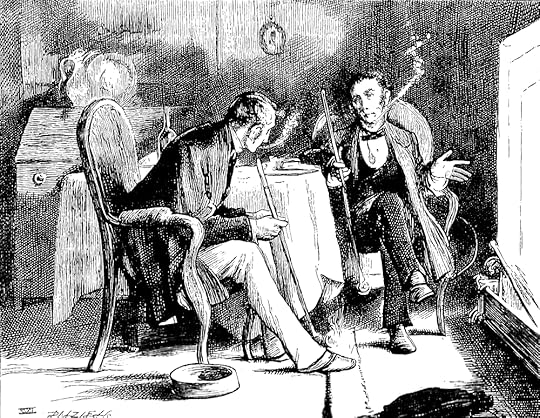
"And have you really invested your thousand pounds Pancks?"
Book II Chapter 13
James Mahoney
Household Edition 1873
Text Illustrated:
"Right in sharing Cavalletto's inclination to speculate with Mr. Merdle?"
"Per-fectly, sir," said Pancks. "I've gone into it. I've made the calculations. I've worked it. They're safe and genuine." Relieved by having got to this, Mr. Pancks took as long a pull as his lungs would permit at his Eastern pipe, and looked sagaciously and steadily at Clennam while inhaling and exhaling too.
In those moments, Mr Pancks began to give out the dangerous infection with which he was laden. It is the manner of communicating these diseases; it is the subtle way in which they go about.
"Do you mean, my good Pancks," asked Clennam emphatically, "that you would put that thousand pounds of yours, let us say, for instance, out at this kind of interest?"
"Certainly," said Pancks. "Already done it, sir."
Mr. Pancks took another long inhalation, another long exhalation, another long sagacious look at Clennam.
"I tell you, Mr Clennam, I've gone into it," said Pancks. "He's a man of immense resources — enormous capital — government influence. They're the best schemes afloat. They're safe. They're certain."
"Well"' returned Clennam, looking first at him gravely and then at the fire gravely. "You surprise me!"
"Bah!" Pancks retorted. "Don't say that, sir. It's what you ought to do yourself! Why don't you do as I do?"
Of whom Mr. Pancks had taken the prevalent disease, he could no more have told than if he had unconsciously taken a fever. Bred at first, as many physical diseases are, in the wickedness of men, and then disseminated in their ignorance, these epidemics, after a period, get communicated to many sufferers who are neither ignorant nor wicked. Mr. Pancks might, or might not, have caught the illness himself from a subject of this class; but in this category he appeared before Clennam, and the infection he threw off was all the more virulent.
"And you have really invested," Clennam had already passed to that word, "your thousand pounds, Pancks?'
Commentary:
The American Household Edition has a much longer caption that clarifies the precise passage illustrated: "And you have really invested," Clennam had already passed to that word, "your thousand pounds, Pancks?" . . . "To be sure, sir!" replied Pancks boldly, with a puff of smoke, "and only wish it ten." — Book 2, chap. xiii. The chief illustrators of the book in the nineteenth century, Phiz and James Mahoney, have focused on very different aspects of the plot revealed in this chapter: whereas Phiz in the original serial illustration underscores Cavaletto's terror of Rigaud, who has suddenly appeared in London, Mahoney pursues the investment mania created by Merdle's promise of high rates of return on significant investment, a mania that has even swept up so cautious an investor as Panks.
Having deployed a serious illustration as the first in the January 1857 number (Part Fourteen), Dickens and Phiz have elected to use a character-comedy steel-engraving as the second for that number, even though this instalment explores a more important matter, the pernicious influence of Merdle's millions. In The Patriotic Conference (Book II, Chapter 12) serial artist and author had employed the rather lackluster Merdle social gathering to draw the reader's attention to Merdle's using his personal influence with the Barnacle clan to effect his step-son's promotion to a post in the governmental Circumlocution Office. Speculation fever based on the lure of high rates of return runs rampant throughout England. Mahoney conveys this mania in this quiet study of two otherwise reasonable characters, Pancks and Clennam, sober-minded, reflective, pipe-smoking men of business who are tempted by Merdle's get-rich-quick promises, with the "infection" passing from Pancks the rent-collector to the cautious capitalist Arthur Clennam.
Mod
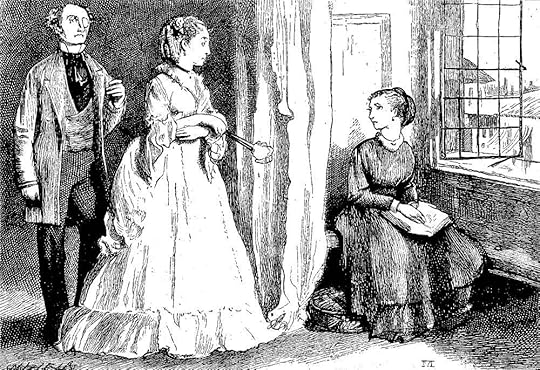
"Little Dorrit used to sit and muse here, much as she had been used to while away the time on her balcony in Venice. Seated thus one day, she was softly touched on the shoulder, and Fanny said, "Well, my dear," and took her seat at her side."
Book II Chapter 14
James Mahoney
Household Edition 1873
Text Illustrated:
"Little Dorrit was at home one day, thinking about Fanny with a heavy heart. They had a room at one end of their drawing-room suite, nearly all irregular bay-window, projecting over the street, and commanding all the picturesque life and variety of the Corso, both up and down. At three or four o'clock in the afternoon, English time, the view from this window was very bright and peculiar; and Little Dorrit used to sit and muse here, much as she had been used to while away the time in her balcony at Venice. Seated thus one day, she was softly touched on the shoulder, and Fanny said, "Well, Amy dear," and took her seat at her side. Their seat was a part of the window; when there was anything in the way of a procession going on, they used to have bright draperies hung out of the window, and used to kneel or sit on this seat, and look out at it, leaning on the brilliant colour. But there was no procession that day, and Little Dorrit was rather surprised by Fanny's being at home at that hour, as she was generally out on horseback then.
"Well, Amy," said Fanny, "what are you thinking of, little one?"
"I was thinking of you, Fanny."
"No? What a coincidence! I declare here's some one else. You were not thinking of this some one else too; were you, Amy?"
Amy had been thinking of this some one else too; for it was Mr. Sparkler. She did not say so, however, as she gave him her hand. Mr. Sparkler came and sat down on the other side of her, and she felt the fraternal railing come behind her, and apparently stretch on to include Fanny."
Commentary:
The scene is significant in that it marks Fanny's determination to be avenged upon Mrs. Merdle by marrying the foolish, good-natured Edmund Sparkler, despite Amy's advice that such a motive is hardly the basis for a satisfactory marriage, or for a happy life. Fanny further justifies her decision by considering that, as hers is a willful and vain nature, she would be better off with a husband who not particularly clever or willful himself (perhaps an oblique allusion to Henry Gowan, who covets the civil service administrative position that Edmund, through his step-father's governmental connects, has just arranged for him). Mahoney underscores the presence of the young man himself in a composition clearly dominated by Fanny as the central figure.
The physical setting is the rooms that the Dorrits have rented in Rome, with Amy in the window-seat, observing life's passing parade rather than joining it as her sister intends to do. The scene prepares the reader for Amy's counseling Fanny not to rush headlong into a marriage based not on a desire to love and be loved, but on a desire for vengeance. The room has extensive curtains, but otherwise Mahoney does not characterize it as a "drawing-room suite, nearly all irregular bay-window, projecting over the street", and the view is hardly "picturesque." Thus, Mahoney focuses the reader's attention upon the contrasting figures of the two sisters: small, modestly, dark-clad Amy in the inferior position, and Fanny in a voluminous white dress backed by dark shading, with pillar-like Edmund jammed in between his fiancée and the left margin. However, since the scene offers little visual engagement or subtlety in detail, it might well be mistaken for a parlor engraving by the illustrator of society fiction George Du Maurier from the same period.
Mod
Well said, Peter. And so are the ways of the world, unto this very day!
Mod
Xan, that is the most brilliant interpretation of Mr F.'s aunt I have ever come across, and I've been thinking a lot about that worthy old lady because I like her so much. It definitely makes sense: Flora is much too kind-hearted to speak up on her own, and yet she must sense that Arthur comes to see her with a long inward face and always some ulterior motive - and her aunt does not mince words about it.
I must immediately go and see if anyone in my family or circle of friends needs a complaining puppet, because I really love complaining and telling people off.
Mod
We will all end up bashing Arthur ;-)
 Mary Lou wrote: "It can never be a good sign when the author/narrator equates investing with an epidemic."
Ha! So well put.
Tristram wrote: "It's even worse, Peter: Fanny does not marry for money and social prestige. She simply marries out of spite, namely in order to be able to humiliate for future mother-in-law. She really and truly joins her own life to the lot of a man she despises - but from his behaviour towards Amy, I noticed that Sparkler is quite a nice person - just to be able to quarrel with his mother on an equal basis. How absurd can a person become?Fanny also seems desperate to marry at all - simply because she does not like to live in a household where Mrs. General might very soon take over the role of her mother. She tells her sister that she would like to marry a cleverer man, but that there are no clever men available in her sphere of society. So, apart from her feud with Mrs Merdle, Mr Sparkler seems to be her only ticket into a realm of relative independence. This tells us quite a lot about the range of opportunities Victorian society allowed even women of higher social status."
Yes. I know we are supposed to disapprove of Fanny here, and I do disapprove of her insofar as she is marrying to spite her future mother in law, but I don't really believe she is marrying to spite Mrs. Merdle. I see spiting Mrs. Merdle as Fanny's revenge against everyone who treated her poorly or thought less of her when she was an actress whose father was in prison. Mrs. Merdle is just the part for the whole of all the social-class snobs.
And I find as I grow older that I am increasingly sympathetic to the supporting-character women in Victorian novels who marry for money and position, and who are supposed to be the negative lesson putting the heroine into relief--but why wouldn't you marry for money and position, when marriage is your only route to social mobility? More power to Fanny. I don't expect this to work out well for her, because Dickens, but on the other hand if I expect Dickens to end up moralizing about her bad choices, I also admire his portrayal of this woman who has her husband so well in hand, who immediately begins protecting him against Gowan as soon as she decides to marry him, and who very consciously chooses which mother-figure she's going to be stuck with, since she has to be stuck with one, and picks the one she knows she can handle. I'm not supposed to like Fanny (obviously Amy is set up as the true soul against her), but I do.
Julie, your comments about Fanny and Victorian women in general, make me think of Charlotte Lucas from "Pride and Prejudice" (at least the BBC version - can't remember details of the book so clearly). Lizzie Bennet is appalled that she married Mr. Collins, who, like Sparkler, is a bit of a fool, but he has a good living and the patronage of Lady Catherine (who may well be worse than a mother-in-law). Charlotte is a smart cookie. She's not ambitious like Fanny, but she realizes she's not first on anyone's dance card, and she knows how to handle Mr. Collins in order to live a quiet, financially secure life. She makes concessions, but she's fully in charge of her own destiny, and is okay with the way things have turned out, despite the lack of passion in her marriage. I wonder if Fanny will ever be content. She's bossy and manipulative of Sparkler and his mother, but I'm not sure if will bring her any joy in the end. I admire Charlotte; the jury's still out on Fanny.
I agree - I do not think Fanny would/could have a happy marriage. It is not in her DNA - Fanny has been wronged for so long and wants revenge (but she does not recognize this) that she will always have a mean mouth and will be phony with most folks (even her own sister). Oh, spare me from the Fannys of the world. peace, janz
Mod
Apart from that, I have always liked spunky female characters like Becky Sharpe or Lizzie Eustace who outplay society by its rules. I even have a soft spot for Wilkie Collins's Lydia Gwylt.
Mod
Our recent reading of Nayder’s “The Other Dickens” may be helpful in assessing Dickens’s personal life and thus, to an extent, what is projected in his novels. Ellen Ternan is about to make her first appearance in Dickens’s life.
Tristram wrote: "Concerning Fanny, I am on Julie's side: Fanny's only chance to become independent lies in marriage, and in marrying a man like Sparky, who is easy to handle, she has a full range of independence. I..."Excellent.
But I have to ask this. My thinking is Amy and Fanny are opposites, and intended to be opposites. Fanny wants to exercise her freedom. This means nothing to Amy. Amy wishes to support and sacrifice herself for someone. Though they are opposites, don't meek husbands serve each's interests best, and aren't Sparky and Richard both meek? For Fanny this is obvious. As you say, a meek husband suits her needs best. Not so obvious with Amy at first glance. But who is more likely to need support and sacrifice, the independent husband who is used to making all the decisions, or a meek husband who could use a push and a word of encouragement from someone standing in the background? So, I guess I'm asking if Richard is to Amy what Sparky is to Fanny?
Mary Lou wrote: "Julie, your comments about Fanny and Victorian women in general, make me think of Charlotte Lucas from "Pride and Prejudice" (at least the BBC version - can't remember details of the book so clearl..."Yes--I was thinking of Charlotte, too!
Peter wrote: "Does Dickens himself now seek a woman/companion who has more spark and spunk"Not if Amy is his dream woman!
But everyone's comments are making me think Fanny might have a chance of contentment (if not absolute happiness) after all. Maybe she *is* just a different take on how to handle getting married.
Of course her contentment will also require her not getting hit by the fallout when the Merdle empire goes--and we do seem to be getting a lot of hints that it will go. Hm. I hope Fanny doesn't end up with a relative in prison again.
Mod
I don't really have high hopes for Fanny's getting out of this story unscathed because Dickens will not allow such independent behaviour in a woman to go unpunished. Amy's sufferings will be rewarded but Fanny's self-assertiveness will definitely not.
Xan,
The idea of Amy's being better off with a meek husband certainly makes a lot of sense. Only a meek husband needs more support and nursing against the cruel ways of the world, and he is also easier to be cowed and browbeaten with the artful device of self-sacrifice. "Look what I am doing for you," quoth the self-denying little wife, "now it would be ungrateful in you to do things on your own again." - We can really see that Amy is thinking in slightly these lines with regard to her father, of course, not reproaching him with a lack of gratitude, but deploring his lack of reliance on her.
Mod
You forgot Little Nell.
Mod


This week's installment begins with Chapter 12 titled "In Which a Great Patriotic Conference Is Holden" (is holden even a word?) and to me seemed like quite a long chapter and quite an uninteresting chapter. I had trouble concentrating on all the exciting things that were taking place in this chapter. The chapter centers on a character I haven't paid much attention to before this, Mr. Merdle. We've seen quite a bit of his wife and his step-son Edmund Sparkler, but not much of him. Now we find him still at home while Mrs. Merdle and her son are abroad spending their time in the Dorrit's world. This chapter gave me a rather uneasy feeling about Mr. Merdle and his fame and fortune. The first line of the chapter is:
"The famous name of Merdle became, every day, more famous in the land."
Just that line makes me think that someday, it's all going to collapse on top of him. Perhaps I'm just being pessimistic, but I can see clouds on the horizon for the Merdles. Just getting Fanny as a member of the family and along with her all the other Dorrits would be a pretty big cloud. But for now Mr. Merdle is adored by all:
"All people knew (or thought they knew) that he had made himself immensely rich; and, for that reason alone, prostrated themselves before him, more degradedly and less excusably than the darkest savage creeps out of his hole in the ground to propitiate, in some log or reptile, the Deity of his benighted soul."
Mr. Merdle still keeps the house open even though his wife is absent, I have no idea why, he doesn't seem to enjoy them, and keeps having dinners for extremely uninteresting guests. This particular dinner was a "Barnacle dinner" and we had Lord Decimus Barnacle, Mr. Tite Barnacle, the young Barnacle and a Chorus of Parliamentary Barnacles who "went about the provinces when the House was up, warbling the praises of their Chief, were to be represented there." At one point during this long dinner I thought I was finally going to learn how Mr. Dorrit got in- and then out again of his financial troubles, something that if we are supposed to know, I've forgotten. Lord Decimus asks about a story he has heard of a gentleman long confined in a debtor's prison, proving to be of a wealthy family having been released. He asks for more information on the story and here is the explanation:
'Oh, it's a good story, as a story,' returned that gentleman; 'as good a thing of its kind as need be. This Mr Dorrit (his name is Dorrit) had incurred a responsibility to us, ages before the fairy came out of the Bank and gave him his fortune, under a bond he had signed for the performance of a contract which was not at all performed. He was a partner in a house in some large way—spirits, or buttons, or wine, or blacking, or oatmeal, or woollen, or pork, or hooks and eyes, or iron, or treacle, or shoes, or something or other that was wanted for troops, or seamen, or somebody—and the house burst, and we being among the creditors, detainees were lodged on the part of the Crown in a scientific manner, and all the rest of it. When the fairy had appeared and he wanted to pay us off, Egad we had got into such an exemplary state of checking and counter-checking, signing and counter-signing, that it was six months before we knew how to take the money, or how to give a receipt for it. It was a triumph of public business,' said this handsome young Barnacle, laughing heartily, 'You never saw such a lot of forms in your life."
I would like to have the name of the person causing al this trouble and I'm wondering if he is spending his life behind bars also. Eventually we learn that the dinner had been given to bring together Mr. Merdle and Lord Decimus to have "five minutes conversation together." And eventually they do get those few minutes of private conversation and soon after that the dinner comes to an end. We find that in a day or two it is announced that Edmund Sparkler, son-in-law of Mr. Merdle has been made one of the Lords of the Circumlocution Office. As the chapter ends we are told that as Mr. Merdle's fame and fortune grow the people come to "look at the house where the golden wonder lived." This has got to come crashing down sometime, I can just feel it.