
Victorians! discussion

This topic is about
Villette
Archived Group Reads 2022
>
Villette: Week 2: Chapters VI-X
date newest »
newest »
 Mod
Mod
Starting this week with Lucy, did anyone’s impressions change of her this week? Did we feel we got to know her any better than previously?
What did we make of her open-handedness, when she is already living on limited means? And when she isn’t naïve or being had?
It is also interesting that she has very few of the usual ‘accomplishments’—she doesn’t ‘play, sing, or speak three or four languages’. And she seems even to struggle with French. And yet, she seemed to have belonged to a fairly well-off family.
Finally, what did we think of the friendship between Lucy and Ginevra? There are opposites in every way, be it temperament or appearance; Ginevra does take advantage of Lucy but Lucy too can tell her off when needed.
And what of Lucy’s attitude towards Dr John?
Mod
I’ll just bring up the three characters who seemed more central in this week’s story:
Ginevra Fanshawe: beautiful, young, coquettish; interested in some talents but not very much in education; enjoys herself at parties, and seems to manage to have all her wants fulfilled quite skillfully.
Madame Beck: Proprietress of a school; efficient, an excellent manager; but with methods that don’t quite appeal to Lucy’s English outlook and morals.
Dr John: a handsome young English doctor, practicing on the continent; he soon makes himself well-liked at Madame Beck’s establishment.
Mod
Schools are often a setting that one associates with Brontë stories, and here too we find ourselves in one; but it a very different one from the dreary, harsh schools that we usually encounter in Victorian literature. Here students are well looked after, not overloaded with work, and permitted a social life.
The school spells a new beginning for Lucy, who arrives as governess but soon makes her mark and gets a job as a teacher (to Madame Beck’s advantage, of course). What did we think of the way she handled her more troublesome pupils?
Mod
While there were certainly no storms in this instalment, there is certainly some element of the otherworldly, for Lucy’s choice of destination—Villette—is determined by an inner voice, for Ginevra hadn’t bothered to tell her where her school lay; so something has certainly led her to it.
Mod
Another theme to stand out rather prominently on Lucy’s reflections was the differences between England and the Continent where she is; she isn’t all critical, for she does approve of the way some things are done such as not burdening students, but Madame’s use of espionage to run her establishment, Madame’s daughter feigning illness, among other things are brought up.
So, how did you find this week’s developments?
 The more I delve into Victorian literature, the more I enjoy illustrations. I have tracked down two early illustrators for Villette. The first illustration I'll post is by B.S. Greig, who also illustrated Jane Eyre. This is from a lovely early edition I paid too much money for in a wonderful book store in Stratford, Ontario, Canada, called Book Stage.
I was holding my breath as I read about Lucy boarding the ship late at night, when her coach driver "served [her] up as a dripping roast, making [her] alight in the midst of a throng of watermen." She is completely at their mercy. "Down the sable flood we glided, I thought of the Styx, and of Charon rowing some solitary soul to the Land of Shades. " But she doesn't feel afraid. Why not, do you think?
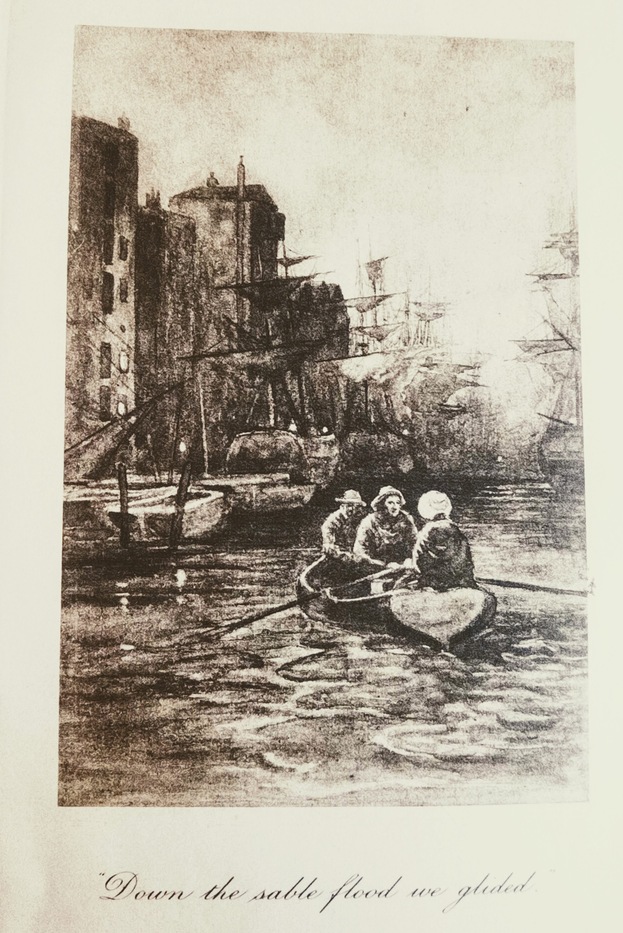 Again in Ch. 8, Lucy is finding her way in an unknown landscape in the rainy dark. She is threatened and lost, but serendipitously finds the school mentioned to her by Miss Fanshawe.
This is by another early illustrator, John Timothy Jellicoe.
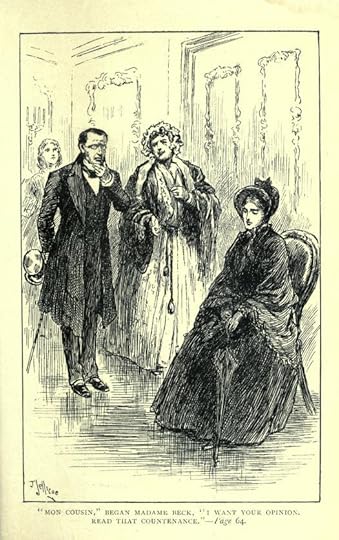 Mod
Mod
Mod
Mod
 I didn´t like Lucy´s prejudices against French people, Irish, Catholics, other school mistresses etc. Imo she comes along as quite sure of herself, though she says otherwise.
She seems interested in Dr. John, though perhaps only because she met him before, while he (so far at least) not in her.
Mod
She is rather enigmatic in that way, one thinks one knows what she thinks or feels about someone, but one isn't always sure.
 At the end of the last section I was surprised to find Lucy all alone in London where, as Trollope would say, young ladies are often ‘devoured by the lions.’ At this time only desperate women with no other means of supporting themselves would take a chance in the metropolis and often they would come to grief by being exploited in the worst possible ways.
Fortunately, Lucy met a trustworthy employee at the inn willing to help her due to his knowledge of her relations. Her self confidence in that situation and during her journey to the boat was both unexpected and alarming. Throughout her journey across the channel and on to Villette, Lucy was self deprecating to a certain extent but showed time and time again a willingness to thrust herself into the unknown.
Lucy’s development from nursemaid into schoolteacher came about partly because of her own intelligence and creativity but also because of the wiles of Madame Beck. Her handling of the schoolgirls was at first impulsive but led by a desire to succeed which the pupils recognised and eventually admired.
Her description of the ‘tall’ and ‘handsome’ Dr. John, accompanied by the numerous references of her glancing at him, leads me to believe that Lucy is quite taken with him. Dr. John himself catches her staring at him, which seems to take her breath away, leaving her unable to reply.
Lucy seems to have established herself quite quickly in the school, gaining the respect of Madame Beck, the school pupils and possibly the other staff working there.
Mod
At the school, I think Madame Beck's hands-off approach would have served to give her more confidence because she knew she had only herself to rely on. Sometimes not having someone who has your back helps too. I liked how she handled the more difficult girls.
Lucy does indeed sneak plenty of glances at Dr John, yet seems shy/reluctant at replying when he tries to speak to her. I wonder how this will turn out in subsequent sections.
CHAPTER X.DR JOHN.
Madame Beck was a most consistent character; forbearing with all the world, and tender to no part of it.
Madame Beck is larger than life. I thought it was interesting, that, although the title of this chapter is DR JOHN, the first word and the first few paragraphs are about Madame Beck. According to Lucy (and I think it is important to remember that everything we read is according to Lucy), Madame Beck is completely selfish and unscrupulously practical in achieving her goals. "Still, Madame knew what honesty was, and liked it—that is, when it did not obtrude its clumsy scruples in the way of her will and interest." But Lucy (at least according to herself) is smarter, and is able manage Madame Beck quite successfully.
Although Lucy translates many conversations that take place in French, as far as I could find, she doesn't translate any of Madame Beck's direct quotes. It's part of Madame Beck's character that she is simply not translatable into English.
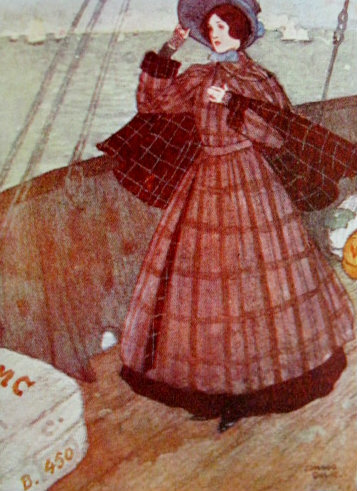
Once aboard ‘The Vivid’ I was intrigued with both the description of the vessel, (including the ‘ladies cabin’ and the stewardess) and Lucy’s revelation of English girls travelling alone.
’ Foreigners say that it is only English girls who can thus be trusted to travel alone, and deep is their wonder at the daring confidence of English parents and guardians. As for the “jeunes Meess,” by some their intrepidity is pronounced masculine and “inconvenant,” others regard them as the passive victims of an educational and theological system which wantonly dispenses with proper “surveillance.” Whether this particular young lady (Ginevra) was of the sort that can the most safely be left unwatched, I do not know: or, rather did not then know; but it soon appeared that the dignity of solitude was not to her taste. She paced the deck once or twice backwards and forwards; she looked with a little sour air of disdain at the flaunting silks and velvets, and the bears which thereon danced attendance, and eventually she approached me and spoke.’
Ginevra Fanshawe, still only seventeen, claimed of travelling alone at least ten times.
There were some vivid descriptions of the characters on board as well as the sea sickness whilst aboard the vessel. A couple of sentences seemed to be a metaphor representing Lucy’s own journey so far.
’ As dark night drew on, the sea roughened: larger waves swayed strong against the vessel’s side. It was strange to reflect that blackness and water were round us, and to feel the ship ploughing straight on her pathless way, despite noise, billow, and rising gale.’
Trev wrote: "A couple of sentences seemed to be a metaphor representing Lucy’s own journey so far..."I found an interesting website and they say: "...Bronte’s use of Gothic doubling to represent externally what her protagonist is suffering internally." Although I have never heard this term before, I think this is what she does over and over with the storms, and with some peaceful moments as well. The weather stands in for her feelings. The feelings she does not allow herself to feel or express.
https://www.thebrusselsbrontegroup.or...
Lucia wrote: "Thanks for sharing, Ginny. The weather and beautiful natural descriptions are used to express her hopes and expectations, too. The following excerpt from chapter 6 stands out for me."In my reverie..."
Yes. An arch of hope. Lovely.
 I love how this beautiful vision directly precedes her getting violently ill, much as Miss Marchmont started raving and feeling unnaturally well right before she died.
It is stated why Miss Snowe is going to the continent. A character (perhaps a nurse or servant?) indicates, regarding a French governess that Lucy observes in England, that English ladies often have the same opportunity for an easy governess role on the Continent because English governesses are wanted. This seems like a prime job opportunity considering her circumstances.
I don't particularly think Madame Beck is untranslatable. With the exception of Luch Snowe herself, Charlotte Brontë could probably assume most of her educated readers had learned a little French, and the French she uses is not particularly difficult. She translates some of it into English that might be more difficult; or simply because a wall of French might be fatiguing, while a few phrases sprinkled here and there add flavor and make the reader feel clever.
I liked the name (Bouquin-Moisi=moldy book) Charlotte decided to use for Leuven! :D
I think the unspoken realization Lucy had about Dr. John at the close of Chapter 10 is that he is Isidore.
Ginevra Fanshawe did not tell Lucy exactly where the school was, but she did say she was staying at Villette.
So far every small child in this novel appears to be suffering from emotional neglect.
How language instruction has changed! These days, you wouldn't need to know French to teach English. You'd simply present all lessons in the target language.
Ginny wrote: "I found an interesting website and they say: "...Bronte’s use of Gothic doubling to represent ..."I enjoyed reading about the Brussels Bronte group. Thank you for that. Another great resource for the Brontës and all their work is the Anne Brontë blog and that includes a number of insightful references to Villette. The illustration in my previous post of Lucy on board The Vivid came from there. Some of the posts on the blog contain spoilers so beware.
Here is an article about Brussels with an illustration of the Pensionnat Heger in Brussels - ( Madame Beck’s school in Villette,) as well as a fascinating newspaper extract focusing on Constantin Heger’s attitude towards Charlotte Brontë.
http://www.annebronte.org/2020/02/17/...
Another article focuses on the month of March and in ‘Villette’ it is in March when Lucy sets off for the continent.
http://www.annebronte.org/2022/03/20/...
(Extract from the ‘March’ article.)
’ Just as March marks a turning point in the year, the start of a journey into spring and then summer, so too Lucy Snowe’s life takes on new life in this month. On the very first day she has left her old life behind and arrived in London, from whence she will travel to the Belgian city of Villette – in reality the Brussels which Charlotte Brontë knew so well.’
The information and illustration relating to Paternoster Row is also very interesting.
I'm really enjoying the articles and the pictures y'all have shared! Thank you!
Mod
True; that could have also triggered her inner voice to spur her on
Mod
I enjoyed reading about the Brussels Bronte group. Thank you for that. Another grea..."
Thanks so much for sharing these Ginny and Trev.
 I really enjoyed Lucy’s voyage and her introduction to Villette at night, with the meeting with the helpful young man that later turns out to be Dr John. These ‘coincidences’ seem to crop up quite often in Victorian novels to introduce key figures into the action.
Mme Beck is a great character, monstrously selfish and completely focused on herself and the success of her business. I agree with Brontë’s view that she would have made a good politician or “comprised the duties of a first minister and a superintendent of police”. There are certainly plenty of modern politicians whose cynicism and opportunism she could match!
Lucy is very critical of the Catholic morality and leaves the reader in no doubt that for her Protestantism is superior and more honest. She notes “to invent might not be precisely a virtue, but it was the most venial of faults” . Reading a novel is more serious than lying in the priest’s eyes.
On the other hand, while the tone is sometimes preachy, there is more sly humour in the writing than I was expecting too. I liked the way Lucy notes that Dr John pays about as much attention to her as he would to average furniture or carpets!
Mod
These contrasts and disapprovals--whether religion or morality between the English and the French or the continent more broadly is something one seems to encounter often in fiction of the day, in fact even even in some earlier 20thc fic.
Lucy's observation was fun. She does seem to observe Dr John more than he does her
LiLi wrote: "I don't particularly think Madame Beck is untranslatable. With the exception of Luch Snowe herself, Charlotte Brontë could probably assume most of her educated readers had learned a little French, and the French she uses is not particularly difficult. She translates some of it into English that might be more difficult; or simply because a wall of French might be fatiguing, while a few phrases sprinkled here and there add flavor and make the reader feel clever. ..."Since Madam Beck speaks no English, and something is always lost in translation, my thought was having almost all of her direct voice in French was a deliberate part of character development. And that brings up the question--why the French and is there any particular meaning in where it is used? Just for flavour?
 Bronte’s task in this section seems to be plot development and the introduction of new characters, two of whom, Madame Beck and Dr. John, seem major. Lucy’s situation changes from impoverished homelessness to an establishment in the Beck household and school. I am coming to like and sympathize with Lucy much more than I did in the opening chapters. And I enjoy her as narrator, I like her careful and detailed observations, particularly of Madame Beck. I was surprised toward the end of the section to find this well organized, self-controlled woman falling in love—and then dealing with her unhappy situation with characteristic efficiency. I am enjoying Villette a great deal!
Mod
Bronte’s task in this section seems to be plot development and the introduction of new characters, two of whom, Madame Beck and Dr. John, seem major. Lucy’s situation changes from impoverished homelessness to an establishment in the Beck household and school. I am coming to like and sympathize with Lucy much more than I did in the opening chapters. And I enjoy her as narrator, I like her careful and detailed observations, particularly of Madame Beck. I was surprised toward the end of the section to find this well organized, self-controlled woman falling in love—and then dealing with her unhappy situation with characteristic efficiency. I am enjoying Villette a great deal!
Mod
Lucy does make for an interesting narrator, since her observations of others are indeed quite detailed, yet she isn't as quick to volunteer information about herself and her feelings.


Welcome to week 2 of our discussion of Villette! This week’s chapters involved a journey, and brought new beginnings for Lucy Snowe in a completely new place, introducing us to new characters of course, and highlighting perhaps the theme of difference.
Summary
In the previous instalment, after the death of Miss Marchmont, which once again left Lucy without means, other than the £15 she had earnt, Lucy decided to travel to London, where she just arrived as we left her. This week’s chapters opened with her exploring London, seeing the sights, and taking some much-needed rest (after all, looking after Miss Marchmont would have been demanding)--living in a sense for the first time. At the hotel, she initially finds herself treated somewhat carelessly, until she makes herself known to the waiter, mentioning her uncles who stayed there. This improves her standing.
Then we learn of her decision, almost abruptly, to travel to a continental port, Boue-Marine, and some swift proceedings later, we find her aboard a vessel to make the journey. Here again, her apparent lack of means leads to some brusque, if not shoddy, treatment. But she soon makes a new friend. A young girl, Ginevra Fanshawe, on her way to school, seems to take to her; and Lucy’s journey, even if not the most comfortable, since she is seasick, is made at least interesting by her presence and conversation.
But both on her London stay, and journey, Lucy has been far too generous with her purse, and that too, when she hasn’t the slightest idea how she will earn her living.
She arrives at the port, and thereafter travels to Villette, unsure even what she will do, but we learn later that Miss Fanshawe had asked her to come to her school, whose proprietress is looking for an English governess for her children (though carelessly omitting to say where it was). Her luggage left behind, a chance meeting with an Englishman leads her to head towards an inn for the night, but on the way what should she come upon but Madame Beck’s establishment. Here she, with the intervention of M. Paul, Madame’s cousin, finds a place as governess to Madame’s three children.
We soon see that things on the continent are not run quite as in England. Lucy settles into her work, but a chance is thrown at her to teach one of the classes, which she is able to handle quite well, despite her limitations with speaking French. Soon, she is promoted to teacher, and life moves on.
Her friendship with Ginevra deepens, and she does often give into the latter’s demands, but sensibly also puts her in her place when she goes too far. We also learn of Ginevra’s mysterious admirer, the handsome and talented Isidore. Meanwhile when Madame Beck’s children fall ill—one actually while the other faked—we meet the Englishman who’d helped Lucy once again. This is Dr John, and he makes himself quite popular in Mme Beck’s household.