
The Old Curiosity Club discussion

This topic is about
Little Dorrit
Little Dorrit
>
Little Dorrit, Book 2, Chp. 19-22
date newest »
newest »
 Mod
Mod
He tells her he is interested in finding Blandois who has disappeared and his mother is suspected of having something to do with it. Miss Wade says she knows nothing of the matter. She tells him he should go ask his friend Henry Gowan about the matter and goes on to say that she hates his wife. She also hates Gowan even more because she had once loved him. I think this is very strange that a woman who never says a word about herself to anyone would all of a sudden tell Arthur, a man she barely knows, that she was in love with Gowan. Not only that, but she has written it all down for him to read and gives it to him. Why would she write it all down for Arthur? They barely know each other, or am I forgetting something between them. Of course I'd be surprised at her giving a document of her past life to anyone And I guess it shouldn't surprise me she gave it to Arthur, he seems to be in the middle of everyone's lives, I'm not sure what they ever did without him. But he takes it and is about to leave when Tattycoram comes into the room, Tatty asks if "they" are well and admits she had been down to look at the house when Miss Wade wasn't home. Miss Wade becomes angry and tells her to return to them but Tattycoram says she never could. And so another dismal chapter ends with this:
He came down the dark winding stairs into the yard with an increased sense upon him of the gloom of the wall that was dead, and of the shrubs that were dead, and of the fountain that was dry, and of the statue that was gone. Pondering much on what he had seen and heard in that house, as well as on the failure of all his efforts to trace the suspicious character who was lost, he returned to London and to England by the packet that had taken him over. On the way he unfolded the sheets of paper, and read in them what is reproduced in the next chapter.
Mod
It goes on and on, she had one friend as a child, but she was angry because the girl was nice to everyone, saying she knows the girl did it to hurt her. When she overheard the girl tell her aunt that all the girls try to be nice to her, Miss Wade insists on leaving and tells her grandmother to send her away before her friend returns to their home. No matter where she went the same thing would happen, if anyone was nice to her she thought they were triumphing over her and made a pretense of treating her kindly. Becoming a governess she insists on leaving because the children's nurse is kind to her and tries to get the children to love her. Wisely the children seem to want nothing to do with her. When she tells the mother of the children she wants to leave this is part of the conversation:
'Miss Wade, I fear you are unhappy, through causes over which I have no influence.'
I smiled, thinking of the experience the word awakened, and said, 'I have an unhappy temper, I suppose.'
'I did not say that.'
'It is an easy way of accounting for anything,' said I.
'It may be; but I did not say so. What I wish to approach is something very different. My husband and I have exchanged some remarks upon the subject, when we have observed with pain that you have not been easy with us.'
'Easy? Oh! You are such great people, my lady,' said I.
'I am unfortunate in using a word which may convey a meaning—and evidently does—quite opposite to my intention.' (She had not expected my reply, and it shamed her.) 'I only mean, not happy with us. It is a difficult topic to enter on; but, from one young woman to another, perhaps—in short, we have been apprehensive that you may allow some family circumstances of which no one can be more innocent than yourself, to prey upon your spirits. If so, let us entreat you not to make them a cause of grief. My husband himself, as is well known, formerly had a very dear sister who was not in law his sister, but who was universally beloved and respected—'
I saw directly that they had taken me in for the sake of the dead woman, whoever she was, and to have that boast of me and advantage of me; I saw, in the nurse's knowledge of it, an encouragement to goad me as she had done; and I saw, in the children's shrinking away, a vague impression, that I was not like other people. I left that house that night.
Eventually she becomes engaged, how she managed this is beyond me, but asks her fiancé not to show affection to her because she knew that the rich people he knew thought he was only marrying her for her looks. When he finally agrees and in front of company sits with his cousin she is furious - even though she is the one that didn't want his attention. During all this she meets Henry Gowan. Henry is the first person who understood her, he must be quite the guy if he can understand her, I wish he could explain her to me. Very shortly she tells us, Henry occupied every thought she has. He was always pleasant, everyone was his friend, but she knew he was just pretending. Whether he was or not I don't know. Eventually, everyone noticed the way she was acting and finally her Mistress decided to speak to her about it. That didn't go well:
It would probably have come, sooner or later, to the end to which it did come, but she brought it to its issue at once. She told me, with assumed commiseration, that I had an unhappy temper. On this repetition of the old wicked injury, I withheld no longer, but exposed to her all I had known of her and seen in her, and all I had undergone within myself since I had occupied the despicable position of being engaged to her nephew. I told her that Mr Gowan was the only relief I had had in my degradation; that I had borne it too long, and that I shook it off too late; but that I would see none of them more. And I never did.
For a while she is happy in her retreat where Henry follows her, but eventually he tells her that it is time they part, they are both people of the world, and were prepared to go their way to make their fortunes, she didn't contradict him and he left. Shortly after that he was courting Pet and now we all know why she hates them both. Why she decided to share the awful story of her life to Arthur I don't know. Why, I wonder is she like this? What part of her childhood made her so filled with hate? And hate not just for a few people but for the world as far as I can tell. I also wonder what her reasons are for taking Tatty, she says it is because her circumstances were similar to her own, but is it? Does she really want Tatty to end up as unhappy as she is? I don't know. I understand her a little better now, that's something I guess.
Mod
This Power, being a barbaric one, had no idea of stowing away a great national object in a Circumlocution Office, as strong wine is hidden from the light in a cellar until its fire and youth are gone, and the labourers who worked in the vineyard and pressed the grapes are dust. With characteristic ignorance, it acted on the most decided and energetic notions of How to do it; and never showed the least respect for, or gave any quarter to, the great political science, How not to do it. Indeed it had a barbarous way of striking the latter art and mystery dead, in the person of any enlightened subject who practiced it.
Accordingly, the men who were wanted were sought out and found; which was in itself a most uncivilised and irregular way of proceeding. Being found, they were treated with great confidence and honor (which again showed dense political ignorance), and were invited to come at once and do what they had to do. In short, they were regarded as men who meant to do it, engaging with other men who meant it to be done.
They have no idea how long he will be gone, it could be months or even years. Daniel leaves the business in Clennam’s hands, he is fully confident in Arthur's abilities saying it will ease his mind knowing Arthur is there. He asks Arthur to abandon his invention, but Arthur refuses. He is confident he can get something from the Circumlocution Office saying he will not quit until he gets a real answer from those people and that it can do him no harm to try. Doyce is equally certain it may harm him, it has aged, tired, vexed and disappointed him. Still Arthur refuses.
Arthur is standing in his office singing a song when Mr. Baptist joins in:
'Who passes by this road so late?
Compagnon de la Majolaine;
Who passes by this road so late?
Always gay!'
'Of all the king's knights 'tis the flower,
Compagnon de la Majolaine;
Of all the king's knights 'tis the flower,
Always gay!'
The last time Arthur heard it, it was sung by Blandois—though he did not know him by that name. Mr. Baptist tells Arthur he knows the man from Marseilles. Blandois was a prisoner there, being convicted of murder. Mr. Baptist says he had been in Marseilles for contraband trading and Blandois had been in the same cell. Blandois was supposed to have been executed, but Baptist was released first and later sees Blandois. He worries that the man will find him again. If he has disappeared, Mr. Baptist is glad and gives a thousand thanks to heaven.
Arthur, though, can know no peace until Blandois is found and asks Baptist to find him. The chapter ends with this:
'I know it. If you could find this man, or discover what has become of him, or gain any later intelligence whatever of him, you would render me a service above any other service I could receive in the world, and would make me (with far greater reason) as grateful to you as you are to me.'
'I know not where to look,' cried the little man, kissing Arthur's hand in a transport. 'I know not where to begin. I know not where to go. But, courage! Enough! It matters not! I go, in this instant of time!'
'Not a word to any one but me, Cavalletto.'
'Al-tro!' cried Cavalletto. And was gone with great speed."
 Mod
Mod
This is a very bizarre chapter. Castles to the coffin. I really can’t make much sense of Dickens’s methodology in this chapter. I get that Dorrit has not been able to escape from his past. I get that we all erect moats and walls and defences in order to preserve, protect or bury events in our past. What I don’t get is Dickens’s methodology and logic of how he presented the brothers’ deaths.
Mod
Kim
I agree with you. The transition of Miss Wade from a woman of anger mixed with mystery to a person who makes revealing comments about her personal life seems discordant. Now both Miss Wade in this chapter and Mr Dorrit in the previous chapter are both people who have tried to bury their pasts. Both have been ultimately unsuccessful.
The re-emergence of one’s past and the revelation of how these pasts explain the person's present character is interesting but, to me, ultimately unsatisfying. This novel was planned in detail so I doubt if Dickens found himself backed into a corner by the plot. But, why, oh why, do I feel so uncomfortable with the direction of these late chapters?
 Peter wrote: "But, why, oh why, do I feel so uncomfortable with the direction of these late chapters? ..."
For me, it seems as if we're rushing to the end, and Dickens is trying to wrap things up more hastily than is in pace with the earlier parts of the book. Dorrit's paranoia has quickly turned to delusions, and I'm not sure how these psychological conditions have resulted in such a rapid physical decline (though I'd be lying if I said it bothered me). Same with Frederick -- we were always told that perhaps he wasn't robust, but I never was given the impression that he was at Death's door. In his case, I suppose we're meant to think that his grief pushed him over the edge. There's no accounting for brotherly love.
I thank God that William never married Mrs. General. It would be a much different book had that taken place.
Miss Wade. Kim - you summed up my thoughts exactly. Why? Why confide in Arthur? They've met, what? A total of four, maybe five times? She owes him nothing. I guess he's just one of those people everyone feels comfortable talking to. But it's very out of character for her, I think. I don't know what a shrink would make of her, but she's definitely got a persecution complex. Everyone is out to get her. The perpetual victim, determined to be bitter and unhappy. What a waste. It really angers me that she's trying to drag Harriet down with her, and I'm glad that Harriet is showing a bit of independence and spunk. In light of these new insights, I wonder if anyone has softened on the subject of the Meagles, or if I'm still all alone in being fond of them. They aren't perfect, but even Harriet seems to realized that maybe they weren't so awful.
When my kids were little we had a nice family across the street with a boy around their ages. I always encouraged them to play with him. They instinctively knew better and resisted my attempts. He ended up a drug addict who died under mysterious circumstances in his 20s. I think Miss Wade's charges also had those instincts. Kids (and dogs, in my experience) may not be able to verbalize that creepy feeling they get from some people, but we should trust it.
Leave it to Dickens to kill off the Dorrit brothers and then leave us hanging when it comes to Amy and her siblings. I'm sure we'll return to them next week. I'm betting Amy will take the first boat back to England. Will she move in with the Sparklers and the Merdles?
Thanks for pointing out that Mrs. Clennam was somehow implicated in the disappearance of Blandois. I completely missed that, and thought Arthur was just borrowing trouble by trying to track him down, but that would explain his reasoning. Still -- who would have even reported him missing? I feel like I must have missed a few pages along the way. (Insert puzzled emoji face here.)
Mod
For me, it seems as if we're rushing to the end, and Dickens is trying to wrap things up ..."
Mary Lou
I have no problem with Meagles. Sure he has mismanaged some aspects of his home life and his treatment of Tattycoram is awkward, but he is not a mean-spirited individual.
I wonder how he will ultimately react to the treatment of Pet?
While I don't particularly like the Meagles, and I think they did some things that probably have really screwed both Harriet and Minipet over, I don't particularly dislike them either. They were people of their time, thinking they did the right thing. I can totally imagine Harried being tired of their condescending ways, but I can also imagine she realises they at least meant well and were not bitter, as well as giving her some sort of future, in contrast to miss Wade who can hardly keep her bitter head above water level herself.
I was thinking, as we are left hanging with the Dorrit siblings ... That William inherited that estate and didn't even realise, probably meant it was entailed. Just like how in Downton Abbey the estate must go to a male heir, so suddenly it went to the cousin thrice removed on the left screwed side or whatever, instead of the daughters. That would probably also mean that all of the money would go to the gambling, almost non-existent Tip instead of Fanny and/or Amy. And suddenly I understand a bit better why William wanted them to be married - not only to get rid of them, but to make sure they could rely on their husbands' fortunes ...
I was thinking, as we are left hanging with the Dorrit siblings ... That William inherited that estate and didn't even realise, probably meant it was entailed. Just like how in Downton Abbey the estate must go to a male heir, so suddenly it went to the cousin thrice removed on the left screwed side or whatever, instead of the daughters. That would probably also mean that all of the money would go to the gambling, almost non-existent Tip instead of Fanny and/or Amy. And suddenly I understand a bit better why William wanted them to be married - not only to get rid of them, but to make sure they could rely on their husbands' fortunes ...
 I never understood the Meagles. They come across as good sorts, but they fail as parents and guardians by refusing to take anything more than a superficial interest in their children -- a kind of good-natured, willful disregard. It's as if Dickens is saying there are people in this world, good-hearted individuals, who wreak havoc with their clueless good-heartedness.
 Neither Tatty nor Pet are prepared for the real world for similar yet opposite reasons. Both are pets, a pet daughter and a pet companion. But Pet is spoiled beyond all measure, while Tatty is used beyond all measure. There were women in this time period who were hired as companions, but they were adults not children. It takes clueless parents not to see how destructive disparate treatment of children is, and it's hard to like the Meagles because of it.
Which brings me to this. It strikes me that Victorian novels do not spend a lot of time on loving relationships between parent and child. Dickens certainly didn't Can you think of any? There are exceptions. The woman hired by Dombey to nurse and raise his son -- sorry don't recall her name -- loved her children. But she is a minor character.
I'm trying to think through Dickens' novels.
Bleak House, forget it.
Little Dorrit, likewise.
Oliver Twist, give me a break.
Nicholas Nickelbye, meh!
Our Mutual Friend, nada!
Hard Times, hmmm . . . maybe.
Old Curiosity Shop, grandpa loved Nell to death, but there is Nell's friend and his relationship with his mother. Excellent.
David Copperfield, haven't read it.
Great Expectations, No way!!!! Havisham and Estella -- WhewHoo
Dombey and Sons -- A special place in Hell is reserved for Dombey for his treatment of his daughter.
Barnaby Rudge, didn't read it.
Mod
Interesting insight. I would add Mr Micawber from DC. He is portrayed as a feckless father figure and yet he turns out to be successful after he arrives in Australia. Still, what a role model for his children.
Xan - first, read David Copperfield! Barnaby Ridge, too, but Copperfield is the more essential of the two. Interesting look at parenting. I'd say the Cratchits were good parents. And there were good parents whose children went astray, like Mrs. Rouncewell in Bleak House. And also good foster parents, like Mrs. - what was it? Higden? From Our Mutual Friend. Also from OMF was Rumpty Wilfer - a good father who just chose, perhaps, the wrong mother for his kids.
The problem with parenting is that despite our best efforts and intentions, we can never be perfect. I think even Mrs. Clennam and William Dorrit may be doing their best, but they're products of their own upbringings, circumstances, and personalities. I think I was a reasonably good parent, as were my own mom and dad, but mistakes are always made -- out of love, fear, ignorance... That's what keeps therapists in business. ;-)
Cratchits were good. Don't remember Rouncewell or Higden for some reason. We know Wilfer was a good father because of his daughter's love for him -- like her character too -- a very touching scene when she takes him to lunch and gives him money. But, like Mr. Jellyby, by the time of the story he's no longer the father he once was. He reminds me of Mr. Jellyby. Disagree about Mrs. Clenham and Mr. Dorrit. I place her in the Havisham camp and I''m not sure what camp to place him in. I see no redeeming value in her as a parent -- she is a religious hypocrite -- and he's a sad, sad mess. I have loads of sympathy and empathy for Mr. Dorrit, the person, but none for Mr. Dorrit, the parent. Whatever good father he might have been, he wasn't. What he did do was turn Amy into his servant and mommy and neglect the other two.
I think Dickens is projecting his own experiences onto his characters.
Mod

An Unexpected After-Dinner Speech
Book II Chapter 19
Phiz
Text Illustrated:
The Father of the Marshalsea, now the wealthy William Dorrit, traveller through the Alps] looked confusedly about him, and, becoming conscious of the number of faces by which he was surrounded, addressed them:
"Ladies and gentlemen, the duty — ha — devolves upon me of — hum — welcoming you to the Marshalsea! Welcome to the Marshalsea! The space is — ha — limited — limited — the parade might be wider; but you will find it apparently grow larger after a time — a time, ladies and gentlemen — and the air is, all things considered, very good. It blows over the — ha — Surrey hills. Blows over the Surrey hills. This is the Snuggery. Hum. Supported by a small subscription of the — ha — Collegiate body. In return for which — hot water — general kitchen — and little domestic advantages. Those who are habituated to the — ha — Marshalsea, are pleased to call me its father. I am accustomed to be complimented by strangers as the — ha — Father of the Marshalsea. Certainly, if years of residence may establish a claim to so — ha — honourable a title, I may accept the hum — conferred distinction. My child, ladies and gentlemen. My daughter. Born here!"
She was not ashamed of it, or ashamed of him. She was pale and frightened; but she had no other care than to soothe him and get him away, for his own dear sake. She was between him and the wondering faces, turned round upon his breast with her own face raised to his. He held her clasped in his left arm, and between whiles her low voice was heard tenderly imploring him to go away with her."
Commentary:
This text accomplishes here what the illustration by itself cannot: the utter dismay of Amy Dorrit as she struggles to apprehend what is happening to her father. The majority of the assembly do not recognise what is happening, for William Dorrit speech about the Marshalsea is inexplicable to Mr. Merdle's well-wishers.
Mod

The Night
Book II Chapter 19
Phiz
Text Illustrated:
"At first her uncle was stark distracted. "O my brother! O William, William! You to go before me; you to go alone; you to go, and I to remain! You, so far superior, so distinguished, so noble; I, a poor useless creature fit for nothing, and whom no one would have missed!"
It did her, for the time, the good of having him to think of and to succour.
"Uncle, dear uncle, spare yourself, spare me!"
The old man was not deaf to the last words. When he did begin to restrain himself, it was that he might spare her. He had no care for himself; but, with all the remaining power of the honest heart, stunned so long and now awaking to be broken, he honoured and blessed her.
"O God," he cried, before they left the room, with his wrinkled hands clasped over her. "Thou seest this daughter of my dear dead brother! All that I have looked upon, with my half-blind and sinful eyes, Thou hast discerned clearly, brightly. Not a hair of her head shall be harmed before Thee. Thou wilt uphold her here to her last hour. And I know Thou wilt reward her hereafter!"
They remained in a dim room near, until it was almost midnight, quiet and sad together. At times his grief would seek relief in a burst like that in which it had found its earliest expression; but, besides that his little strength would soon have been unequal to such strains, he never failed to recall her words, and to reproach himself and calm himself. The only utterance with which he indulged his sorrow, was the frequent exclamation that his brother was gone, alone; that they had been together in the outset of their lives, that they had fallen into misfortune together, that they had kept together through their many years of poverty, that they had remained together to that day; and that his brother was gone alone, alone!
They parted, heavy and sorrowful. She would not consent to leave him anywhere but in his own room, and she saw him lie down in his clothes upon his bed, and covered him with her own hands. Then she sank upon her own bed, and fell into a deep sleep: the sleep of exhaustion and rest, though not of complete release from a pervading consciousness of affliction. Sleep, good Little Dorrit. Sleep through the night!
It was a moonlight night; but the moon rose late, being long past the full. When it was high in the peaceful firmament, it shone through half-closed lattice blinds into the solemn room where the stumblings and wanderings of a life had so lately ended. Two quiet figures were within the room; two figures, equally still and impassive, equally removed by an untraversable distance from the teeming earth and all that it contains, though soon to lie in it.
One figure reposed upon the bed. The other, kneeling on the floor, drooped over it; the arms easily and peacefully resting on the coverlet; the face bowed down, so that the lips touched the hand over which with its last breath it had bent. The two brothers were before their Father; far beyond the twilight judgment of this world; high above its mists and obscurities. — Book The Second, "Riches," conclusion of Chapter 19, "The Storming of the Castle in the Air,"
Commentary
James Mahoney in the Household Edition volume of 1873 reinterpreted this illustration as The two brothers were before their Father. However, whereas Phiz has provided plenty of contextual bric-a-brac to establish the affluence of the English travellers on the Continent (indeed, these material objects such as statues and paintings almost seem to entomb the prostrate figure), Mahoney focuses on the somberly dressed, aged upper-middle-class English gentleman who has just followed his older brother into death, freeing them both from a tawdry past and a present obsession with decorous behaviour and the cultivation of polished, sophisticated surfaces.
"The Night" is the kind of subject which tended to stimulate Browne's emblematic imagination. No doubt the idea of showing just Mr. Dorrit's arm and hand, and having the illustration center on his loving and devoted brother Frederick, formed part of Dickens' instructions, though in this regard it does not follow the text precisely, since the latter speaks repeatedly of two figures, yet the notion is consistent with the last two sentences in the chapter, especially the description of "the arms easily and peacefully resting on the coverlet, the face bowed down so that the lips touched the hand over which with its last breath it had bent". On the wall are paintings of a king and a ruined castle, the first probably representing the condition of power and eminence Dorrit has so recently imagined himself to occupy, the second the collapse of his castle in the air. A third emblematic detail is a statue of a seminude woman, probably Psyche, with her head turned to took at the butterfly on her shoulder. The butterfly as soul is a traditional emblem, and here as in the plate dealing with Dora Copperfield's death the reference is to the impending departure of the dying person's soul.
Mod

"The sun had gone down full four hours, and it was later than most travellers would like it to be for finding themselves outside the walls of Rome, when Mr. Dorrit's carriage, still on its last wearisome stage, rattled over the solitary Campagna."
Book II Chapter 19
James Mahoney
Household Edition 1873
Text Illustrated:
"The sun had gone down full four hours, and it was later than most travellers would like it to be for finding themselves outside the walls of Rome, when Mr. Dorrit's carriage, still on its last wearisome stage, rattled over the solitary Campagna. The savage herdsmen and the fierce-looking peasants who had chequered the way while the light lasted, had all gone down with the sun, and left the wilderness blank. At some turns of the road, a pale flare on the horizon, like an exhalation from the ruin-sown land, showed that the city was yet far off; but this poor relief was rare and short-lived. The carriage dipped down again into a hollow of the black dry sea, and for a long time there was nothing visible save its petrified swell and the gloomy sky.
Mr. Dorrit, though he had his castle-building to engage his mind, could not be quite easy in that desolate place. He was far more curious, in every swerve of the carriage, and every cry of the postilions, than he had been since he quitted London. The valet on the box evidently quaked. The Courier in the rumble was not altogether comfortable in his mind. As often as Mr. Dorrit let down the glass and looked back at him (which was very often), he saw him smoking John Chivery out, it is true, but still generally standing up the while and looking about him, like a man who had his suspicions, and kept upon his guard. Then would Mr. Dorrit, pulling up the glass again, reflect that those postilions were cut-throat looking fellows, and that he would have done better to have slept at Civita Vecchia, and have started betimes in the morning. But, for all this, he worked at his castle in the intervals."
Commentary:
Back from a hurried London trip, like Charles Dickens in December 1844 when he briefly visited his publishers to superintend the publication of the second Christmas Book, The Chimes, through the press and read the novella aloud to a select audience at 58 Lincoln's Inn Fields on the evening of December 3, 1844, William Dorrit must be exhausted. Called away from Rome to manage his financial affairs, he has had unsettling interviews with Mrs. Clennam and John Chivery, the latter being an embarrassing reminder of his former identity as Father of the Marshalsea. Now, still shocked by threat of exposure of his former life, he returns to the family in Rome, but the dark plate is full of foreboding.
A useful point of comparison is not an illustration for Little Dorrit, but On the Dark Road, the steel-engraving for Chapter 55 of Dombey and Son by Phiz (Hablot K. Browne) twenty-five years earlier. According to Valerie Lester Browne, this was Phiz's first attempt at a classic 'dark plate', in this case to show the futility of the villainous Carker's trying to cheat death as he returns to England to confront Mr. Dombey. The 1848 illustration, moreover, engages the viewer with the sharpness and vivacity of the figures and the prancing horses — horses having been from his earliest compositions one of Phiz's strengths. Better reproductions of this delightful illustration convey the aerial perspective through making clear the line of Lombardy poplars running off the horizon, upper right.
For the illustration, 'On a dark road,' Phiz turned the plate horizontally and used a ruling machine, which pushed a bank of needles across the wax ground on the plate, creating a background of narrow stripes, akin to mezzo tinting. (The technique is sometimes referred to as 'machine tinting'.) He then drew into dark areas to make them blacker and produced a variety of greys by stopping-out other areas. To retain the dazzling whites, he burnished away the ruled lines and stopped out those areas completely on the first and all subsequent visits to the acid.
The dark plate becomes ubiquitous among Browne's etchings in the late forties and through the fifties, and it is as well to explain the technique at this point. In its most basic form it provides a way of adding mechanically ruled, very closely spaced lines to the steel in order to produce a "tint," a grayish shading of the plate. It is this simple method that Browne occasionally used for authors other than Dickens. But in general he made more subtle and complex use of the dark plate. . . . . The highlights, areas which were to remain white, would be stopped out with varnish, and then the biting could commence. Those areas which were to be lightest in tint would be stopped out after a short bite, the next lightest after a longer bite, and so on down to the very blackest areas — which would never, except where wholly exposed by the needle, become totally black, but would shimmer with the tiny lights of the unexposed bits between the ruled lines; the darkest sky in On the Dark Road has these little lights, while the dark parts of the puddle have none, apparently having been exposed to the acid by the needle rather than the ruling machine. [Steig, p. 106-107]
An ominous and menacing atmosphere surrounds each carriage as the onset of darkens implies impending doom, although the characters and horses in the Phiz engraving are more sharply delineated than the driver, passenger, and horses passing rapidly through Roman Campagna in the Mahoney wood-engraving, which has a rougher, less polished and precise effect, coinciding with the coarseness of the landscape and the peasantry which Dickens describes in the accompanying text. In particular, Phiz's horses are far more dynamic and precisely drawn than Mahoney's two, highlighted horses of much more solid build. Moreover, whereas Phiz has the open coach or barouche approaching the viewer, with an apparent break in the clouds throwing the face of the standing figure, the lead horse, the body of the postilion's horse, and the vegetation at the side of the road (lower right) into fleeting sunlight in a powerful chiaroscuro that contributes to the melodramatic effect of the illustration as a whole as dark and light compete for dominance in the plate. The effect of the Mahoney wood-engraving is somewhat different. As the closed carriage moves away from the viewer, very little detail about the carriage or the countryside evident is evident because the darkness is so intense. Indeed, the greatest point of interest seems to be the sky and the light-colored horses to the upper left as Mahoney has thrown the second postilion (holding the whip aloft), the obscured driver, and the passenger with his hand on the window ledge in darkness. In contrast, he shows the back of the first postilion, the road, the guard, several blocks of sawn wood, and the pond (lower center), at least providing aerial perspective through the sharpness of the foreground and the precision with which Mahoney has described the turning carriage wheels in the center. William Dorrit's hopes for a better future, his "castle in the air," Mahoney represents as the light on the horizon, upper left, so connected with the right-to-left movement of the horses and carriage that the reader fails to attend to the ominous bank of cloud, upper right. Given the technical limitations of the composite woodblock engraving, Mahoney has achieved a suitably gloomy atmosphere that prepares the reader for William Dorrit's death at the close of the chapter.
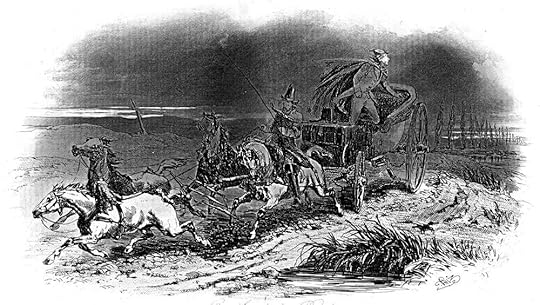
On the dark road
Phiz
Mod

The two brothers were before their Father
Book II Chapter 19
James Mahoney
Text Illustrated:
"It was a moonlight night; but the moon rose late, being long past the full. When it was high in the peaceful firmament, it shone through half-closed lattice blinds into the solemn room where the stumblings and wanderings of a life had so lately ended. Two quiet figures were within the room; two figures, equally still and impassive, equally removed by an untraversable distance from the teeming earth and all that it contains, though soon to lie in it.
One figure reposed upon the bed. The other, kneeling on the floor, drooped over it; the arms easily and peacefully resting on the coverlet; the face bowed down, so that the lips touched the hand over which with its last breath it had bent. The two brothers were before their Father; far beyond the twilight judgment of this world; high above its mists and obscurities."
Commentary:
Visiting Rome on the nineteenth-century, bourgeois equivalent of the eighteenth-century, aristocratic Grand Tour, William Dorrit, Amy's father, is suddenly unwell, ironically just before he is about to commit the great misstep of proposing to his daughters' governess (the naïve family's companion and instructor), the sententious and dictatorial Mrs. General. At Mr. Merdle's farewell reception, Mr. Dorrit becomes confused, and reverts to his former identity as The Father of the Marshalsea when he delivers a farewell address before Rome's English expatriate community. The present scene of his death after a sharp decline is ten days after the reception. He dies in the family's lavishly furnished rooms, attended by his younger brother Frederick, the musician, who then dies himself. Thus, Mahoney has captured the highly sentimental moment when Frederick (depicted) dies, leaving Little Dorrit a complete orphan. The illustration is so highly effective that Harper and Brothers chose it for the frontispiece in the New York volume.
The Mahoney illustration is a re-interpretation of one of the original serial's illustration, namely Phiz's The Night, the second illustration for the sixteenth monthly number, the first being of the dinner at which Mr. Dorrit experiences a mental collapse (also Book Two, Chapter 19, originally March 1856), An Unexpected After-Dinner Speech. However, whereas Phiz has provided plenty of contextual bric-a-brac to establish the affluence of the English travelers (indeed, these material objects almost seem to entomb the prostrate figure), Mahoney focuses on the somberly dressed, aged upper-middle-class English gentleman who has just followed his older brother into death, freeing them both from a tawdry past and a present obsession with decorous behavior and the cultivation of polished, sophisticated surfaces.
Mod

Miss Wade and Tattycorum
Book II Chapter 20
Sol Eytinge Jr.
The Diamond Edition 1871
Commentary:
In the fifteenth character study to complement Dickens's narrative, "Miss Wade and Tattycoram," Eytinge contrasts the stubborn adolescent (her nickname based on Coram's Foundling Hospital) taken up by the Meagles as a servant for their spoiled adolescent daughter and the psychologically disturbed, but "handsome" Miss Wade in the latter's rented rooms in Calais as Clennam prosecutes his search of Blandois. The relevant passage for this dual character study (the perspective presumably being Clennam's) is probably this, as Tattycoram — to Miss Wade, "Harriet" — enters and finds Arthur Clennam conversing with her mistress:
Are they well, sir?"
"Who?"
She stopped herself in saying what would have been "all of them"; glanced at Miss Wade; and said "Mr. and Mrs. Meagles."
"They were, when I last heard of them. They are not at home. By the way, let me ask you. Is it true that you were seen there?"
"Where? Where does any one say I was seen?" returned the girl, sullenly casting down her eyes.
"Looking in at the garden gate of the cottage."
"No," said Miss Wade. "She has never been near it."
"You are wrong, then," said the girl. "I went down there the last time we were in London. I went one afternoon when you left me alone. And I did look in."
"You poor-spirited girl," returned Miss Wade with infinite contempt; "does all our companionship, do all our conversations, do all your old complainings, tell for so little as that?"
"There was no harm in looking in at the gate for an instant," said the girl. "I saw by the windows that the family were not there."
"Why should you go near the place?"
"Because I wanted to see it. Because I felt that I should like to look at it again."
As each of the two handsome faces looked at the other, Clennam felt how each of the two natures must be constantly tearing the other to pieces.
"Oh!" said Miss Wade, coldly subduing and removing her glance; "if you had any desire to see the place where you led the life from which I rescued you because you had found out what it was, that is another thing. But is that your truth to me? Is that your fidelity to me? Is that the common cause I make with you? You are not worth the confidence I have placed in you. You are not worth the favor I have shown you. You are no higher than a spaniel, and had better go back to the people who did worse than whip you."
"If you speak so of them with any one else by to hear, you'll provoke me to take their part," said the girl.
"Go back to them," Miss Wade retorted — "go back to them."
"You know very well," retorted Harriet in her turn, "that I won't go back to them. You know very well that I have thrown them off, and never can, never shall, never will, go back to them. Let them alone, then, Miss Wade."
"You prefer their plenty to your less fat living here," she rejoined. You exalt them, and slight me. What else should I have expected? I ought to have known it."
"It's not so," said the girl, flushing high, "and you don't say what you mean. I know what you mean. You are reproaching me, underhanded, with having nobody but you to look to. And because I have nobody but you to look to, you think you are to make me do, or not do, everything you please, and are to put any affront upon me. You are as bad as they were, every bit. But I will not be quite tamed, and made submissive. I will say again that I went to look at the house, because I had often thought that I should like to see it once more. I will ask again how they are, because I once liked them and at times thought they were kind to me."
Hereupon Clennam said that he was sure they would still receive her kindly, if she should ever desire to return.
"Never!" said the girl passionately. "I shall never do that. Nobody knows that better than Miss Wade, though she taunts me because she has made me her dependent. And I know I am so; and I know she is overjoyed when she can bring it to my mind."
"A good pretence!" said Miss Wade, with no less anger, haughtiness, and bitterness; "but too threadbare to cover what I plainly see in this. My poverty will not bear competition with their money. Better go back at once, better go back at once, and have done with it!"
Arthur Clennam looked at them, standing a little distance asunder in the dull confined room, each proudly cherishing her own anger; each, with a fixed determination, torturing her own breast, and torturing the other's. He said a word or two of leave-taking; but Miss Wade barely inclined her head, and Harriet, with the assumed humiliation of an abject dependent and serf (but not without defiance for all that), made as if she were too low to notice or to be noticed.
Little of Miss Wade's anguish, or her rancorous jealousy of Pet Meagles, or her bitterness at having been thrown over by Gowan are evident in Eytinge's illustration; rather, she sternly and with mild surprise regards the gloomy Harriet as the girl (left, in servant's apron) confesses having taken an interest in the welfare of the Meagles after leaving them. Eytinge's Miss Wade is thoroughly respectable in dress and deportment, severe, and even dignified, but hardly handsome — and hardly the passionate misanthrope of Dickens's text. Likewise, Eytinge's figure of Harriet Beadle ("Tattycoram") suggests the girl's generalized resentment of Miss Wade, but nothing of her fine features, albeit features marred by a sense of being continually put upon.
Mod

Mr. Dorrit Forgets Himself
Book II Chapter 19
Harry Furniss
Household Edition 1910
Text Illustrated:
"Mrs. Merdle had written on it in pencil, "Pray come and speak to Mr. Dorrit, I doubt if he is well."
[Amy] was hurrying to him, unobserved, when he got up out of his chair, and leaning over the table called to her, supposing her to be still in her place:
"Amy, Amy, my child!"
The action was so unusual, to say nothing of his strange eager appearance and strange eager voice, that it instantaneously caused a profound silence.
"Amy, my dear," he repeated. "Will you go and see if Bob is on the lock?"
She was at his side, and touching him, but he still perversely supposed her to be in her seat, and called out, still leaning over the table, "Amy, Amy. I don't feel quite myself. Ha. I don't know what's the matter with me. I particularly wish to see Bob. Ha. Of all the turnkeys, he's as much my friend as yours. See if Bob is in the lodge, and beg him to come to me."
All the guests were now in consternation, and everybody rose.
"Dear father, I am not there; I am here, by you."
"Oh! You are here, Amy! Good. Hum. Good. Ha. Call Bob. If he has been relieved, and is not on the lock, tell Mrs. Bangham to go and fetch him."
She was gently trying to get him away; but he resisted, and would not go.
"I tell you, child," he said petulantly, "I can't be got up the narrow stairs without Bob. Ha. Send for Bob. Hum. Send for Bob — best of all the turnkeys — send for Bob!"
He looked confusedly about him, and, becoming conscious of the number of faces by which he was surrounded, addressed them:
"Ladies and gentlemen, the duty — ha — devolves upon me of — hum — welcoming you to the Marshalsea! Welcome to the Marshalsea! The space is — ha — limited — limited — the parade might be wider; but you will find it apparently grow larger after a time — a time, ladies and gentlemen — and the air is, all things considered, very good. It blows over the — ha — Surrey hills. Blows over the Surrey hills. This is the Snuggery. Hum. Supported by a small subscription of the — ha — Collegiate body. In return for which — hot water — general kitchen — and little domestic advantages. Those who are habituated to the — ha — Marshalsea, are pleased to call me its father. I am accustomed to be complimented by strangers as the — ha — Father of the Marshalsea. Certainly, if years of residence may establish a claim to so — ha — honourable a title, I may accept the hum — conferred distinction. My child, ladies and gentlemen. My daughter. Born here!"
She was not ashamed of it, or ashamed of him. She was pale and frightened; but she had no other care than to soothe him and get him away, for his own dear sake. She was between him and the wondering faces, turned round upon his breast with her own face raised to his. He held her clasped in his left arm, and between whiles her low voice was heard tenderly imploring him to go away with her."
Commentary:
This text accomplishes here what the illustration by itself cannot: the utter dismay of Amy Dorrit as she struggles to apprehend what is happening to her father. The majority of the assembly do not recognise what is happening, for William Dorrit's speech about the Marshalsea is inexplicable to Mr. Merdle's well-wishers. Furniss manages the group scene with aplomb by placing the collapsing figure of Mr. Dorrit well forward and has Amy solicitously touching his back, as if to remind him where (and who) he is.
With an eye for feminine beauty and feminine fashion alike, Furniss depicts several beautiful women in evening gowns. A master touch which is a departure from the Phiz original is Mr. Dorrit's bracing himself with his right hand on the back of his elegant dining-chair. Moreover, Furniss emphasizes both William Dorrit's baldness (he has a full head of black hair in the Phiz plate) and his formal evening dress. The elegantly dressed older woman to the right is undoubtedly Mrs. General, to whom he had intended to propose that very evening. Fanny Dorrit, a commanding figure in a splendid dinner-dress, and her husband, Edmund Sparkler (with monocle), are upper right in the opulent dining room. In Furniss's interpretation, the banquet has suddenly broken up, and most of the diners are hurriedly leaving, their backs to William Dorrit as, looking upward (as if into the past), he calls for the assistance of a Marshalsea turnkey to get him to his cell. Daringly, Furniss minimizes the importance of the long table, and re-orients the entire scene around the pathetic figure of William Dorrit, but again emphasizes Amy's role as his care-giver while Mrs. General does nothing to assist him.
Mod

As each of the two handsome faces looked at each other, Clennam felt how each of the two natures must be contantly tearing the other to pieces.
Book II Chapter 20
James Mahoney
Household Edition 1873
Text Illustrated:
"As each of the two handsome faces looked at the other, Clennam felt how each of the two natures must be constantly tearing the other to pieces.
"Oh!" said Miss Wade, coldly subduing and removing her glance; "if you had any desire to see the place where you led the life from which I rescued you because you had found out what it was, that is another thing. But is that your truth to me? Is that your fidelity to me? Is that the common cause I make with you? You are not worth the confidence I have placed in you. You are not worth the favour I have shown you. You are no higher than a spaniel, and had better go back to the people who did worse than whip you."
"If you speak so of them with any one else by to hear, you'll provoke me to take their part," said the girl.
"Go back to them," Miss Wade retorted. "Go back to them."
Commentary:
Although there is no comparable illustration in the original serial, the present woodcut continues the thread of Arthur Clennam's observing Miss Wade and Tattycoram's meeting Blandois in the Adelphi Terrace. Now, he has ascertained that the women are living in rented rooms across the Channel in Calais. In her possession are the papers pertaining to Little Dorrit's legacy. The three figures are Arthur Clennam (left), Tattycoram (center) (seemingly trapped between the table and the overstuffed chair), and Miss Wade (right). His quest, however, does not involving Tattycoram to return to the Meagles, but to acquire information about Blandois. We have reached the point in the conversation when the girl admits to having gone down to Twickenham when Miss Wade left her alone in London. Miss Wade, ever jealous and insecure, interprets the girl's visit to the Meagles' cottage as a betrayal:
"Oh!" said Miss Wade, coldly subduing and removing her glance; "if you had any desire to see the place where you led the life from which I rescued you because you had found out what it was, that is another thing. But is that your truth to me? Is that your fidelity to me? Is that the common cause I make with you?"
These remarks are delivered with passionate conviction and rhetorical flourish, neither of which does one detect in Mahoney's placid image of Miss Wade, who has just denounced the man who jilted her, Clennam's acquaintance, Henry Gowan. Tattycoram, too, seems quite calm, although her dialogue suggests her chafing at Miss Wade's attempts to control her. The papers that Miss Wade has given Clennam to read are apparently on the table beside Tattycoram. However, the overall effect of the picture is to suggest a staging of Arthur Clennam's visit to Miss Wade's rooms at Calais, and nothing more.
Mod

Chapter 21, Book 2
James Mahoney
Text Illustrated:
"After one of the nights that I have spoken of, I came down into a greenhouse before breakfast. Charlotte (the name of my false young friend) had gone down before me, and I heard her aunt speaking to her about me, as I entered. I stopped where I was, among the leaves and listened."
Book II Chapter 21
James Mahoney
Text Illustrated:
"In the family there was an aunt who was not fond of me. I doubt if any of the family liked me much; but I never wanted them to like me, being altogether bound up in the one girl. The aunt was a young woman, and she had a serious way with her eyes of watching me. She was an audacious woman, and openly looked compassionately at me. After one of the nights that I have spoken of, I came down into a greenhouse before breakfast. Charlotte (the name of my false young friend) had gone down before me, and I heard this aunt speaking to her about me as I entered. I stopped where I was, among the leaves, and listened. The aunt said, "Charlotte, Miss Wade is wearing you to death, and this must not continue." I repeat the very words I heard. Now, what did she answer? Did she say, "It is I who am wearing her to death, I who am keeping her on a rack and am the executioner, yet she tells me every night that she loves me devotedly, though she knows what I make her undergo?" No; my first memorable experience was true to what I knew her to be, and to all my experience."
Commentary:
The first-person narrative which Miss Wade gives Arthur Clennam is a "framed tale" that can be treated as an independent short story, although it is informed by the reader's prior knowledge of Miss Wade and her treatment of Harriet Meagles ("Tattycoram"), and her utter disdain for the male sex. Moreover, in the original serial and volume editions other than the Household, Miss Wade's account of herself, given to Clennam to read on the packet-boat back to England, is not usually illustrated, perhaps because of the shift in the narrative perspective from omniscient in the novel as a whole to first-person here. In Dickens and the Short Story, Deborah A. Thomas notes the importance of the interpolated psychological study in the midst of a large-scale narrative that places the reader in this secondary character's shoes, so to speak, but with this difference: instead of accepting the judgments of the first-person narrator, the reader will consistently find Miss Wade's judgments faulty and her assessments tinged with prejudice. Again and again, beginning with the childhood incident depicted in the illustration, Miss Wade justifies herself in such a way that the astute reader is likely to see her self-centered response as warped and her judgments of others as wrong-headed as she pleads that she is imposed upon and treated with contempt resulting initially from her status as an orphan and later from her inferior status as a governess:
This impression is like a colored glass through which she persistently looks at life. As a child, she misinterprets the kindness of the girls with whom she is raised, and, like Browning's Duke who executes his Duchess for smiling indiscriminately, Miss Wade interprets any kindness shown to others by her "chosen friend" as an act of disloyalty to herself . . . .
In the illustration, a twelve-year-old Miss Wade (who looks much older) overhears a conversation between her best friend and the friend's aunt from the corner of a greenhouse. Mahoney describes the friend as slight, small for her age, and blonde, but dark-haired, sharp-featured Miss Wade as mature for her age, and apparently an astute observer of others — and yet she is wholly mistaken in her judgments of others, taking umbrage at kindness which she receives as a reminder of her class inferiority. Her psychopathology is so developed as a young adult that she consistently sees her employers as proud, spiteful, and condescending. In Mahoney's illustration of this pivotal childhood event several decades previous, Miss Wade recalls the circumstances of the overheard conversation in vivid detail, although Mahoney has had to supply the manner of dress of the three females, contrasting the light-colored dresses of her friend and friend's aunt with the black dress and dark hair of the eavesdropper, who only vaguely resembles the Miss Wade at the beginning of Mahoney's narrative-pictorial sequence, The observer stood with her hand upon her own bosom, looking at the girl (Book 1, Chapter 2).
The events which she describes [except perhaps her perceptions of Henry Gowan] are clearly open to more interpretations than the ones she puts upon them. Her fierce attachment to her childhood friend and her identification with the girl whom she later takes to live with her [Tattycoram] seem at least implicitly lesbian, and such details combine to suggest that her particular "truth" is a delusion.
 Mod
Mod
Xan,
David Copperfield has a loving mother but - alas! she is also very easy to influence and to subdue, and that is where Mr Murdstone and his infamous sister come into play and rob the boy of his childhood haven. Still, Davy has a caring substitute mother in his nurse Peggotty - even after his mother's death. I also remember the Omers as a happy family and the people in the boat in Yarmouth.
In Barnaby Rudge, we have Gabriel Varden as a doting and warm-hearted father although his wife is a termagant but then there are three father-son conflicts in this book.
Why all those family conflicts? Probably for two reasons: One, it is surely more interesting to read and write about dysfunctional families rather than of perfect ones. I remember the famous introductory sentence to Anna Karenina where it says that all happy families are similar but that every unhappy family is unhappy in its own particular way. - Second, in a family people usually live together very closely, and there is hardly any chance to hide your true wishes, peeves and grievances, and sooner or later there will be conflicts. I can easily imagine Mrs Cratchit nagging her husband about their poverty and their troubled future and asking him again and again to find a better employer but Scrooge - but probably not during the Christmas season.
Mod
Unlike you, Peter, I really enjoyed the first chapter of this week: Mr. Dorrit's solitary trip through the dark night (of the soul) because it shows the vanity of Mr Dorrit's life: He is still building castles in the air, i.e. making pipe dreams about his future with Mrs General as his wife, although his days are numbered, and it's a one digit figure. That castle-building shows the same disregard for reality that was typical of Dorrit in his prison days where he pretended not to know about his daughter's slaving herself to death in order to provide the means for his shabby-genteel existence and where he termed the alms he got "testimonials" to his special position in the Marshalsea. Special position? What merit is there in being a long-time prisoner? In a debtor's prison, anyone who is lazy, idle and callous enough can rise to that title - and Dorrit makes something of a merit out of it.
He is definitely a dreamer of grandeur, but one who lives on other people's money while dreaming. The funeral procession crossing Dorrit's path I considered creepy and brilliant foreboding.
Mod
I agree: Miss Wade would hardly ever deign to write the story of her life for Arthur and then hand it to him. This seems completely out of character, as is also shown by the threadbare excuse Dickens has Miss Wade accompany the gesture with. She would simply not care what other people think about her and that is why she wouldn't let them know. And yet, I think that she actually writes is a testimony to Dickens's maturity as a psychological writer in his later novels because it all makes sense. Miss Wade's overbearing and tormenting pride - tormenting in that she always scents ulterior motives in any act of sympathy - is something that exists in real life. I must say that in a way I can even sympathize with her because if there is one of the seven deadly sins that I have a soft spot for, it is definitely Pride, and I know how it can feel. Miss Wade, however, also reminds me of Edith Dombey: Both were born in rather unstable circumstances and have tasted the keen edge of poverty and neglect, and instead of being open to compassion and human interest, they resent it, which is a pity but which can be psychologically explained, I think.
I found it very telling, though, that now Harriet, having taken lots of lessons from Miss Wade, is beginning to turn against her and that Miss Wade uses the same kinds of psychological games that she accuses the Meagles of using. I don't believe the Meagles actually used them because they are simply too bland and thoughtless to be so manipulative.
 Well, I am finally convinced that Miss Wade is mean. Why is she in this novel? We have many other mean examples here. And her reasoning to hate Pet does not hold water with me. People break off relationships all the time. This is a part of life, growing up. But I have been waiting for something connecting her to Arthur's father - was he her father? I just can not make sense of where she is in this puzzle. Rescuing Tattycorum is not enough for me. And we are running out of pages. peace, janz
Mod
Well, I am finally convinced that Miss Wade is mean. Why is she in this novel? We have many other mean examples here. And her reasoning to hate Pet does not hold water with me. People break off relationships all the time. This is a part of life, growing up. But I have been waiting for something connecting her to Arthur's father - was he her father? I just can not make sense of where she is in this puzzle. Rescuing Tattycorum is not enough for me. And we are running out of pages. peace, janz
Mod
I agree: Miss Wade would hardly ever deign to write the story of her life for Arthur and then hand it to him. This seems completely out of character, as is also shown by the threadbare excu..."
Letters. Is it me or does this novel seem to have a preponderance of letters. We have Miss Wade’s letter, entire chapters that are devoted to Amy’s letters to Arthur, those strange lost-love meanderings of Young John Chivery, and other bits and bobs that we have come across throughout the novel.
I’m not at all sure what it all means (if anything) but I cannot recall another Dickens novel that has so many epistolary touches.
Can anyone help me?
 Kim wrote: Mrs. General is no one to him now -good.
Mary Lou wrote: "I thank God that William never married Mrs. General. It would be a much different book had that taken place. "
Me three. It's a measure of Mrs. G's hatefulness (and also of the soft spot I continue to have for Fanny who is nobody's fool), that in the face of everything else that is and has been going on with this family, I am also greatly relieved by this near miss.
Tristram wrote: Unlike you, Peter, I really enjoyed the first chapter of this week: Mr. Dorrit's solitary trip through the dark night (of the soul) because it shows the vanity of Mr Dorrit's life
I really enjoyed this, too. I liked the way all the puffery Mr. D had surrounded himself with fell away at the end.
But I was sorry to see Frederick go.
Oh, I think Dickens is just tired, maybe too much roaming around. Letters or diaries are always ways to get info to the reader and not have to bother about who, where, what - just the plain old letter and now the reader gets more info. Dickens does this in all his books but he may be excessive in this book. I haven't taken it up as a bother YET. And I agree, sad that Frederick could not hang on longer and enjoy some of the wealth.
peace, janz
 I guess I was still not impressed with Miss Wade's story, it left me rather cold. Even if she had hard times it doesn't justify her bitterness and anger in my mind but that's just my opinion. I still could not warm up to her at all.
 As for the deaths, I guess it is logical for the brothers to go at the same time although it seemed surprising to me but what would Frederick do without William? I think this certainly leaves the door open for Little Dorrit to go on with her life without the care of her father. I did see Mr. Dorrit's mental state at the end very telling.
I was glad to see all the connections and clues coming together regarding Blandois and am anxious to see him found and that story line wrapped up.
Mod
While I found Miss Wade's paper written expressly for the perusal by Clennam quite unbelievable as a plot device - although brilliant as a piece of writing in itself -, because why should Miss Wade in her self-centred arrogance care to make Clennam, whom she despises, privy to her soul-life?, I thought that Amy's letters to Clennam are not only entirely believable but a very clever decision of Dickens as a craftsman. Not only do those two letters allow us to witness what is going on in Amy's mind and heart, but they also allow Dickens to keep the reader up-to-date on what is happening in the Gowan family and among the Dorrits without having to write a long chapter. We all agree, don't we, that some of the chapters are too long already - namely the Circumlocution ones and the ones in which we are told about Society in the Merdle household.
On a general note, letters and papers play an important role in Dickens's novels: The best example is Bleak House where the lawyers' assistants literally carry bags and bags of letters around with them and where Krook hoards staples of the same commodity in his den.
Mod
Could we call Little Dorrit Dickens’s most epistolary novel? Certainly Bleak House overwhelms us with paper, but I find LD makes more use of specific letters to deliver more focussed information to the reader.
The epistolary novel seems to be fading as we move into the mid 19C. That leads me to another question. Can you recall any late 19C novels, or 20/21 C novels that are epistolary in nature?
I've read a few, and enjoy them. The most well known is probably The Guernsey Literary and Potato Peel Pie Society.I read one several years back that followed a woman and her family through the years via a her annual Christmas letters. Can't remember the name of the book, but my recollection is that it was well done. Lots of reading between the lines to ferret out their personalities, relationships, etc.
Mod
I read one several years back that followed a woman and her family through the y..."
Thanks Mary Lou. I completely forgot about “The Guernsey …”
Mod
The Color Purple
Meet Me at the Museum
84, Charing Cross Road
Dear Thief"
Xan
Thank you for these titles. You and Mary Lou have given me focus on the genre.
I am glad that the form is still in use. I also now have a few more books to read. ;-)
The format can be very evocative -- heartache, happiness, melancholy. Meet me at the museum is about two lonely people getting on in age. One, a farmer's wife, the other, a curator of a museum. There is distance between them, so they communicate by letter. They look back at their lives and in so doing grow closer.
Dear Thief is about a woman writing many letters to a long, lost friend. She misses her, may love her, but she can't mail the letters because she doesn't know where she is. There is pain and longing in the letters.
The Color Purple is a tour de force -- sad, yet life affirming.
84 Charing Cross Road is about an American woman who writes to a bookstore in England looking for a book. The correspondence continues for most of the rest of their lives. This is nonfiction, humorous, and wonderful.
Mod
Could we call Little Dorrit Dickens’s most epistolary novel? Certainly Bleak House overwhelms us with paper, but I f..."
Can we not count the famous Dracula among epistolary novels? There are also lots of diary entries but also letters if I remember correctly.

The Old Curiosity Club
Books mentioned in this topic
The Color Purple (other topics)Meet Me at the Museum (other topics)
84, Charing Cross Road (other topics)
Dear Thief (other topics)
The Color Purple (other topics)
More...

"The sun had gone down full four hours, and it was later than most travellers would like it to be for finding themselves outside the walls of Rome, when Mr Dorrit's carriage, still on its last wearisome stage, rattled over the solitary Campagna. The savage herdsmen and the fierce-looking peasants who had chequered the way while the light lasted, had all gone down with the sun, and left the wilderness blank. At some turns of the road, a pale flare on the horizon, like an exhalation from the ruin-sown land, showed that the city was yet far off; but this poor relief was rare and short-lived. The carriage dipped down again into a hollow of the black dry sea, and for a long time there was nothing visible save its petrified swell and the gloomy sky."
Mr. Dorrit is busy working on his castle, but is still very uncomfortable with the desolate surroundings, and while I am seeing bad omens in so many things, this has to be on my list:
And now, a sudden twist and stoppage of the carriage inspired Mr Dorrit with the mistrust that the brigand moment was come for twisting him into a ditch and robbing him; until, letting down the glass again and looking out, he perceived himself assailed by nothing worse than a funeral procession, which came mechanically chaunting by, with an indistinct show of dirty vestments, lurid torches, swinging censers, and a great cross borne before a priest. He was an ugly priest by torchlight; of a lowering aspect, with an overhanging brow; and as his eyes met those of Mr Dorrit, looking bareheaded out of the carriage, his lips, moving as they chaunted, seemed to threaten that important traveller; likewise the action of his hand, which was in fact his manner of returning the traveller's salutation, seemed to come in aid of that menace. So thought Mr Dorrit, made fanciful by the weariness of building and travelling, as the priest drifted past him, and the procession straggled away, taking its dead along with it.
Finally Mr. Dorrit and his castle arrive but is very upset to find that Amy isn't at the door waiting for him, I suppose she should have waited there all night. In fact, she probably shouldn't had a minute of sleep or a bite to eat since he left. All the sun, moon, and light went when he did, all is dark. In case you didn't know by now I can't stand the guy. He goes in search of her and finds her with Frederick sitting by the fire and is jealous because for once in her life she thought of someone other than him. He is probably shocked her thoughts could ever be on anyone or anything but him. When Amy mentions that he looks a little tired he tells her she is mistaken that he is much fresher than when he went away. Mr. Dorrit tells them he is stronger than his brother and the late arrival was nothing to him. He insists that his brother go to bed because he is feeble.
'Dear Frederick,' said Mr Dorrit, 'do, I adjure you! Good night, brother. I hope you will be stronger to-morrow. I am not at all pleased with your looks. Good night, dear fellow.' After dismissing his brother in this gracious way, he fell into a doze again before the old man was well out of the room: and he would have stumbled forward upon the logs, but for his daughter's restraining hold."
He's the first person I ever knew who could fall asleep standing up. Amy tells him Mrs. Merdle is planning on having a farewell assembly now that she is planning on returning to England, Mr. Dorrit tells her to accept the invitation. The day of the dinner arrives and on that day Mr. Dorrit doesn't leave his room until it is time to leave at which time he comes downstairs looking "shrunken and old". Amy doesn't comment on it knowing he would become angry and they leave for Mrs. Merdle's home. Once they are there Amy loses sight of her father who is seated at the table far from her. She receives a note shortly after the dinner starts, the note is from Mrs. Merdle and asks her to come to her father that he isn't well. He never was. Once she gets to his side he tells her she must get Bob - his favorite turnkey - to help him up the stairs. He is now back in the Marshalsea and even gives one of his speeches to the guests of Mrs. Merdle:
'Ladies and gentlemen, the duty—ha—devolves upon me of—hum—welcoming you to the Marshalsea! Welcome to the Marshalsea! The space is—ha—limited—limited—the parade might be wider; but you will find it apparently grow larger after a time—a time, ladies and gentlemen—and the air is, all things considered, very good.... Those who are habituated to the—ha—Marshalsea, are pleased to call me its father. I am accustomed to be complimented by strangers as the—ha—Father of the Marshalsea."
I wonder what Fanny or Tip would have done if they were there. Frederick would probably started clapping. I wonder where Tip is, I haven't seen him in a long time, not that I remember anyway. She finally gets him home and gets him to bed, but for the rest of his life - which will be about ten days - he is always in the Marshalea. Mrs. General is no one to him now -good. Frederick is devastated with the death of his brother who was so far distinguished, noble and superior to him. How he got that way I've never known. The chapter ends with this:
"One figure reposed upon the bed. The other, kneeling on the floor, drooped over it; the arms easily and peacefully resting on the coverlet; the face bowed down, so that the lips touched the hand over which with its last breath it had bent. The two brothers were before their Father; far beyond the twilight judgment of this world; high above its mists and obscurities."
l
That's two Dorrits down, three to go, unless you count Fanny married already gone, and wherever Tip is he can stay there. As you can tell if your name is Dorrit, I don't like you.