
Victorians! discussion

This topic is about
Villette
Archived Group Reads 2022
>
Villette: Week 5; Chapters XXI-XXV
date newest »
newest »
 Mod
Mod
Lucy certainly seems to indulge Ginevra more than one thinks she deserves, even though she tells her off as well. This time we see that Lucy chooses not to disillusion Ginevra about Graham’s true feelings. She knows well (even though she wonders if this mightn’t be the case) that Graham now knows Ginevra for what she is and has pretty much given her up. Why do we think she did this?
Mod
The Brettons’ attitude was also an interesting to ponder in this instalment. We see them going out of their way to ensure that Lucy feels she has friends—Grahams regular letters, and then also some visits off and on to their home. But then when work comes in the way, they simply stop. Now of course, one understands that they can’t always be there in the same way for Lucy, but one does wonder why neither even wrote a line to Lucy, and weren’t particularly apologetic about it either. For Lucy the letters and visits seem the thread by which she is living, and one can only imagine what it is like for it to be withdrawn in that way. Yet, they seem not to have thought of it.
Mod
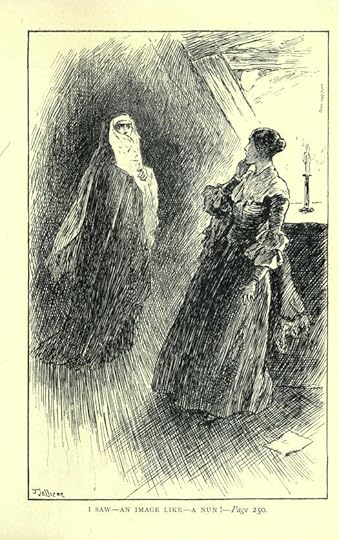
The ‘ghost’ or not ghost nun appears to be back in this segment, and in a more unsettling form. Lucy sees it first when she finds a quiet space to read her letter, and then again, when she goes t retrieve a dress to attend Vashti’s performance. But is it really as Graham thinks, merely a hallucination—something her mind is throwing up since she is so stressed and unhappy, or is there something more to it?
Mod
Lucy’s reduced circumstances seem to assume relevance in this segment once again; not only does this mean her having to return to Madame Beck’s pensionnat which is almost prison for her, however stoically she may bear it, but Paulina’s attitude also seems to reinforce her position—as though she’d never be Polly’s ‘equal’.
Mod
This week we also see how Lucy’s feeling self is at constant battle with her reason, and she always gives in to the latter, perhaps a way to ensure that she doesn’t get carried away by hopes or dreams, and is consequently not hurt. Yet, this also shows a lack of confidence in herself, a belittling of the self as though she somehow doesn’t deserve happiness, isn’t good enough or pretty enough or worthy of it.
So, what did you make of this week’s developments?
 I’m continuing to enjoy reading Villette and trying to puzzle out Lucy’s character. She is certainly the most complicated heroine I’ve met in fiction. I was ridiculously pleased with myself to recognize Paulina on the night of the fire, long before Lucy did. (Of course, Bronte provided ample clues.) I am speculating about what more will be revealed about Lucy’s past, perhaps some explanation of why she is so stern with herself, allowing herself no pleasure, no positive emotion. I am struck with Pere Felix’s response to her confession earlier, when he tells her that she would be better off as a Catholic in the situation she has described. And her goal in life seems to be one of maintaining a strict life of penance. Will we find out for what? I’ve also enjoyed the apparition of the nun who appears in order to terrify Lucy when she is having her happiest feelings and is arguing with the demands of “Reason. The nun finds a self-proclaimed foe in Graham. There is so much in this novel to appreciate! I look forward to completing it, and then to a reread.
Mod
I’m continuing to enjoy reading Villette and trying to puzzle out Lucy’s character. She is certainly the most complicated heroine I’ve met in fiction. I was ridiculously pleased with myself to recognize Paulina on the night of the fire, long before Lucy did. (Of course, Bronte provided ample clues.) I am speculating about what more will be revealed about Lucy’s past, perhaps some explanation of why she is so stern with herself, allowing herself no pleasure, no positive emotion. I am struck with Pere Felix’s response to her confession earlier, when he tells her that she would be better off as a Catholic in the situation she has described. And her goal in life seems to be one of maintaining a strict life of penance. Will we find out for what? I’ve also enjoyed the apparition of the nun who appears in order to terrify Lucy when she is having her happiest feelings and is arguing with the demands of “Reason. The nun finds a self-proclaimed foe in Graham. There is so much in this novel to appreciate! I look forward to completing it, and then to a reread.
Mod
 Poor Lucy! Just when she sees off one rival for Dr. John’s affection, along comes another.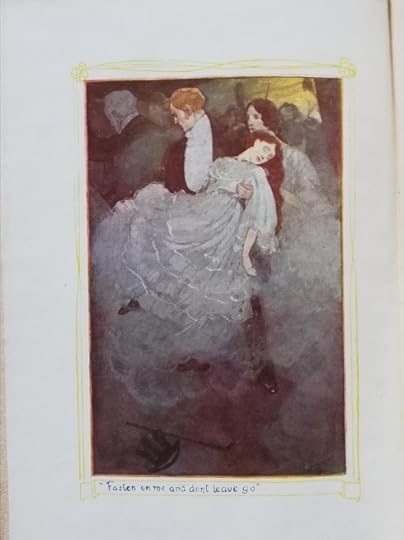
Those who predicted the return of Polly were right, and what a dramatic reentrance to the story even if we didn’t know it was her at that time. It seems obvious to me that the reason for Lucy’s seven weeks of letterless torture was because Dr. John was too focused on looking after Polly after her collapse in the crush at the theatre. It even took his mum to break the icy silence and write to Lucy, realising that her son was neglecting Lucy.
Ginevra is not so happy now that her ‘Isadore’ has well and truly dumped her. Her peevish, selfish nature begins to show through, even with Lucy who doesn’t deserve this sort of taunting about Dr. John.
’ “Passionate thing! Your face is the colour of a coquelicot. I wonder what always makes you so mighty testy à l’endroit du gros Jean? ‘John Anderson, my Joe, John!’ Oh, the distinguished name!”
Maybe it’s because Ginevra suspects that Lucy is in love with him that these taunts are becoming more hurtful. Polly’s imminent arrival at the school could create a difficult situation for all three of them.
 I, like Diane, felt like C.B. gave us plenty of clues to Polly's identity. I found myself standing around waiting for her to figure it out.
Lady Clementina, I absolutely put Lucy's perspective regarding herself down to experience. Could be what we today would call a trauma response. C.B.'s insight here is truly genius.
I agree with Trev that Dr John got wrapped up in attending to Paulina and forgot all about Lucy. Thank goodness for his mom!
Would y'all consider Ginevra Lucy's frenemy? She really seems to love having Lucy around to put down.
 I am rarely the kind of astute reader (like my wife, who reads much less than me), to sniff out hidden identities. But for some reason within a few sentences I was all over the return of Paulina in the scene where the "new" young woman had injured a shoulder.
 I enjoyed the reunion scene in which the Count and Graham return from a night out in blizzard conditions. Graham's interaction with Paulina was fascinating. While she playfully begs for a drink of the forbidden nectar, his actual thoughts are hidden, but we can see that he is balancing his old relationship with her as a favored girl-child-sister with how he might be expected to behave with a girl on the cusp of womanhood.
I continue to think about the appearances of the Nun and her possible meaning for the novel. She was introduced in the chapter called “The Casket,” where we learn of the legend of a medieval nun who had been buried alive in a vault beneath the old pear tree Methusaleh, for “some sin against her vow.” This nun is said to appear occasionally “at unspecified times.” I think of Lucy as having imprisoned herself in the convent-like atmosphere of the pensionnere. I wonder if we could see the ghost’s appearances as warnings to Lucy when she is in danger of breaking her “vows.” I’m guessing we haven’t seen the last of the ghost, and I don’t think that Bronte will wind up “explaining” her as an hallucination.
Victorian writers win me with eloquence and subtlety. When Lucy realizes that Graham's attention has turned elsewhere, Bronte doesn't put it quite that way:"... never more would letters ... come ... That goodly river on whose banks I had sojourned, of whose waves a few reviving drops had trickled to my lips, was bending to another course: it was leaving my little hut and field forlorn and sand-dry, pouring its wealth of waters far away. ... I grieved that the grand tide should roll estranged, should vanish like a ... mirage."
Here is an account from the Anne Brontë blog of how the great Vashti is based on Elisa Felix, known by her stage name of Rachel. Charlotte Brontë went to see her several times and was thrilled by her performances.http://www.annebronte.org/2021/03/28/...
@Trev, thanks! I tried to look up who she might be and couldn't find anything.
@Diane, I agree, I think someone is playing a trick on her.
Mod
Mod
At this point, one still wonders whether it is hallucination (her reason acting up, perhaps), or a human agency. But we shall see by and by, of course.
A couple of ideas occurred to me about who the nun could be. Ginevra having a laugh at Lucy's expense again? Mme. Beck using a disguise to frighten her into correct behavior or to spy on her? Probably not Dr John, as I don't think it would be worth his time...
Mod
Thoughts in this book are rarely straightforward told to us are they? We see, and we read between what is said, and expressions we are shown. And all of it is as Lucy choses to show us.
Mod
Ginevra does seem the most likely candidate. Dr John is unlikely, both as you said since, it wouldn't be worth his time, and he is present at another location when the nun appears. Mme Beck is also not so likely since her tactics are of a different nature
Lady Clementina wrote: "LiLi wrote: "A couple of ideas occurred to me about who the nun could be. Ginevra having a laugh at Lucy's expense again? Mme. Beck using a disguise to frighten her into correct behavior or to spy ..."At first I thought it could be M. Paul because he has easy access to all areas, seems to want to know and get involved in all Lucy’s business and keeps popping up where she is. But then I thought that haughty M. Paul wouldn’t demean himself by getting into a nun’s habit.
Could Ginevra stop herself from giggling for enough time not to give herself away?
 Lady Clementina wrote: " Lucy’s emotions vs her reason
This week we also see how Lucy’s feeling self is at constant battle with her reason, and she always gives in to the latter, perhaps a way to ensure that she doesn’t g..."
She personifies the qualities of this battle very effectively.
This hag, this Reason, would not let me look up, or smile, or hope: she could not rest unless I were altogether crushed, cowed, broken-in, and broken-down.
.....Imagination—her soft, bright foe, our sweet Help, our divine Hope.
Trev wrote: "Poor Lucy! Just when she sees off one rival for Dr. John’s affection, along comes another...."I suppose Dr. John is still under 30, but his attraction to these childish pretty girls is definitely off-putting. While Lucy, still significantly younger, is much too mature to interest him sexually.
Lady Clementina wrote: "The NunThe ‘ghost’ or not ghost nun appears to be back in this segment, and in a more unsettling form. Lucy sees it first when she finds a quiet space to read her letter, and then again, when she ..."
I think Diane is onto something comparing the nun who was buried alive for “some sin against her vow" with Lucy who has some past "sin" that we do not know about. As soon as Lucy finds a moment of joy, the ghost (her conscience?) intervenes to terrify her.
 Why Vashti? I had never heard of her before, but whichever version you pick (villain or heroine), she is notable for refusing to obey her husband.
Ginny wrote: "Lady Clementina wrote: "The Nun
Why Vashti? I had never heard of her before, but whichever version you pick (villain or heroine), she is notable for refusing to obey her husband.
Ginny wrote: "Lady Clementina wrote: "The NunThe ‘ghost’ or not ghost nun appears to be back in this segment, and in a more unsettling form. Lucy sees it first when she finds a quiet space to read her letter, a..."
So there are now at least three possibilities to explain the appearance of the nun.
1. It is really the ghost of the incarcerated nun according to the legend, restlessly roaming the pensionnat and creating an eerie gothic backdrop to the story.
2. It is an hallucination conjured up by Lucy’s imagination due to her guilty conscience, in some way linked to Lucy’s confession to the astounded priest.
3. It is a prank, organised by a person or persons unknown, to frighten Lucy, again for reasons as yet unknown.
I am still not sure which is most likely.
 I thought it was a hallucination of Lucy´s, and didn´t have any idea it could be something/one else.
Agree she´s quite complex, but then it´s an memoir of someone who can have a difficult life like many of us.
Poor Lucy not getting the contact with Dr. John she wants! Obviously he´s more interested in nymphets.
 I found the contrast between Ginevra and Polly (now Paulina) interesting and it illuminated the Victorian view of women’s conduct and attitudes. Ginevra is now annoyed at having lost Dr John’s attention to Paulina, and as she was quite selfish and mercenary towards him, it probably serves her right. She’s certainly portrayed as the less virtuous one. Yet I for one can have some sympathy with her view of Paulina, who is quite manipulative in her own way and changes her manner from playful to serious to keep her admirers onside. Paulina is more the traditional Victorian good girl, yet I feel Charlotte is slightly undermining this through the figure of Lucy, who is more honest and genuine, yet finds herself overlooked yet again by Dr John.
Mod
I found the contrast between Ginevra and Polly (now Paulina) interesting and it illuminated the Victorian view of women’s conduct and attitudes. Ginevra is now annoyed at having lost Dr John’s attention to Paulina, and as she was quite selfish and mercenary towards him, it probably serves her right. She’s certainly portrayed as the less virtuous one. Yet I for one can have some sympathy with her view of Paulina, who is quite manipulative in her own way and changes her manner from playful to serious to keep her admirers onside. Paulina is more the traditional Victorian good girl, yet I feel Charlotte is slightly undermining this through the figure of Lucy, who is more honest and genuine, yet finds herself overlooked yet again by Dr John.
Mod
Agree she´s quite complex, but then it´s an memoir of someone who can have a difficult life like..."
That gave me a laugh--there's more of that point (Graham's interest) to discuss in the next segment; but one can't deny his interest lies in that direction!
Mod
True--Ginevra manipulates, flirts, and acts in ways unbecoming of the ideal woman of the day, but then she is honest with her opinions and feelings as Lucy acknowledges. Paulina acts within the confines of what is expected, but you're right, she too manipulates


summary
Lucy has spent time convalescing and really living the rare happy moments she has had in her present life with the Brettons, and now it is almost time to return to Madam Beck’s. This is akin to going to prison for her but rather than accept the Brettons’ offer to extend her stay once again, she prefers to get the inevitable over with and insists in going back.
Graham promises to write to Lucy and not uncharacteristically, she believes that he is only saying this out of kindness and one letter perhaps is all she can expect. She waits, but not too hopefully. Yet that treasure does arrive and one sees how much she prizes it; not devouring it immediately but keeping it safe, waiting for a time that she can read it with all the care and attention it deserves. But neither can she read it in her room, nor in the classroom, and when she finally does find a quiet corner, and begins to read it, the ghost nun seems to manifest. The letter is lost, but then thanks to Graham, recovered again. She soon gets 4 others to add to those treasures, and the Brettons take her out from time to time, ensuring that she isn’t entirely alone any more.
One such outing is an unexpected one, for Mrs Bretton asks Graham to take Lucy to see Vashti, when she herself is unable to go. Lucy finds herself completely absorbed in the performance, feeling every emotion, admiring everything that goes into the performance. But even amidst this, Lucy is interested to know Graham’s reaction to it all. Towards the end of the performance though, there is a fire and they end up helping a young lady and her father. The girl is in need of some medical attention and Graham and Lucy look after her back at their hotel.
This is followed by a sort of absence from the Brettons, and for no short while, but nearly two months. For Lucy who had been surviving on those letters that Graham sent and those few precious moments spent with the Brettons, it is almost as though a lifeline has been withdrawn. But suddenly a letter arrives, this time from Mrs Bretton, explaining that work has been keeping Graham occupied while she herself has been trying to recover some of the fortune that Graham’s father left him. She invites her to their home that evening.
Meanwhile we have also seen that Ginevra’s uncle who has been sponsoring her education, M de Bassompierre is in town and it turns out that he and his daughter are the very same whom She and Graham had helped at the theatre. Ginevra seems to dislike her cousin and uncle but is likely only put out by the fact that she isn’t the centre of attention or that Graham and Mrs Bretton have been entertained at the Bassompierres’ hotel as well. Previously, Lucy has chosen not to disillusion Ginevra as to Graham’s true feelings towards her encouraging her to continue to believe that he is pining after her.
The mystery is soon solved when Lucy arrives at the Bretton home to find that M de Bassompierre and his daughter are none other than little Polly Home and her father who have taken their French relations’ name and inherited their property. Paulina has grown to be very beautiful but in a very different way to the ostentatious and flirtatious Ginevra, and she hasn’t forgotten any of her feelings towards Graham. He too, seems to be taking notice again. Paulina is also quite taken aback (and doesn’t hide her feelings) when she finds Lucy is a teacher and works for her living (despite her father trying to salvage the situation). But interestingly, they seem to believe that this was always Lucy’s situation, since they never really knew much about her.
Meanwhile M Paul has also been around—with his fiery temper, yet seeming to show some sensitivity and perception as well, seeing into Lucy’s character better than any others seem to do.
So where does all of this leave Lucy?