
Science and Inquiry discussion
General
>
Arts and Humanities
date newest »
newest »
message 1:
by
Lucy
(last edited Feb 06, 2023 04:54PM)
(new)
Feb 06, 2023 03:41PM
 I know that a lot of people in this group have backgrounds or interests in science, but I was wondering what everyone thinks of arts and humanities. Some people who specialize or are interested in STEM might avoid arts and humanities, while others might embrace them. What do you think of arts and humanities? How do you think your interest in STEM influences your perception of arts and humanities?
reply
|
flag
 Mod
Mod
 I have an eclectic background, science is an interest for me rather than my career. also love art and later in life found out that history is interesting AND relevant and regret that I slept through all those boring social studies classes in college. I would like to hear how arts and humanities do relate to science. there is probably common ground somewhere around sociology, psychology and economics and certainly some mathematics (fractals are art!)
 Mod
Mod
There are tons of books about the connections between science and arts. I especially enjoyed Art and Physics: Parallel Visions in Space, Time, and Light, Proust Was a Neuroscientist, The Power of Music, Why You Love Music: From Mozart to Metallica--The Emotional Power of Beautiful Sounds, and Music, the Brain, and Ecstasy: How Music Captures Our Imagination.
I think it is interesting how we acquire these interests. In my case, I probably inherited my love for science from my father, who was a doctor, and my love for the arts from my mother, who was an artist and an actress.
 I like to believe that I may have found the perfect balance (for me) between Art and Math/Science through Architecture/Urban Deisign - 1/2 engineering and 1/2 Artistic expression. I have great appreciation for both sides and love walking the line down the center.
 I am a retired hydrogeologist. Art and the humanities have long appealed to me. Certainly, art and science are both about observation and interpretation. Additionally, both rely on creativity and imagination. The ability to visualize and imagine contributes to success when applying scientific methods to efficiently characterize and communicate subsurface geology. For instance, correctly imagining the depositional environment often results in fewer drill holes along with the associated lower costs needed to understand subsurface conditions. Also, users of the hydrogeological consulting reports regularly prefer communicating with reference to geologic cross section illustrations. And to use a very old example, da Vinci's art was definitely informed by science. Without question, the Mona Lisa's famous smile was a creation based on cadaver dissection to understand how the lip muscles function.
 Didn't someone famous say something like "science is how we find out what & how, but the humanities are why we look in the first place"? Maybe it was 'art'.
Jim, I suspect art and science are not separate. Where they intersect is the sweet spot. Also, the work environment of a scientist is best managed by someone with art and humanities knowledge. Probably, an art colony would most effectively be managed by someone with knowledge of science.
I don't think humans can separate such things either. We sure try to put things in discrete groups usually resulting in a lot of waste. A glance at the debates over classifying hominids is a good example.
Didn't someone famous say something like "science is how we find out what & how, but the humanities are why we look in the first place"? Maybe it was 'art'.
Jim, I suspect art and science are not separate. Where they intersect is the sweet spot. Also, the work environment of a scientist is best managed by someone with art and humanities knowledge. Probably, an art colony would most effectively be managed by someone with knowledge of science.
I don't think humans can separate such things either. We sure try to put things in discrete groups usually resulting in a lot of waste. A glance at the debates over classifying hominids is a good example.As for managers with a different skill set than those they manage, I'm not convinced. I'm not a scientist, but I was a network engineer/systems admin for over 20 years. Over that period, I was managed by 3 different managers who had liberal arts bachelors. Two were fine since they were managerial minimalists, but the other one meddled & she didn't have a clue. She wound up ruining the department.
I guess managers don't have to have the skill set of those they manage, but they need to have some understanding of their own limits. They need to keep their hands off when they're out of their depth & trust their people to know their jobs.
Mod
I believe that the best managers are ones who have worked in their subordinates' positions, who are very familiar with the work they do.
Learning the skill set needed to understand the needs and wants of a diverse group of people is available through a humanities curriculum. Also, learning skills like persuasion and negotiation are usually not part of a geology or engineering curriculum. At larger offices there are often both technical and human resources managers. The best human resources managers I've encountered have a humanities curriculum education with a lot of human resources experience with managing people with a particular technical focus.
To answer my own question:As much as I love math and science, I do not think it can ever, ever replace arts and humanities. In fact, I don't think society can have math and science without having arts and humanities.
While math and science facilitates discovery, I believe arts and humanities helps society analyze and make the most of these discoveries. Interestingly, a computer science major of Ponoma college described his computer science course to "tie in nicely with the liberal arts education at Pomona, which offered diverse perspectives to weigh the ramifications of software developments and amalgamate varying dimensions to complement the technical side of studying computer science."
I love this insight.
Learning and discovering pivotal mathematics and code in computer science can be highly useful, but things like philosophical thinking, ethics, and creativity can actually give mathematics and code a relevant purpose.
I also like the quote Jim pointed out in this discussion thread; I think that while STEM provides tools to discovery, humanities actually provides the reason behind discovery.
I think this can be summed up in a quote from Stephen Hawking's A Brief History of Time:
"Ever since the dawn of civilization, people have not been content to see events as unconnected and inexplicable. They have craved an understanding of the underlying order in the world. Today we still yearn to know why we are here and where we came from. Humanity's deepest desire for knowledge is justification enough for our continuing quest. And our goal is nothing less than a complete description of the universe we live in."
Although Hawking was not necessarily trying to support humanities, having once expressed an aversion to philosophy, I do think his insight does show that things like inquiry and meaning, both of which can be acquired with a mindset in humanities, do provide a purpose for all the math and science we learn.
That being said, I do see why some people, including STEM specialists, might look down on arts and humanities. Some curricula can severely water down arts and humanities; after all, analyzing word choice and memorizing history may not be as great as learning how to code or understanding the function of a cell's mitochondria. Being formally educated in humanities/arts might actually ruin arts and humanities. However, I think that if taught right, arts and humanities can really amplify the experiences society can have with STEM.
For instance, in my English course, we use FFLAVA (Fears, Flaws, Longings, Attitudes, Values, Aspirations) and A-LIST (Actions, Looks, Impressions, Speech, and Thoughts) as a way to analyze and pinpoint character traits. Now, just rigidly structuring your paper based on these acronyms may not seem appealing to anyone, but actually pondering, for instance, the parallels between learning about the FFLAVA/ALIST of characters and learning the FFLAVA/ALIST of human beings can really help us dive into things such as the effective expression of human nature in literature and maybe even propel and motivate some scientific discovery in anthropology and psychology.
Coincidentally, I discovered an artist called Janet Saad-Cook, whose artwork is inspired by the impact of space, time, and Earth's rotation on the reflection of light. She uses mirrored metals and optically coated glass to sculpt the ever-changing colors and reflections of sunlight as time passes and the Earth rotates.In this situation, science and art mutually benefit one another:
The artistic aspect of sun drawing gives us reason to pursue space, time, and light in the first place. Meanwhile, the scientific aspect reveals seasonal changes in color and sunlight overtime, so that we can see and ponder the impact of pursuing space, time, and light.
Lucy, How do you interpret ancient cave art? You know, the good stuff. A form of graffiti? An information record? Art for art's sake? And do you know if any other species, like Neanderthal, created art? If our species is the only species inclined to create art, does that suggest that our abstract neuro module "collectively" can't help but conjure up uncountable abstract concepts like money. clock time, property lines, sheet music, numbers, and I won't mention calculus? Don't we, alone, swim in abstract ideas like fish in water? If our abstract notions are completely useless to other species, what is there to understand about that that's helpful?
Michael wrote: "Lucy, How do you interpret ancient cave art? You know, the good stuff. A form of graffiti? An information record? Art for art's sake? And do you know if any other species, like Neanderthal, created..."Interesting points, Michael!
I did read that the Neanderthals did create abstract cave art, including images of dots, hand prints, and ladder-like shapes. In addition, I have read that they created flatbread, so I suppose that can be considered "art" if you consider baking a form of art.
I believe that whether or not we "swim in abstract ideas" via art, as you pointed out, depends on the art itself.
Generally speaking, for instance, the pool of abstract ideas we may swim in while creating and discussing photorealistic and mimetic art may be a bit more shallow. While considerations of color, lighting, and texture used to create and critique photorealistic/mimetic art may require some abstract thought, these forms of art do imitate concrete objects that already exist in nature. Hence, artists may delve into the "what's" and even some of the "how's" of depicting these objects, but the "why's," which I believe are indispensable to abstract thinking in art, can be left out. Now, this is most certainly not the case for all photorealistic and mimetic artworks, but works that are solely intended to depict an object realistically may not be the strongest indicator of humans swimming in abstract ideas
However, there are artworks, especially abstract and conceptual artworks, that are intentionally created to model ideas and concepts. Those really can show how art can allow us to swim in abstract ideas, including those related to math and science. For instance, Jean Helion's Balance does use geometric and abstract figures to illustrate the concepts of balance, tension, equilibrium, and asymmetry. Even art works that do incorporate some photorealism and mimesis can show just how easy it is for us humans to swim in abstract ideas. For instance, Frida Kahlo's Viva La Vida does imitate the succulent textures of a watermelon's flesh, but the fact that "live life" was literally engraved in the watermelon through is very symbolic, open-ended, and philosophical, or abstract.
As for your question "If our abstract notions are completely useless to other species, what is there to understand about that that's helpful," all I have to say is that only science can tell. I think the abstract notions are useful for human civilization itself; abstract notions can help us solve problems specific to humans, like ethics, finances, architecture, and climate change (which can actually be useful for animals, too!)
However, I don't think we are completely alone when it comes to abstract thought. There are some bodies of research that do establish that animals are capable of some degree pf abstract thought; although animals' abstract thought is not as strong as humans', it is abstract thought nonetheless. For instance, basic categorization, which does require some pattern recognition and abstract thought, can be accomplished by apes and bears. In addition, our beautiful primatologist Jane Goodall did observe that a chimpanzee used a twig to fish out termites (using tools does require some degree of logic and abstract thought!)
Lucy - Your abstract insight inspires reflection. As you likely know, the word, abstract, is homonymous. Your preponderant meaning of the word is the more narrow application used to describe certain paintings or art, in general: 'Having only intrinsic form with little or no attempt at pictorial representation or narrative content.I'm using the word in it's broadest application, which includes abstract and photorealistic paintings, billboards, photographs, television images, numbers, alphabet letters, money, science, property lines, clock time, and all the uncountable abstract notions that have and continue to result from abstract thinking, otherwise known as language based thinking.
In most cases, language facilitates abstract thinking including human concepts like society, law, religion, or evolution. Words for emotions are especially vital for successful human life. From deaf children, who were denied sign language, we know that language is necessary for our thinking and for having conceptual hierarchies.
The human brain excels at constructing and using abstractions, such as rules and concepts. Comedians are experts in abstract thinking because they build jokes out of unexpected connections with detected incongruities, absurdities, and outrages.
As an example, dogs don't process language as we do. Just because we can train dogs and other mammals to perform actions using verbal commands, doesn't mean their thinking is language based. Additionally, house dogs will occasionally bark at a TV image, though usually dogs ignore TV images as they ignore money. If an enlarged photograph of a mouse is placed on a rural billboard, it will not attract owls or coyotes.
There's no denying that we are clever. It's interesting that "photorealistic" or at least mimetic images of respected presidents and royals are placed on abstract money currency and coins. Then there is the abstract terminology: real estate. Property lines are real, at best, only to people.
What makes us human? Language does not fossilize. However, the occurrence of Neanderthal cave art indicates their capacity for symbolic behavior, meaning their thoughts, likely, were language based.
Abstract thinking can cause thinking problems such as:
Cognitive Bias: Seeking out patterns that may or may not exist.
Catastrophic Thinking: The struggle with feelings of fear and thoughts about the worst possible scenario.
Rumination: Struggling with overthinking that may cause depression and anxiety. Abstract thoughts are even related to post-traumatic stress disorder.
And other abstract thinking problems.
Human activities powered by our language based abstract thinking increasingly affect the whole biosphere system of Earth, driving an ongoing global mass extinction and massive environmental changes. Mammals represent one of the most studied organism groups and the general distribution of most mammalian groups and their population decline is well known.
Currently and well into the future, there is increased need for people with an educational background in arts and humanities with knowledge of science, including climate change issues. These unresolved issues, along with ongoing societal trouble like earthquake damage, will create societal instability. People comfortable with arts and humanities concepts, provided as examples, can contribute to the various scales of effective communication needed to safely increase situational awareness, on the large scale; relocate from low-lying residential and commercial coastal properties; and provide better societal knowledge regarding abstract thinking problems.
I think abstract thinking ability is analogous to J.K. Rowling's comparison of wizards to muggles. Though, awareness that our form of magic has real constraints needs a larger societal distribution.
The abstract painters you mentioned were new to me. I have looked at images of their paintings and have read their biographical summaries. It is always good to acquire new knowledge.
Michael wrote: "Lucy - Your abstract insight inspires reflection. As you likely know, the word, abstract, is homonymous. Your preponderant meaning of the word is the more narrow application used to describe certai..."Indeed, our superior abstract thinking abilities is so integral to making us human. As you pointed out, while animals do have some degree of abstract thinking, their ability to think abstractly is not as great as that of humans. A dog, for instance, might just be piecing together the sounds of certain words from a human's verbal command, but it is not like they are applying and facilitating linguistic reasoning to actually comprehend what exactly they are being commanded to do. As you pointed out, language, which is very prominent in the arts and humanities, facilitates a lot of that abstract thinking.
Both STEM subjects and arts and humanities generate some degree of abstract thinking, although I think things related to arts and humanities, such as philosophical thinking or analysis on human nature, has a special kind of abstract thinking that is so open-ended, lateral, and flexible. I think you can go beyond the raw numbers and statistics generated by the STEM field and think of something greater and more meaningful---maybe analyze what those numbers and statistics truly mean.
As I said previously, I do see why formal education in arts and humanities can be looked down upon. Arts and humanities can just seem like reading and memorizing while science and math can actually be pushing boundaries, and unfortunately, they can be reduced to that. As Betsy points out, some art can just be meh. Plus, I do find it (generally easier) to apply higher-order analytical skills in a scientific lab report than in a literary analysis essay.
After all, analyzing line and color in an artwork may not be as fun as engineering a device for Invention Convention or doing a scientific investigation about something you are genuinely curious about. I have even heard that some people in college choose to do social sciences and humanities just because they are easier! (Sad, right?) However, using arts and humanities to help people reflect on society and themselves is really impactful and can even be just as effective as STEM.
Lucy - You've expanded my curiosity. Is it possible to think, without language, like a dog? No doubt, it never occurs to dogs to try thinking like people. They don't have the language skills necessary to attempt the challenge. What's it like to suppress language when we think?Maybe a successful practice of meditation or mindfulness results in being able to think like a dog without language and having minimal stray thoughts about the past and future. Although, I'm not a mindfulness expert, books on the topic like, 'Coming To Our Senses' by Jon Kabat-Zinn even discuss walking meditations. From what I gather, meditation involves controlling or stopping our incessant thoughts about the past and future by focusing on the present such as our breathing patterns.
As a geologist, my language-based thoughts often focus on the Pleistocene Epoch or the Jurassic Period. Although, plentiful thoughts about the past may be contrary to the practice of personal mindfulness, it may be a unique ability of our species. Probably no other species has the ability to think about the past and future as we do.
Marcia Bjornerud's, 'Timefulness: How Thinking Like A Geologist Can Help Save The World', was one of the books this group read. She writes, "Antipathy toward time clouds personal and collective thinking". And, "Geology is in fact the closest we may get to time travel". She introduces unusual timefulness vocabulary such as wyrd (power of the past upon the present) and Seventh Generation thinking (a kind of nostalgia for the future).
Would you consider, earlier mentioned artist, Janet Saad-Cook's sun drawing artworks to be an attempt at creating without using language-based thinking? If not do you know of artworks resulting from intentional application of non-language based thinking? Maybe Stonehenge (unlikely) or Japanese Zen Sand Gardens (more likely).
You mentioned that, "arts and humanities can just seem like reading and memorizing while science and math can actually be pushing boundaries..." My experience with taking early geology courses like mineralogy and supporting curriculum such as inorganic chemistry, physics, and calculus prerequisites like geometry and algebra required abundant rote-memorization and reading. Probably advanced ethics, comparative religion, philosophy and archaeology courses involve as little rote-memorization as advanced hydrogeology or geophysical methods courses. What's your opinion?
Art married to science can change public perception in big ways as I was reminded today when I found "10 Things You Should Know About Rachel Carson". Her writing was too good for a government report & it was a big boost to the environmental movement.https://science.howstuffworks.com/dic...
Jim - I'm new to Rachel Carson. Reading, 'The Sea Trilogy', now. I was unaware that such information dense paragraphs, yet, somehow, compelling could be written. To absorb her, seemingly, comprehensive narratives about life, geology, physics and chemistry associated with the marine environment will require at least a couple slow rereads over the next year or two. I may be blind to new science titles for awhile.
Michael wrote: "Lucy - You've expanded my curiosity. Is it possible to think, without language, like a dog? No doubt, it never occurs to dogs to try thinking like people. They don't have the language skills necess..."I once wondered what would happen to your thinking capabilities if you did not know any language. Would you still be able to think logically and abstractly? Would the thoughts in your head be coherent and tangible?
There have been times in my own experience when I felt the spark of an idea without tangibly articulating it in words. During these situations, I would have the raw understanding---the raw outline of an idea, but in all these cases, I have observed that not being able to articulate the idea in words just shows how little I understand the idea, or how little I have actually formulated and expanded it. Normally, ideas that I know I have but don't know how to articulate in words are not fully developed. It's like when I have an idea without articulating it in words, I feel the idea, but I don't actually think it.
This situation might be different from person to person, though. I think you'll be fine performing the most basic tasks without too much language-based thinking, like breathing and maybe even some of the mindfulness practices you mentioned.
I believe sun drawing might still require some language-based thought. Saad-Cook did mention that she specifically shaped and assembled the materials needed to reflect the sunlight, so this might require some degree of language-based reasoning, and according to her website, she does fuse ancient and modern techniques and technology to design the optics for the artwork, so she might have had to exercise some spatial and scientific though, which might require her to articulate some language in her head. In addition, she has actually presented papers about her art to MIT, IAU, and the Royal Institution of Britain, so I think there is actually a lot of language-based, as an artist, when it comes to discussing sun drawings. Although, I think that if you are looking at this from a viewer's standpoint, not an artist's or critic's, this artwork really can be admired without too much language-based thinking. It is just pure, ever-changing sunlight, which can make it hard to have more coherent, precise language-based thoughts; you might instead have simple awe and perception.
I don't think I know of any artists who minimize language-based thinking as they create artwork. I do remember this one time when I myself just carelessly scribbled on a sheet of paper with multiple colors to abstractly depict the incoherence of Brain Fog (hence the title). I think the actual process required little if not any language-based thinking at all. However, the formulation of the concept behind the artwork did require some words to be articulated in my head.
As for your statement about rote memorization in STEM and arts/humanities, I think it really depends on how it is taught and what subjects you are studying. From my experiences as a high schooler, there is always going to be some memorization to everything, although, throughout middle school up to the present, I did feel as if STEM involved not just memorization, but understanding and logical reasoning. Since the laws of science structure our Earth, they aren't just random; they actually have to logically follow what happens. You cannot have random rules thrown at you. Otherwise, the world would crumble. Math, as a formal science, seems to have no other choice but to be structured by logic as well. Hence, while there can be some memorization to STEM, you can at least reason through and prove why things happen; everything exists for a reason in the world of math and science. I think the reason why I sometimes associated arts and humanities with reading and memorization was just because of my experiences, specifically with history. In a history test, you cannot just hypothesize what you believed happened in history, because events that have occurred in history are actual things dictated by human nature. While we do have the study of psychology, you cannot deduce your way fully to the core of human nature. That's why it is best if you thoroughly read and memorize what happens to know what actually occurred in history. While you can still analyze history, you cannot exactly reason through it like you can with math and science. I mean, it is true that not a lot of people, for instance, can magically deduce the imaginary unit from thin air---that would still require some memorization. But as you study it, you can still understand and detect the logic behind the creation of the imaginary unit. History (for me, unfortunately) has been a lot of memorization; it was really shoved into my throat lol.
However, though, I think the opposite may apply if you are taking more advanced courses. I am still in the ninth grade, so I have not felt too overwhelmed by rote memorization in the math and biology I am learning; there are still things I have to memorize (i.e. combination notation and quadratic formula), but the content you have to memorize seems pretty balanced with the content you can logically reason through. Next year, I am taking chemistry, which does understandably require a lot of memorization, so I guess how much rote memorization must be performed does depend on the course you are taking.
Lucy - A recent article in the Washington Post's 'Brain Matters' section, authors Susan Magsamen and Ivy Ross are highlighted with regard to their upcoming book, 'Your Brain on Art: How the Arts Transform Us,' about the new field of neuroaesthetics which studies the brain's response to art. Magsamen says, "We are physiologically wired for art, our brains respond to it without needing to be taught." And her suggestions to bring more art into your life:Develop a 20 minute, daily, arts practice, like: Music, dancing, coloring, sculpting, or knitting.
Appreciate art in your daily life: Preparing food or gardening are both examples of artistic pursuits.
Be creative about living with art: Wake up to smells that make you happy, gaze at the clouds and find new images, and bring flowers indoors.
Regarding your relevant ideas and observations about the learning and teaching of history: 1) "That's why it is best if you thoroughly read and memorize what happens to know what actually occurred in history." And 2) "...not a lot of people, for instance, can magically deduce the imaginary unit from thin air - that would still require some memorization." Consider reading the non fiction book, 'Forget the Alamo: The True Story of the Myth That Made Texas,' by Bryan Burrough, Chris Tomlinson, and Jason Stanford. It captures your observations about history perfectly.
Mod
Michael, that sounds like a really great book! Why don't you nominate it in a few months?
Jim wrote: "Art married to science can change public perception in big ways as I was reminded today when I found "10 Things You Should Know About Rachel Carson". Her writing was too good for a government repor..."Jim-
Your comment sort of reminds me of the poem The Horrid Voice of Science by Vachel Lindsay. (You can find the poem in Poetry Foundation or poetry.org; the poem is actually pretty short).
As much as I enjoy science, science itself can be quite oversimplifying, reducing the life, beauty, and elegance of the universe to numbers and mechanics.
This is why I find your observations about Rachel Carson's influence on environmentalism interesting. The Horrid Voice of Science was reprimanding science for the way it oversimplifies the beauty and life in NATURE, yet Rachel Carson was able to write content that was considered to be so beautiful and profound about science and nature itself!
Mod
I find exactly the opposite to be true! When we can quantitatively describe the universe in terms of numbers and physics, we obtain a unified way to understand nature. This understanding is beautiful and elegant.
As one example, Newton's law of gravitation is F = G*M1*M2/R^2. We use it to describe how an apple falls to the earth, or how the planets revolve around the sun. What can be more beautiful than a unification of such phenomena that appear to be so different?
As another example, Maxwell's Equations are simple, but they describe an incredible number of phenomena, including the fact that light is an electromagnetic wave. Maxwell's Equations help to unify our understanding of so much of nature; they are beautiful and elegant, how they treat electric and magnetic fields as two sides of the same coin:
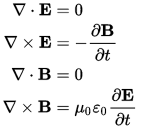
These equations are as important (and elegant) to physics as evolution is to biology.
I am in agreement, David. Although, and only recently, I've become, probably, the biggest fan of Rachel Carson's paragraphs.
David wrote: "Lucy wrote: "As much as I enjoy science, science itself can be quite oversimplifying, reducing the life, beauty, and elegance of the universe to numbers and mechanics...."I find exactly the oppos..."
Interesting thoughts, David!
I suppose finding the beauties of math and science depends on one's perspective.
The way you looked at Newton's Law of Gravitation and Maxwell's equations really can exemplify how beautiful and elegant mathematics can be. To be able to see the world and the universe in that holistic, bigger-picture perspective as you were able to do really can emphasize the beauty and clarity math and science can reveal.
There have been times in my own experiences when math does manifest elegance in its own unique way, not just as a bunch of arbitrary quantifications. Recently during one math class, my teacher walked my classmates and I into how the Pythagorean theorem can be used to derive the standard form equation of a circle. That was actually super cool. I have particularly been able to see the beauties in algebra in my past; solving for the number(s) that can satisfy an equation's variables feels like solving a puzzle---a mystery, even! And there are just so many ways you could approach that mystery; I remember this one time when I completed a Portfolio Problem for the end of a unit on quadratic equations; the problem was called "Solving Methods," and as implied by the name, students had to apply and analyze a variety of different methods that can be used to solve quadratic equations. At the time, the assignment was a little stressful, given how time-consuming it was (and knowing that the due date was looming over my head!) However, now that I look back, the variety of methods and the astounding versatility of algebra was quite elegant!
I think people can become completely oblivious to these beauties like the voice of science was in Vachel Lindsay's poem if they just zoom in too much in the raw details instead of actually looking at things from a bigger perspective. If a person just analyzed the what's instead of the how's and why's in science as you did, that's when things can go downward. I remember in sixth grade, I finished the sixth grade Khan Academy mastery early and began practicing seventh/eighth grade math in hopes of skipping grades and showing off. XD XD
I still enjoyed math, but there were quite a few times when I just remembered a math topic for the sake of remembering it and getting more mastery points. That was when it got harder for me to actually see the beauties and applications in mathematics, as you have.
But yeah, now that I have read your insights, I do agree with you--depending on how you perceive it, math/science really can be quite beautiful and elegant.
Mod
There are many books about science and natural history that are pure poetry. The one that really sticks in my mind is Arctic Dreams by Barry Lopez. The natural history books by Stephen Jay Gould are also beautiful (and controversial), as are those by Carl Sagan.
For quantitative science books, the most poetic for me was The Feynman Lectures on Physics.

Science and Inquiry
Books mentioned in this topic
Arctic Dreams (other topics)The Feynman Lectures on Physics (other topics)
Art and Physics: Parallel Visions in Space, Time, and Light (other topics)
Proust Was a Neuroscientist (other topics)
The Power of Music: Pioneering Discoveries in the New Science of Song (other topics)
More...
