
The History Book Club discussion
EUROPE - EUROPEAN HISTORY
>
UNITED KINGDOM
date newest »
newest »
 Mod
Mod

The Royal coat of arms is the official coat of arms of the British monarch, currently Queen Elizabeth II.
These arms are used by the Queen in her official capacity as monarch of the United Kingdom. Variants of the Royal Arms are used by other members of the Royal Family; and by the British government in connection with the administration and government of the country. In Scotland, the Queen has a separate version of the Royal Arms, a variant of which is used by the Scotland Office.
The shield is quartered, depicting in the first and fourth quarters the three passant guardant lions of England; in the second, the rampant lion and double tressure flory-counterflory of Scotland; and in the third, a harp for Ireland. The crest is a statant guardant lion wearing the St Edward's Crown, himself on another representation of that crown. The dexter supporter is a likewise crowned English lion; the sinister, a Scottish unicorn. According to legend a free unicorn was considered a very dangerous beast; therefore the heraldic unicorn is chained,[3] as were both supporting unicorns in the Royal coat of arms of Scotland. In the greenery below, a thistle, Tudor Rose and shamrock are present, representing Scotland, England and Ireland respectively. The coat features both the motto of English monarchs, Dieu et mon droit (God and my right), and the motto of the Order of the Garter, Honi soit qui mal y pense (shame upon him who thinks evil of it) on a representation of the Garter behind the shield.
Source: Wikipedia
Mod
 Mod
Mod
The British National Anthem dates back to the eighteenth century.
'God Save The King' was a patriotic song first publicly performed in London in 1745, which came to be known as the National Anthem at the beginning of the nineteenth century.
The words and tune are anonymous, and may date back to the seventeenth century.
In September 1745 the 'Young Pretender' to the British Throne, Prince Charles Edward Stuart, defeated the army of King George II at Prestonpans, near Edinburgh.
In a fit of patriotic fervour after news of Prestonpans had reached London, the leader of the band at the Theatre Royal, Drury Lane, arranged 'God Save The King' for performance after a play. It was a tremendous success and was repeated nightly.
This practice soon spread to other theatres, and the custom of greeting monarchs with the song as he or she entered a place of public entertainment was thus established.
There is no authorised version of the National Anthem as the words are a matter of tradition. Additional verses have been added down the years, but these are rarely used.
The words used today are those sung in 1745, substituting 'Queen' for 'King' where appropriate. On official occasions, only the first verse is usually sung.
The words of the National Anthem are as follows:
God save our gracious Queen!
Long live our noble Queen!
God save the Queen!
Send her victorious,
Happy and glorious,
Long to reign over us,
God save the Queen.
Thy choicest gifts in store
On her be pleased to pour,
Long may she reign.
May she defend our laws,
And ever give us cause,
To sing with heart and voice,
God save the Queen.
The British tune has been used in other countries. European visitors to Britain in the eighteenth century noticed the advantage of a country possessing such a recognised musical symbol.
In total, around 140 composers, including Beethoven, Haydn and Brahms, have used the tune in their compositions.
Source: The Official Site of the British Monarchy
Here it is being performed:
A beautiful rendition of the national anthem of the United Kingdom sung at the Royal Maundy Service at Westminster, in 2011.
On this occasion Her Majesty The Queen also celebrated her 85th birthday.
http://youtu.be/j7ujvOWWfpY
And of the splendid Diamond Jubilee:
http://youtu.be/mGDujdUQNVg
Source: Youtube
Mod
London
51°30′N 0°7′W
Official language and national language:
English
Recognized regional languages:
Scots
Ulster‑Scots
Welsh
Cornish
Scottish
Gaelic Irish
Ethnic groups (2011):
87.1% - White
7.0% - Asian
3.0% - Black
2.0% - Mixed
0.9% - others
Demonym:
British
Briton
Government:
Unitary parliamentary constitutional monarchy
- Monarch - Elizabeth II
- Prime Minister - David Cameron
Legislature:
Parliament
- Upper house - House of Lords
- Lower house - House of Commons
History:
- Acts of Union of England and Scotland - 1 May 1707
- Acts of Union of Great Britain and Ireland - 1 January 1801
- Irish Free State Constitution Act - 5 December 1922
- EEC accession - 1 January 1973
Area
- Total - 243,610 km (80th)
94,060 sq mi
- Water (%) - 1.34
Population;
- 2013 estimate - 64,100,000[ 22nd)
- 2011 census - 63,181,775[ (22nd)
- Density - 255.6/km (51st)
661.9/sq mi
GDP (PPP)
2013 estimate
- Total - $2.378 trillion (8th)
- Per capita - $38,309[ (21st)
GDP (nominal):
2013 estimate
- Total- $2.490 trillion (6th)
- Per capita- $40,879 (24th)
Gini (2012)
positive decrease 32.8[
medium · 33rd
HDI (2013):
Steady 0.892[7]
very high · 14th
Currency:
Pound - sterling (GBP)
Time zone::
GMT (UTC)
- Summer (DST)
BST (UTC+1)
Date format:
dd/mm/yyyy (AD)
Drives on the:
left
Calling code:
+44
ISO 3166 code:
GB
Internet TLD:
.uk
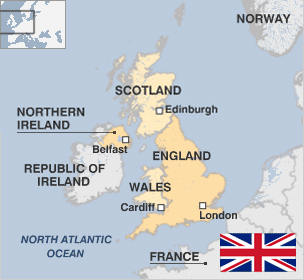 Mod
Mod
http://ucblibraries.colorado.edu/govp...
Source; University of Colorado - Boulder
Mod
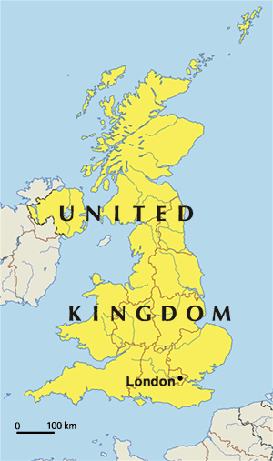
The United Kingdom (UK) consists of England, Wales, Scotland (which collectively make up Great Britain) and Northern Ireland. The UK’s geography is varied, and includes cliffs along some coastlines, highlands and lowlands and hundreds of islands off the western and northern coasts of Scotland.
The most important sectors of the UK’s economy in 2012 were public administration, defence, education, human health and social work activities (19.4 %), wholesale and retail trade, transport, accommodation and food services (18.2 %) and industry (14.6 %).
The UK’s main export partners are Germany, the US and the Netherlands, while its main import partners are Germany, China and the Netherlands.
Capital:
London
Geographical size:
248 527.8 km²
Population:
63 495 303 (2012)
Population as % of total EU population:
12.6 % (2012)
GDP:
€ 1.933 trillion (2012)
Official EU language(s):
English
Political system:
parliamentary constitutional monarchy
EU member country since:
1 January 1973
Seats in the European Parliament:
73
Currency:
Pound sterling GBP
Schengen area member? No, the UK is not a member of the Schengen Area.
Presidency of the Council:
Tthe UK has held the revolving presidency of the Council of the EU 5 times between 1977 and 2005. The next time will be in 2017.
Remainder of article: http://europa.eu/about-eu/countries/m...
Mod
See: http://www.10sballs.com/2015/03/08/th...
 The United States and Britain, divided by a common language!!! This book is lots of fun.
Rules, Britannia: An Insider's Guide to Life in the United Kingdom
 by Toni Summers Hargis (no photo)
Synopsis:
How do you respond to a dinner invitation that says "Eight for eight thirty"? What might induce you to get off a London train at a place called Mud Chute? When is it okay to drive over a sleeping policeman? And why do the Brits keep saying "Who's she, the cat's mother"?
Rules, Britannia is an invaluable resource for Americans who want to make a smooth transition when visiting or relocating to the UK. This entertaining and practical insider's guide contains scores of established do's and dont's that only a Brit would know.
Most of us know that an elevator is called a "lift," a toilet is a "loo," and the trunk of your car is the "boot," but who would have a clue about a "sprog" or a "gobsmacked berk"? These phrases are part of daily conversation in the UK, and leave many visiting Americans as baffled as if they listening to a foreign language.
Covering such essential topics as vocabulary, house- or "flat"-hunting, business culture, child rearing, and even relationship etiquette, Rules, Britannia will ease the anxiety that comes with a transatlantic move or extended visit, and is sure to make any old Yank feel like a regular Joe Bloggs.
An interesting look at the history of those countries that make up the United Kingdom.The Four Nations: A History of the British Isles
 by Frank Welsh(no photo)
Synopsis:
Even by comparison to the United States, the United Kingdom has had a brief and fractious history. Its existence as an undivided entity lasted only for a disputatious 125 years, and its future remains precarious.In The Four Nations, Frank Welsh offers a lively narrative history of the four component parts of the British Isles-England, Ireland, Scotland, and Wales. Moving from the Roman period, which first defined many of the current internal boundaries, through the present day, Welsh describes the history of each nation, their interactions, and the impacts of crises ranging from the Norman Invasion to the Protestant Reformation to the two world wars of the twentieth century. Along the way, Welsh questions many cherished illusions and poses some awkward questions: To what extent were Scotland, Ireland, and Wales victims of predatory English aggression? How serious is the frequently invoked specter of national fragmentation?Filled with illuminating vignettes and provocative insights, The Four Nations is an accessible and comprehensive introduction to the troubled histories of the British Isles.
An in-depth guide to some of the changes in law that have happened in the 21st century in the UK.Constitutional Reform in the United Kingdom
 by Dawn Oliver(no photo)
Synopsis:
This new account of constitutional reform in the UK offers a detailed discussion of all the significant changes that have developed following the elections of 1997 and 2001. Issues discussed include the recent devolution of power in Scotland and elections of Assemblies in Wales and Northern Ireland; reform of the House of Lords and the system of hereditary peers; the influence of the Human Rights Act, changes to electoral systems and party funding and the significance of the European dimension on the British Constitution.
Dawn Oliver presents a broad overview of the latest developments in constitutional reform while analysing the implications of these reforms for the theories of democracy, citizenship and good governance within an UK context. Discussion is also given on the gradual move away from a political constitution to a more law-based system, the general ethics and standards within Parliament and consideration of possible future reforms in the areas of regional government, the House of Lords and the House of Commons. Written in a straightforward and accessible style, the text is well referenced to aid further research and offers an extensive bibliography and list of official publications. It is essential reading for all those studying constitutional law and reform as part of their law or politics degree programmes, while academics and civil servants in these areas will also find the discussions and analysis in the work of interest.
How much fun is this????The Whisky Distilleries of the United Kingdom
 by Alfred Barnard(no photo)
Synopsis:
Around 1885, Alfred Barnard was secretary of Harper’s Weekly Gazette, a journal dedicated to the wine and spirit trade. In order to provide his readers with the history and descriptions of the whisky-making process, Barnard decided to visit each distillery in Scotland, England and Ireland. Accompanied by friends, he visited over 150 distilleries. The names found in his reports still excite the dedicated whisky connoisseur today, as well as others whose fame has faded at the turn of the 19th century. The appeal of Barnard’s book lies not only in the technical descriptions of each distillery’s processes, but also in the colourful descriptions of his journeys, brimming with historical colour and detail. A superbly illustrated facsimile edition, with over 200 engravings, this book is a complete guide to the origins of Scotland’s national drink, as well as a lively picture of life and travel in the Victorian age. This new revised edition has finally gathered together all of Alfred Barnard’s writings on the whisky distilleries of the United Kingdom, making it the definitive collection on the subject.
After WWII, the image and size of the United Kingdom changed dramatically. This book looks at those changes and how they affected the UK we know today.Seeking a Role: The United Kingdom 1951-1970
 by Brian Howard Harrison(no photo)
Synopsis:
This is a detailed and wide-ranging analysis of post-war Britain in the 1950s and 60s. It covers everything from international relations to family life, the countryside to manufacturing, religion to race, and cultural life to political structures.
 Hi Jill, it's worth noting that the book you cited is part of a series, the New Oxford History of England. This is contrast to an earlier series, the Oxford History of England. This Wikipedia entry summarizes the two series as well as the current status of the newer series, which is only partially complete.
https://en.wikipedia.org/wiki/Oxford_...
Note also the discussion of what is meant by "England" in the series title. It is used in the broad sense, as the quote from A.J.P. Taylor indicates: "England" was still an all-embracing word. It meant indiscriminately England and Wales; Great Britain; the United Kingdom; and even the British Empire. This certainly justifies the inclusion in this United Kingdom thread.
I hope that having made that point, I will not be punished by being required to add citations for all of the volumes. :-) But here are the Goodreads links to the two series:
Oxford History of England
https://www.goodreads.com/series/1251...
New Oxford History of England
https://www.goodreads.com/series/7467...
I haven't read any of the books but have been favorably impressed by several of the Oxford History of the United States series, so the England series is on my radar.
Oxford History of the United States (cited for completeness)
https://www.goodreads.com/series/7378...
Here is another book that I've been meaning to read one of these days, although I have been saying that since it was published in 2000, so who knows if I will ever get to it. The Goodreads blurb is very brief, so I copied the publisher blurb from Amazon instead.The only downside of this book is that it has become incredibly expensive for some reason. I think it was maybe $30 when published, whereas now Amazon wants $142 for the hardcover and $74 for the paperback. It'a also available for rental. I guess it must have been adopted as a textbook at some point.
The Isles: A History
 by
by
 Norman Davies
Synopsis:
Written by one of the most brilliant and provocative historians at work today, The Isles is a revolutionary narrative history that takes a new perspective on the development of Britain and Ireland, looking at them not as self-contained islands, but as an inextricable part of Europe.
At every stage, The Isles connects offshore development with parallel events on the Continent. This richly layered history begins with the Celtic Supremacy in the last centuries BC, which is presented in the light of a Celtic world stretching all the way from Iberia to Asia Minor. Roman Britain is seen not as a unique phenomenon but as similar to the other frontier regions of the Roman Empire, such as Germany. The Viking Age is viewed not only through the eyes of the invaded but from the standpoint of the invaders themselves--Norse, Danes, and Normans. Plantagenet England is perceived, like the Kingdom of Jerusalem, as an extension of medieval France. In the later chapters, Davies follows the growth of the United Kingdom and charts the rise and fall of the main pillars of "Britishness" - the Royal Navy, the Westminster Parliament, the Constitutional Monarchy, the Aristocracy, the Protestant Supremacy, the British Empire, the imperial economy and sterling area, and the English Language.
The book ends with the crisis confronting Britain now - the emergence of the European Union. As the elements that make up the historic Britishness dissolve, Davies shows how public confusion is one of the most potent factors in this process of disintegration. As the Republic of Ireland prospers, and power in the United Kingdom is devolved, he predicts that the coming crisis in the British State may well be its last.
This holistic approach challenges the traditional nationalist picture of a thousand years of "eternal England" - a unique country formed at an early date by Anglo-Saxon kings which evolved in isolation and, except for the Norman Conquest, was only marginally affected by continental affairs. The result is a new picture of the Isles, one of four continents - England, Ireland, Scotland and Wales - constantly buffeted by continental storms and repeatedly transformed by them. Illuminated by the same clarity and piercing originality that distinguished Europe: A History, The Isles will become an agenda-setting book, one that will encourage a reassessment of what it means to be British while sparking debate about ideas of national identity and sovereignty.
Citation for Davies' other book mentioned in the review:
 by
Norman Davies
Your citations for the Oxford Books is sufficient, Grafakos or you would to take up two pages to cover all the books!!!! Thanks for mentioning it.
by
Norman Davies
Your citations for the Oxford Books is sufficient, Grafakos or you would to take up two pages to cover all the books!!!! Thanks for mentioning it.BTW, I can't imagine $74 for a paperback book!!!!!! re:
by
Norman Davies
Yes, that's a good candidate for borrowing from the library instead of buying. But it will have to be a library with generous lending terms, because the book is nearly 1300 pages long!
by
Norman Davies
Mod
Go to the address below for some pretty hysterical pictures of "Mud Madness", an annual charity event in Northern Ireland that raises large amounts of money for the terminally ill. It looks like a lot of fun if you don't mind getting dirty!!http://www.aol.com/article/2015/09/15...
(Source: AOL)
Mod
Even if you are not considering becoming a British citizen, this book is a interesting read.Life in the United Kingdom: A Guide for New Residents
 by Great Britain Home Office(no photo)
Synopsis:
Ensure you are fully prepared for your Life in the UK test with the new 2013 3rd edition of the Life in the UK handbook. This downloadable PDF gives you instant access to the only official handbook for Life in the UK tests taken on or after 25 March 2013. It contains all the official learning material for the test and is written in clear, simple language - making it easy to understand.
This essential handbook covers a range of topics you need to know to pass your test and apply for UK citizenship or permanent residency, including:
The process of becoming a citizen or permanent resident
The values and principles of the UK
Traditions and culture from around the UK
The events and people that have shaped the UK's history
The government and the law
Getting involved in your community
A bit dated but still informative.Devolution in the United Kingdom
 by Vernon Bogdanor (no photo)
Synopsis:
The issue of devolution has often been one for polemic rather than reasoned analysis.This title places developments in the United Kingdom in their historical context, examining political and constitutional aspects of devolution in Britain from Gladstone's espousal of Home Rule in 1886 right up to the 1998 legislation governing the Scottish Parliament and the Welsh Assembly.
Just plain fun!!!The Queen's English: An A to Zed Guide To Distinctively British Words
 by C.J. Moore (no photo)
Synopsis:
From "chips" and "crumbs" to "spending a penny," The Queen's English is your indispensable guide to surviving and thriving in the tricky byways of the English language, which has shown many a poor soul the way out for little more than twanging a vowel, splitting an infinitive or, crime of all crimes, saying dinner instead of tea. With The Queen's English there's no need to become "flummoxed" ever again. This must-have A to Z guide uncovers the quintessential meanings behind more than 100 familiar words and phrases of the distinctively British lexicon, including:
By hook or by crook (adv. phrase): It is good to find a phrase in common use that goes back as far as this one, and which appears (though not entirely proven) to link back to England's feudal past. In medieval times when the peasantry were not allowed to cut down trees, they were permitted nonetheless to gather firewood from loose or dead branches which could be obtained using "hook" (bill hook, a traditional cutting tool) or "crook," a staff with a curved end. No doubt the desperate peasant often exceeded the strict use of these tools, and so the sense is to achieve something by whatever means possible. The first recorded use of the phrase is from the fourteenth century.
Gazump (vt.): Usually so proud of their reputation for playing fair, the English have a curious blind spot when it comes to buying and selling houses. To "gazump" is to raise the price of a piece of real estate after the sale has been agreed but before the contract is signed, usually on the pretext that the owner has received a higher offer elsewhere. The original buyer is then forced to raise their offer or the property goes to the higher bidder. This unethical but not illegal practice appeared first with the spelling "gazoomph" and was derived from an older and more general term "gazumph" (or gezumph) for the various kinds of swindling that go on at dishonest auctions.
In a nutshell (adv. phrase): "Oh God, I could be bounded in a nutshell and count myself a King of infinite space..." cries Hamlet in Shakespeare's tragic play. But the meaning of the expression, namely, to put much into a small space, goes way back to classical times, to Pliny's Natural History where he writes: "Cicero records that a parchment copy of Homer's poem The Iliad was enclosed in a nutshell (in nuce)." In Shakespeare's own time, a Bible is said to have been produced that could fit into a nutshell, and that curiosity may have come to the playwright's notice.
People like us (np.): Often abbreviated to PLU, this phrase is used by those of a certain social class to approve of others as acceptable by birth and station, and originates in the 1940s milieu typified by the artistic, wayward, and eccentric Mitford sisters, daughters of the second Baron Redesdale. We get a flavor of the attitude where Nancy Mitford, in a letter to her sister Jessica (August 28, 1957), declared that "People Like Us are never killed in earthquakes ...." Nancy refined the art of social class distinctions with a list of subtle differences in vocabulary first defined as U (upper class) and non-U (aspriring middle class) by the sociolinguist Alan Ross in 1954.
So if you ever wanted to know what it means to be a "meat-and-potatoes man," a "lame duck," or to be in a "pretty pickle," stop "umming and erring" and read this fascinating collection "straightaway."
Now you will know what "Boxing Day" is and what it celebrates!Cultural Traditions in the United Kingdom
 by Lynn Peppas (no photo)
Synopsis:
hroughout history, the United Kingdom has been one of the most influential places in the world. Its culture and language have spread far and wide. This interesting book describes the holidays and traditions in the United Kingdom that celebrate important dates in history, religion, royal ceremonies, and changes in the seasons.
The Making of the United Kingdom by Daniel Philip Waley (no photo)
Synopsis:
The histories of the "three kingdoms" or "four nations" that eventually became the United Kingdom of Great Britain and Ireland in 1801 are distinct but not separate. From the Restoration of Charles II to the Act of Union with Ireland, Jim Smyth interweaves the different national stories into an authoritative account of the creation of the modern British state. Including discussion of society and economy alongside analysis of contemporary politics and the religious question, Smyth shows how the experiences of England, Scotland, Wales and Ireland were shaped by unity as well as diversity. In an age of anxiety about national identity and the future of the United Kingdom, this is a timely and important book.
Mod
For the beginner or the advanced coin collector.Coins of England and the United Kingdom
 by Philip Skingley (no photo)
Synopsis:
Coins of England and the United Kingdom remains the only single-volume reference work which features every major coin type from Celtic to the present day with accurate market values for every coin type listed. It is an essential guide for beginners, serious numismatists and anyone interested in British coinage. This edition is published in FULL COLOUR for the first time with over 1,500 actual size images to aid identification. Other features of this 42nd edition include: *A revision of the Early and Late Anglo-Saxon coinages *A revision of the coinage of the Norman Kings *New illustrations of the groat and sixpence busts of Elizabeth I *Comprehensive revision of valuations in all grades throughout the book *Updated Decimal section to include all new Royal Mint issues *Concise introductions to each reign to aid the collector *Mintmarks and Symbols illustrated and explained
Do you believe in ghosts?Ghosts of The United Kingdom
 by David Pietras (no photo)
Synopsis:
Whether you are looking for information on castles, or if you more interested in the paranormal activities and manifestations from the other side, you have come to the right place. Learn about the apparitions and specters which walk abroad including the reasons for their hauntings, along with confirmed sightings, cases of witchcraft and much more in the towers, mansions, and dungeons in the north of the United Kingdom.
Here you will find the history of haunted locations in England, Scotland, Wales and Ireland, along with the stories of the ghosts and spooks which haunt these fortifications and palaces.
Go to the link below to get up to date about what will happen now that PM David Cameron has resigned as PM after the UK left the European Union.http://www.telegraph.co.uk/news/2016/...
Brexit: The Isolated Island by Norman B. Lechat (no photo)
Synopsis:
Brexit: The Isolated Island is an insightful view into the potential fallout of the UK's 2016 Referendum. Written with a touch of English prose and a slight satirical tone, The Isolated Island is to be understood and enjoyed. Is immigration the issue? This edition explores the truth of Europe and how it has successfully fleeced many nations by hiding its dream in plain sight. Will Britain see that Dream or will it become entangled in a bureaucratic nightmare?
FERVOR FOR SCOTTISH INDEPENDENCE WANINGFlanked by the Scottish saltire and the blue-and-yellow EU colors, the first minister of Scotland looked like a steadfast stateswoman amid the confusion of Brexit.
Just hours after the results came in from the June 23 vote, Nicola Sturgeon spoke from Edinburgh, telling the world that a Scottish referendum on independence from Britain was “highly likely.”
Three months on, her strategy is less certain.
And while it hasn’t disappeared entirely, the widespread anger that greeted Brexit north of the border, where almost two-thirds voted to remain in the European Union, has since faded.
After an initial post-Brexit bump, support for leaving the U.K. is roughly where it was at the last referendum, two years ago on Sunday. Polls show 52 percent of Scots would vote against independence. More significantly, opposition to holding another referendum is growing.
“In June, it was around 50-50 between those who wanted another referendum and those who didn’t. Now 54 percent say they don’t want another referendum in the next two years,” said Mark Diffley, Scotland director for pollsters IPSO Mori.
“The movement of opinion both in how people say they would vote and whether they want another referendum is not what the SNP would want, and it’s not what they would have predicted,” he said.
Scottish politics is firmly divided along constitutional lines. Nationalists have controlled the devolved parliament in Edinburgh for almost a decade. The unionist opposition, predominantly fractured between Conservative and Labour, has struggled to gain ground.
For a brief moment, Brexit appeared to unite all strands of Scottish political thought. A few days after the referendum result, Sturgeon received cross-party backing in the Edinburgh parliament “to protect Scotland’s place in the EU.”
That window has long since shut. Conservative leader Ruth Davidson has continued where she left off during the 2016 Scottish parliament campaign, claiming that Sturgeon has only one aim: independence.
Meanwhile, Sturgeon’s Scottish National Party (SNP), which fell just short of an overall majority in the Scottish parliament in May, has done little to assuage unionist fears that a second referendum is inevitable.
Earlier this month, Sturgeon unveiled a new “conversation” on independence. The party’s 125,000 members will be charged with convincing ‘No’ voters to reassess the SNP offer. A “growth commission” will be established to answer the hoary economic questions — most notably on currency — that dogged the 2014 ‘Yes’ campaign.
Sturgeon has described Brexit as a “material change” in Scotland’s position in the U.K. Speaking before the Scottish parliament’s Europe Committee last week, she warned that Scotland faced a “lost decade” as a result of the U.K.’s vote to leave the EU.
The following day, rival Scottish and U.K. Brexit ministers met for the first time. Their job titles are revealing: Mike Russell, a combative, capable former Scottish education minister, is the “Minister for U.K. Negotiations on Scotland’s Place in Europe.” His opposite number, David Davis, is “Secretary of State for Exiting the European Union.”
Can accommodation be found between these two poles? During the summer various ideas were floated that could allow for Scotland to remain in both the U.K. and the EU, including the so-called “Reverse Greenland.”
A bespoke deal for Scotland “would be difficult but not impossible,” said Adam Tomkins, a Conservative member of the Scottish parliament and professor of constitutional law at Glasgow University. “But the only way Scotland can get that sort of deal is if it works with the U.K. government.”
For now, Edinburgh appears to be focusing most of its energy on building support for independence, at home and abroad. Sturgeon has held a number of meetings with European politicians, including Germany’s Europe Minister Michael Roth .
Spain, of course, has said it would block any attempt by an independent Scotland to join the EU. But the appointment of Guy Verhofstadt — previously sympathetic to the Scottish nationalist desire to remain in the EU — as the European Parliament’s lead Brexit negotiator was widely welcomed in SNP circles.
Brexit, however, has yet to lead to any significant shift in the dynamics of independence in Scotland. That is not surprising given the parlous state of the local economy, particularly compared to 2014.
Oil revenues have collapsed: tax receipts from the North Sea have fallen from over £11 billion in 2011-2012 to just £60 million last year. Scotland’s deficit — the difference between what the government raises in tax and what it spends — has spiraled to 9.5 percent of GDP. The overall figure for the U.K. is 4 percent.
The expected surge of angry Remain voters to the Scottish nationalist cause has not materialized. Polls suggest that while some who backed the U.K. in 2014 are now sympathetic to independence, this cohort is almost entirely canceled out by voters moving in the opposite direction. Over 30 percent of the SNP’s own supporters voted Leave, denting the party’s confidence in the depth of Scottish support for the EU.
Exhausted electorate
A snap independence referendum — a move favored by some in the upper echelons of the SNP — looks increasingly unlikely. Former SNP leader Alex Salmond has predicted that a fresh vote will be held in 2018, once the Brexit negotiations have been completed.
But the shape of the U.K.’s deal with Europe could prove highly significant. Counter-intuitively a ‘hard Brexit’ could make independence far harder to sell. The possibility of border controls between England and an independent Scotland, for example, would be anathema to many Scots.
“Brexit will determine the course of Scottish politics over the next few years,” said James Mitchell, professor of politics at Edinburgh University. “It depends when Brexit happens, and what happens. A lot of the dynamic lies outside Scotland.”
Modern Scottish nationalism rests, essentially, on a single core claim: that the political cultures on either side of the border are irreconcilably different. Scotland votes Labour — and, latterly, SNP — but is routinely ruled by Conservative governments in London.
Brexit — an English majority forcing Scots out of the EU against their will — reinforces this argument, even in the eyes of some pro-devolution unionists. That sense of injustice, coupled with wider political factors, could yet lead Sturgeon to call another referendum, says pollster Mark Diffley.
“The gap they have to close is small. With a good campaign and answers to the economic arguments, a more supportive media and the U.K. government completely fixated by Brexit, maybe [the SNP] do see a window of opportunity.”
European officials certainly think a second vote in the short-term is a distinct possibility. EU member country diplomats are meeting weekly in Edinburgh to discuss developments. Previously such formal contact was sporadic.
Internal pressure could build on Sturgeon, too. Next month, SNP activists will debate a second independence referendum at the party’s conference in Glasgow. Polls suggest some 85 percent of ‘Yes’ voters in 2014 want a rerun. (90 percent of ‘No’ voters do not.)
But aside from the economic and political uncertainty, there is also a sense of fatigue among the Scottish electorate. The last year without a major vote was 2013 — and that was occupied by the independence campaigns.
“Voters are tired. Even many activists on the Yes side are tired,” said Peter Lynch, lecturer in politics at Stirling University and author of the definitive history of the SNP.
Sturgeon faces a political headache: to stay, or to go. Having talked up the prospect of a second referendum, a climbdown could prove extremely tricky.
But there are huge risks to another vote, too. Sturgeon’s predecessor Salmond called a referendum, lost it and resigned. David Cameron followed suit in June, after the Brexit vote. If she gambles and loses, her career — one of the most promising in British politics — could be over aged just 46.
(Source: Politico)
One man's love affair with the Outer Hebrides Islands of Scotland, UK.........wild and wonderful.Sea Room: An Island Life in the Hebrides
 by
by
 Adam Nicolson
Synopsis:
In 1937, Adam Nicolson’s father answered a newspaper ad—“Uninhabited islands for sale. Outer Hebrides, 600 acres . . . Puffins and seals. Apply . . . ”.
In this radiant and powerful book, Adam describes, and relives, his love affair with this enchantingly beautiful property, which he inherited when he was twenty-one. As the islands grew to become the most important thing in his life, they began to offer him more than escape, giving him “sea room”—a sailing term Nicolson uses to mean “the sense of enlargement that island life can give you.”
The Shiants—the name means holy or enchanted islands—lie east of the Isle of Lewis in a treacherous sea once known as the “stream of blue men,” after the legendary water spirits who menaced sailors there. Crowned with five-hundred-foot cliffs of black basalt and surrounded by tidal rips, teeming in the summer with thousands of sea birds, they are wild, dangerous, and dramatic—with a long, haunting past. For millennia the Shiants were a haven for those seeking solitude—an eighth-century hermit, the twentieth-century novelist Compton Mackenzie—but their rich, sometimes violent history of human habitation includes much more. Since the Stone Age, families have dwelled on the islands and sailors have perished on their shores. The landscape is soaked in centuries-old tales of restless ghosts and ancient treasure, cradling the heritage of a once productive world of farmers and fishermen.
In passionate, keenly precise prose, Nicolson evokes the paradoxes of island life: cut off from the mainland yet intricately bound to it, austere yet fertile, unforgiving yet bewitchingly beautiful.
Sea Room does more than celebrate and praise this extraordinary place. It shares with us the greatest gift an island can bestow: a deep, revelatory engagement with the natural world.
Mod

The Instrument of Accession signed by His Majesty King George VI in London on 17 May 1949
Presentation of the history and contribution of the United Kingdom to Western defense and the Atlantic Community.
"Introducing the United Kingdom" is part of a series originally designed as "Know your Allies", and finally titled "the Atlantic Community Series".
Its objectives were to familiarize public opinion in each of the member country with the other Alliance members and to emphasize the national contributions to Western culture and political traditions, economic reconstruction and allied defense in the framework of NATO.
The series was produced between 1954 and 1956 and financed by the US government in the context of the Marshall Plan with the cooperation of the Information Service of NATO, and distributed by NATO. The films in the Atlantic Community Series received large non-theatrical distribution and, in some cases, were shown in cinemas and on TV. Language versions were made and distributed with the help of the national governments.
“My country and NATO” tells the story of each one of NATO’s members, using a selection of unique archival materials to take you back in time.
Link to film: https://youtu.be/ODrja3SmIL4
Note: This is an excellent little film produced between 1954 - 1956 so there is a lot of history in the making here. And it shows a lot of pride in the country.
The United Kingdom and Nato
Link: https://www.nato.int/cps/en/natohq/de...
Nato Declassified:
Link: https://www.nato.int/cps/en/natohq/de...

The History Book Club
Books mentioned in this topic
Sea Room: An Island Life in the Hebrides (other topics)Brexit: The Isolated Island (other topics)
Ghosts of The United Kingdom (other topics)
Coins of England and the United Kingdom (other topics)
The Making of the United Kingdom 1660-1800 (other topics)
More...
Authors mentioned in this topic
Adam Nicolson (other topics)Norman B. Lechat (other topics)
David Pietras (other topics)
Philip Skingley (other topics)
Daniel Philip Waley (other topics)
More...

The United Kingdom of Great Britain and Northern Ireland, commonly known as the United Kingdom (UK) or Britain, is a sovereign state in Europe. Lying off the north-western coast of the European mainland, the country includes the island of Great Britain—a term also applied loosely to refer to the whole country—the north-eastern part of the island of Ireland and many smaller islands.[8] Northern Ireland is the only part of the UK that shares a land border with another state (the Republic of Ireland).[nb 5] Apart from this land border, the UK is surrounded by the Atlantic Ocean to its west and north, the North Sea to its east and the English Channel to its south. The Irish Sea lies between Great Britain and Ireland. The UK has an area of 93,800 sq mi[convert: unknown unit], making it the 80th-largest sovereign state in the world and the 11th-largest in Europe.
The United Kingdom is the 22nd-most populous country, with an estimated 64.1 million inhabitants. It is a constitutional monarchy with a parliamentary system of governance. Its capital city is London, an important global city and financial centre with an urban population of 10,310,000, the fourth-largest in Europe and second-largest in the European Union. The current monarch—since 6 February 1952—is Queen Elizabeth II. The UK consists of four countries: England, Scotland, Wales, and Northern Ireland. The latter three have devolved administrations, each with varying powers, based in their capitals, Edinburgh, Cardiff, and Belfast, respectively. Guernsey, Jersey, and the Isle of Man are not part of the United Kingdom, being Crown dependencies with the British Government responsible for defence and international representation.
The relationships among the countries of the United Kingdom have changed over time. Wales was annexed by the Kingdom of England under the Acts of Union of 1536 and 1543. A treaty between England and Scotland resulted in 1707 in a unified Kingdom of Great Britain, which merged in 1801 with the Kingdom of Ireland to form the United Kingdom of Great Britain and Ireland. In 1922, five-sixths of Ireland seceded from the country, leaving the present formulation of the United Kingdom of Great Britain and Northern Ireland. The UK has fourteen Overseas Territories. These are the remnants of the British Empire which, at its height in the 1920s, encompassed almost a quarter of the world's land mass and was the largest empire in history. British influence can be observed in the language, culture, and legal systems of many of its former colonies.
The United Kingdom is a developed country and has the world's sixth-largest economy by nominal GDP and tenth-largest by purchasing power parity. The country is considered to have a high-income economy and is categorised as very high in the Human Development Index, currently ranking 14th in the world. It was the world's first industrialised country and the world's foremost power during the 19th and early 20th centuries. The UK remains a great power with considerable economic, cultural, military, scientific, and political influence internationally. It is a recognized nuclear weapons state and its military expenditure ranks fifth or sixth in the world. The UK has been a permanent member of the United Nations Security Council since its first session in 1946. It has been a member state of the European Union (EU) and its predecessor, the European Economic Community (EEC), since 1973; it is also a member of the Commonwealth of Nations, the Council of Europe, the G7, the G8, the G20, NATO, the Organisation for Economic Co-operation and Development (OECD), and the World Trade Organization (WTO).
Location:
Flags:
Flag of United Kingdom
De jure flag of the United Kingdom, used by HM Government in England
From c. 1801 in present form
The Many Other Flags of England, Great Britain, Royal Standards, Government, Church, Counties, etc
See: http://en.wikipedia.org/wiki/List_of_...
More: http://en.wikipedia.org/wiki/List_of_...
The Union Flag - at sea The Union Jack