
The History Book Club discussion
EUROPE - EUROPEAN HISTORY
>
CROATIA

 Mod
Mod
 Mod
Mod
Zagreb
45°48′N 16°0′E
Official languages:
Croatian
Ethnic groups (2011):
90.4% - Croats
4.4% - Serbs
5.2% - others / unspecified
Demonym:
Croat
Croatian
Government:
Unitary parliamentary constitutional republic
- President - Kolinda Grabar-Kitarović
- Prime Minister - Zoran Milanović
- Speaker of Parliament - Josip Leko
- Chief Justice - Jasna Omejec
Legislature:
Sabor
Establishment:
- Duchy - 8th century
- Kingdom - c. 925
- Personal union with Hungary - 1102
- Joined Habsburg Empire - 1 January 1527
- Secession from Austria-Hungary - 29 October 1918
- Creation of Yugoslavia - 4 December 1918
- Decision on independence - 25 June 1991
- EU accession - 1 July 2013
Area:
- Total -56,594 km 126th)
21,851 sq mi
- Water (%) - 1.09
Population:
- 2011 census - Decrease - 4,284,889 (128th)
- Density 75.8/km2 (126th)
196.3/sq mi
GDP (PPP):
2014 estimate
- Total - $80.620 billion
- Per capita - $20,392
GDP (nominal):
2014 estimate
- Total - $61.280 billion
- Per capita - $13,920
Gini:
(2012)
30.5
medium
HDI (2013)
Steady - 0.812
very high · 47th
Currency:
Kuna - (HRK)
Time zone:
CET - (UTC+1)
- Summer (DST)
- CEST (UTC+2)
Drives on the
right
Calling code:
+385
ISO 3166 code:
HR
Internet TLD:
.hra
Source: Wikipedia
Mod
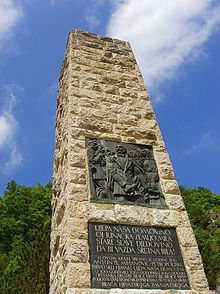
Monument to Croatian national anthem in Zelenjak
"Lijepa naša domovino" (Our Beautiful Homeland) is the national anthem of Croatia. It is often referred to as just "Lijepa naša" ("Our Beautiful") in Croatia, which is also a phrase widely used as a metonym for the country.
The original lyrics were written by Antun Mihanović and first published under the title Horvatska domovina (Croatian homeland) in 1835. In 1846, the music amateur Josip Runjanin (1821–1878) composed the music for Horvatska domovina. Runjanin's army bandmaster Josip Wendl adapted his music for a military brass orchestra. It has not been known what was the original form of the melody because the first copy has not been recovered to this day.[citation needed.
The song was scored and harmonized for a male choir by a teacher of singing and organist of the Zagreb Cathedral Vatroslav Lichtenegger in 1861, and after that it started to be performed as the Croatian people's anthem. The title Lijepa naša has been applied since that time. The original anthem has 14 verses. Since then it has come to be known under the slightly longer present title and a few minor adjustments have been made to the lyrics.[citation needed.
The song was not immediately adopted by the Croatian Parliament as the national anthem. In 1907, the Association of Croatian Singing Clubs requested the parliament to do so but received no response, even though the song was used as the anthem in unofficial capacity at ceremonies, including the 29 October 1918 session of the parliament when Croatia formally dissolved its ties with Austria-Hungary.
Between 1918 and 1941, segments of the Croatian national anthem were part of the national anthem of the Kingdom of Yugoslavia and it was unofficial hymn of Croats. During the World War II, in the Independent State of Croatia it was also used as state anthem, albeit with some modifications to the lyrics. Croatian partisans were also using it, for example during ZAVNOH sessions.
The song became the official anthem of Croatia through amendments of the Constitution of Croatia adopted by the parliament of the SR Croatia on 29 February 1972. The anthem was confirmed by constitutions of 1974 and 1990, when its lyrics were slightly modified, and by the Coat of Arms, the Flag and the National Anthem of the Republic of Croatia Act.
Lyrics in Croatian:
Lijepa naša domovino,
Oj junačka zemljo mila,
Stare slave djedovino,
Da bi vazda sretna bila!
Mila, kano si nam slavna,
Mila si nam ti jedina.
Mila, kuda si nam ravna,
Mila, kuda si planina!
Teci Dravo, Savo teci,
Nit' ti Dunav silu gubi,
Sinje more svijetu reci,
Da svoj narod Hrvat ljubi.
Dok mu njive sunce grije,
Dok mu hrašće bura vije,
Dok mu mrtve grobak krije,
Dok mu živo srce bije!
Lyrics in English:
Our beautiful homeland,
O so fearless and gracious.
Our fathers' ancient glory,
May you be blessed forever.
Dear, you are our only glory,
Dear, you are our only one,
Dear, we love your plains,
Dear, we love your mountains.
Drava, Sava, keep on flowing,
Danube, do not lose your vigour,
Deep blue sea, tell the world,
That a Croat loves his homeland.
Whilst his fields are kissed by sunshine,
Whilst his oaks are whipped by wild winds,
Whilst his dear ones go to heaven,
Whilst his live heart beats.
Here it is being performed:
Audio link: http://www.linkonlearning.com/public/...
National Anthem of Croatia - "Lijepa Naša Domovino" (Our Beautiful Homeland)
Includes lyrics in both Croatian and English: http://youtu.be/1lvHpkndatM
Lijepa naša domovino - Domagoj Dorotić, Zbor i Simfonijski orkestar Hrvatske radiotelevizije: http://youtu.be/YsDPZqDCgnY
Source; Wikipedia and You Tube
Mod
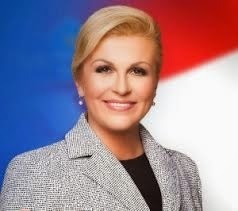
Kolinda Grabar-Kitarovic - President of the Republic of Croatia
The Republic of Croatia is a unitary state using a parliamentary system of governance. With the collapse of the ruling communist party in SFR Yugoslavia, Croatia adopted its present constitution in 1990 and organised its first multi-party elections.
It declared independence on 8 October 1991 leading to the break-up of Yugoslavia and the country was internationally recognised by the United Nations in 1992. Under its 1990 constitution, Croatia operated a semi-presidential system until 2000 when it switched to a parliamentary system.
Government powers in Croatia are divided into legislative, executive and judiciary powers.The legal system of Croatia is civil law, strongly influenced, as is the institutional framework, by the legal heritage of Austria-Hungary. By the time EU accession negotiations were completed on 30 June 2010, Croatian legislation was fully harmonised with the Community.
The President of the Republic (Croatian: Predsjednik Republike) is the head of state, directly elected to a five-year term and is limited by the Constitution to a maximum of two terms. In addition to being the commander in chief of the armed forces, the president has the procedural duty of appointing the prime minister with the consent of the parliament, and has some influence on foreign policy. The most recent presidential elections were held on 10 January 2010, when Ivo Josipović won. He took the oath of office on 18 February 2010.
The government is headed by the prime minister, who has four deputy prime ministers and 17 ministers in charge of particular sectors of activity. As the executive branch, it is responsible for proposing legislation and a budget, executing the laws, and guiding the foreign and internal policies of the republic. The government is seated at Banski dvori in Zagreb. Since 23 December 2011, the prime minister of the government has been Zoran Milanović.
The parliament (Sabor) is a unicameral legislative body. A second chamber, the House of Counties, set up in 1993 pursuant to the 1990 Constitution, was abolished in 2001. The number of Sabor members can vary from 100 to 160; they are all elected by popular vote to serve four-year terms. The sessions of the Sabor take place from 15 January to 15 July, and from 15 September to 15 December. The two largest political parties in Croatia are the Croatian Democratic Union and the Social Democratic Party of Croatia.
Croatia has a three-tiered judicial system, made up of the Supreme Court, County courts, and Municipal courts. The Constitutional Court rules on matters regarding the Constitution. In addition there are misdemeanour courts, commercial courts and administrative courts. Law enforcement in Croatia is the responsibility of the Croatian police force, which is under the control of the Ministry of the Interior. In recent years, the force has been undergoing a reform with assistance from international agencies, including the Organization for Security and Co-operation in Europe (OSCE) since its mission to Croatia began on 18 April 1996.
Source: Wikipedia
Mod
http://www.bbc.com/news/world-europe-...
Source: BBC
Mod
The center of the city of Split, built in and around the Palace of the Emperor Diocletian.
Croatia was first subdivided into counties in the Middle Ages.
The divisions changed over time to reflect losses of territory to Ottoman conquest and subsequent liberation of the same territory, changes of political status of Dalmatia, Dubrovnik and Istria. Traditional division of the country into counties was abolished in the 1920s, when the Kingdom of Serbs, Croats and Slovenes and subsequent Kingdom of Yugoslavia introduced oblasts and banovinas respectively
Communist ruled Croatia, as a constituent part of post-WWII Yugoslavia, abolished earlier divisions and introduced municipalities, subdividing Croatia into approximately one hundred municipalities. Counties were reintroduced in 1992 legislation, significantly altered in terms of territory relative to the pre-1920s subdivisions: In 1918, the Transleithanian part of Croatia was divided into eight counties with their seats in Bjelovar, Gospić, Ogulin, Požega, Vukovar, Varaždin, Osijek and Zagreb, and the 1992 legislation established 14 counties in the same territory.
Since the counties were re-established in 1992, Croatia is divided into 20 counties and the capital city of Zagreb, the latter having the authority and legal status of a county and a city at the same time.
Borders of the counties changed in some instances since, with the latest revision taking place in 2006. The counties subdivide into 127 cities and 429 municipalities.
Nomenclature of Territorial Units for Statistics (NUTS) division of Croatia is performed in several tiers. NUTS 1 level places the entire country in a single unit, while there are three NUTS 2 regions. Those are Northwest Croatia, Central and Eastern (Pannonian) Croatia and Adriatic Croatia. The latter encompasses all the counties along the Adriatic coast. The Northwest Croatia includes the city of Zagreb, Zagreb, Krapina-Zagorje, Varaždin, Koprivnica-Križevci and Međimurje counties, and the Central and Eastern (Pannonian) Croatia includes the remaining areas—Bjelovar-Bilogora, Virovitica-Podravina, Požega-Slavonia, Brod-Posavina, Osijek-Baranja, Vukovar-Syrmia, Karlovac and Sisak-Moslavina counties. Individual counties and the city of Zagreb also represent NUTS 3 level subdivision units in Croatia. The NUTS Local administrative unit divisions are two-tiered. LAU 1 divisions match the counties and the city of Zagreb in effect making those the same as NUTS 3 units, while LAU 2 subdivisions correspond to the cities and municipalities of Croatia.
Source: Wikipedia
Mod

Counties (21)
Bjelovar-Bilogora
Brod-Posavina
Dubrovnik-Neretva
Istria
Karlovac
Koprivnica-Križevci
Krapina-Zagorje
Lika-Senj
Međimurje
Osijek-Baranja
Požega-Slavonia
Primorje-Gorski Kotar
Šibenik-Knin
Sisak-Moslavina
Split-Dalmatia
Varaždin
Virovitica-Podravina
Vukovar-Syrmia
Zadar
Zagreb
City of Zagreb
Mod
An urbanized area in Croatia can gain the status of grad (which can be translated as town or city as there is no distinction between the two terms in Croatian) if it meets one of the following requirements:
is the center of a county (županija), or
has more than 10,000 residents, or
is defined by an exception
Grad (city/town) is the local administrative equivalent of općina (translated as "municipality"), with the only distinction being that the former usually comprise urban areas whereas the latter commonly consist of a group of villages. Note that both municipalities and city/towns often comprise more than one settlement, as the administrative territory of a grad may include suburban villages or hamlets near the city/town in question. Individual settlements (or naselje in Croatian) are the smallest statistical unit counted by the Croatian Bureau of Statistics but are not administrative entities, i.e. they are governed by the municipal or city/town council of the local administrative unit they belong to.
In 1991 there were 701 cities and towns and 419 municipalities in Croatia organized into 20 counties (plus the city of Zagreb which is both a city and a county).
In 2001 there were 122 cities and towns (excluding Zagreb) and 423 municipalities. This was the territorial division used for the 2001 census.
In 2006 the latest revision was made, which listed a total of 127 cities and towns and 429 municipalities in Croatia. This division was used for the latest 2011 census.
In 2013 the municipality of Popovača was upgraded to town, bringing the total to 128 cities and towns and 428 municipalities.
http://en.wikipedia.org/wiki/List_of_...
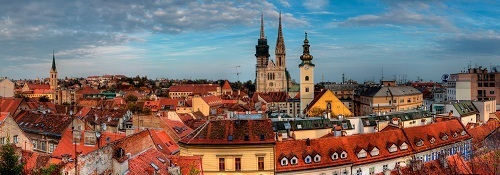
Zagreb
Mod
A Municipality in Croatia is known as an općina (plural: općine). Though equal to Croatian cities in administrative powers, they are usually more likely to consists of a collection of villages in more rural or suburban area, whereas Grads are more likely to cover urban area. As of 2014, there are 428 municipalities in Croatia.
http://en.wikipedia.org/wiki/Municipa...
Source: Wikipedia

Дубровник Dubrovnik - Croatia
Mod
A fascinating land with a hard-fought history in a complex corner of Europe, Croatia is emerging as one of Europe's top destinations. Sampling the very best of Croatia, we start by exploring the fabled Dalmatian Coast from dramatic Dubrovnik to crusty Adriatic island ports. Heading inland, we hike through Plitvice Lakes National Park and enjoy the thriving capital city Zagreb. Our Croatian finale: the Istrian Peninsula and its enchanting port town of Rovinj.
http://youtu.be/GVxZxOaEuF4
Source: You Tube - Rick Stevens
Mod
Nestled inside its mighty ramparts is Dubrovnik, the "Pearl of the Adriatic." From this remarkably preserved medieval fortress city, we venture into less-touristed corners of the former Yugoslavia. In Bosnia-Herzegovina, we visit Mostar — war-torn in the '90s, but bursting with promise today. In Montenegro, we sail the fjord-like Bay of Kotor and explore its mysterious, mountainous interior.
http://youtu.be/D5Buk6NPVPg
Source: You Tube - Rick Stevens
 Mod
Mod
 by
by
 Ivo Goldstein
Synopsis:
When in the fourth century the Roman empire split into the Western and Eastern empires, the boundary between the two stretched from the Montenegrin coast up the river Drina to the confluence of the Sava and the Danube and then further north. This boundary has remained virtually unchanged for 1,500 years: the European, Catholic West and the Orthodox East meet on Slav territory. There were, and still are, ethnic similarities between the peoples on either side of the divide, but their culture and history differ fundamentally.
The Croats and Croatia, on the western side of the divide, are traditionally linked with Hungarian, Italian, and German regions and Western Europe, and are also influenced by their long Mediterranean coastline. Ivo Goldstein's Croatia provides a necessary, accessible history of development of what is now an independent state. Croatia includes major sections on the early medieval Croatian state (until 1101), the periods of union with Hungary (1102-1526) and with Austria (1526-1918), incorporation in Yugoslavia (1918-91) and the creation of a sovereign state. Charting social, economic, and cultural developments, Goldstein shows us that this complex historical pattern explains many of the political developments of today
Mod
 by Marcus Tanner (no photo)
Synopsis:
From the ashes of former Yugoslavia an independent Croatian state has arisen, the fulfillment, in the words of President Franjo Tudjman, of the Croats' "thousand-year-old dream of independence." Yet few countries in Europe have been born amid such bitter controversy and bloodshed: the savage war between pro-independence forces and the Yugoslav army left about one-third of the country in ruins and resulted in the flight of a quarter of a million of the country's Serbian minority.
In this book an eyewitness to the breakup of Yugoslavia provides the first full account of the rise, fall, and rebirth of Croatia from its medieval origins to today's tentative peace. Marcus Tanner describes the creation of the first Croatian state; its absorption into feudal Hungary in the Middle Ages; the catastrophic experience of the Ottoman invasion; the absorption of the diminished country into Habsburg Austria; the evolution of modern Croatian nationalism after the French Revolution; and the circumstances that propelled Croatia into the arms of Nazi Germany and the brutal, home-grown "Ustashe" movement in the Second World War. Finally, drawing on first-hand knowledge of many of the leading figures in the conflict, Tanner explains the failure of Tito's Communists to solve Yugoslavia's tortured national problem by creating a federal state, and the violent implosion after his death.
Croatia's unique position on the crossroads of Europe—between Eastern and Western Christendom, the Mediterranean, and the Balkans and between the old Habsburg and Ottoman empires—has been both a curse and a blessing, inviting the attention of larger and more powerful neighbors. The turbulence and drama of Croatia's past are vigorously portrayed in this powerful history.
Mod
 My grandparents emigrated from what is now Croatia. They always considered themselves "Austrians" since it was then part of the Austrian Empire. My husband and I are going to visit Croatia in a few months. I'll have to check out this information.
Mod
My grandparents emigrated from what is now Croatia. They always considered themselves "Austrians" since it was then part of the Austrian Empire. My husband and I are going to visit Croatia in a few months. I'll have to check out this information.
Mod
Samanta is from Croatia and may be able to help you too. The country sure has been through a lot in its history. After World War I - it seceded from Austria-Hungary and became Yugoslavia - it wasn't until 1991 that it gained its independence.
It looks like a beautiful country.
 Let's look at the positive side of this beautiful country. Take this book with you when you visit as it provides some little known areas to visit to appreciate the people and culture.
Croatia
 by Leandro Zoppé (no photo)
Synopsis:
"DK Eyewitness Travel Guide: Croatia" is your indispensable guide to this beautiful part of the world. The fully updated guide includes unique cutaways, floor plans, and reconstructions of the must-see sights, plus street-by-street maps of cities and towns.
DK's insider travel tips and essential local information will help you discover the best of this country, from local festivals and markets to day trips around the countryside. Detailed listings will guide you to hotels, restaurants, bars and shops for all budgets, while practical information will help you to get around by train, bus, or car.
With hundreds of full-color photographs, hand-drawn illustrations, and custom maps that brighten up every page, "DK Eyewitness Travel Guide: Croatia" truly shows you around this destination as no one else can.
 Watch famous Croatian cellist Ana Rucner perform Ode to joy and Lindjo in the promotional videos made as part of Croatian National Tourist Board's tourist campaign of 2011 - "Croatia - the new tourism star of the European Union".
Ode to joy (video)
Project coordinator: Croatian National Tourist Board
Performer: Ana Rucner, Croatian cellist
Ana Rucner - Ode to joy
Lindjo (video)
Project coordinator: Croatian National Tourist Board
Performer: Ana Rucner, Croatian cellist
Ana Rucner - Lindjo
Ana Rucner
Ana is an innovative artist with numerous international and national awards for her work, a successful performer whose show is equally well received all over the world. Ana Rucner toured China, Korea, Japan, India, Russia, Scandinavian countries, Australia, the United States, Brazil, Holland, Germany, Belgium, France, Spain, Italy, Chech republic, Ukraine, Hungary, Slovakia, Austria, Slovenia, Serbia, Monte Negro, Macedonia, Greece, Israel, Turkey and the Emirates, spreading the joy of music and the genius of some of the greatest composer of all times in her modern and unique style.
Every show and every concert is for Ana a chance for promotion of Croatia, and for her promotional activities she has received several awards collaborating with the Croatian National Tourist Board and the Zagreb Tourist Board. Ana was also honoured with the prestigious F.E.S.T. 2011 charter for her extraordinary contribution to development of culture and tourism at the 14th annual ITF’CRO tourism film festival 2011.
Source: Youtube and Ana Rucner Official Site
More about Croatia:
 by Robert Cooper (no photo)
The "History, culture, art heritage" series by Turistička naklada
by Robert Cooper (no photo)
The "History, culture, art heritage" series by Turistička naklada by Antun Travirka (no photo)
Pula: History, Culture, Art Heritage (no image) by Antun Travirka (no photo)
Istria: History Culture Art Heritage (no image) by Antun Travirka (no photo)
Dubrovnik: history, culture, art heritage (no image) by Antun Travirka (no photo)
 by Ana Ivelja - Dalmatin (responsible editor) (no photo)
Synopsis from the publisher:
These soft-bound monographs, in a format adjusted to travel, reveal a unique sense and spirit of Croatia, its cities, regions, islands ... We have tried to present tradition, history, culture, art, attractions, monuments and natural heritage of Croatia, a country that has inherited exceptional values, has kept them, and today it offers everyone to enjoy them and leave them intact for all those who will come after them.
Our authors are excellent writers of monographs who have, by word and image, transferred their knowledge, experience and love. They have opened the door for better knowing of our country, its people, heritage, life, culture and mysteries.
In this series, monographs of individual shrines are published and also monographs of secular and religious buildings, churches, monasteries and their art treasures.
Part of the series is dedicated to the Croatian national parks. Most monographs have a geographic map or plan of the city.
Source:Turistička naklada
Traditional Croatian souvenirsCravat
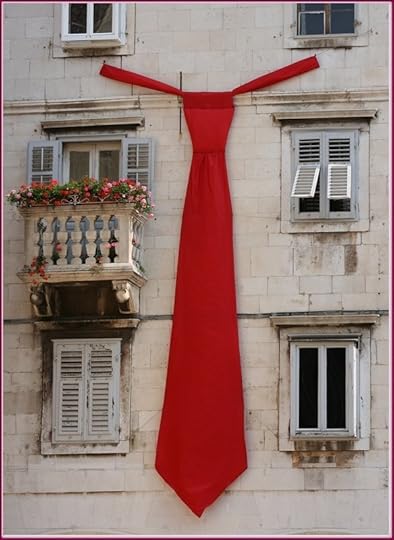
A very innovative commercial for the brand Croata
Overview:
The cravat (/krəˈvæt/, krə-VAT) is a neckband, the forerunner of the modern tailored necktie and bow tie, originating from 17th-century Croatia.
The cravat originated in the 1630s; like most men's fashions between the 17th century and World War I, it was of military origin. In the reign of Louis XIII of France, Croatian mercenaries[4] were enlisted into a regiment supporting the King and Cardinal Richelieu against the Duke of Guise and the Queen Mother, Marie de' Medici. The traditional Croat military kit aroused Parisian curiosity about the unusual, picturesque scarves distinctively knotted at the Croats' necks; the cloths that were used ranged from the coarse cloths of enlisted soldiers to the fine linens and silks of the officers. The sartorial word cravat derives from the French cravate, a corrupt French pronunciation of Croate. Croatia (Hrvatska in Croatian) today celebrates Cravat Day on October 18.

A guard dressed in traditional garb standing in front of the Croatian Parliament in Zagreb
If you find yourself in Croatia and you want to buy a cravat as a souvenir be sure to visit here:
Croata or Kravata Zagreb
Read the rest here: Cravat on Wikipedia
Source: Wikipedia
Licitarsko srce (Gingerbread heart)Overview:
Licitars (pronounced [lǐtsitaːr]) are colorfully decorated biscuits made of sweet honey dough that are part of Croatia's cultural heritage and a traditional symbol of Zagreb. They are used as an ornamental gift, often given at celebrations of love such as weddings and St. Valentine's Day. At Christmas time, the city of Zagreb and the Christmas tree in the main square in particular are festooned with thousands of licitar hearts.
In 2010, UNESCO added the Gingerbread craft from Northern Croatia to the "Representative List of the Intangible Cultural Heritage" for Croatian culture.
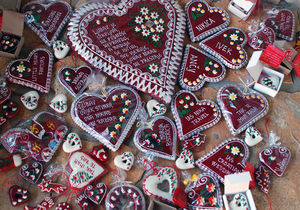
Licitar hearts
Read the rest here: Licitar on Wikipedia
Source: Wikipedia
I love the cravat!!!!!! That was new information for me. I knew about the licitars which are so beautiful.
You know the story about licitars? Why the looks as they do? It is said that, when you give a girl (or a boy in modern times :) ) a licitar heart you have to give it with the mirror facing the person you are giving it to. That way he/she sees his/her refelection and knows that he/she is your heart and that your heart belongs to him/her. A very sweet story really. :)
The original scarf(later called cravat by French) was actually a sign of love and affection given to the soldiers by their mothers or sweethearts or sisters. It was meant to bring them luck and eventually bring them back home safe and in one piece. Thus the color red (the color of love).
"Eternal Zagreb: stories and legends from Zagreb" by Ljiljana Marks (no photo)
Synopsis:
For the first time in this book, centuries old narratives, myths and legends from and about Zagreb are gathered: stories about the founding of Zagreb, about the Manduševac spring. St. Mark's square and Matija Gubec, Mother Mary and the Stone gate....
Original records, narratives and teksts are accompanied by the author's comentaries and illustrations made by Rudi Labaš.
My review:
A great collection of written and oral popular legends of Zagreb and the surrounding area with a thorough and interesting introduction by the author of the collection.
Some of the stories were familiar and with some I learned something new. It is generally an interesting collection, with a few stories that were simply nonsensical. The problem with some was that they were written or spoken in a dialect of old Zagreb or Zagorje (north of Zagreb) and I had trouble understending them.
Croatian rulers: dukes, kings, bishops by Neven Budak (no photo)
Synopsis:
"Probably every historian sometimes feels the need to fantasize about persons he writes about; to try to put himeself to times that are a subject of his scientifical research and with his own fantasizing fulfill the great black holes set by the past."
These are the words from the preface of the new book of the author Neven Budak that probably best describe the motives for which this great national expert for Croatian Middle ages and the main expert adviser of the highly successful TV series "Croatian kings", decided to bring to life some of the most important characters - dukes, kings and bishops - and events from the earliest Croatian history to which he dedicated a large part of his scientific research.
Eleven fictionalized stories included in this book - about Ivan, the Archbishop of Split; Grgur, the Bishop of Nin, dukes Borna, Trpimir and Mutimir, as well as about kings Tomislav, Stjepan I Držislav and his successors (Svetosalav Suronja, Krešimir III and Gojslav), Stjepan III, Zvonimir and finally about the end of independent Croatian kingdom - were made in the period of almost twenty years and are "the fruit of imagination rooted in reality".
About the "Croatian kings" TV series mentioned in the synopsis above:
Overview:
"Croatian kings" is the name of the part documentary part fictional TV series produced by the Croatian National Television, that is, its Scientific - educational programme. The series consists of seven episodes.
The theme of the series is the earliest period of Croatian history, the time of the so-called national rulers form the Trpimirovic dynasty, from the beginning of the 9th century till the end of the 11th century. The last episode's theme is the period of the immigration of Croats to the area of modern-day Croatia.
Watch here the wonderful intro to the series. I really love it! :)
Croatian kings - Intro
The whole show can be found here: Croatian kings
and, believe it or not, I also found out that English titles can be found on the internet...just google "hrvatski kraljevi engleski titlovi"
Sources: Wikipedia and Youtube
Klapa (Dalmatia)Overview:
The klapa music is a form of traditional a cappella singing in Dalmatia, Croatia.
The word klapa translates as "a group of friends" and traces its roots to littoral church singing. The motifs in general celebrate love, wine (grapes), country (homeland) and sea. Main elements of the music are harmony and melody, with rhythm very rarely being very important.
In 2012 klapa was inscribed in UNESCO Intangible Cultural Heritage of Humanity.
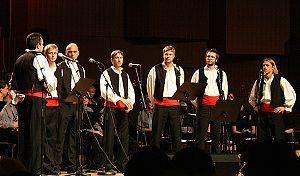
Male klapa "Sagena" in the Vatroslav Lisinski Concert Hall in Zagreb
Read more here: Klapa on Wikipedia
Watch the a capella performance of one of my favorite songs here:
Klapa Cambi - Izliči me (A capella)(Video)
Performer: Klapa Cambi from Kaštel Kambelovac near Split
Song: Izliči me (originally by Tedi Spalato)
Klapa Cambi - Izliči me - LIVE - 25 godina - Zagreb, Hypo Centar 2011
Sources: Wikipedia and Youtube
Mod
Personal stories from refugees forced to flee from Croatia/Bosnia.The Suitcase: Refugee Voices from Bosnia and Croatia
 by Julie Mertus (no photo)
Synopsis:
he whirlwind of Europe's longest war in half a century has produced this powerful collection of personal narratives—essays, letters, and poems—from refugees fleeing Bosnia and Croatia. Taking us behind the barrage of media coverage, these stories tell of perseverance, brutality, forced departure, exile, and courage. With startling immediacy and in moving detail, speakers tell of stuffing a few belongings—a handful of photographs, a rock from the garden, a change of clothes—into a suitcase and fleeing their homeland.
Contributors from all ethnic groups and every region of Bosnia and Croatia describe their sense of lost community, memories of those left behind, recollections of town squares that no longer exist, and homes now occupied by neighbors. The editors of The Suitcase, themselves representing the diverse peoples of the region, traveled to camps and temporary homes across the globe to collect these stories. An antidote to apathy, this work moves beyond and outside the vicissitudes of daily politics to portray the human tragedy at the center of present-day Bosnia and Croatia. Probing the intimate losses of countless individuals, it delivers a powerful indictment of injustice, militarism, prejudice, and warfare.
Mod
Zrinski guard from Čakovec, Croatia
Zrinski guard in front of the Zagreb Cathedral before the mass; photo taken on 14th June 2015; author: Samanta Bićanić
About the association:
The Association of citizens „Zrinska garda Čakovec“ was founded on 30th April 2001 with the goal of preserving and promotion of the heritage of the famous aristocratic family Zrinski, which ruled in Čakovec from 1546 to 1670. The wish of the founders is to prevent that people forget about the members of the family Zrinski and that future generations, in their homeland and outside of it, pay homage to their actions and learn how to nourish philanthropy, respect family, defend the home, love your country and God.
The association has within it a historical troops with guards, artilleryman and drum orchestra dressed in historical uniforms from the time of the Zrinski family. The Zrinski guard Čakovec performed many times in Croatia, Hungary, Slovakia, Poland, Austria, France, Italy and Vatican.
The member of the Association can be any honest and moral Croatian citizen of legal age, while the member of the historical troops can only be males age 18 to 35 that want to witness the heroism and chivalry of the Zrinski generals.
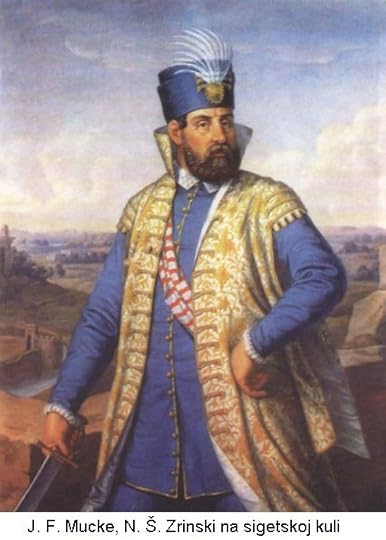
Nikola Šubić Zrinski, Croatian general and war hero from the 16th century
A short history lesson:
In 1546, Nikola Zrinski Sigetski, received a property in Čakovec and Međimurje from king Ferdinand, for his service and merit during war. The family Zrinski held Čakovec, which during their reign became one of the most important citadels in that part of the Habsburg empire, until 1670. The Zrinski had, from Čakovec, gone to many defense battles, today described in history textbooks, and invented many new ways of planning and leading battles, which brought them great fame in former imperial courts.
The Habsburgs weren't happy with the too big strength and influence the family Zrinski and their companions, the family Frankopan, had, because the economic strength allowed them to have a strong influence on independent decision-making on the fate of Croatia and its independence. It all ended with Zrinski and Frankopan joint rebellion, which had a bloody end on 30th April 1671 when Petar Zrinski and Fran Krsto Frankopan were decapitated in Wiener Neustadt (a city situated 50 km South of Vienna).
Thus the family Zrinski, made of cultural patrons, writers, but above all knights and generals, was exiled from Međimurje, imprisoned and robed by those whom they defended against the Ottomans.
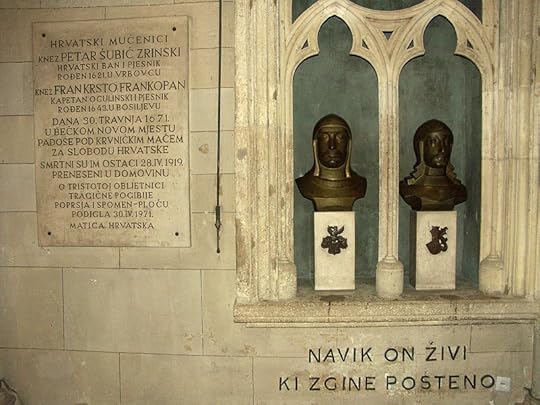
A monument dedicated to Petar Zrinski and Fran Krsto Frankopan inside the Zagreb Cathedral where they are now buried
Below the monument is the motto of the family that says "Navik on živi ki zgine pošteno" (in English: "Those who die with honour live forever"
Source: Zrinska garda Čakovec (in Croatian only)
You have such great adds about your country, Samanta. Thanks so much!!!!
I got the idea for the last one when I took the photo outside the cathedral.
Mod
Thank you! It gives me inmense joy to share things like this with all of you. :)
Taken on the morning of 3rd July 2015 on the streets of Zagreb, Croatia. A group of guys from Auckland, New Zealand, called Klapa Samoana, singing Croatian traditional klapa songs, in Croatian. I am overwhelmed and in tears. Croatian is far from an easy language, and singing klapa style requires some heavy skill. Vilo moja (video)
Project coordinator: Croatian National Television (HRT)
Performers: Klapa Samoana, Acapella/Male Voice Singing group from Auckland, New Zealand
Klapa Samoana - Vilo moja
Klapa Samoana
Klapa Samoana Vocal Ensemble seeks to connect with people across cultures through the medium of music, believing in the power of music to transcend boundaries and barriers unite humanity.
2011 saw the birth of this small ensemble, which, in that same year, had it's début at the Croatian Society's Annual Christmas concert. Since then they have performed at various events in both Croatian and Pacific circles, hoping to communicate to its audience the joys of music, regardless of culture, language or ethnicity.
Sources: Youtube and Klapa Samoana Official Facebook page
Traditional manufacturing of children’s wooden toys in Hrvatsko Zagorje (UNESCO intangible cultural heritage)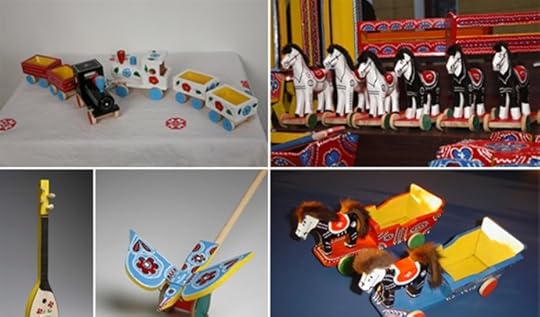
Wooden toys
Villagers along the pilgrimage route to the Marian shrine of Our Lady of the Snow in Marija Bistrica in Hrvatsko Zagorje in northern Croatia developed a technique for traditional manufacturing of children’s wooden toys that has now been handed down for generations. The men in a family take soft willow, lime, beech and maple wood from the region and dry, hew, cut and carve it using traditional tools; the women then apply ecologically-friendly paint in improvisational floral or geometric patterns, painting ‘from imagination’. The whistles, horses, cars, tiny furniture, spinning dancers, jumping horses and flapping birds produced today are almost identical to those made more than a century ago – though no two toys are precisely the same, thanks to the handcrafted production process. Popular among both locals and tourists, these toys are sold in parish fairs, markets and specialty shops around the world. They have also evolved with the times and, in addition to the traditional shapes such as horses and carts, new ones representing cars, trucks, airplanes and trains have appeared, reflecting the world surrounding modern-day children. Tiny toy instruments, carefully tuned as they are created, still serve as important components in the musical education of rural children.
The art of making traditional wooden children's toys in Hrvatsko Zagorje was made part of UNESCO-s Representative List of the Intangible Cultural Heritage of Humanity in 2009.
Sources: UNESCO and Tourist board Marija Bistrica
Mod
Exactly! Plus, children get to play with something other than Transformers, Winks (or however the heck they are called :D).
Mod
Since I've spent this weekend in my beloved second hometown, Zadar, I thought it appropriate to introduce you to some sun and sea related features of the city.The most beautiful sunset in the world...at least according to Alfred Hithcock :)
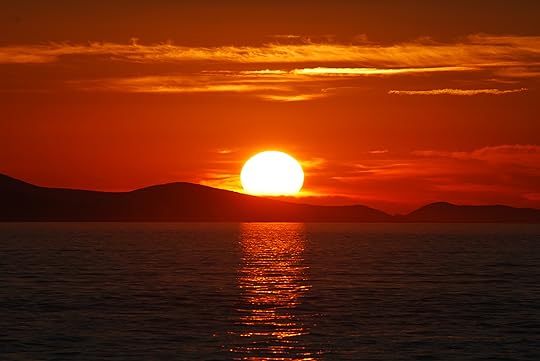
On the occasion of his visit to Zadar, in May 1964, while observing the luxurious game played by the sun the Maestro said: »Zadar has the most beautiful sunset in the world, more beautiful than the one in Key West, in Florida, applauded at every evening.«
The Sea Organ
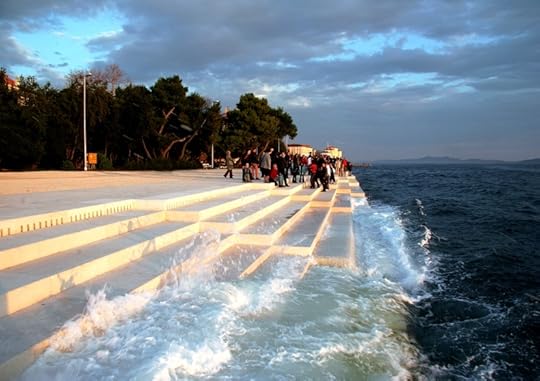
Sea Organ is situated on the western end of Zadar´s Riva, and can be observed as a differently shaped part of the coast which consists of several stairs that descend into the sea.
The stairs extend for about 70 meters along the coast, under them, at the lowest sea-tide level, 35 pipes of different lenght, diameter and tilts were built in vertically to the coast and they raise aslant until the paved part of the shore and end in a canal (a service corridor). On the pipes there are LABIUMS (whistles), which play 7 chords of 5 tones. Above the canal there are perforated stone stairs through which the sound comes out, the air pushed by the sea.
Sea Organ is constructed according to the project made by Croatian architect Nikola Bašić who, in 2006, received the European Prize for Urban Public Space in Barcelona for his Zadar Sea Organ project, as the best among 207 candidate projects from across Europe.
The Greeting to the Sun
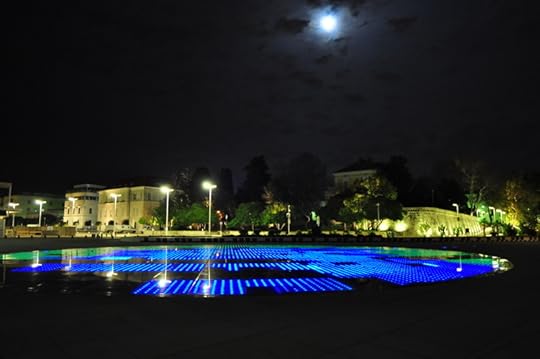
The Greeting to the Sun consists of three hundred multi-layered glass plates placed on the same level with the stone-paved waterfront in the shape of a 22-meter diameter circle. Under the glass conduction plates there are photo-voltage solar modules through which symbolic communication with nature is made, with the aim to communicate with light, just like the Sea Organs do with sound.
The photo-voltage solar modules absorb the sun energy and then transform it into electrical energy by releasing it into the distributive voltage power network. It is expected for the entire system to produce around 46.500 kWh yearly, being, actually, a small power plant from which energy will be used not only for the Greeting to the Sun installation, but also for the lighting of the entire waterfront. This energy will be three times cheaper than the actual one, and the project itself is a unique example of connecting the use of renewed energy sources, energy efficiency and city space arrangement.
The Greeting to the Sun installation, as a model of the solar system with its appertaining planets, is connected to the Sea Organs whose sound is transposed into a show of light that starts performing on the Zadar waterfront after sunset. In creating the lighting effects, the installation will be able to receive other outer, spontaneous impulses through modem connection, while the lighting pictures will adapt to different occasions.
Source: Zadar tourst board
Mod
There is so much about Croatia of which I was unaware. Your posts are just wonderful.....thanks so much.
 Spectacular! Zadar has been added to my list of must-visit cities/regions for our trip next summer. I second what Jill said: your posts are wonderful, Samanta.
Thank you, all! I'm glad you like it. It warms my heart because I love my country and am really proud of it. And I like showing it to you. :) :)
Kristen, Zadar has a very long history, dating from the Roman times (the remains of Roman forum is a testimony to that) and it was also the capital of Dalmatia during Venetian rule. In the past few years the City has worked a lot on perserving the old remains and making some new tourist attractions (like the Organ and the Greeting) to use the space that, for years, had been totally empty and used for nothing.
Spectacular! Zadar has been added to my list of must-visit cities/regions for our trip next summer. I second what Jill said: your posts are wonderful, Samanta.
Thank you, all! I'm glad you like it. It warms my heart because I love my country and am really proud of it. And I like showing it to you. :) :)
Kristen, Zadar has a very long history, dating from the Roman times (the remains of Roman forum is a testimony to that) and it was also the capital of Dalmatia during Venetian rule. In the past few years the City has worked a lot on perserving the old remains and making some new tourist attractions (like the Organ and the Greeting) to use the space that, for years, had been totally empty and used for nothing. If you do get a chance to visit Zadar, be sure to visit the attractions mentioned in the post above, St. Donat's church (from 9th century AD), the exibition "The Gold and Silver of Zadar" kept in the monastery right next to the church of St. Mary and climb the tower of the Cathedral (St Anastasia or Stošija, as the locals call it). The great things is that all of those things are practicaly right next to each other.
Unique Croatian Tourist Tour Wins International Award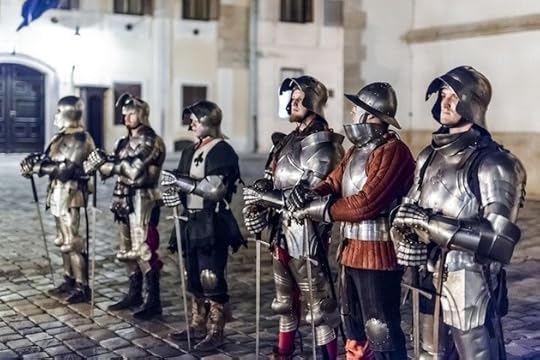
Some international recognition for one of Zagreb’s favourite cultural tourist tours…
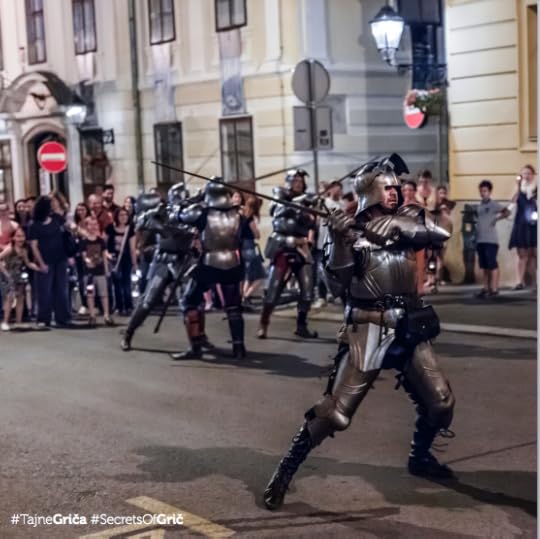
The interactive theater night tour Secrets of Grič was last month nominated for an award at The Luxury Travel Guide Awards 2016, and after voting by more than 500,000 registered users from all over the world, the Croatians were announced the winners in the Unique Experience of the Year category.
Secrets of Grič is a tour designed for those who wish to discover the historical and mystical side of the capital. The 1-hour tour is based on historical facts, romanced history taken from the novel by Marija Jurić Zagorka, and the famous urban legends. Night tour “The Secret of Grič” is special for its evening term and costumed historical and fictional characters that represent the city’s history on a scenic and interactive way that visitors can partake in some scenes.
Source: CroatiaWeek (http://www.croatiaweek.com/unique-cro...)
 Marija Jurić Zagorka
 This sounds fascinating. I had always hoped to visit this part of the world, but was never able.

The History Book Club
Books mentioned in this topic
101 Zagrebački naj… (other topics)Seljačka buna (other topics)
Seljačka buna Matije Gupca - Nova povijest 1573. (other topics)
The Krapina hominids: an illustrated catalog of skeletal collection (other topics)
Croatian Tales of Long Ago (other topics)
More...
Authors mentioned in this topic
Michael Bull (other topics)August Šenoa (other topics)
Zvonimir Despot (other topics)
Jakov Radovčić (other topics)
Ivana Brlić-Mažuranić (other topics)
More...
We have World Hosts that are folks who are helping out with the country threads. There can be multiple group members who are World Hosts for any country. In the case of Croatia - Samanta Bićanić is one of the World Hosts for the country of Croatia. Samanta is from Croatia and has volunteered to help out.
Croatia officially the Republic of Croatia is a sovereign state at the crossroads of Central Europe, Southeast Europe, and the Mediterranean. Its capital city is Zagreb, which forms one of the country's primary subdivisions, along with the twenty counties. Croatia covers 56,594 square kilometres (21,851 square miles) and has diverse, mostly continental and Mediterranean climates. Croatia's Adriatic Sea coast contains more than a thousand islands. The country's population is 4.28 million, most of whom are Croats, with the most common religious denomination being Roman Catholicism.
The Croats arrived in the area of present-day Croatia during the early part of the 7th century AD. They organised the state into two duchies by the 9th century. Tomislav became the first king by 925, elevating Croatia to the status of a kingdom. The Kingdom of Croatia retained its sovereignty for nearly two centuries, reaching its peak during the rule of Kings Peter Krešimir IV and Dmitar Zvonimir. Croatia entered a personal union with Hungary in 1102. In 1527, faced with Ottoman conquest, the Croatian Parliament elected Ferdinand I of the House of Habsburg to the Croatian throne. In 1918, after World War I, Croatia was included in the unrecognised State of Slovenes, Croats and Serbs which seceded from Austria-Hungary and merged into the Kingdom of Yugoslavia. A fascist Croatian puppet state existed during World War II. After the war, Croatia became a founding member and a federal constituent of Second Yugoslavia, a constitutionally socialist state. In June 1991, Croatia declared independence, which came into effect on 8 October of the same year. The Croatian War of Independence was fought successfully during the four years following the declaration.
A unitary state, Croatia is a republic governed under a parliamentary system. The International Monetary Fund classified Croatia as an emerging and developing economy, and the World Bank identified it as a high-income economy. Croatia is a member of the European Union (EU), United Nations (UN), the Council of Europe, NATO, the World Trade Organization (WTO) and a founding member of the Union for the Mediterranean. As an active participant in the UN peacekeeping forces, Croatia has contributed troops to the NATO-led mission in Afghanistan and took a non-permanent seat on the UN Security Council for the 2008–2009 term.
The service sector dominates Croatia's economy, followed by the industrial sector and agriculture. Tourism is a significant source of revenue during the summer, with Croatia ranked the 18th most popular tourist destination in the world. The state controls a part of the economy, with substantial government expenditure. The European Union is Croatia's most important trading partner. Since 2000, the Croatian government has invested in infrastructure, especially transport routes and facilities along the Pan-European corridors. Internal sources produce a significant portion of energy in Croatia; the rest is imported. Croatia provides a universal health care system and free primary and secondary education, while supporting culture through numerous public institutions and through corporate investments in media and publishing.
Remainder of Article: http://en.wikipedia.org/wiki/Croatia
Source: Wikipedia
Location:
Flag: