
Catching up on Classics (and lots more!) discussion

This topic is about
The Illustrated Man
Buddy Reads
>
The Illustrated Man

message 1:
by
Sara, Buddy Reads
(new)
-
rated it 4 stars
Mar 31, 2025 08:22AM
 Mod
Mod
reply
|
flag
 Thank you, Sara. I just picked up my library copy over the weekend.
 Waiting on my library copy.
 Mod
Mod
 Mod
Mod
Mod
Mod
 I started it tonight, and thought the overall premise of an illustrated man was clever.
 I read it a few years back, but I'll see if I can find my copy and read a few of the stories.
 I have been looking forward to this book! I plan to buy it on my kindle tomorrow and start reading.
 Got my copy from the library. Looking forward to reading another Ray Bradbury book with my reading friends!
I plan to read stories a day. That way I read many enough to enjoy and few enough to make short quick notes.
Mod
Got my copy from the library. Looking forward to reading another Ray Bradbury book with my reading friends!
I plan to read stories a day. That way I read many enough to enjoy and few enough to make short quick notes.
Mod
I first read The Veldt as a standalone short story back in 2020. At that time, I gave it four stars and was impressed with the quality of Bradbury’s writing. I did not think about the story any deeper than to blame the parents for their lack of discipline and control of their kids.
This time I thought about technology, specifically video games and the internet. This was written in 1950, if memory serves television was in its infancy. I’m a child of the sixties and TV was a big thing. But it pales when compared to the power of video games and time spent on the internet. As I’m doing right now. Yes, I’m addicted and spend way too much time on-line, just like the Hadley children.
Was Bradbury giving us a warning about the dangers of technology in 1950?
Mod
I first read The Veldt as a standalone short story back in 2020. At that time, I gave it four stars and was impressed with the quality of Bradbury’s writing. I did not t..."
I totally agree, Bob. It's kind of amazing how right Bradbury got this threat of technology, way back then.
I loved this line: "This room is their mother and father, far more important in their lives than their real parents." I suppose we felt like that about TV when we were kids, a little bit, but not nearly as much as kids today (all of us really, as you say), feel about the internet. Plus I think it was easier back then for parents to control our TV time, since EVERYTHING didn't revolve around the TV the way it does around the internet now.
 Mod
Mod
And a warning on not "truly living."
Mod
The Veldt is eerily recognizable in our present society. I agree that it mirrors the addictions to game play and internet use, the separation of families even when they are together, and the dangers of having a technology that makes people obsolete. Bradbury is so good at pinpointing the possible traps in what was the future for him and has become reality for us.
 I wanted to join this one, but I am behind in my assignments and at the moment only 78 pages into Chesapeake, out of 1,081 pages of pure Michener pleasure. So I am passing for now, but may read it later this year.
Technology certainly can use up hours of time before you even realize it, and keeps people from socializing as much.
I wanted to join this one, but I am behind in my assignments and at the moment only 78 pages into Chesapeake, out of 1,081 pages of pure Michener pleasure. So I am passing for now, but may read it later this year.
Technology certainly can use up hours of time before you even realize it, and keeps people from socializing as much.I've never tried Virtual Reality, but the experience in the room in The Veldt seems similar, but without the glasses. It's very cool that Bradbury was predicting the technology of the future in some ways. (While I could see how it could be addictive for kids as entertainment, virtual reality is also used to treat phobias, PTSD, and anxiety in mental health settings.)
Mod
I do love to read Michener
Mod
Beautifully said, Sara. The end gave me goose bumps! And I thought this line was so lovely:
“There was only the great diamonds and sapphires and emerald mists and velvet inks of space, with God’s voice mingling among the crystal fires.”
Mod
I also enjoyed the lovely writing in "Kaleidoscope" that Sara and Kathleen brought out so well."The Illustrated Man" was published in 1951 during the Cold War when nuclear war was on everyone's minds. Many of the black people living on Mars in The Other Foot had first-hand experience with the Jim Crow system. It was a story to make readers think what would happen if there was a reversal in social and political power. Would the Martian community be helpful or take revenge? The ending had me wondering if a black author would have been quite so generous to the white travelers. It would be a wonderful world if everyone could treat each other as just humans.
Mod
Interesting question, Connie. I could believe this ending, but it felt a little too much like everything was even at the end, when really, one side caused the suffering for both. But as in all conflicts, eventually someone has to say “The time for being fools is over. We got to be something else except fools.”
 Franky wrote: "I read it a few years back, but I'll see if I can find my copy and read a few of the stories."
I listened to a free audiobook of this one on YouTube four years ago and like it, though a few of the stories are a bit creepy. Alas, that book no longer seems available, which is too bad, as it had an excellent narrator. I was able to find a decent copy at a local used book store and have started it. I’m aiming for a story a day.
Connie (on semi-hiatus) wrote: "Technology certainly can use up hours of time before you even realize it, and keeps people from socializing as much.I've never tried Virtual Reality, but the experience in the room in The Veldt seems similar, but without the glasses. It's very cool that Bradbury was predicting the technology of the future in some ways."
Bradbury was indeed prescient when it came to future technology (at the time he was writing). He has another similar story that revolves around radio, “Ma Perkins Comes to Stay,” which is included in his book We'll Always Have Paris: Stories. It speaks of how easily the lines between reality and fiction can blur.
Ma Perkins" was a long-running American radio soap opera, known as "America's mother of the air," which premiered in 1933 and ran until 1960.
I was able to find it online, for anyone interested: https://www.fiftytwostories.com/?p=502
Re: “The Other Foot.”This is more or less a sequel for a story originally included in The Martian Chronicles, but which has apparently been excluded from some more recent editions of the book. It’s titled “June 2003: WAY IN THE MIDDLE OF THE AIR,” and is about the mass exodus of Black people from Earth.
It can be read here, for anyone interested:
https://classicsbookclub.wordpress.co...
 I've been traveling, so I'm a bit late to this, but expect to start in the next few days.
 I've actually read a few of the stories before, in other compilations: The Rocket Man, The Long Rain, The Fire Balloons (which seems to be in some versions and not others), The Last Night of the World, and The Rocket. I'll probably reread them though, so I can better take part in discussions (I haven't yet read the earlier posts about specific stories, to avoid spoilers).
I'm a fan of Bradbury's writing, and am looking forward to this one.
Mod
Sara wrote: "I have also read many of these stories before, but Bradbury is generally worth the re-read. Glad you are back, Wobbley, hope the trip was fun!"Thanks Sara. The trip had its charms, but I'm glad to be home. Maybe still a bit too jet-lagged for much reading, but I'm working up to it. ;)
Mod
Mod
Alright, I've gotten a start, and read the first two stories (I'll try to catch up to where you folks are as quickly as I can).The Veldt
I didn't actually enjoy this one, but nevertheless, Bradbury is usually trying to say something important. This is about what happens when we replace human connection with something artificial (such as technology). It is a cautionary tale. The particular effect here is on morality. The children's morality is most affected, because their experiences early in life did not come from the example of other people, and so they are never taught how to fit into society. (Reading the comments above about this story, I agree that it is quite prescient.)
Kaleidoscope
This is about how people face death and how it changes the meaning of our lives, and it was kind of heartbreaking. In just a few minutes, the characters go through a lot of stages of grieving. Although there is some hope in the end of the story (his death brings a small piece of hope to a child), for me the prevalent feeling was sadness. The writing was strong (well, it usually is with Bradbury). My favourite quote from this one:
From the outer edge of his life, looking back, there was only one remorse, and that was only that he wished to go on living. Did all dying people feel this way, as if they had never lived?
The next two stories: The Other Foot and The Highway.For me, these two stories sort of exemplify the tension Bradbury's stories often have between a certainty that we will destroy ourselves (particularly via atomic war) and a fundamental hopefulness about humanity.
The preoccupation with nuclear war is, I think, simply a product of being a thinking person in the time he was living, in the years after WWII. Both of these stories have the world being destroyed (or perhaps about to be destroyed) via atomic war.
The ending of The Other Foot is a bit of a twist. The story is about the self-perpetuating nature of hatred, and in the end of the story, the characters are able to break away from this cycle. I wish I could believe that it was a realistic ending to the story, but either way his hopefulness is refreshing.
The ending of The Highway is a little harder for me to get a handle on. On the one hand, it could be about how the large events of history don't really affect the day-to-day lives of most individuals. But if (as often happens in Bradbury stories that are about nuclear war) everything is destroyed, it will affect this person's life. Perhaps it's more about resignation. The main character may be affected in the end by large world events, but he knows he cannot stop them, so just goes on living his life as best he can.
Okay, now reading through everyone's comments on these stories: Sara, I absolutely agree that The Other Foot is a condemnation of racial segregation (still very much formally in place when this story was published). He's almost making use of a shock element: How ridiculous does it sounds to his readers that white people might be relegated to the back of the train and sometimes randomly killed by a mob just for being white? And if that sounds ridiculous, why doesn't it sounds ridiculous if it's happening to black people instead? He's trying to use reverse psychology to change people's minds, to snap them out of a pattern of thinking. (I wonder whether that sort of thing ever worked, or whether it could only convince those who were already convinced.) And you're right, he does a great job at tackling contemporary issues in a sci-fi setting. At its best, this is one of the most important roles of sci-fi.
Okay, looks like I'm caught up now. :)
Mod
I totally agree that these stories are a direct result of the political and world climate of this era. The threat of nuclear war hung over everything and no one could be sure that mankind would be smart enough to pull back from the brink. I think the threat is probably exactly the same today, we have just learned to live with it.
In The Man, space explorers land on a planet where the people are full of joy. They have been visited by a man who is Christ or a Christ-like figure. Some of the crew wants to stay on the planet to learn how to achieve this perfect happiness. But Captain Hart is only concerned about competition. He never slows down long enough to even think about what is important in life, so he'll never find peace, love, and healing.
Sara wrote: "Great comments, Wobbley. I thought a bit about The Highway, and I think the places that will be destroyed are the cities to the north. "Ah yes, I see what you mean Sara. Thanks, I think you've probably interpreted it correctly. I was thinking that even if it's the cities that get bombed, the fallout would be widespread. But it's true that in Bradbury's stories, he tends to focus on the bombed areas themselves as being the areas of destruction (this seems to be what's happened in The Other Foot, for example). Perhaps awareness about the fallout was more limited when he wrote these stories (or maybe I'm overestimating its extent). Either way, I think you've nailed the intent of the ending.
In The Long Rain, a crew is stranded on Venus since their rocket has been destroyed. There is unrelenting heavy rain on the planet which is driving them to madness. They compare it to water torture. Fungus grows on everything. They are looking for a Sun Dome, a warm shelter with an artificial sun, dry clothes, and food. One astronaut never lets go of hope, and is rewarded.There must have been a lot of fear in the 1950s that we would destroy the planet Earth with nuclear bombs, and find other planets unsuitable for human life. Very few people would survive.
Thanks for your comments about The Highway, Wobbley and Sara. It's a great point that only the simple way of life will survive in the short term, and only if the land was not contaminated. I think most of us in the modern world never even learned the skills to be self-sufficient since everything we need is at the grocery store.
Mod
And you explanation of The Highway is spot on, Sara. I thought it was a beautiful depiction of a simple life.
And I agree with Connie about The Man. My thought was peace can never come to a conquering society. I was inspired by this exchange:
Captain: "I overlook your petty insubordination.”
Lieutenant: "I don’t overlook your petty tyranny …”
Mod
Connie you are so right that we have forgotten all the skills that would be required to stay alive. Even if the blast and fallout did not get us, starvation would, because we would not have the time to learn how to grow food or properly catch and prepare animals to eat. Disease would be widespread and simple ailments would become deadly.
I am old enough to remember the under the desk drills during the Cuban Missile Crisis. It makes you laugh now. Why scare all the kids...a desk would have been zero protection against a nuclear bomb. Did we really understand so little? The scientists obviously knew, but we didn't want to panic the general population, so I guess such things made it seem a little less hopeless.
I also agree with Connie's interpretation of The Man. Kathleen, you chose a fantastic quote!I really liked this one. Martin was very likeable, of course, and I'm sure we all know people like the Captain.
I also liked that they never specified who they were comparing the Man to. Yes, perhaps he's a Jesus-like figure, or maybe he's a Buddha-like figure, and so on; everyone can bring their own interpretation to that detail. (Okay, maybe this is wishful thinking on my part -- they do mention it's been twenty centuries since the Man was on Earth, so maybe Jesus is the realistic option. However, we don't know when this story takes place, it could be hundreds of years in the future, so a more recent historical figure is a possibility. Perhaps that rules out Buddha, but Muhammad is still in the picture, as is the first Dalai Lama, Guru Nanak, Marcus Aurelius, etc.)
My favourite lines:
“Why, I’ll ask him for a little—peace and quiet.” He touched the rocket. “It’s been a long time, a long, long time since—since I relaxed.”
“Did you ever just try, Captain?”
The only thing I didn't like as much was the very ending: I would have liked the story better if the Man hadn't still been there, if Martin and the others had been staying just for the peace and because they had understood a truth, and not for the Man himself.
Mod
He could have been thinking of us destroying the earth with bombs, but climate science has been around a long time. From Wikipedia: this is from a 1912 Popular Mechanics article:
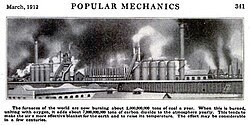
Unfortunately the words are blurry. They say: “The furnaces of the world are now burning about 2,000,000,000 tons of coal a year. When this is burned, united with oxygen, it adds about 7,000,000,000 tons of carbon dioxide to the atmosphere yearly. This tends to make the air a more effective blanket for the earth and to raise its temperature. The effect may be considerable in a few centuries.”
I can imagine Bradbury reading this kind of stuff. :-)
Mod
I really liked this one. Martin was very likeable, of course, and I'm sure we all know people like the ..."
I did not think the Man was still there, but that his spirit was, and thus the qualities that the Captain will seek and never find. He cannot ever catch the Man, who presents himself everywhere and then vanishes, leaving his teachings and his spirit. He is everywhere he has ever been, but not physically...and it is the physical that the Captain wants to find and never will. I thought this story was very much about the tangible vs. the intangible. Bradbury does seem to like exploring faith--not specifically religion but faith itself. (I might try to re-read this one before I return the book and see if I have gone wrong).
Mod
Sara wrote: "I did not think the Man was still there, but that his spirit was, and thus the qualities that the Captain will seek and never find."I didn't think of it this way. I don't know. I think it can maybe be interpreted either way. But the line at the end "We mustn’t keep him waiting" suggests to me that he's actually there. If it was only his spirit and teachings, that's not really something you can keep waiting, if you know what I mean. But perhaps I'm looking at it too literally. Everything the mayor has said before this would suggest he's not physically there. I certainly like your interpretation better than mine, I'm just not totally sure I believe it.
What do other people think? Is the Man still there?
The Long RainThis is my second time reading this story. The first time, I couldn't quite connect with it. I couldn't understand how rain would make someone kill themselves; it seemed so exaggerated. I feel like this time I got more out of his descriptions, and was better able to understand the suffering he was describing. This isn't meant to be anything like rain we have experienced.
This could be about any of the issues people have brought up: fear of global climate issues, or fear that we'll destroy the Earth and not find somewhere else we could live.
I'm wondering what people think: was the rain really able to turn their eyes white, for example, or is that meant to be a metaphor, or are they going crazy and only imagine that their eyes have turned white?
Mod
I love all these thoughts on The Man. I went back and re-read the end and think I agree with Sara: "He is everywhere he has ever been, but not physically...and it is the physical that the Captain wants to find and never will." If he was there physically, it wouldn't require faith. But like Wobbley, I like that this is based on a nameless, timeless being.
message 48:
by
Kathleen, New School Classics
(last edited Apr 09, 2025 02:34PM)
(new)
-
rated it 4 stars
Mod
Oh, this one really got to me. The song was a favorite from my young days when I had time to listen to songs over and over and over. I can’t believe this is the first time I’ve read the story that inspired it. The words always haunted me, and now I feel like I understand them. “And I think it’s gonna be a long long time, til touchdown brings me round again to find, I’m not the man they think I am at home oh no, no no. I’m a rocket man.”
The Rocket ManYeah, for me this is pretty easily the best story in the collection so far. Very emotionally effective. A tone of sad resignation throughout, the ending inevitable without feeling disappointingly predictable.
I think it's possible to read this story as being about addiction, and its effects on the addict and the addict's loved ones. Intellectually that feels like a valid interpretation, but somehow it's not what sticks with me; the poignant interactions and observations are what stick with me. I generally find that Bradbury's stories that resonate with me best are the ones with a strong poignant or nostalgic tone.
And he listened to me. That was the thing he did, as if he was trying to fill himself up with all the sounds he could hear. He listened to the wind and the falling ocean and my voice, always with a rapt attention, a concentration that almost excluded physical bodies themselves and kept only the sounds. He shut his eyes to listen.
I didn't realize this story was the inspiration for the Elton John song. Thanks for that, Kathleen.
The Last Night of the WorldThere is literally no part of me that believes that this is how everyone would react if they found out the world was ending.

Catching up on Classics (and lots more!)
Books mentioned in this topic
Zero Hour (other topics)Zero Hour (other topics)
Science Fiction: A Historical Anthology (other topics)
The Martian Chronicles (other topics)
The City (other topics)
More...
Authors mentioned in this topic
Ray Bradbury (other topics)Arthur C. Clarke (other topics)
Frank Herbert (other topics)
Ray Bradbury (other topics)
Ray Bradbury (other topics)
More...
