
The Pickwick Club discussion

This topic is about
David Copperfield
David Copperfield
>
Copperfield, Chapters 25 - 27
date newest »
newest »
 In Chapter 26, we learn about how David is getting on in the world and how he is articled by Spenlow and Jorkins. Whereas the occasion itself was not celebrated in a becoming way, Mr. Spenlow makes amends for this by inviting David to spend a weekend at his house some time later. Here he meets Dora Spenlow, his widowed employer’s daughter, who has just returned from Paris, and – guess what! – he again falls in love head over heels. Of course, it is rather awkward to fall in love with your boss’s daughter, but in David’s case matters are made worse by the fact that Dora’s chaperon in none other but Miss Murdstone, our old beloved ironclad. Miss Murdstone is no less dismayed by this unforeseen encounter than David, and she proposes a kind of truce to him which consists in their mutually refraining from making any comments on their antecedents. David willingly accepts the offer – however, I don’t think that Miss Murdstone will be as good as her word.
Dora obviously has taken a great dislike to her “confidential friend”, and it is to be hoped that she will not be subdued in the same way that Clara Copperfield was. By the way, what do you think of Dora? I find her rather childish … The whole love subject is treated in a funny vein by the narrator so that one might suppose that it is not to be taken too seriously after all. I’d also say that Mrs. Crupp has shown herself a woman of astute perception when she infers from David’s change of wardrobe and his tendency to wear shoes that are too small for him that he must be in love. And isn’t she brilliant in scrounging some brandy from him?
”She came up to me one evening, when I was very low, to ask (she being then afflicted with the disorder I have mentioned) if I could oblige her with a little tincture of cardamums mixed with rhubarb, and flavoured with seven drops of the essence of cloves, which was the best remedy for her complaint;—or, if I had not such a thing by me, with a little brandy, which was the next best. It was not, she remarked, so palatable to her, but it was the next best. As I had never even heard of the first remedy, and always had the second in the closet, I gave Mrs. Crupp a glass of the second, which (that I might have no suspicion of its being devoted to any improper use) she began to take in my presence.”
Chapter 27 is quite unassuming, exactly like the character for whom it is named, and it deals with David’s going to see his old friend Traddles. The shabby-genteel appearance of the house where Traddles lodges reminds David of the Micawbers, and an angry milkman upbraiding a maid for her master’s remissness in paying his bill, furthermore intensifies David’s associations. His chat with Traddles shows David that his old friend has not changed a lot: He is still a very good-natured, honest and modest young man who has earned his own position in professional life, unimpressive as it might be, to his own efforts and economy. He paid the 100 £ for being articled out of his own pocket, investing the majority of his savings, and although he is in love with a parson’s daughter he has decided to postpone the marriage until his financial situation is on a more secure footing. After all the two lovers have already bought two articles of furniture ;-) Traddles shares David’s admiration of Steerforth and he is even so good-natured as to imbue the dreadful Mr. Creakle, in retrospect, with an air of “It-wasn’t that bad after all”-ness.
Towards the end of their conversation David suddenly realizes that the house not only reminds him of Mr. Micawber but is also inhabited by the very self-same gentleman and his family. As usual Mr. Micawber is in dire straits but quite sure that something is going to turn up in the near future. His wife and children are in good health and there is even a new member of the family on the horizon for Mrs. Micawber is again in good hopes – a circumstance that was not regarded with much favour by her own family.
I am actually asking myself what I should think of Dickens’s repeatedly throwing the Micawbers into David’s way. Seems like relying too much on coincidence again, doesn’t it? There is a saying in German that you always see each other twice in life – but three times? In this context, however, it can be said that Micawber serves as a foil to Traddles, who is very hard-working, not much given to illusions of grandeur but putting his nose to the grindstone and who even postpones his personal plans to a moment when he will be able to raise a family responsibly. Mr. Micawber is the opposite of all that. However, is that a reason for having Micawber reappear?

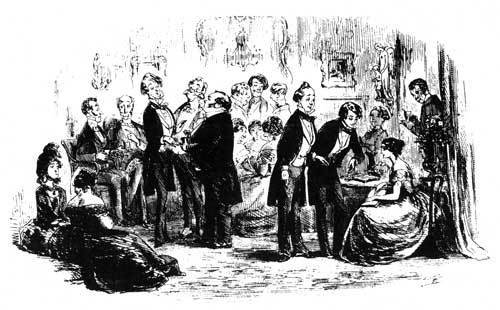
Uriah persists in hovering near us, at the dinner party
Chapter 25
"I found Uriah Heep among the company, in a suit of black, and in deep humility. He told me, when I shook hands with him, that he was proud to be noticed by me, and that he really felt obliged to me for my condescension. I could have wished he had been less obliged to me, for he hovered about me in his gratitude all the rest of the evening; and whenever I said a word to Agnes, was sure, with his shadowless eyes and cadaverous face, to be looking gauntly down upon us from behind."
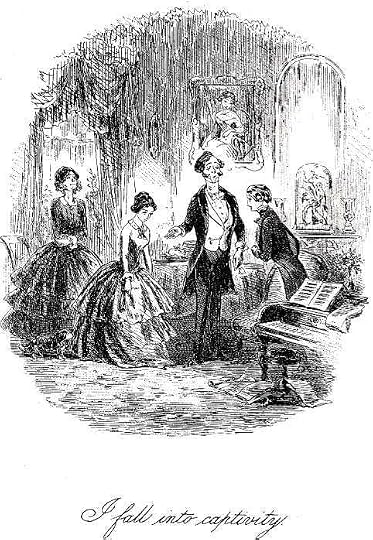
Chapter 26
"I heard a voice say, "Mr. Copperfield, my daughter Dora, and my daughter Dora's confidential friend!" It was, no doubt, Mr. Spenlow's voice, but I didn't know it, and I didn't care whose it was. All was over in a moment. I had fulfilled my destiny. I was a captive and a slave. I loved Dora Spenlow to distraction!"
 Congratulations, Tristram, on your nephew's baptism. It was really good of you to open the thread at all. Haven't caught up
on this section yet - otherwise engaged with my older son being home from London this week. :-)
 Tristram wrote: "Dear Fellow Pickwickians,
I am afraid that this week’s summaries will be rather short because today my little nephew was baptized and I spent most of the day at my sister’s house. Maybe it’s just ..."
It is one of my least favorite aspects of Dickens that he creates characters I come to care about and then sacrifices them mercilessly for his dramatic purposes. I fear this is the fate he has in store for Agnes. No decent minded author could force her to marry a Uriah Heep. But will Dickens? I greatly fear for her.
Tristram wrote: "Dora obviously has taken a great dislike to her “confidential friend”, and it is to be hoped that she will not be subdued in the same way that Clara Copperfield was. "I have confidence in Dora. And I think she would be good for David if she would take him in hand. But maybe that's too simple?
I think we're getting close to the point when we can start to ask whether the presentation of David's personality as he ages is psychologically valid, whether it comes across as real. I have somewhat my doubts, but I won't express them quite yet.
Tristram wrote: "Towards the end of their conversation David suddenly realizes that the house not only reminds him of Mr. Micawber but is also inhabited by the very self-same gentleman and his family. "This is two chapters almost in a row that Dickens has recycled characters we reasonably assumed we were done with. First Miss Murdstone shows up completely unexpectedly as Dora's companion. What possibly qualified her to be a young lady's companion? And where is Mr. Murdstone? And then, by golly, Mr. Micawber shows up again, also in a totally unexpectedly guise of a landlord (how has he gathered enough money to be a landlord of anyplace?) I know that Dickens is committed, one might almost say addicted, to coincidence as a key ingredient of his novels, but these two popping back up in completely unrealistic guises so close together -- both in the same magazine section -- is a bit much I think even for a Dickens lover.
And I could very easily have done without revisiting either of them ever again. But I sort of thought we had to revisit Micawber, since there is such a deal of him being a wonderful comic figure, but there wasn't enough of him on our first encounter to justify that, so it's not unexpected that we see more of him.
But Miss Murdstone? Begone with you foul woman and never darken our pages again!
I must say, however, that Dickens is getting into his stride in creating a palate of very different, very memorable supporting characters. We may not like Uriah Heep -- I pity any person who does -- but he is certainly memorable and very strongly drawn. Miss Murdstone, likewise. Both villains in their way, but not obviously villainous in a traditional sense. Then there's Aunt Betsy, a totally different person but equally strongly drawn. Mr. Murdstone, Little Emily, Ham, Peggoty, Mr. Peggoty, Steerforth, Agnes, all come as alive as real people we met would, but not a duplicate among them -- all strongly independent. Miss Dartle, not so much yet, but it's early days for her. Traddles is the only character who doesn't yet ring really true for me. I just can't believe in him. But even Dickens has to stumble somewhere.
 Tristram wrote: "Dear Fellow Pickwickians,
I am afraid that this week’s summaries will be rather short because today my little nephew was baptized and I spent most of the day at my sister’s house. Maybe it’s just ..."
First, congratulations to your sister and all the family on the occasion of your nephew's baptism. It's never too early to start the young man on Dickens; Anderson's stories on the other hand ...
Chapter 25 is a rich and full one. I found Dickens's phrasing and structuring of the chapter particularly rich. David tells us that Agnes " put her hand - its touch was like no other hand - upon my arm for a moment. This gesture reminds us of Little Em'ly's hand gestures, or lack of, when she meets with Steerforth while with Ham. Could we see this action as having both an emotional and a protective context? As a good angel, Agnes is touching David as a protector, as darkness and evil are soon to present themselves to both him and those he loves. In addition, is the touching of the arm a precursor and suggestion of something yet to occur between David and Agnes?
For now, let's remember that when David sees Agnes she is "netting a purse." We have seen characters earlier with purses that suggested their characters. I think it might be interesting to continue considering how purses are being used as symbols in the novel.
It seems that this chapter offers us a parallel in character relationships as well. Just as Steerforth seems to have some grasp or control over David, so Uriah Hep has gained control of a sort over Mr. Whitfield.
Did anyone else feel that Dickens's description of Uriah Heep had suggestive concepts of Heep being snake-like? Heep's "shadowless red eyes, which looked like they had scorched their lids off" his "snakey undulation pervading his frame" and David's contemplation of Heep as if he had a "splay foot on Mr. Wickfield's head" all suggest an evil, a devil-like character who appears to take the night away when he leaves David's house makes me uncomfortable to say the least.
Everyman wrote: "Tristram wrote: "Dora obviously has taken a great dislike to her “confidential friend”, and it is to be hoped that she will not be subdued in the same way that Clara Copperfield was. "I have conf..."
I agree with you Everyman. There is much to discuss about the development of David's character. Perhaps in a couple of weeks we will have a major point of maturation, or point in a young man's life when he should be mature occur and then away we go ...
David has yet another passion! Dora seems to be the latest in a long line of young ladies that capture his adolescent heart and mind. The epanalepsis description of Dora as little ... "little voice," little laugh, " tell us much about Dora and David's maturity. Mrs. Crupp's habit of calling David "Mr. Copperfull" is suggestive of David's lack of an established personality and persona. From Trotwood to Daisy and to now to Copperfull David is seen by others as something and someone else. To become David Copperfield will be a struggle to maturity and a singular identity.
Peter wrote: "Mrs. Crupp's habit of calling David "Mr. Copperfull" is suggestive of David's lack of an established personality and persona. From Trotwood to Daisy and to now to Copperfull David is seen by others as something and someone else."Really appreciate that observation. I hadn't picked up on it, but should have. And let's not forget the Murdstones imposing their name on young David.
 Peter wrote: "Everyman wrote: "Tristram wrote: "Dora obviously has taken a great dislike to her “confidential friend”, and it is to be hoped that she will not be subdued in the same way that Clara Copperfield wa..."
Regarding David's development, I found the transition between his concern for Agnes, and infatuation of Dora, a stark one. This was intensified by Miss Murdstone's reappearance, and David's willingness to make a truce, for fear she will disparage him to Dora, who he has just met. Considering the impact Miss M had on his childhood, it was difficult for me to believe. He barely confronts her, and appears more concerned of Dora's opinion, than her well-being under the 'companionship' of someone who David's aunt calls a 'murdering sister'. Dickens' comment on the nature of falling in 'love', and/or David's immaturity?
I felt David's childhood was echoed in the greenhouse geraniums (Mr. Murdstone insisting Clara choose one for him), as well as Miss M sitting beside him in church and watching them vigilantly over books in the evening.
Peter wrote: "Did anyone else feel that Dickens's description of Uriah Heep had suggestive concepts of Heep being snake-like? Heep's "shadowless red eyes, which looked like they had scorched their lids off" his "snakey undulation pervading his frame" and David's contemplation of Heep as if he had a "splay foot on Mr. Wick field'so head" all suggest an evil, a devil-like character ...."Yes, this is something cold-blooded and reptilian about Heep. What he reminds me most of, is a gargoyle -- from his first introduction, when David thinks he sees his face on the end of a beam outside Wickfield's house. It fits with his sliminess. Although gargoyles were meant to ward off evil spirits, there's an increasingly sinister sense of duplicity with Heep. Does anyone know what Dickens means by referring to him as a 'detestable Rufus'? His thumb shaking the table and the room was palpably creepy.
Interesting contrast to Steerforth as a 'bad Angel' (a fallen one?).
Vanessa wrote: "Peter wrote: "Did anyone else feel that Dickens's description of Uriah Heep had suggestive concepts of Heep being snake-like? Heep's "shadowless red eyes, which looked like they had scorched their ..."Yes, a fallen angel fits nicely into a framework of analysis. To me, there seems to be many hints of the good, characterized by the good angelic Agnes, and the fallen angel(s) characterized by both Steerforth and Uriah Heep. In the middle, drawn, pushed and pulled every which way, is David. I think that David is unsure about where to turn, which path to choose, and indeed, who he really is as an individual is reflected by the various names others tag him with in the chapters.
David needs to find the path that will lead to him to becoming a fully-formed individual. David's image of Heep's "splay[ed] foot" on Mr. Wickfield's neck is horrid. The devil has cloven hooves. Both Heep and Steerforth are given characteristics of the devil. David certainly needs a guardian angel.
Vanessa wrote: "What he reminds me most of, is a gargoyle -- from his first introduction, when David thinks he sees his face on the end of a beam outside Wickfield's house."Nice.
Vanessa wrote: "Does anyone know what Dickens means by referring to him as a 'detestable Rufus'?"This is what I found out about a "rufus":
Latin, meaning: red, ruddy.
Roman cognomen which meant "red-haired" in Latin. Several early saints had this name, including one mentioned in one of Paul's epistles in the New Testament. As a nickname it was used by William II Rufus, a king of England, because of his red hair. It came into general use in the English-speaking world after the Protestant Reformation.
Canis rufus - reddish-grey wolf of southwestern North America it is a predatory carnivorous canine mammals of North America and Eurasia that usually hunt in packs.
In "A Child's History of England" written by Dickens, chapter 9 was titled: "England Under William the Second, Called Rufus". Here is some of what Dickens says in this chapter:
"Rufus was no sooner on the throne, than he ordered into prison again the unhappy state captives whom his father had set free, and directed a goldsmith to ornament his father's tomb profusely with gold and silver. It would have been more dutiful in him to have attended the sick Conqueror when he was dying; but England itself, like this Red King, who once governed it, has sometimes made expensive tombs for dead men whom it treated shabbily when they were alive."

"Hamlet's aunt betrays the family failing, and indulges in a soliloquy on "blood."
Chapter 25
Fred Barnard

Dora
Chapter 26
Fred Barnard

"Here," drawing the cloth off with great pride and care, "are two pieces of furniture to commence with."
Chapter 27
Fred Barnard
Kim wrote: "Dora
Chapter 26
Fred Barnard"
Kim
Thanks for the pictures. I am really enjoying the work of Fred Barnard. The Dora one you just posted really is wonderful.
Tristram wrote: "Uriah seems to know something about her father that enables him to keep him under his thumb. Not only is he going to be a partner in the business but – as David is going to find out later – he also entertains serious hopes of marrying Agnes. Whatever happened to Mr. Wickfield that made him become dependent on Uriah?" I found this out about a possible real Uriah Heep in Dickens life:
"Thomas Powell (eventually revealed as an embezzler and forger) was, according to Dickens biographer Edgar Johnson, originally introduced to Charles Dickens by the latter’s ne’er-do-well brother Augustus. Powell and Augustus Dickens were fellow clerks in the office of Thomas Chapman, a friend of Charles Dickens. Through Augustus, Powell ingratiated himself into the Dickens household, and dined several times with Charles Dickens at the Dickens home, Devonshire Terrace. Later, it was revealed that through a series of forgeries, Powell had defrauded his employer Chapman out of 10,000 pounds. Chapman took pity on Powell for the sake of the latter’s family, and forgave his crime. Subsequently, Powell passed forged checks defrauding various tradesmen. He was brought before a magistrate, but escaped prosecution by having himself certified insane and committed to a lunatic asylum. He thereafter fled to New York where he escaped prosecution for another forgery. Powell passed himself off as a literary man who had mingled with many celebrities in London, and published a sketch of Dickens in “The Evening Post.” Hearing of the sketch, Dickens branded it “A complete and libelous lie.” Dickens wrote to New York publisher William Gaylord Clark, giving the latter a full account of Powell’s career. Dickens’s letter was published in the “New York Tribune.” Powell then sued Dickens for 10,000 pounds. In retaliation, Dickens gathered together all of the evidence of Powell’s misdeeds, and in 1849 had Bradbury and Evans print these in a four-page pamphlet, which Dickens forwarded to Charles Kent, editor of “The Sun.” Eckel terms this pamphlet the “Leaflet on Thomas Powell,” and says that there is only one known copy of it. Eckel further states that Powell cultivated the acquaintance of various well-known writers, including Leigh Hunt. Robert Browning corrected the proof sheets of a collection of verse published by Powell. According to Eckel, Browning later regretted his acquaintance with Powell, and wrote to a friend, “None of your Powells inspecting my Bowels.” According to Eckel, Powell was also acquainted with Tennyson and Wordsworth."
Whether Dickens will send Uriah to an lunatic asylum, I can't remember.
Kim wrote: "Tristram wrote: "Uriah seems to know something about her father that enables him to keep him under his thumb. Not only is he going to be a partner in the business but – as David is going to find ou..."Wonderful information Kim. Thank you. More and more it appears Dickens is introducing into DC people he had acquaintance with in his life.
Peter wrote: " More and more it appears Dickens is introducing into DC people he had acquaintance with in his life."It is generally described as semi-autobiographical for, I assume, this very reason (as well as echoing many of the things that happened to him in his childhood).
Which, though, makes me wonder why he made DC an orphan (other than the convenience of orphans in literature, which we have discussed here before) and an only child. After all, his parents both, I believe, lived into his adulthood, and he was the second of eight children. So most of DC's childhood is very much NOT autobiographical (in addition to the above, Dickens was brought up in cities, Portsmouth and London, not in the country).
Everyman wrote: "Peter wrote: " More and more it appears Dickens is introducing into DC people he had acquaintance with in his life."It is generally described as semi-autobiographical for, I assume, this very rea..."
Yes. There are numerous bits and pieces of Dickens's life that run through this novel. DC and GE seem to have the most echoes of his life. The time little David spends at Murdstone's factory is reflective of the real time Dickens spent at Warren's Blacking Factory, which makes its first veiled appearance in OT. You make a great point about David's "escape" to the country in the novel. I wonder if that was a dream/ wish of young Charles.
Aren't Kim's research items great?
David's interest in Miss Dartle was somewhat unexpected as I don't remember his having a particular rapport with her at the time. His falling head-over-heels in love with Dora, not at all surprising. David follows a similar pattern here. I'm glad at least that he had the courage to say his bit to Miss Murdstone, though she escaped very lightly. What on earth was Spenlow thinking in employing her as his daughter's companion? Not thinking, I suppose. Surely even a glance at said lady ought to have told him with what sort of character he was dealing. So yet again another motherless 'child' is thrown on the mercies of Mother Theresa Murdstone. In Dora's case, however, it looks as though no quarter will be given. Dora will have her way, though why she doesn't make her dislike of her companion clear to her father I fail to understand.
Agnes, Traddles and the Micawbers reappear, all it seems to me with a benign influence. Why couldn't Agnes be his true love?! Then we have the 'umble, unworthy, underhanded Uriah. Ugh! And Steerforth ... Agnes has read his cards and David is yet too blind to see the truth. Poor David certainly wouldn't make a good candidate for the detective branch.
Thanks Peter for drawing attention to Mrs Crupp and her naming David, 'Copperfull'. I don't know that Mrs Crupp finds a place with the baddies, but so far she is a waste of space and more so, of brandy.
David, Copperfield, Trotwood, Trot (did they toy with Murdstone at a time?), Daisy and Copperfull. It certainly smacks of a certain loss of identity and when looked at as a whole seems more than a tad condescending.
Peter, you mention the purse that Agnes is netting and the potential symbolism. Interesting. I wonder if she will have money to fill her purse or if it will remain as purely decorative. The lack of money and desire for it seem to be recurring themes.
Hilary wrote: "David's interest in Miss Dartle was somewhat unexpected as I don't remember his having a particular rapport with her at the time. His falling head-over-heels in love with Dora, not at all surprisi..."Hi Hilary
Names, references to purses, boats/boat names, the use of imagery and such stuff fascinates me in a novel. Too often I will follow one, but unlike a bloodhound, end up just bumping my nose on a wall. Still, the fun is in the hunt.
It does seem to me that the constant references to purses is too frequent to be just unintended chance. We'll see.
Yes indeed, Peter, we shall. :-)
Hilary wrote: "David, Copperfield, Trotwood, Trot (did they toy with Murdstone at a time?),"They did indeed. Remember that's the name they put him under (was it the inn, or the coach? one of those) when he went off to school. He asked about David Coopperfield, they didn't have that name, then he said try David Murdstone, and that they had.
I'm not sure which name he actually used at school. Did we ever find out?
Ah of course, Everyman, you're right. I remember the Murdstone patronym. Thankfully that one didn't catch on for long.I thought that at Creakle's school he was under the name of David Copperfield, hence Copperfield, except, of course, for Steerforth's Daisy. I should not, however, like to take the witness stand on this. Well, Daisy, yes. A definite undermining of David by Steerforth in his use of the name of such a delicate flower. Of course, it is only with hindsight that this occurs to me.
Poor guy. :-(
Kim wrote: "Vanessa wrote: "Does anyone know what Dickens means by referring to him as a 'detestable Rufus'?"This is what I found out about a "rufus":
Latin, meaning: red, ruddy.
Roman cognomen which mean..."
Thanks, Kim! Uriah is getting redder with each chapter. "Rufus" is reinforced then by his mulberry great-coat. (I've never pictured a great-coat in that colour.) A sign of blood and/or hell?
Dickens' History of England sounds like a fun, irreverent read. Heep certainly wants to be King at the House of Wickfield...
I hadn't really noticed that Agnes was netting a purse. Now that I think of it, it brings to mind fish nets (not stockings:) and the Peggottys. Who don't really have anything to do with Agnes, but maybe in the sense of family and sustenance. Or possibly David's safety net of sorts? David was called Copperfield at Creakle's school. I wonder how he managed that?
Vanessa wrote: "I hadn't really noticed that Agnes was netting a purse. Now that I think of it, it brings to mind fish nets (not stockings:) and the Peggottys. Who don't really have anything to do with Agnes, but..."Hi Vanessa
Talking about purses, I recall you were the one who initially spotted the similarities between Miss Murdstone and her iron personality ( or would that be purse-inality?) and her purse. My bet is that if we rummage through the appearances of purses and the like with their owners we will find some interesting insights. I think Agnes and her action of "netting" a purse is significant. We will see ...
Hi Vanessa, I'm not sure if he actually was known as Copperfield in Creakle's school, hence I would not like to find myself 'sworn in'.
Hi Hilary,I recalled he was summoned by David Copperfield when informed of his mother's death. There was a feeling of impending loss, which I suppose made it stick in my mind. I think Steerforth also called him Copperfield, in his pre-Daisy days.
Your association between Agnes' purse and money is interesting too. It seems obvious now you mention it, but it hadn't occurred to me. So many levels of interpretation with the names as well...
Peter: "purse-inality" :)
Everyman wrote: "I'm not sure which name he actually used at school. Did we ever find out?" One of the last things said to him while still at home but about to leave for school was by Miss Murdstone:
'Master Copperfield's box there!' said Miss Murdstone, when wheels were heard at the gate.
So he was Copperfield to her, then you are right he was under the name of Murdstone at the inn:
'Is that the little gentleman from Blunderstone?'
'Yes, ma'am,' I said.
'What name?' inquired the lady.
'Copperfield, ma'am,' I said.
'That won't do,' returned the lady. 'Nobody's dinner is paid for here, in that name.'
'Is it Murdstone, ma'am?' I said.
'If you're Master Murdstone,' said the lady, 'why do you go and give another name, first?'
Every reference I can find of his name at school is Copperfield, Master Copperfield or young Copperfield by Steerforth.
Thanks for following this up, Kim. :-)
Kim wrote: "Everyman wrote: "I'm not sure which name he actually used at school. Did we ever find out?" One of the last things said to him while still at home but about to leave for school was by Miss Murdst..."
Like Hilary, thanks Kim. I am trying to keep track of all the names/changes David is undergoing. Quite the list so far.
Hilary wrote: "Congratulations, Tristram, on your nephew's baptism. It was really good of you to open the thread at all. Haven't caught upon this section yet - otherwise engaged with my older son being home fr..."
Thanks, Hilary! My daugher's baptism will be on Sunday, 14th June :-)
Peter wrote: "her iron personality ( or would that be purse-inality?)"Oh Peter, you just made my day! More of that, please!
Talking of names as a sign of how David is denied the status of adulthood or personality by others - or of how he simply lacks personality yet, let's not forget that Uriah Heep always calls him "Master Copperfield" just in order to correct himself by saying that it should actually be "Mister Copperfield" but never really keeping up mistering instead of mastering him.
Tristram wrote: "Talking of names as a sign of how David is denied the status of adulthood or personality by others - or of how he simply lacks personality yet, let's not forget that Uriah Heep always calls him "Ma..."Nice! I'm keeping a list of David's many names. At the end of the novel let's see how many there are.
It must be at least half a dozen names,not including his actual one.
Tristram wrote: "It must be at least half a dozen names,not including his actual one."I'm at eight in the first 40 chapters. Could even Dickens be running out of names ...? No, didn't think so ;-)
Peter wrote: "Tristram wrote: "It must be at least half a dozen names,not including his actual one."I'm at eight in the first 40 chapters. Could even Dickens be running out of names ...? No, didn't think so ;-)"
As long as he doesn't run out of characters, he can hardly be running out of names ;-)

I am afraid that this week’s summaries will be rather short because today my little nephew was baptized and I spent most of the day at my sister’s house. Maybe it’s just as well that I won’t start the discussion with all my impressions, associations and ideas this time but stick mostly to what is going on in the novel …
Chapter 25 is entitled “Good and Bad Angels”, which made me really anxious to read on because I wanted to know especially who the “Bad Angels” were – and I found my suspicions confirmed. After his embarrassing housewarming party, David is summoned to Agnes, who is presently staying at the house of a certain Mr. Waterbrook, who does legal business with her father. Agnes, the good angel, warns David not to trust too much in Steerforth, to whom she has taken an instinctive dislike. At first, David is inclined to defend Steerforth against her remonstrations but later on, when he thinks matters over, there appears to be a sense of suspicion that Agnes might be right. The conversation between Agnes and David also centres on changes that have occurred in the position of Uriah Heep within the House of Wickfield. Uriah seems to know something about her father that enables him to keep him under his thumb. Not only is he going to be a partner in the business but – as David is going to find out later – he also entertains serious hopes of marrying Agnes. Whatever happened to Mr. Wickfield that made him become dependent on Uriah?
I was also surprised that apparently David seems to have taken some fancy to Miss Dartle, whom he likes to talk to – for she is very clever – but whom he does not adore, as he points out. The chapter also brings back a very likeable character from David’s schooldays, Tommy Traddles, who sometimes works for Mr. Waterbrook and who, according to that gentleman, is one of those men that stand in their light. So apparently nothing has changed since Salem House times?
The most gripping part of this chapter is certainly the second half, in which Uriah Heep spends the rest of the evening starting at Waterbrook’s house with David. His creepy way of appearing meek and servile and at the same time leaving no doubt as to his sense of power and influence! Uriah seems to take infinite pleasure in making David feel that it was he, David, who once told him that he might one day oven be a partner to his employer Wickfield. He clearly warns David not to interfere with his pursuit of Agnes because otherwise there might be “unpleasentness” – for David? for Mr. Wickfield? for Agnes?
The chapter has a very powerful ending:
”I never shall forget that night. I never shall forget how I turned and tumbled; how I wearied myself with thinking about Agnes and this creature; how I considered what could I do, and what ought I to do; how I could come to no other conclusion than that the best course for her peace was to do nothing, and to keep to myself what I had heard. If I went to sleep for a few moments, the image of Agnes with her tender eyes, and of her father looking fondly on her, as I had so often seen him look, arose before me with appealing faces, and filled me with vague terrors. When I awoke, the recollection that Uriah was lying in the next room, sat heavy on me like a waking nightmare; and oppressed me with a leaden dread, as if I had had some meaner quality of devil for a lodger.
The poker got into my dozing thoughts besides, and wouldn't come out. I thought, between sleeping and waking, that it was still red hot, and I had snatched it out of the fire, and run him through the body. I was so haunted at last by the idea, though I knew there was nothing in it, that I stole into the next room to look at him. There I saw him, lying on his back, with his legs extending to I don't know where, gurglings taking place in his throat, stoppages in his nose, and his mouth open like a post-office. He was so much worse in reality than in my distempered fancy, that afterwards I was attracted to him in very repulsion, and could not help wandering in and out every half-hour or so, and taking another look at him. Still, the long, long night seemed heavy and hopeless as ever, and no promise of day was in the murky sky.
When I saw him going downstairs early in the morning (for, thank Heaven! he would not stay to breakfast), it appeared to me as if the night was going away in his person. When I went out to the Commons, I charged Mrs. Crupp with particular directions to leave the windows open, that my sitting-room might be aired, and purged of his presence.”
This physical revulsion at seeing his ungainly guest asleep in his own sitting-room was one of the scenes I vividly remembered from my first reading of the novel – and now I can imagine why Dickens was able to draw such a haunting picture: Maybe he was thinking of the horrible experience of having Hans Christan Andersen as a guest in his house. Andersen was apparently not able to speak English very well, but still I wonder whether he ever read David Copperfield and whether he might have recognized himself in Uriah Heep.