
Dickensians! discussion

This topic is about
A Christmas Tree
Short Reads, led by our members
>
A Christmas Tree

 Links to on-line versions of A Christmas Tree:
https://vsfp.byu.edu/index.php/title/...
http://www.free-short-stories.org.uk/...
https://www.dickens-online.info/some-... (this link includes all 4 of the stories we will be reading)
Summaries
Summary 1 starts HERE
Beginning of essay to: There is everything, and more
Summary 2 starts HERE
From: This motley collection of odd objects….
To: "he was ghastly, and not a creature to be alone with."
Summary 3 starts HERE
From: When did that dreadful Mask first look at me?
To: ……was a mighty marvel and a great delight.
Summary 4 starts HERE
From: Ah! The doll's house......
To: ….how the tails of the larger animals used gradually to resolve themselves into frayed bits of string!
Summary 5 starts HERE
From: Hush! Again a forest, and somebody up in a tree….
To: ….the oppression of the weight of remorse.
Summary 6 starts HERE
From: And now, I see a wonderful row of little lights…..
To: “Forgive them, for they know not what they do.”
Summary 7 starts HERE
From: Still, on the lower and maturer branches of the tree, ….
To: And never left off saying so, until he went to bed
Summary 8 starts HERE
From: Or, a friend of somebody’s whom most of us know,…..
To: ……almost at the very top; ripening all down the boughs
Summary 9 starts HERE
From: Among the later toys and fancies hanging there.
To: The End
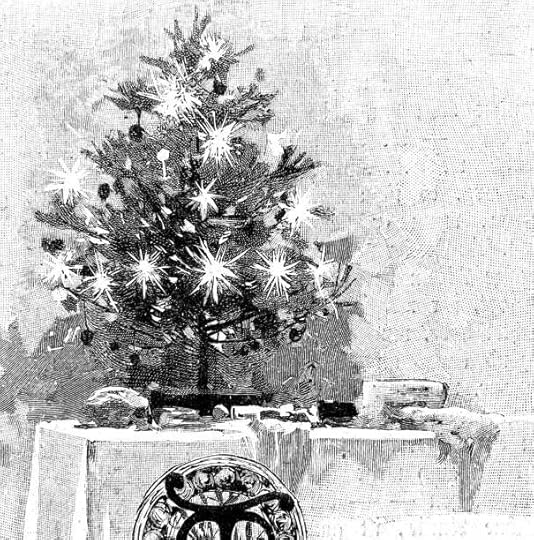
Welcome to our reading of Charles Dickens' short reflections withing A Christmas Tree: by Charles Dickens.
I'm looking forward to spending time with you with delightful stories and our invigorating discussions of them.
The short stories are unillustrated. Any illustration, therefore, (and there are a few) are not original illustrations.
We will start our reading on Friday, December 19.
(I'm posting this segment early because I'm going out of town until our start date)
A Short History of the Christmas TreeThe evergreen fir tree has been used in pagan and Christian rituals for over a thousand years but its first use as a Christmas tree is unknown. The first documented case was in the town square of Riga the capital of Latvia in 1510. A plaque commemorates the tree in eight languages as the first New Year tree.
The custom was introduced into England during the Georgian period. Queen Charlotte, German wife of George III, is known to have had a decorated tree for her family as early as the 1790s, and there is also a record of a tree at a children's party given by a member of Queen Caroline's court in 1821. Queen Victoria herself remembered such trees in the 1830s, happily describing potted trees placed on round tables 'hung with lights and sugar ornaments'.
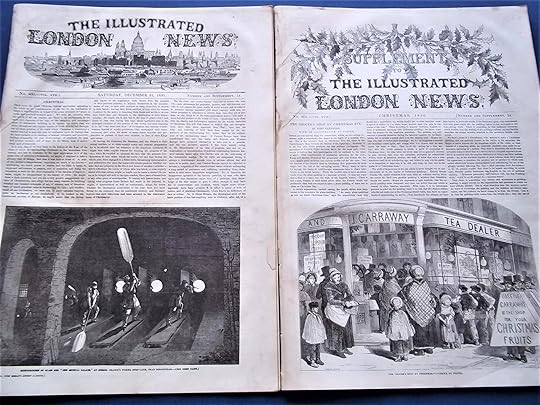
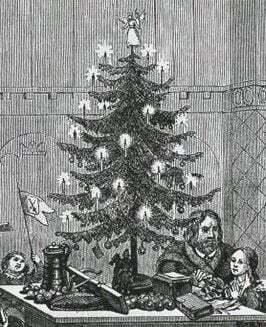
In 1848, a print showing Prince Albert and Queen Victoria with their children was published in the Illustrated London News. From this time onwards, the popularity of decorated fir trees spread beyond Royal circles and throughout society.
Trees were generally displayed on tables in pots, with gifts placed unwrapped underneath. The tree was decorated with wax candles, baskets of sweets, flags and little ornaments and gifts.
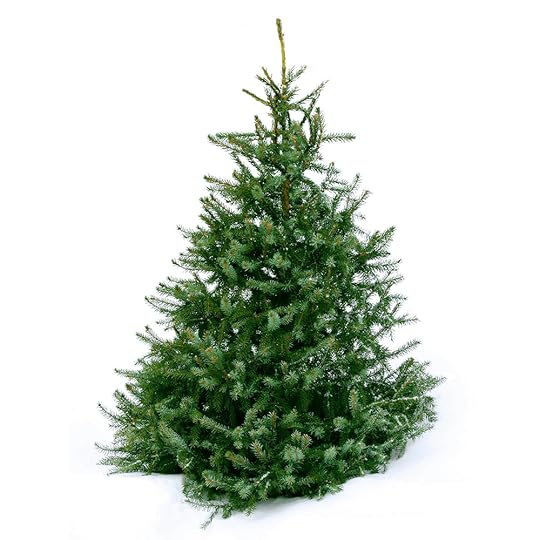
The imported German Springelbaum was the tree of choice until the 1880s, at which time the home-grown Norway Spruce became available. This made a larger tree more affordable, and people began placing trees on the floor.
The Springlebaum Christmas tree: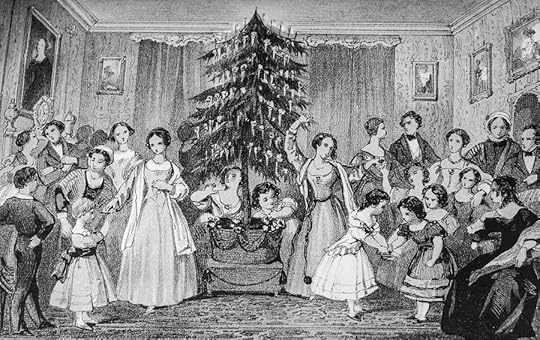
 The Illustrated London News, Dec 21, 1850
 A Christmas Tree by Charles Dickens
A Christmas Tree: by Charles Dickens is an essay of remembrance and reflection of the Christmas spirit, with some nostalgia thrown in.
Using the Christmas tree as the focus, Charles Dickens takes us through his thoughts, feelings and memories of this special time of year.
I've kept the summaries short to allow for each of us to allow the essay to wash over us and help us bring out our own memories and reflections without adding my own words, even inadvertantly.
As we read, we can reflect alongside Dickens and share his delight in the wonder of the Season.
A Christmas Tree Summary 1The story begins with a description of a Christmas tree standing on a table. It is lit with little candles.
Gifts, toys, tasty treats and trinkets are under it and among its branches.
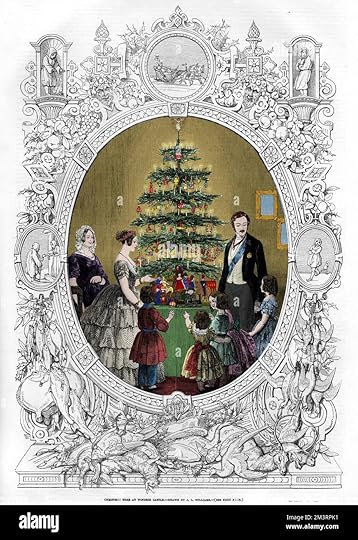
In 1848, a print showing the Royal couple with their children was published in the Illustrated London News.
Here is a colorized picture of the print.
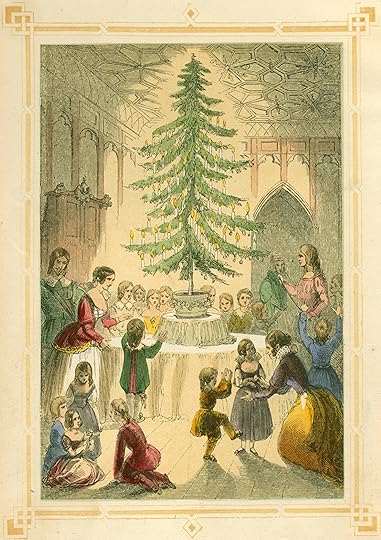
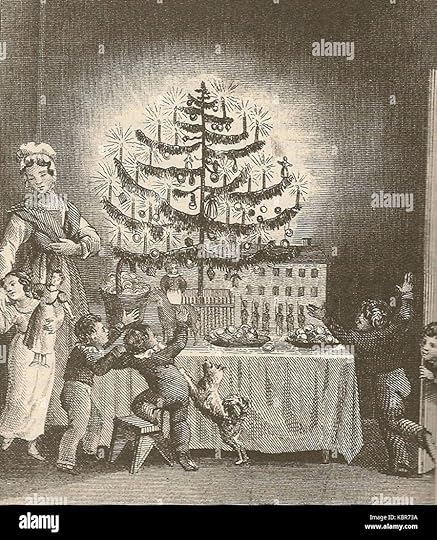
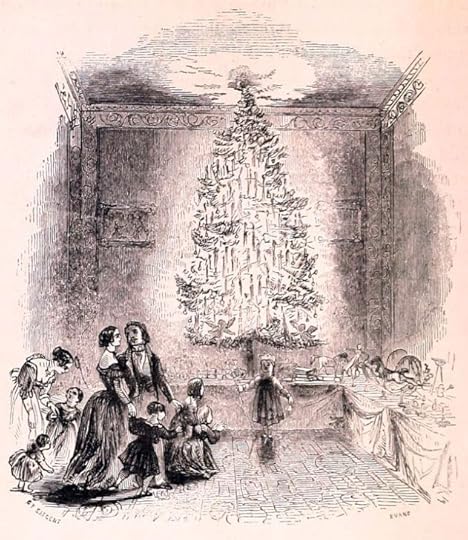
 Mod
Thanks, Jean. The original publications have no illustrations. I hope I've found some that reflect the intentions of this essay.
I loved this first section. It was, to me, full of wonder and a sense of festive excitement, what with all the gifts in and under the tree.
Mod
Thanks, Jean. The original publications have no illustrations. I hope I've found some that reflect the intentions of this essay.
I loved this first section. It was, to me, full of wonder and a sense of festive excitement, what with all the gifts in and under the tree. I particularily liked:
"there were jolly, broad-faced little men, much more agreeable in apperarnce than many real men - and no wonder, for their heads took off, and showed them to be full of sugar-plums"
I got a chuckle from that.
I enjoyed the listing of all the gifts in the tree. Gifts were the first baubles & decorations, it seems. That's something I didn't know.
Gifts weren't wrapped but hung open in the tree or under it. I can almost feel the excitement building in the kids when they saw gifts but didn't know which were theirs and couldn't play with them until Christmas.
There was an indication of, perhaps, the first Christmas ornament, in Dickens' description of fruit: (there was) "real fruit, made artificially dazzling with gold leaf". I imagine that these looked like Christmas ornaments hanging on the tree.
There's a Christmas magic in the last line, "as a pretty child, before me, delightedly whispered to another pretty chidl, her bosom friend, "there was everything, and more" "
This brings to me feelings of the excitement and anticipation building up as Christmas draws near.
 The illustrations are wonderful! Thank you, Petra!
I'll be reading the essay all in one piece.
 I love this essay--read it a few years ago. I'll be enjoying re-reading with you all, and appreciating all of the detail. Thank you for the background and the lovely illustrations, Petra! I love the ones of Victoria and Albert and family.
I have a question about this section. What is a teetotum? I could google it, but it's more fun if someone is familiar and wants to share. :-)
I looked that up, too, Kathleen, when I first read this essay. It's some type of spinning toy, like a top. It would be interesting to find out how "teetotum" became the name for a spinning toy.
I am hoping that the illustrations help bring the essay to our lives and remind us of the magic of Christmas, a little bit. The families gathered around the trees, the children jumping for joy and looking at the tree in wonder, brings to mind the magic of Christmas. All is good; all is possible.
The other thing that raised my eyebrows.....there are guns and swords on or under the tree...just sitting on the table! Different times, for sure.
 I’m looking forward to reading these Christmas stories with everyone and putting us in the spirit of Dickens’ Christmas! Thank you for finding all those illustrations, Petra. My, how I wish Dickens had included an illustration of all those lit candles and trinkets and toys and sweets “hiding behind the green leaves”, “dangling from innumerable twigs”, and “perched among the boughs” of the tree. The tree’s branches must have been enormous!
I was visualizing all of those beautifully detailed handmade ornaments and realizing that our present-day mass-produced ornaments would pale in comparison to them. Can you just imagine the look of awe on all those tiny faces!? This has really made me feel their joy!
Shirley, it would have been special had these stories contained illustrations. But, regardless, we'll do our best to fill that gap.Yes, I also visualized the candles and the gifts hanging on the boughs. Like you, I wondered at the strength of the boughs on that tree.
The excitement felt by the children is in each of the illustrations. It brings back the magic of Christmas to see their excitement and joy. Those last words in this section ("it has everything and more") portrays the wonder that the children were feeling.
Rosemarie, thank you! (your comment wasn't visible ealier today....I wonder why?!)Yes, read the essay as you wish but please comment only up to the current day's summaries.
I'm so glad that we have a good group already. I'm sure others will join in with us in the next few days.
A Christmas Tree Summary 2A crowd of people gathered around the tree. The very young timidly in the arms of their mothers and nannies, the children admiring the wonders and beauty of the tree.
The narrator looks around the room and thinks of how all the things in existence on Earth have a time to shine and be remembered.
Later, when home alone and his family asleep, the narrator thinks back to his own childhood and the wonderful items he saw on Christmas trees in his past. He sees a vision of a tree in the middle of the room as he recalls the past Christmas seasons of his childhood.
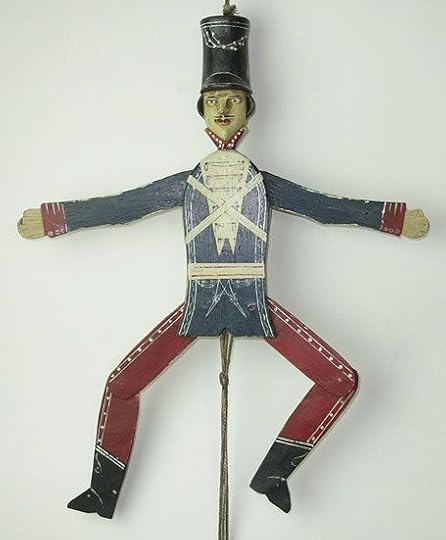
Looking up to the top of the tree, he remembers the toys of his youngest days first: the acrobat that rolled on the floor until still, the jack-in-the-box, jumping frog (all toys that equally delighted & frightened), the cardboard lady in the blue dress, and the larger cardboard man.
The Tumbler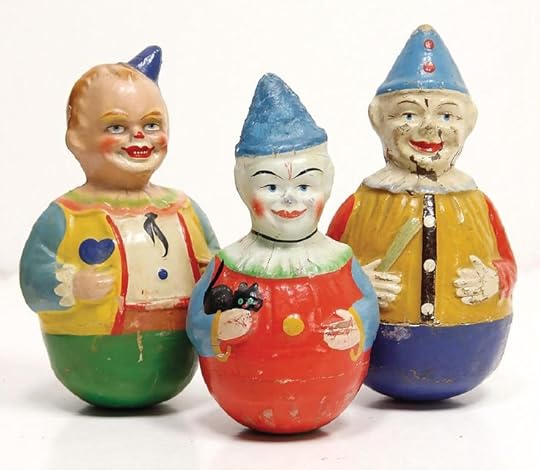
I think this is what Charles Dickens is describing.
The "infernal" snuff-box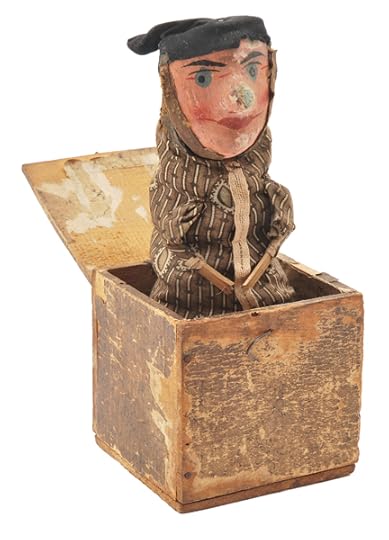
This is what I envision the scary snuff-box figure that Dickens describes more closely resembles:
 The Jumping Frog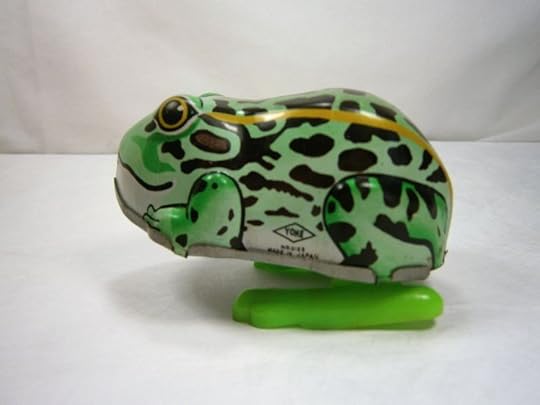
(this isn't a toy from the 1850s. I couldn't find a picture of one that old. This is a "vintage" jumping frog that may be similar to what Dickens is describing)
The Cardboard Lady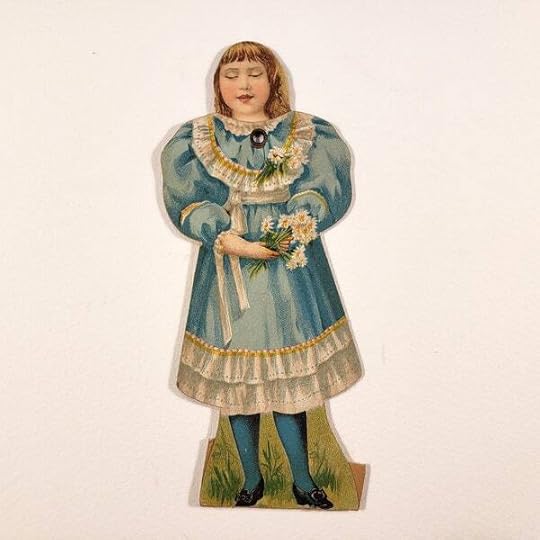 The Larger Cardboard Man
 Petra, thank you for explaining the teetotum. That does seem the perfect word for a spinning top. :-)
I love these old toy pictures--great finds! Especially the detail on the cardboard man. I feel like a child could stare at that for hours on end.
 Hello Petra!! So nice to see you back bringing us Christmas joy with your Dickens' selections. I missed yesterday so I am catching up, but look at all the wonders you left us. So far I am loving this piece especially since you have added the pics which have definitely added to my read. I have not read this essay before but love how it begins with Dickens' viewing all the family and friends celebrating Christmas around the tree, but we quickly move to Dickens' sitting up in the house alone as he revisits his memories of Christmas past and there is darkness and anxiety in those thoughts. I can't wait to continue.
message 34:
by
Bionic Jean, "Dickens Duchess"
(last edited Dec 20, 2025 03:06PM)
(new)
-
rated it 4 stars
Mod
Those tumblers would have freaked me out as a child - the snuff box too (I hated jack-in-the-boxes) - in fact I'm a bit twitchy about them all even now 😆 I have mild Automatonophobia, probably because like the young Dickens imagined, they seem so alive and real!
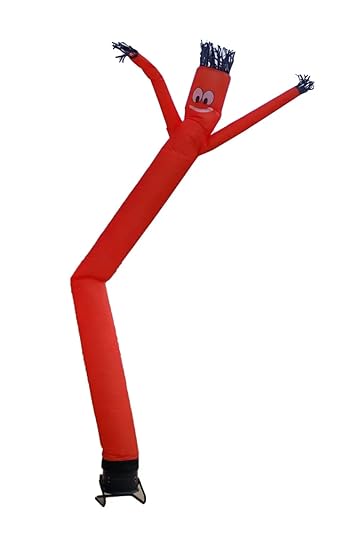
Kathleen, I recall toys like the cardboard man but made of wood in my childhood. My brother and I loved these toys. Pulling the string and watching the men dance was tons of fun.I still enjoy seeing and watching the Dancing Man displays when I see them:
 Sam, so good to see you here and joining us!
 Dickens is painting a quaint, warm, homey experience of family and joy in this essay.
Jean, I don't recall having tumblers or jack-in-the-boxes as a child. I do recall playing with jack-in-the-boxes, though. If I recall correctly (dubious, perhaps....it was awhile ago), I didn't find them very entertaining. I'm really enjoying the descriptions of these simple toys and Dickens' sharp remembrances of both the good and bad aspects of them.
A Christmas Tree Summary 3The narrator contemplates a mask he’d been given as a child and why it was such a horror to him. No other toys could ease the revulsion he felt for the mask. Even when he discovered that the mask was merely paper or locked it in a cupboard his uneasiness about it would not go away. Just knowing that the immovable features existed somewhere, even out of sight, would bring out fear, even waking him at night.
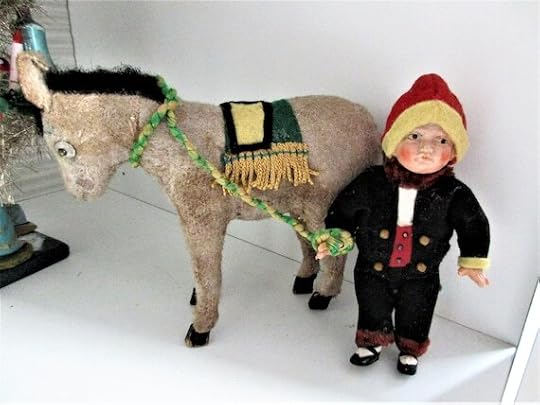
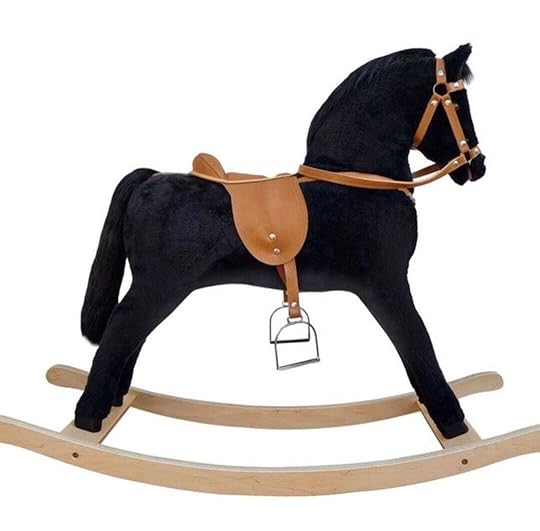
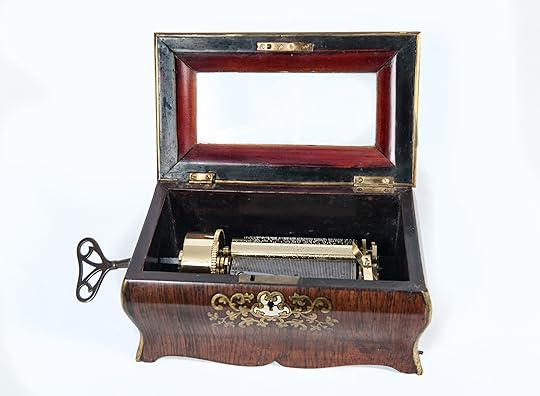
He recalls riding horses, music-carts and the Jacob’s Ladder game fondly.
19th Century Mask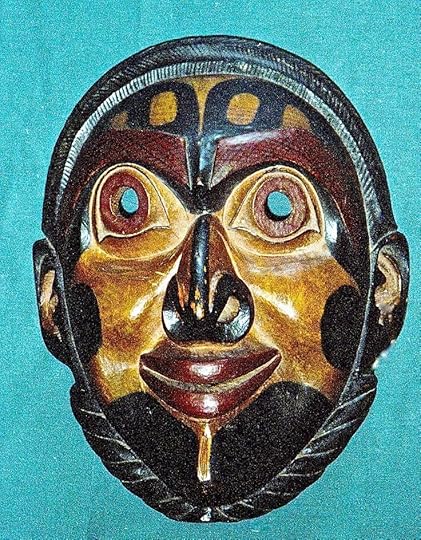 Lazy tongs are an extendable contraption used to move articles to/from afar without leaving one's chair or place. They are made of steel and expand in a lattice action.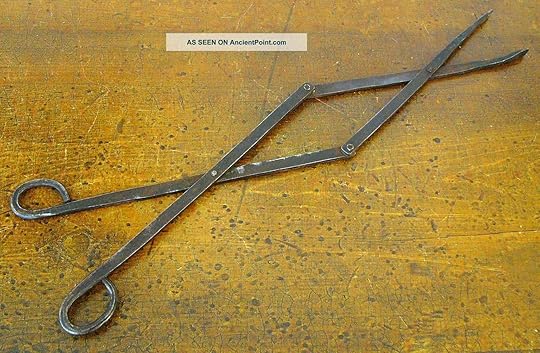
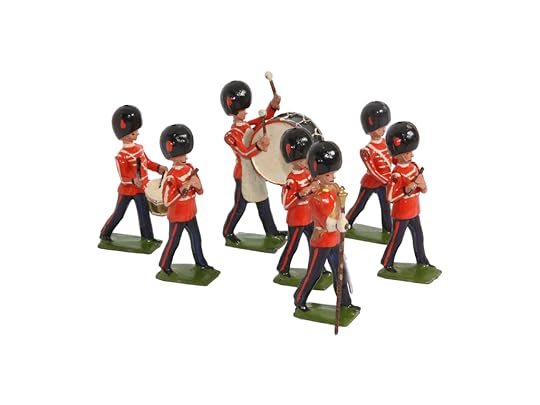
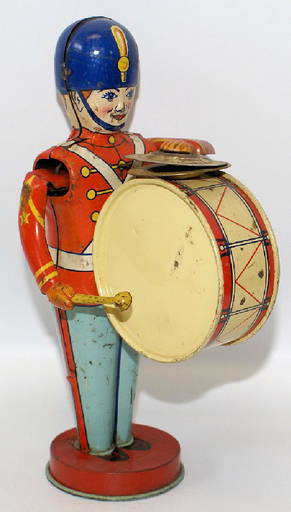
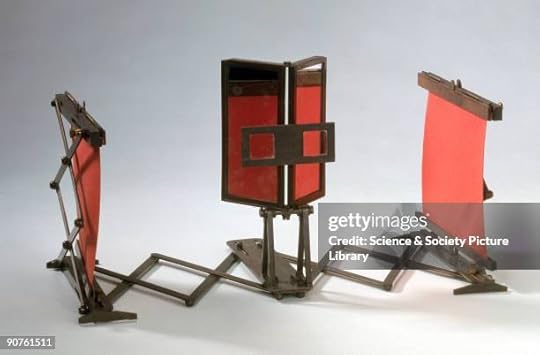 The narrator reminisces about using the lazy tongs to move his toy soldiers and military band.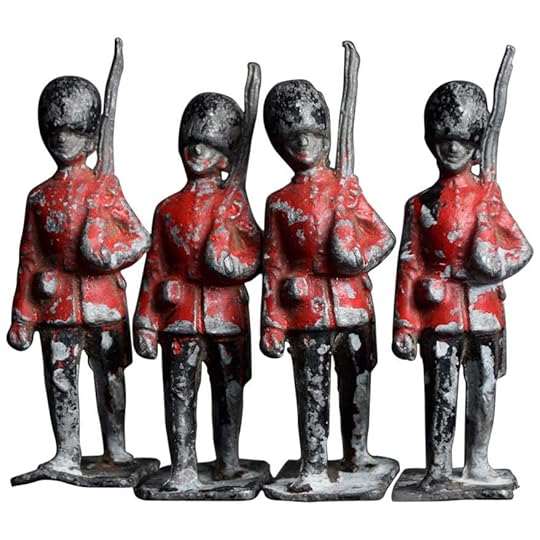
 Dear Old Donkey
 Black Rocking Horse
 Music-Cart
 Jacob's Ladder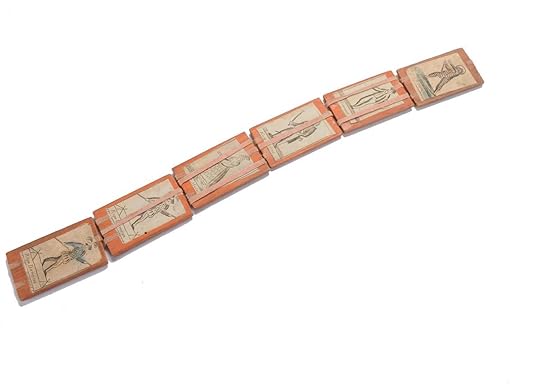
“It consisted of six oblong pieces of wood, adorned with pictures on both sides, and so connected with tapes that when the top piece, which was held in the hand, was turned down, all the others would turn down likewise by an apparently spontaneous movement, causing a new series of pictures to be presented to the eye, which was highly gratified by the change, as were also the ears by the clattering of the wooden tablets and the tinkling of some little bells which they were decorated.”
Quote from an essay written by Charles Dickens named “Toys, Past & Present”. It was printed in All the Year Round on October 1, 1870.
Toys, Past & Present essay in All the Year Round: https://djo.org.uk/media/downloads/ar...
Note: the essay linked says the contributor is "anon", and this article (https://blogs.princeton.edu/cotsen/ta...) claims the essay was printed in All the Year Round on October 1, 1876.
There seems to be a bit of confusion.
I think the essay was written by Charles Dickens and printed on October 1, 1870. For some reason, All the Year Round did not credit the author.
message 46:
by
Bionic Jean, "Dickens Duchess"
(last edited Dec 21, 2025 05:21AM)
(new)
-
rated it 4 stars
Mod
I remember these linked wooden toys. They had a string through them and when you pulled at the end (or underneath if there was a little platform) the animal would spring to life. But I'm still getting heebee-jeebies from those all too-human ones (wonderful though they are to see 😊). I had a night light shaped like a pig when I was tiny, and its ugly big yellow glowing face terrified me in the dark, and gave me nightmares. My parents had to get rid of it!
message 47:
by
Bionic Jean, "Dickens Duchess"
(last edited Dec 21, 2025 05:25AM)
(new)
-
rated it 4 stars
Mod
As Petra mentioned, the day was not celebrated so much until after his influence. Before then the main holiday was "Twelfth Night", and most people would work on Yuletide (Christmas Day). But the parties for "Twelfth Night" became so drunken and rowdy that Queen Victoria - a great admirer of Charles Dickens - persuaded Parliament to change the national holiday for everyone to Christmas Day. During Charles Dickens’s childhood, the festive season lasted for 12 days, beginning with Yuletide on Christmas day with celebrations gradually reaching a climax and ending on 6th January, or “Twelfth Night”.
But going back to the Christmas tree, when Charles Dickens was very young, as he imagines/remembers here, holly, ivy, pine needles and other greenery started to be used to decorate homes, just as they had been in pagan times, but with the more recently appropriated Christian symbolic significance. More elaborate Christmas decorations were not yet in evidence, although mistletoe had been popular since before the Regency, as pictured in cartoons of the time. His impressions must be partly superimposed, I think, the older Dickens remembering his childhood, and merging those thoughts with the later Christmas tree he now descibes.
Over the years then, Charles Dickens witnessed the holiday change from focusing on Twelfth Night to Christmas, seeing the arrival of Christmas Trees, Christmas crackers, Christmas shopping, present giving and other such celebrations. Prince Albert wanted a little Christmas tree on the table, as he had at his home in Saxe-Coburg and Gotha, (Germany). And the British royal family soon had several, including in the servants' quarters. They were reported in the papers (see Petra's illustrations) and then quickly copied by any ordinary people who could afford it. In part the change of emphasis was Queen Victoria’s doing, but it was also to a large extent down to Charles Dickens.
For Scottish people though, the most important holiday is Hogmanay, the last day of the year or New Year’s Eve. In fact Christmas was not celebrated as a festival and virtually banned in Scotland for around 400 years.
Charles Dickens wrote so many stories to be read at Christmas that his name is by now inextricably linked with Christmas. However his daughter Mamie Dickens wrote in her memoir My Father as I Recall Him that he had a love-hate relationship with it, because of the obligations he felt to his demanding public.
With pieces like this though, we can sense his inner delight 😊
 Petra What wonderful memories you have gifted us with your commentary and all the delightful pictures. I lingered over them. I imagine all of us can connect to ‘A Christmas Tree’ on some level and some intimate way.
The John Leech illustration below is my favourite from ‘A Christmas Carol.’ At the centre left the two lovers embrace while a sprig of mistletoe is held over their heads. Dancing, music, and the inter-generational nature of the illustration remind us that Christmas is for all.
https://victorianweb.org/art/illustra...
Bionic Jean wrote: "He used a few pseudonyms sometimes. Could this be why? Perhaps the "anon" was added by a later editor ... oh but from what you say the piece was not credited to anyone in the contents. ..."Jean, I worded it incorrectly. I meant that "anon" could be anyone, therefore it's not a piece credited to anyone (in particular).
Bionic Jean wrote: "But I'm still getting heebee-jeebies from those all too-human ones (wonderful though they are to see 😊). I had a night light shaped like a pig when I was tiny, and its ugly big yellow glowing face terrified me in the dark, and gave me nightmares. My parents had to get rid of it! ..."It's easy to forget that our little folks are experiencing everything for the first (or almost first) times and they haven't figured out (completely) how things work in their surroundings. A "too realistic" toy or mask can seem real and scary for many reasons.
Reading through this section of the essay reminds me of how new the experience of Christmas would be to a very young child and how overwhelming and surreal it must all be, what with the tree & candles in the house, the free-flowing treats (normally limited), the special foods, the extra activity (quite overstimulating), etc.
It's a wonder, in some ways, that a small child finds a positive excitement in all the festivities. It must all be so strange.
That's the magic of Christmas.

Dickensians!
Books mentioned in this topic
The Poor Relation's Story (other topics)The Arabian Nights (other topics)
Robinson Crusoe (other topics)
The Tale of Two Bad Mice (other topics)
The Tale of Two Bad Mice (other topics)
More...
Authors mentioned in this topic
Charles Dickens (other topics)Mamie Dickens (other topics)
Charles Dickens (other topics)
Lucinda Hawksley (other topics)
Charles Dickens (other topics)
More...
This is the thread to discuss A Christmas Tree by Charles Dickens, which is our first Christmas read this year. It will be hosted by Petra, between 19th and 27th December.
**PLEASE ALLOW PETRA TO COMMENT FIRST. Thanks