
Works of Thomas Hardy discussion
Poetry
>
No Bell-Ringing
date newest »
newest »
 No Bell-Ringing is a ballad with supernatural elements set on New Year's Eve. It was first published in Dorchester in 1925 as a pamphlet and illustrated with a photograph of the Tower of St George's Church in Fordington. (Durnover is Hardy's Wessex name for Fordington, Dorchester) It was a tradition for churches to ring their bells at midnight on New Year's Eve, and the bells of St George's could be heard at Max Gate.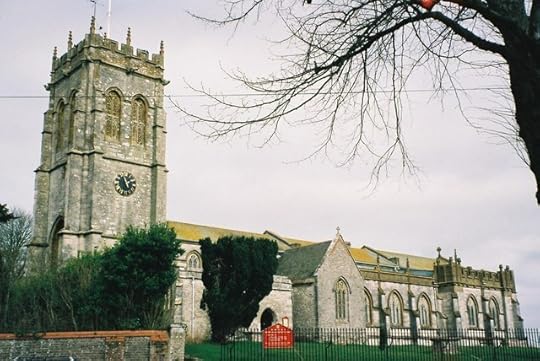
St George's Church
https://en.wikipedia.org/wiki/St_Geor...
In the poem a young boy wondered why the bell-ringing never occurred one New Year's Eve. Years later, he talks to a bell-ringer who now is an old man. The man explains what happened after the bell-ringers had swilled the Sacrament-wine.
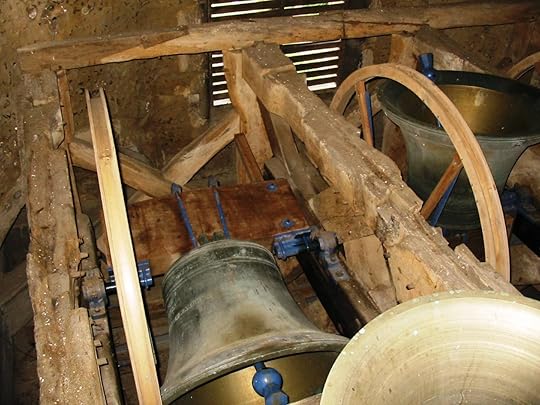
Bells and bell frames in an Anglican church
https://www.churchofengland.org/resou...
Happy New Year!
 Mod
Mod
There's a tradition of telling ghost stories at Christmas in England, from Christmas Eve until Twelfth Night (5th Jan) and New Year's Eve is a key spooky time!
As Connie mentions, Durnovaria was the Roman name for their settlement in 60 C.E. Now it is Dorchester, but Hardy calls the main town Casterbridge and the part of it on the outskirts, Fordington. By the way, the fields at Fordington are flooded at the moment! The aerial view is quite impressive.
Linking now.
 Thank you so much for this poem and additional details, Connie! This was a very good read and it does indeed have that little touch of spookiness, like a ghost story.
 This segment foretells, for me, what is coming as Hardy compares a flapping flag: Like a dead man's bones on a gibbet-post, Tugged as to be released.
Bionic Jean wrote: "Wow - what a perfect poem for New Year's Eve! Thank you so much, Connie.There's a tradition of telling ghost stories at Christmas in England, from Christmas Eve until Twelfth Night (5th Jan) and ..."
I didn't realize that the tradition of telling of ghost stories lasted until Twelfth Night, Jean. What a fun time for everyone!
Pamela wrote: "Thank you so much for this poem and additional details, Connie! This was a very good read and it does indeed have that little touch of spookiness, like a ghost story. This segment foretells, for ..."
I liked that phrase you pulled out, Pamela. The poem is spooky with a moral lesson.
 I love the image of the statue on the grave, being bathed in moonlight, which increases the eeriness. Brave boy to see in the year standing among the graves in the churchyard.
‘Why is there no ringing to-night?’
Said the boy to a moveless one
On a tombstone where the moon struck white;
But he got answer none.
Of course, for him, no new year's coming, bell or not.
Marvelous selection, Connie.
Sara wrote: "I love the image of the statue on the grave, being bathed in moonlight, which increases the eeriness. Brave boy to see in the year standing among the graves in the churchyard.‘Why is there no rin..."
There's a sinister feeling to that stanza, Sara. I doubt if I'm brave enough to be standing in a cold graveyard at midnight.
 The common phrase, or idiom, “doesn’t ring a bell” seems to occur here in a concrete form.
John wrote: "The common phrase, or idiom, “doesn’t ring a bell” seems to occur here in a concrete form."
The common phrase, or idiom, “doesn’t ring a bell” seems to occur here in a concrete form.
John wrote: "The common phrase, or idiom, “doesn’t ring a bell” seems to occur here in a concrete form."I can't argue with that, John! LOL Happy New Year!
 Mod
Mod
I loved the "treble-bobbed when young" description of the now old man telling the story of the stealing of the sacrament wine. Hardy so often coins some new turn of phrase in his poems. That's one of my favorite things about reading his poetry.
Bridget wrote: "What a fun poem Connie!! I barely leave my house on New Year's Eve, let alone visit a graveyard -- a brave boy indeed!!I loved the "treble-bobbed when young" description of the now old man tellin..."
I had no idea what "treble-bobbed" meant so I looked it up. It's a term for a sequence of change ringing. The treble bell is the smallest, highest-pitched bell. The treble bell sometimes bobs (swaps with another bell) in a sequence. Tuned bells have to be rung in a controlled sequence. Some churches have a large number of bells in their tower, and the bell-ringers have to ring with precision.
https://en.wikipedia.org/wiki/Change_...
Interesting way to achieve a time shift — “his head was gray.” A very economical way, in words, to do that. It would be important to the poem’s story to do that, and it was done almost stealthily.
Mod
 Bionic Jean wrote: ""treble-bobbed" took me straight back to Dorothy L. Sayers's The Nine Tailors! She wrote it quite a bit later, in 1934, but it was the only Lord Peter Wimsey novel where..."
I immediately thought of The Nine Tailors too, Jean! I love that book (although I can understand why some people feel there's too much bell-ringing in it! Although personally I think she indulged herself far more in Five Red Herrings, but that's for another discussion...)
I really enjoyed this poem - I haven't come across it before. In fact I'm really enjoying this whole thread - it's a great way to discover new Hardy poems and I like reading other people's responses.
John wrote: "Interesting way to achieve a time shift — “his head was gray.” A very economical way, in words, to do that. It would be important to the poem’s story to do that, and it was done almost stealthily."It sounds much more poetic than saying he was eighty years old. Thanks for pointing that out, John.
Bionic Jean wrote: ""treble-bobbed" took me straight back to Dorothy L. Sayers's The Nine Tailors! She wrote it quite a bit later, in 1934, but it was the only Lord Peter Wimsey novel where..."Jean and Lorna, I haven't read The Nine Tailors although it's on my TBR. I would like to know more about bell-ringing after reading this poem.
Lorna wrote: "Bionic Jean wrote: ""treble-bobbed" took me straight back to Dorothy L. Sayers's The Nine Tailors! She wrote it quite a bit later, in 1934, but it was the only Lord Pete..."I'm glad you're enjoying the poetry thread, Lorna.
Hardy does not tell us in the poem exactly why the bells will not ring after the bell-ringers drank the sacramental wine. Possibilities could be that it was the work of God, the work of the Devil, or a ghost in the church. Does anyone have an opinion about the cause, or do you just prefer that it remains ambiguous?
Mod
But literally, bellringing takes a lot of strength, so I assume the drink had made them sleepy and uncoordinated so that they had no power to pull the bellropes.
Or ... if this was Charles Dickens it would be goblins in, or of, the bells.😆 But it isn't, so my hunch is the first one.
Like Jean, I assumed that God was having none of the intoxicated bell-ringing in His church. It is an interesting question, and perhaps it was just a failure to be able to execute the job, but I would think at least one of them would have gotten a sound, so I am sticking with a displeased deity.
Mod
I liked that phrase too, John! Its so subtle, I missed it at first, and then went back to re-read and had an aha! moment.
The first time I read the poem I also thought the bells wouldn't ring because the ringers were too drunk. But the second time through I changed my mind and I like Sara's term "displeased deity" as the cause of the silence.
I'm not sure I would have read this poem twice, and carefully if not for all of you - so thank you all!
Thanks for your input, Jean, Sara, and Bridget. I think Sara's term "displeased deity" is a great way of stating the reason for the lack of bells.According to J. O. Bailey, there is a folktale in Hardy's papers in the Dorset Museum, and in the book A Popular and Illustrated Guide to St. Peter's Church, Dorchester by Alfred Metcalfe (pg 46-47). St Peter's and St George's are both in Dorchester.
On Christmas Eve 1814, there was a similar situation when the church clerk and the sexton were decorating the St Peter's Church with evergreen branches. They were cold and drank the sacramental wine to warm up. The ghost of the late rector, Rev Nathaniel Templeman, appeared to them with an angry countenance. The clerk fainted and the sexton prayed as he went for help for the clerk.
Hardy changed the story somewhat, but this is thought to be the inspiration for this poem.
Connie wrote: "Thanks for your input, Jean, Sara, and Bridget. I think Sara's term "displeased deity" is a great way of stating the reason for the lack of bells.According to J. O. Bailey, there is a folktale in..."
I absolutely love this story, Connie. Just a guilty conscience maybe...or maybe not.

Works of Thomas Hardy
Books mentioned in this topic
A Popular and Illustrated Guide to St. Peter's Church, Dorchester (other topics)The Nine Tailors (other topics)
The Nine Tailors (other topics)
The Nine Tailors (other topics)
The Nine Tailors (other topics)
Authors mentioned in this topic
Alfred Metcalfe (other topics)Charles Dickens (other topics)
Dorothy L. Sayers (other topics)
Dorothy L. Sayers (other topics)
Dorothy L. Sayers (other topics)
More...
A Ballad of Durnover
The little boy legged on through the dark,
To hear the New-Year's ringing;
The three-mile road was empty, stark,
No sound or echo bringing.
When he got to the tall church tower
Standing upon the hill,
Although it was hard on the midnight hour
The place was, as elsewhere, still;
Except that the flag-staff rope, betossed
By blasts from the nor'-east,
Like a dead man's bones on a gibbet-post
Tugged as to be released.
‘Why is there no ringing to-night?’
Said the boy to a moveless one
On a tombstone where the moon struck white;
But he got answer none.
‘No ringing in of New Year's Day.’
He mused as he dragged back home;
And wondered till his head was gray
Why the bells that night were dumb.
And often thought of the snowy shape
That sat on the moonlit stone,
Nor spoke nor moved, and in mien and drape
Seemed like a sprite thereon.
And then he met one left of the band
That had treble-bobbed when young,
And said: ‘I never could understand
Why, that night, no bells rung.’
‘True. There'd not happened such a thing
For half a century; aye,
And never I've told why they did not ring
From that time till to-day. . . .
‘Through the week in bliss at The Hit or Miss
We had drunk—not a penny left;
What then we did—well, now 'tis hid,—
But better we'd stooped to theft!
‘Yet, since none other remains who can,
And few more years are mine,
I may tell you,’ said the cramped old man.
‘We—swilled the Sacrament-wine.
‘Then each set-to with the strength of two,
Every man to his bell;
But something was wrong we found ere long
Though what, we could not tell.
‘We pulled till the sweat-drops fell around,
As we'd never pulled before,
An hour by the clock, but not one sound
Came down through the bell-loft floor.
‘On the morrow all folk of the same thing spoke,
They had stood at the midnight time
On their doorsteps near with a listening ear,
But there reached them never a chime.
‘We then could read the dye of our deed,
And we knew we were accurst;
But we broke to none the thing we had done,
And since then never durst.’
From "Winter Words in Various Moods and Metres" (1928)