
The Pickwick Club discussion
David Copperfield
>
Copperfield, Chapters 38-40
date newest »
 Chapter 39 is titled "Wickfield and Heep" and it is with them we spend most of our time. At the beginning of the chapter Aunt Betsey asks David to go to Dover, mostly because she is worried about his depression, but she tells him it is "to see that all was working well at the cottage, which was let; and to conclude an agreement, with the same tenant, for a longer term of occupation." After checking on the cottage which he finds in satisfactory shape he is able to tell his aunt that the new tenant is carrying on the war against the donkeys. He then goes to visit Mr. Wickfield and Agnes. When he arrives at the house he finds Mr. Micawber sitting in Uriah's old seat "plying his pen with great assiduity" and wearing a legal-looking black suit. He tells David he and his family are now living in Uriah Heep's old house and Uriah and his mother now live with the Wickfield's. David seems to think that Mr. Micawber has changed since he began working for Uriah, that there is an uneasy change about him.
David then goes to the drawing room where he finds Agnes alone and sitting by the fire. He talks to Agnes about his troubles and comments often of how much he misses her advice on matters.
'Whenever I have not had you, Agnes, to advise and approve in the beginning, I have seemed to go wild, and to get into all sorts of difficulty. When I have come to you, at last (as I have always done), I have come to peace and happiness. I come home, now, like a tired traveller, and find such a blessed sense of rest!'
David tells her that he finds it difficult to confide in Dora in the same way because though she is "the soul of purity and truth" she is also a timid little thing and so "easily disturbed and frightened." Agnes suggests to David that he write to Dora's aunts and seek permission to visit Dora. David agrees and spends the afternoon writing the letter. From this time on although David would like to spend more time alone with Agnes, Mrs. Heep joins them and doesn't leave them the rest of the day.
"At dinner she maintained her watch, with the same unwinking eyes. After dinner, her son took his turn; and when Mr. Wickfield, himself, and I were left alone together, leered at me, and writhed until I could hardly bear it. In the drawing-room, there was the mother knitting and watching again. All the time that Agnes sang and played, the mother sat at the piano. Once she asked for a particular ballad, which she said her Ury (who was yawning in a great chair) doted on; and at intervals she looked round at him, and reported to Agnes that he was in raptures with the music. But she hardly ever spoke—I question if she ever did—without making some mention of him. It was evident to me that this was the duty assigned to her."
The next day during a walk David tells Uriah that he is engaged to someone other than Agnes, and Uriah in his joy admits that he asked Mrs. Heep to follow David and Agnes around. He once again professes his love for Agnes and his intention to marry her. Then he tells David that his father taught him to be humble and ingratiating in order to succeed in the world until I am entiring sick of seeing the word 'umble.
"They taught us all a deal of umbleness—not much else that I know of, from morning to night. We was to be umble to this person, and umble to that; and to pull off our caps here, and to make bows there; and always to know our place, and abase ourselves before our betters. And we had such a lot of betters! Father got the monitor-medal by being umble. So did I. Father got made a sexton by being umble. He had the character, among the gentlefolks, of being such a well-behaved man, that they were determined to bring him in. "Be umble, Uriah," says father to me, "and you'll get on. It was what was always being dinned into you and me at school; it's what goes down best. Be umble," says father, "and you'll do!" And really it ain't done bad!'"
Uriah observes that, although he is humble, he does have some power. That evening after dinner Uriah tells David and Mr. Wickfield of his intention to be Agnes' husband and when Mr. Wickfield hears that he jumps to his feet.
"I had my arms round Mr. Wickfield, imploring him by everything that I could think of, oftenest of all by his love for Agnes, to calm himself a little. He was mad for the moment; tearing out his hair, beating his head, trying to force me from him, and to force himself from me, not answering a word, not looking at or seeing anyone; blindly striving for he knew not what, his face all staring and distorted—a frightful spectacle. "
Mr. Wickfield calls Uriah his torturer and says'before him I have step by step abandoned name and reputation, peace and quiet, house and home."
The next morning as David is leaving in the coach Uriah arrives admits that perhaps he has "plucked a pear before it was ripe." But then says, "It'll ripen yet! I can wait!"
In Chapter 40, "The Wanderer" David tells us of how when he told his aunt of the domestic occurances at the Wickfield house, his aunt walks back and forth for more than two hours thinking of the things he had said. This reminded me of how many people I see on cell phones just walk around while talking on them, family and friends that I have will walk back and forth through the house or up and down the driveway all the while talking on the phone. It makes me wonder how people ever managed to have a phone conversation when all the phones were still connected to the wall.David sends his letter to Dora's aunts and impatiently waits for an answer. Meanwhile, one night as he is walking home from Dr. Strong's house he sees a woman that looks familiar to him but he doesn't remember where he has seen her before. As he is thinking of this a man who is sitting on the steps of a church stands up and walks over to him and David realizes it is Mr. Peggoty. He then realizes the woman whom he passed was Martha Endell, the "fallen woman" whom Emily had once helped. David and Mr. Peggotty go to one of the public rooms of an inn which is empty and has a good fire burning. Of Mr. Peggotty's appearance David says this:
..." not only that his hair was long and ragged, but that his face was burnt dark by the sun. He was greyer, the lines in his face and forehead were deeper, and he had every appearance of having toiled and wandered through all varieties of weather; but he looked very strong, and like a man upheld by steadfastness of purpose, whom nothing could tire out."
Mr. Peggotty shows David the letters which were received from Emily while he was out looking for her on the continent. Mr. Peggotty has come close to finding her a few times, but has always missed her. In all Emily has sent three letters. In one she asks for understanding and forgiveness, and saying clearly that she will never return. The letters Emily sent contain money, obviously originating from Steerforth, but Mr. Peggotty vows that he will return every cent of the money if he has to go "ten thousand miles." The last note received bears the postmark of a town on the Upper Rhine, and Mr. Peggotty declares that he is going there now in search of her. Throughout Mr. Peggotty's story, David sees Martha Endell listening at the inn door. After awhile they part, and the grieving uncle "resumes his journey". His last words to David are:
'I'd go ten thousand mile,' he said, 'I'd go till I dropped dead, to lay that money down afore him. If I do that, and find my Em'ly, I'm content. If I doen't find her, maybe she'll come to hear, sometime, as her loving uncle only ended his search for her when he ended his life; and if I know her, even that will turn her home at last!'
I was confused at the end of the chapter because David says he saw the lonely figure of Martha "flit away before them". I thought when David saw her at the beginning of the chapter that she was with Mr. Peggotty, I thought he must have found her in his travels and brought her with him, but it seems to me now like he didn't know she was there. So was she following him?
 Kim wrote: ""My aunt and Mr. Dick represented the Government or the Opposition (as the case might be), and Traddles, with the assistance of Enfield's Speaker or a volume of parliamentary orations, thundered as..."
Kim
Again, thanks for the illustration. Is it me or is there another bird cage over the left shoulder of Aunt Betsey? There is a cat sitting on the chair beneath the bird cage. Phiz seems to have a fascination with bird cages and cats in his illustrations. Strange, symbolic, or just because he likes birds and cats?
Kim wrote: "The Wanderer
Chapter 40
"It was Martha at the door. I saw her haggard, listening face distinctly. My dread was lest he should turn his head, and see her too."
Commentary:
"To maintain a focus..."
What a powerful illustration. The explanation/analysis, to me at least, makes perfect sense.
"The Wanderer" is a very powerful chapter. In fact, it seems that Dickens has ramped up the concept of wandering or going on some journey/odyssey to a new level. In PP Mr. Pickwick rambles around the countryside having his excellent adventures. Then, OT gives us a homeless orphan, NN another itinerant man and then OCS an odyssey. Martin Chuzzlewit is sent off to America and in D&S Walter Gay travels to The Carribean. In DC, however, Dickens creates a much more powerful character. From the illustration provided for the chapter, to the dignity of Peggotty who will search the world for Little Em'ly and will not touch a penny of the money enclosed in the letters, to the nobility of his character that contrasts so much with the likes of Steerforth, Uriah Heep and the Murdstones, Dickens gives us a portrait of honesty and dignity.
Peter wrote: "Phiz seems to have a fascination with bird cages and cats in his illustrations. Strange, symbolic, or just because he likes birds and cats?" I didn't look for Phiz and cats yet, but I did find this story of Dickens and cats written by his daughter Mamie.
"On account of our birds, cats were not allowed in the house; but from a friend in London I received a present of a white kitten -- Williamina -- and she and her numerous offspring had a happy home at "Gad's Hill." She became a favorite with all the household, and showed particular devotion to my father. I remember on one occasion when she had presented us with a family of kittens, she selected a corner of father's study for their home. She brought them one by one from the kitchen and deposited them in her chosen corner. My father called to me to remove them, saying that he could not allow the kittens to remain in his room. I did so, but Williamina brought them back again, one by one. Again they were removed. The third time, insted of putting them in the corner, she placed them all, and herself beside them, at my father's feet, and gave him such an imploring glance that he could resist no longer, and they were allowed to remain. As the kittens grow older they became more and more frolicsome, swarming up the curtains, playing about on the writing table and scampering behind the bookshelves. But they were never complained of and lived happily in the study until the time came for finding them other homes. One of these kittens was kept, who, as he was quite deaf, was left unnamed, and became known by servants as "the master's cat," because of his devotion to my father. He was always with him, and used to follow him about the garden like a dog, and sit with him while he wrote. One evening we were all, except father, going to a ball, and when we started, left "the master" and his cat in the drawing-room together. "The master" was reading at a small table, on which a lighted candle was placed. Suddenly the candle went out. My father, who was much interested in his book, relighted the candle, stroked the cat, who was looking at him pathetically he noticed, and continued his reading. A few minutes later, as the light became dim, he looked up just in time to see puss deliberately put out the candle with his paw, and then look appealingly towards him. This second and unmistakable hint was not disregarded, and puss was given the petting he craved. Father was full of this anecdote when all met at breakfast the next morning.
Mary (Mamie) Dickens, My Father as I Recall Him, chapter IV"
And here is a story also by Mamie Dickens talking about Dickens and birds."During one of his walks through the slums, my father was so fascinated by the intelligence of a busy goldfinch drawing water for himself in his cage—he had other accomplishments as well—that he went in and bought it. But not a thing would the little bird do, not a trick would he perform when he got to his new home in Doughty Street, and would only draw up water in the dark or when he thought no one was looking. “After an interval of futile and at length hopeless expectation,” my father writes, “the merchant who had educated him was appealed to. The merchant was a bow-legged character, with a flat and cushiony nose, like the last new strawberry. He wore a fur cap and shorts, and was of the velveteen race velveteeny. He sent word that he would ‘look round.’ He looked round, appeared in the doorway of the room, and slightly cocked up his evil eye at the goldfinch. Instantly a raging thirst beset the bird, and when it was appeased he still drew several unnecessary buckets of water, leaping about the perch and sharpening his bill with irrepressible satisfaction.”
While at Broadstairs one summer, our bathing woman, who reared birds, gave a canary to my sister and myself. “Dick,” who was only a few weeks old when he came to us, grew to be a very king of birds, and became in time a most important member of the household.There was a fierce war waged against cats during his lifetime, and writing from Boulogne my father very funnily describes our troubles with the feline race: “War is raging against two particularly tigerish and fearful cats (from the mill, I suppose), which are always glaring in dark corners after our wonderful little ‘Dick.’ Keeping the house open at all points it is impossible to shut them out, and they hide themselves in the most terrific manner, hanging themselves up behind draperies like bats, and tumbling out in the dead of night with frightful caterwaulings. Hereupon French, the footman, borrows a gun, loads it to the muzzle, discharges it twice in vain, and throws himself over with the recoil exactly like a clown. But at last, while I was in town, he aims at the more amiable cat of the two and shoots that animal dead. Insufferably elated by this victory he is now engaged from morning to night in hiding behind bushes to get aim at the other. He does nothing else whatever. All the boys encourage him and watch for the enemy, on whose appearance they give an alarm, which immediately serves as a warning to the creature, who runs away. They—the boys—are at this moment (ready dressed for church) all lying on their stomachs in various parts of the garden. I am afraid to go out lest I should be shot. Mr. Plornish, says his prayers at night in a whisper lest the cat should overhear him and take offence. The tradesmen cry out as they come up the avenue: ‘Me Voici! C’est Moi—boulanger—me tirez pas, Monsieur Frenche!’ It is like living in a state of siege, and the wonderful manner in which the cat preserves the character of being the only person not much put out by the intensity of this monomania is most ridiculous. The finest thing is that immediately after I have heard the noble sportsman blazing away at her in the garden in front I look out of my room door into the drawing-room and am pretty sure to see her coming in after the bird, in the calmest manner possible, by the back window.” But no harm ever came to “our wonderful little ‘Dick,’” who lived to a ripe old age—sixteen years—and was buried under a rose tree at “Gad’s Hill.”
KimWhat great detail you have tracked down and shared with us. You have braided the novel, the illustrations and Dickens's personal life together. We are very grateful for the time and effort you provide to our reading experience.
If I ever figure out a way to send cold air down from Canada to you, on demand, I will.
 Kim wrote: "I was confused at the end of the chapter because David says he saw the lonely figure of Martha "flit away before them". I thought when David saw her at the beginning of the chapter that she was with Mr. Peggotty, I thought he must have found her in his travels and brought her with him, but it seems to me now like he didn't know she was there. So was she following him?"
I actually had the same impression at first, i.e. that Martha and Mr. Peggotty had become travelling companions but when I found her eavesdropping on David and Peggotty, I remembered that time was when Mr. Peggotty would not have wanted her to have any social contact with Emily - by the way, there was a similar reluctance on Mr. Wickfield's part as to Agnes's becoming too close with Minnie Strong - and I asked myself whether in the light of the latest events Mr. Peggotty would not have changed his mind about Martha and adopted a more understanding attitude.
Nevertheless, Martha seems to be shadowing Mr. Peggotty. Maybe she knows something she is about to divulge.
Kim wrote: "Chapter 39 is titled "Wickfield and Heep" and it is with them we spend most of our time. At the beginning of the chapter Aunt Betsey asks David to go to Dover, mostly because she is worried about ..."Finally, Chapter 39 allows us some inside view into Uriah Heep and his development, which again shows Dickens as a good observer of human nature. In this context, David notes:
"It was the first time it had ever occurred to me, that this detestable cant of false humility might have originated out of the Heep family. I had seen the harvest, but had never thought of the seed."
However, since David himself is but a human being, this glimpse behind the curtains does not suffice to make him overcome his disgust with Uriah - and rightly so. Then there is also this:
"And he said all this — I knew, as I saw his face in the moonlight—that I might understand he was resolved to recompense himself by using his power. I had never doubted his meanness, his craft and malice; but I fully comprehended now, for the first time, what a base, unrelenting, and revengeful spirit, must have been engendered by this early, and this long, suppression. "
Dickens realizes that an education as received by Uriah would probably result in pent-up and underhanded aggression. Finally, Uriah has become more than just a caricature.
Kim wrote: "Again, how anyone can see this is beyond me."Some people say seeing is believing. I would also make a case for the reverse.
Kim wrote: "The Wanderer
Chapter 40
"It was Martha at the door. I saw her haggard, listening face distinctly. My dread was lest he should turn his head, and see her too."
Commentary:
"To maintain a focus..."
Like Peter, I can only once again say thank you, Kim, for the detailed background information. It is really a pity that my old editions don't have all the illustrations.
I would never have guessed, though, that the person in the centre is supposed to be Mr. Peggotty. What is supposed to be white hair was taken for fair hair by me, and from the picture alone I would have surmised that David had met Steerforth - for the character looks very young to me.
Tristram wrote: "I would never have guessed, though, that the person in the centre is supposed to be Mr. Peggotty." That is true. I didn't really look that closely at the picture even though I posted it, but now going back and looking, it looks nothing like Mr. Peggotty to me and much more like Steerforth. It does say in the commentary that he almost looks like another man and he certainly does.
 I missed last week's discussion again, so I better jump in on this week before it flies by me and I find the week is at an end.
Kim, I also felt for David trying to learn shorthand. I've never tried to learn it myself, but I remember long ago seeing some shorthand and being quite surprised that all those little squiggles could actually be translated into something intelligible.
The day after Mr. Spenlow confronted David concerning his secret engagement to Dora, I somehow was not surprised to find that he had died. I knew what was to come as David walked closer to the Commons and found everyone mingling about. Although I had no hard feelings towards Mr. Spenlow, I felt a bit as if a weight had been lifted and that David would be able to carry on with his engagement to Dora. And although I completely understand Dora's saddened state after her father's death, I was surprised to find that as time went on she did not seem to mention David's name or try to reach out to him? Did anyone else find this behavior strange? If she really loved him, I would have thought that she would find some comfort in being able to talk to him and having David console her. Unless Dora is mentioning David and that perhaps Miss Mills is not relating Dora's conversations faithfully.
Oh my goodness, the chapters describing all of Uriah's writhing and jerking make me writhe and jerk just having to read them. He is a very wormy, creepy, cold and fish-like (as his hand was described by David, I believe) man and is just plain icky. The close of the chapter where he describes Agnes as a pear who is not quite ripe was just over the top. I almost gagged! lol.
Kim, I was also a bit confused by what Martha was doing. I thought David had just passed by her, but then she popped up again at the end of the chapter. In the illustration you posted, she certainly doesn't look haggard at all. And I agree that Mr. Peggoty is not drawn the way I imagined either. He looks too young and slim.
As to the letters from Emily, I also got the impression that the money came from Steerforth. But does this mean that he is traveling with her? Or did he simply give her a sum of money and he was done with her, and instead of using it for herself, she forwarded the money to her family?
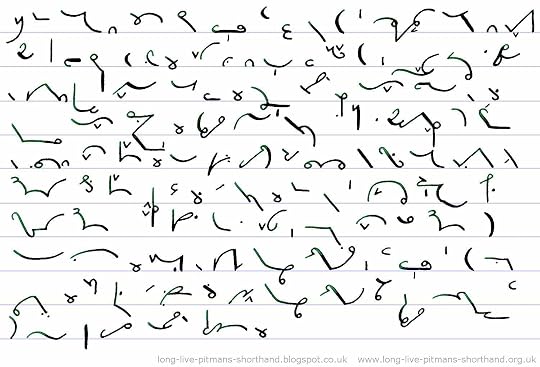
Linda wrote: "I remember long ago seeing some shorthand and being quite surprised that all those little squiggles could actually be translated into something intelligible. ..."It can't. Here's a sample.
 Kim wrote: "It can't. Here's a sample."
I see squiggles, rainbows, hockey sticks, a letter Y, more squiggles. One looks like a notation for microgram that we use in the lab, so I'm curious what that one actually represents.
Linda wrote: "Kim wrote: "It can't. Here's a sample."I see squiggles, rainbows, hockey sticks, a letter Y, more squiggles. One looks like a notation for microgram that we use in the lab, so I'm curious what t..."
I too see anything but what it is supposed to be. That is I assume it isn't supposed to be a sled, seagulls, a tent, a man's eyes and nose, a mouse head, and the letters Y and B. If I ever knew what it was I don't have a clue anymore.
Linda wrote: "Kim wrote: "It can't. Here's a sample."I see squiggles, rainbows, hockey sticks, a letter Y, more squiggles. One looks like a notation for microgram that we use in the lab, so I'm curious what t..."
Hi Linda
Yes, I see hockey sticks as well, but being Canadian I guess that is genetic. LOL!
Hmmm, I once dabbled in Germany shorthand, and I had the same experience you described, i.e. being able to write it but not being able to read what I had written later on - but the English shorthand characters do not resemble the German ones in the least. Your sample almost looks like Arabic letters to me.
Linda wrote: " If she really loved him, I would have thought that she would find some comfort in being able to talk to him and having David console her. Unless Dora is mentioning David and that perhaps Miss Mills is not relating Dora's conversations faithfully."Although Miss Mills has a tendency to romanticize the relationship between David and Dora, I would still not entertain any doubts as to her honesty. Maybe Dora's not reaching out for David is a bad omen and shows that for her the relationship is more of a treat and a kind of romantic adventure. She is probably quite a father's girl, and Mr. Spenlow's death has devastated her completely.
Linda wrote: "As to the letters from Emily, I also got the impression that the money came from Steerforth. But does this mean that he is traveling with her? Or did he simply give her a sum of money and he was done with her, and instead of using it for herself, she forwarded the money to her family?"I think we cannot tell really whether Emily and Steerforth are still together or whether Steerforth has lost interest in Emily already. However, the fact that there were several missiles with money - if I remember correctly - seems to imply that they are still travelling together.
Tristram wrote: "Linda wrote: "As to the letters from Emily, I also got the impression that the money came from Steerforth. But does this mean that he is traveling with her? Or did he simply give her a sum of money..."Dickens has keep up our interest in the pairing of Steerforth and Emily with the mystery of the money.
As David navigates his way through his relationship with Dora and Uriah creeps ever closer to Agnes, we now have three "pairings" of individuals that offer the reader a wide scope of interest, worry and wonder.
 Tristram wrote: "Kim wrote: "Chapter 39 is titled "Wickfield and Heep ... It was the first time it had ever occurred to me, that this detestable cant of false humility might have originated out of the Heep family. I had seen the harvest, but had never thought of the seed."
This passage saddened me. Not for Uriah, who doesn't seem to care about the feelings of Wickfield or Agnes (or maybe anyone but his mother) but as a sad commentary on the society at the time. If Mr. Heep's opinion of class divisions/human nature is correct (People like to be above you, keep yourself down), debasement is the only way to get ahead among people who pride themselves on their own superiority. Aptitude, merit and diligence seem to count for nothing.
I find this character puzzling in light of Dickens having ascended the social scale himself. Despite his own childhood experience of poverty, and his becoming a champion for the poor through his writing, Dickens through the character of Uriah Heep has created a repulsive example of social climbing. Was he trying to make readers question their assumptions, or is it merely an expression of his own ambivalence?
Tristram wrote: "Linda wrote: " If she really loved him, I would have thought that she would find some comfort in being able to talk to him and having David console her. Unless Dora is mentioning David and that per..."I took Dora's avoidance of David to show that she feels guilty of concealing the courtship from her father, and perhaps she even feels responsible for his death, since he died shortly after confronting David. Mr. Spenlow was likely shocked by David's 'abuse' of his confidence, something he (in keeping with the times) viewed as dishonorable. Dora was made very aware of her father's protectiveness, since he hired an Iron chaperone for her.
Vanessa wrote: "Tristram wrote: "Kim wrote: "Chapter 39 is titled "Wickfield and Heep ... It was the first time it had ever occurred to me, that this detestable cant of false humility might have originated out of ..."This is really a tricky point you're bringing up, Vanessa. I think that for all his commitment to social questions and improving the situation of the poor, Dickens was rather paternalistic in that he expected people to know their place. Just consider the deferential behaviour Mr. Peggotty and Ham always show towards David - even when the latter is just a little kid -, e.g. when they give him the master bedroom, a room of his own, in their boat-turned-house. Reading through the dialogue between Mr. Peggotty and David or Ham and David gave me a very strong impression of the fishermen always showing some kind of submission to David. In another thread I have already commented on David's situation in the factory, viz. on the other workers and children acknowledging some sort of social gap between them.
Dickens may not have condoned in Steerforth's callous arrogance with regard to people of the "lower" classes but I would say that he, too, was quite class conscious and that the passage in which David muses on his status amongst the factory workers must have reflected Dickens's own feelings at the time when he was in a similar situation.
In a way, there are two predecessors to Uriah Heep in previous novels, i.e. young men who attended charity schools and left them as scheming, hypocritical creeps, namely Noah Claypole from "Oliver Twist" and Rob the Grinder from our last group read - so the topic must have preoccupied Dickens. What might his issue be? That charity schools twist children's characters, or that social climbers are to be distrusted?
Vanessa wrote: "I took Dora's avoidance of David to show that she feels guilty of concealing the courtship from her father, and perhaps she even feels responsible for his death, since he died shortly after confronting David. Mr. Spenlow was likely shocked by David's 'abuse' of his confidence, something he (in keeping with the times) viewed as dishonorable. Dora was made very aware of her father's protectiveness, since he hired an Iron chaperone for her. "That sounds like a very conclusive reading of Dora's feelings to me, Vanessa. Is it not quite frequent that we link events that happened one after the other and ascribe some cause-and-effect relationship to them? I think the technical term for this logical fallacy is post hoc ergo propter hoc. Dora feels as though she had betrayed her father and somehow this makes her suspect that she is in some weird way responsible for his accident.
Tristram wrote: "This is really a tricky point you're bringing up, Vanessa. I think that for all his commitment to social questions and improving the situation of the poor, Dickens was rather paternalistic in that he expected people to know their place..."Yes, I find it a troubling one. I agree with your perceptions of Dickens'/David's experience at the warehouse, in his awareness of class differences and his own sacrificed gifts during his drudgery work. I saw these as somewhat separate issues, but perhaps Dickens didn't. When he looked back, I wonder if he ever considered that the likes of (countless) Mealy Potatoes might have unrecognized talents, that would never have a chance to develop, or even to be discovered.
Recently I was surprised to see in a coffee-table book on Dickens' life (Watts) that his older sister Fanny attended the Royal Academy of Music while he worked at the blacking warehouse, and while the the family were in the debtors' prison. (How did they manage that?!) Presumably that would also have aggravated his resentment to his parents and his feelings of being sacrificed.
It's interesting to know that Uriah Heep's character had predecessors. I can only imagine that the charity schools were worse than Creakle's. Perhaps the former were more likely to twist kids by lack of hope for the future. It's difficult to know if Dickens, by portraying social climbers as untrustworthy, is condemning them, the system, or both.
Tristram wrote: "Is it not quite frequent that we link events that happened one after the other and ascribe some cause-and-effect relationship to them? I think the technical term for this logical fallacy is post hoc ergo propter hoc. Dora feels as though she had betrayed her father and ..."Yes, Dora doesn't strike me as a terribly logical character :) The idea that she linked her father's death to her secret engagement seems to be suggested by her reply, when Miss Mills asks her if she should send her love to David, of "Oh, poor papa!" David is also keen to assure Dora that Mr. Spenlow, when he spoke to him, had not been reproachful toward her. The timing of his death is dramatic, and in fairness to her, she probably believes she and David have betrayed not only her father, but the social morality of the time.
 One thing that really struck me in this section was the notion of how people try to better themselves. Uriah Heep consciously utilizes humility as a tool to rise in society, which is a contradiction in terms, but effective. Emily wants to be "a lady" and compromises herself to that end. I never thought I would see a parallel between Uriah Heep and Little Em'ly, but there it is. And, I cannot blame either for trying to change their lot in life.
 Kim, I love the last example in your shorthand. It looks like a very cross Snoopy. "Why am I here among all these squiggles?" I had to learn French business shorthand many years ago (different from the traditional). I empathise with you. It was like another language or code; whichever sits more easily with you. I did use the odd symbol years later, but I agree that reading it back was a task unique to itself and the reader. Thanks again for all your research!
When Spenlow died I felt a tinge of shock, yes, even during a reread. I wasn't plunged into overwhelming bereavement, however. I allowed Dora that privilege.
Isn't Uriah something else?! What a chap! Is he suffering from some sort of urinary retention, hence the undulating gait? Perhaps he does have an undiagnosed illness; if so I ought to feel sympathy. His unhappy umble life almost brings me to the verge of pity, but pity always seems to be beyond reach, a few miles further up the road. Oh dear, Uriah, what will be your end and that of those around you?!
Now Dora get your act together! You are beyond being privileged in being loved by a man like David, if only you were mature enough to realise it. Maturity and Dora do not, however, sit comfortably together.
Vanessa wrote: "Tristram wrote: "This is really a tricky point you're bringing up, Vanessa. I think that for all his commitment to social questions and improving the situation of the poor, Dickens was rather pater..."Dickens's sister Fanny attending the Royal Academy of Music while he was drudging in the blacking warehouse is a detail I have not known about until now. It must have been bitter to Dickens that he had to do factory work and forego a formal education while his sister was learning music. However, this might have made sense from the point of view of the middle classes at that time: Probably some knowledge of and practice in the "fine arts" would have made her more eligible as a wife so that you might regard her musical education as an investment in the future. That's the only explanation that occurs to me - however, I don't think that this made matters any better for Dickens himself.
Jane wrote: "One thing that really struck me in this section was the notion of how people try to better themselves. Uriah Heep consciously utilizes humility as a tool to rise in society, which is a contradicti..."Social rise is definitely one of the main themes in David Copperfield, and we could also rank David himself among those who want to better their lot in life. He tries to make his mark in the world in order to become a worthy husband for Dora but the difference between him and Uriah or Emily is that his social status seems to entitle him to wealth and a respected position in society. Uriah, no doubt, will come to grief, and Emily had to pay for her ambitions - was she actually in love with Steerforth, or did she just see the golden opportunity? - with the estrangement from her family and the forfeiture of her reputation.
Tristram wrote: "Dickens's sister Fanny attending the Royal Academy of Music while he was drudging in the blacking warehouse is a detail I have not known about until now."Here's what John Forster says about Fanny attending the Academy:
The cousin by marriage of whom I have spoken, James Lamert, who had lately completed his education at Sandhurst and was waiting in hopes of a commission, lived now with the family in Bayham Street, and had not lost his taste for the stage, or his ingenuities in connection with it. Taking pity on the solitary lad, he made and painted a little theatre for him. It was the only fanciful reality of his present life; but it could not supply what he missed most sorely, the companionship of boys of his own age, with whom he might share in the advantages of school and contend for its prizes. His sister Fanny was at about this time elected as a pupil to the Royal Academy of Music; and he has told me what a stab to his heart it was, thinking of his own disregarded condition, to see her go away to begin her education, amid the tearful good wishes of everybody in the house."
Later he says this:
"Fanny received one of the prizes given to the pupils of the Royal Academy of Music. "I could not bear to think of myself—beyond the reach of all such honorable emulation and success. The tears ran down my face. I felt as if my heart were rent. I prayed, when I went to bed that night, to be lifted out of the humiliation and neglect in which I was. I never had suffered so much before. There was no envy in this." There was little need that he should say so. Extreme enjoyment in witnessing the exercise of her talents, the utmost pride in every success obtained by them, he manifested always to a degree otherwise quite unusual with him; and on the day of her funeral, which we passed together, I had most affecting proof of his tender and grateful memory of her in these childish days."
Other things I found were this:
"The fees were thirty-eight guineas a year, an expense that the family could not really afford. One of the consequences of this decision was that her younger brother, Charles Dickens, was denied an education."
Claire Tomalin , the author of "Dickens: A Life" says:
"Dickens maintained that he never felt any jealousy of what was done for her, he could not help but be aware of the contrast between his position and hers, and of their parents' readiness to pay handsome fees for her education, and nothing for his. It is such a reversal of the usual family situation, where only the education of the boys is taken seriously, that the Dickens parents at least deserve some credit for making sure Fanny had a professional training, although none for their neglect of her brother."
"In February 1827, John Dickens was once again, deeply in debt. Fanny's fees at the Royal Academy of Music were so badly in arrears that she had to leave; but she showed such promise and determination that she was able to make an arrangement which allowed her to return and pay for her studies by taking on part-time teaching."
One more thing about Fanny Dickens and then I'm done.In this letter, dated July 5, 1848, to John Forster, Dickens describes a visit to see his 38-year-old sister who is dying of consumption. Fanny died a few weeks later and her son followed soon after:
"A change took place in poor Fanny about the middle of the day yesterday, which took me out there last night. Her cough suddenly ceased almost, and, strange to say, she immediately became aware of her hopeless state; to which she resigned herself, after an hour's unrest and struggle, with extraordinary sweetness and constancy. The irritability passed, and all hope faded away; though only two nights before, she had been planning for 'after Christmas.'
She is greatly changed. I had a long interview with her to-day, alone; and when she had expressed some wishes about the funeral, and her being buried in unconsecrated ground" (Mr. Burnett's family were dissenters), "I asked her whether she had any care or anxiety in the world. She said No, none. It was hard to die at such a time of life, but she had no alarm whatever in the prospect of the change; felt sure we should meet again in a better world; and although they had said she might rally for a time, did not really wish it. She said she was quite calm and happy, relied upon the mediation of Christ, and had no terror at all. She had worked very hard, even when ill; but believed that was in her nature, and neither regretted nor complained of it. Burnett had been always very good to her; they had never quarrelled; she was sorry to think of his going back to such a lonely home; and was distressed about her children, but not painfully so.
She showed me how thin and worn she was; spoke about an invention she had heard of that she would like to have tried, for the deformed child's back; called to my remembrance all our sister Letitia's patience and steadiness; and, though she shed tears sometimes, clearly impressed upon me that her mind was made up, and at rest. I asked her very often, if she could ever recall anything that she could leave to my doing, to put it down, or mention it to somebody if I was not there; and she said she would, but she firmly believed that there was nothing -- nothing. Her husband being young, she said, and her children infants, she could not help thinking sometimes, that it would be very long in the course of nature before they were reunited; but she knew that was a mere human fancy, and could have no reality after she was dead.
Such an affecting exhibition of strength and tenderness, in all that early decay, is quite indescribable. I need not tell you how it moved me. I cannot look round upon the dear children here, without some misgiving that this sad disease will not perish out of our blood with her; but I am sure I have no selfishness in the thought, and God knows how small the world looks to one who comes out of such a sick-room on a bright summer day. I don't know why I write this before going to bed. I only know that in the very pity and grief of my heart, I feel as if it were doing something."
I had always thought that in that era, the sons in a family took precedence over their sisters. Ah, but now it occurs toMe that I'm referring to families of the aristocracy- the heir, the spare and the third son thrown on the mercy of the church. Perhaps the Royal Academy of Music was not as prestigious or expensive as today, but even so Dickens must surely have felt hard done by.
Thank you for your research into Fanny and her education, Kim. It's much more detailed than the reference in Watts' book. The information about James Lamert's pity toward Dickens is very interesting as well, since he managed the blacking warehouse. It's ironic he was the only one to supply something 'fanciful' (the toy theatre) in his life at this time.
Thank you for the extra information, Kim! So even to contemporaries it seemed odd that the son's education was neglected over the daughter's, which proves my humble - hehehe - theory wrong.What strikes me, though, is that not only Dickens himself but also Forster inisted so much on there being no hard feelings of jealousy in Dickens when he contemplated his neglect. At least I must own that there were quite some situations in my childhood when I was jealous of my sister ;-)
That is one powerful letter! The concept of family, the sorrow of impending death and the ability to write with so much emotion are all clearly displayed.Through his letters we find much more about Dickens, and much more to consider as we read his novels.

Another week has passed and it is again time for the next installment of our book. Actually I'm a little bit late getting the thread ready, I could perhaps have a good reason such as being rushed to the hospital like our other moderator managed to do, but I have a much different reason, I forgot. Yes, as the sun set this evening it suddenly occured to me that I hadn't given the opening of the thread a thought for days, so here it is, a little rushed.....but open.
We begin with Chapter 38 titled "A Dissolution of Partnership" and I was hoping it was the partnership of Uriah and Mr. Wickfield that was ending, however I don't think either one is mentioned the entire chapter. The first paragraph brought back my school days to me and of how I was totally lost in confusion learning shorthand. David says this:
"I bought an approved scheme of the noble art and mystery of stenography (which cost me ten and sixpence); and plunged into a sea of perplexity that brought me, in a few weeks, to the confines of distraction. The changes that were rung upon dots, which in such a position meant such a thing, and in such another position something else, entirely different; the wonderful vagaries that were played by circles; the unaccountable consequences that resulted from marks like flies' legs; the tremendous effects of a curve in a wrong place; not only troubled my waking hours, but reappeared before me in my sleep. When I had groped my way, blindly, through these difficulties, and had mastered the alphabet, which was an Egyptian Temple in itself, there then appeared a procession of new horrors, called arbitrary characters; the most despotic characters I have ever known; who insisted, for instance, that a thing like the beginning of a cobweb, meant expectation, and that a pen-and-ink sky-rocket, stood for disadvantageous. When I had fixed these wretches in my mind, I found that they had driven everything else out of it; then, beginning again, I forgot them; while I was picking them up, I dropped the other fragments of the system; in short, it was almost heart-breaking. "
That is exactly how I felt during my shorthand classes. I wouldn't have thought that shorthand and stenography was the same thing, but the definition in the dictionary says:
"Shorthand is an abbreviated symbolic writing method that increases speed and brevity of writing as compared to a normal method of writing a language. The process of writing in shorthand is called stenography."
[image error]
It was nothing like I thought it would be. I thought something called shorthand would be shortening the words - Xmas for Christmas or something like that, but no, it was just like Dickens described it. Even when I managed to learn enough to actually keep up with the speaker and write it all down, when I went to type it all out I had no idea what it said.
Anyway, as David goes to the Commons one morning he is greeted, or perhaps I should say, not greeted by Mr. Spenlow, but is requested to go with him into a neighboring coffeehouse. When they arrive David is confronted by Miss Murdstone, holding all of his letters to Dora. It seems that Dora's dog, Jip, was playing with one of the letters and Miss Murdstone managed to be the one to get it from him. Mr. Spenlow is very angry, and tells David to take his letters and throw them in the fire. When David refuses and states that he and Dora are engaged, Mr. Spenlow says he is determined to protect his daughter from the "consequences of any foolish step in the way of marriage," even to the extent of changing his will if necessary. Mr. Spenlow says that he will forget the matter if David, in turn, will forget about marrying Dora. When David refuses, Mr. Spenlow gives him a week to reconsider, telling him he if he remains foolish and obstinate he will send Dora abroad.
David goes to see Miss Mills to see if she can help him, but he is given the impression that Miss Mills actually enjoyed their afflictions. David says:
" She made me much more wretched than I was before, and I felt (and told her with the deepest gratitude) that she was indeed a friend. We resolved that she should go to Dora the first thing in the morning, and find some means of assuring her, either by looks or words, of my devotion and misery. We parted, overwhelmed with grief; and I think Miss Mills enjoyed herself completely."
The next morning when David appears at the Commons he learns that Mr. Spenlow died suddenly the night before. The night before Mr. Spenlow had dined in town going home alone a few hours later. However Mr. Spenlow never arrives home, the carriage arrives but without Mr. Spenlow in it. The servants go searching for him and find him lying partly on the roadside, and partly on the path, dead. A few days later, Mr. Jorkins, David, and an office clerk search Mr. Spenlow's desk for a will, but none is found; it appears that he never made any will at all and that his records are out of order, also he has long lived beyond his income, and Dora will be left with very little money. I was wondering if without a will Dora would have inherited her father's estate, if a woman could inherit without a will, but it appears that there was nothing to inherit. Dora is sent to live with two maiden aunts, and the only news David hears of her is by way of Miss Mills and by the reading of her journal. Dora refuses to see him and David says:
"that my broken-hearted little Dora would say nothing, when I was mentioned, but 'Oh, poor papa! Oh, dear papa!'"