
The Readers Review: Literature from 1714 to 1910 discussion

This topic is about
Emma
Emma - Mar-Apr 2026
>
Emma - Week 1 - Ch 1-9
date newest »
newest »
 I’ll dive in on the last question. Yes, Emma is a terrible snob! Her very interest in Harriet is motivated by self-serving considerations (I need a walking companion and someone to keep me from boredom in the evenings). I hate ever to say Mr. Knightley is right about anything, but he is right to assume that Emma’s “friendship” with Harriet will only serve to inflate her ego and harm Harriet. The very premises for the relationship are class-based—Emma wants to lift Harriet out of her associations with the yeoman class and teach her to associate with gentlemen. She wants to “improve” her. It’s all very patronizing.
It’s also a hypocritical undertaking: Emma herself is inconsistent about whom she associates with. For all she goes on about “elegance” (a word she uses as a stick to beat others with), her closest friend is a governess and she’s always inviting a schoolmistress to dinner. Even her father is less classist in his attitudes than Emma.
As for teaching Harriet the realities of the age and place, it’s more Emma who has some learning to do.
You’ve all probably realized this by now, but I loathe Emma the character. I was very much an Emma in my youth, and I can’t forgive her for holding up a mirror to me! I want her attitudes erased from the face of the earth. I have no sense of humor about it, and it makes this book no fun for me to read.
 I've read this before, I think it's a fantastic opening, I think Emma means well, and Harriet comes across more pleased than being offended by Emma's guidance.
 Mod
Mod
Emma doesn't seem at all fazed by Knightley's objections, she is still sure she is right.
 I think that the personality of Mr. Woodhouse is more than comic relief. It has a significant bearing on Emma’s behavior.
After several readings, I developed the impression that Emma, with the help of her governess, probably had been “managing” him for years, leaving Emma with the impression that this was a natural way to behave, and that she was good at it. Unfortunately, I don’t have a clear textual basis for this.
However, more simply, Emma could also have picked up that attitude directly from Mr. Woodhouse himself, as we see him, always with the best of intentions, trying to micromanage everyone and everything that comes to his attention.
Ian wrote: "I think that the personality of Mr. Woodhouse is more than comic relief. It has a significant bearing on Emma’s behavior.After several readings, I developed the impression that Emma, with the hel..."
I think you’re right about Emma managing Mr. Woodhouse, and there’s some evidence in chapter 9, when she’s guiding him through understanding Mr. Elton’s little charade as well as managing his feelings about Isabella and her family.
The alert reader intent on picking up clues might note that Mr. Elton is good at charades—just as in Mansfield Park Mr. Crawford is good at acting.
 Well, we are only nine chapters in and this novel could (auspiciously) be my favourite by Jane Austen. There is humour in this, and as far as I can remember no one has yet burst into tears and taken to their bed for a few days. I hope you all get my drift.
I’d rather like the character of Mr. Woodhouse, when he made an excuse for not having a walking companion, he said “we invalids think we’re privileged people“. That made me laugh because I thought of today’s world and imagined a person being knocked off the footpath by a mobility scooter with its rider looking back with contempt.
On a more serious note the question of Harriet’s legitimacy is important. Time and time again in novels of the period when their parentage is revealed-it totally changes the story. Who knows, she may even be related to one of the characters we’ve already met, but that is pure conjecture and (as far as I’m aware) not a spoiler!
Robin P wrote: "Yes, it's rather sad how eager Harriet is for Emma's approval, to the point of letting her decide how to respond to Robert Martin's offer. Emma doesn't seem at all fazed by Knightley's objections..."
Yeah, Emma is very sure of herself but the comedy plays off on this, and maybe Harriet’s need of her approval stems from Harriet not being anyone’s daughter? I think back then this mattered a lot.
Mod
I was struck in reading Middlemarch how, in the era before mass media, the local gentry were the celebrities of the time, and people in the village were fascinated by details of the gentry’s clothing, parties, and scandals.
Robin P wrote: "Yes, it is an honor for Harriet to be admitted into Emma’s family, and she looks up to Emma, who is to her a local celebrity,I was struck in reading Middlemarch how, in the era before mass media,..."
I think this contributes to my sense that Emma’s behavior is reprehensible—she has power within her community and uses it recklessly to feed her own ego, not bothering to consider the impacts on the “little people.” I grant that everything in her upbringing encourages her to be that way, but the same could be said of Mr. Knightley and he approaches his privilege with humility and a sense of responsibility.
Robin P wrote: "Yes, it is an honor for Harriet to be admitted into Emma’s family, and she looks up to Emma, who is to her a local celebrity,I was struck in reading Middlemarch how, in the era before mass media,..."
that's how I see it that gentry were the celebrities of their time, maybe it's part of human nature where we aspire to be something more, and when we see someone else is already there we think that's what we need ---- maybe ??? And maybe that's the dynamics that exist between Emma and Harriet? Maybe?
Abigail wrote: "I think this contributes to my sense that Emma’s behavior is reprehensible—she has power within her community and uses it recklessly to feed her own ego, not bothering to consider ..."I'd say Knightley kind of agrees with this where he sees Emma's flaws but also the good things about her. Later on (I can't remember which chapter and doing this from memory), his scene with Mrs Weston may explain more. It will be interesting to see where you stand after this.
Mod
I was struck in reading Middlemarch how, in the era be..."
There's also schadenfreude when higher-up people get involved in scandals or are shown to have flaws! But in this case, Harriet treats Emma like a movie star or famous influencer, just thrilled to be in her orbit and wanting her approval for everything.
I’m afraid I’ve read this book at least 20 times and my opinion is fixed.
Mod
That's perfectly fine!
 Anisha Inkspill wrote: "Emma is very sure of herself but the comedy plays off on this, and maybe Harriet’s need of her approval stems from Harriet not being anyone’s daughter? I think back then this mattered a lot...."
I found this while researching another novel: Under English common law a child born of unmarried parents was indelibly filius nullius (‘nobody’s child’), and while under canon law (still in operation in Scotland) and European civil law children could become legitimate if their parents married, the English child remained illegitimate for life. This rigid and oppressive law continued until 1926, when the child could be “legitimized” by the subsequent marriage of their parents, and it was not until the Family Law Reform Act 1987 that the 'label' of illegitimacy was removed from the statute book.
When Emma is defending her campaign to get Harriet to refuse Robert Martin, she says “As to the circumstances of her birth, though in a legal sense she may be called Nobody, it will not hold in common sense. She is not to pay for the offence of others, by being held below the level of those with whom she is brought up."
It mattered very, very much. With this friendship, Emma is seriously challenging the mores of the time. I think she genuinely has a bit of a crush on Harriet. She was a very pretty girl, and her beauty happened to be of a sort which Emma particularly admired. She was short, plump, and fair, with a fine bloom, blue eyes, light hair, regular features, and a look of great sweetness,
Emma may be unlikeable, but she is such an interesting mix of contradictions. I had forgotten how naive she is. So unsophisticated and unworldly. They live only 16 miles from London, yet she really cannot leave home because her father is so needy. She has never been to school--her only education has been from a most indulgent governess/friend. She is so gentle and patient with her father. So oblivious to the fact that Mr. Elton's love passages are for her and not Harriet. She does notice that "I come in for a pretty good share [of his compliments] as a second. But it is his gratitude on Harriet’s account.”This illustration is a wood-engraving by Joan Hassall from the Folio Society 1975. Mr. Elton is reading to the artist and her model. I like way my not great photo of the illustration puts the focus even more on Harriet's sweet beauty.
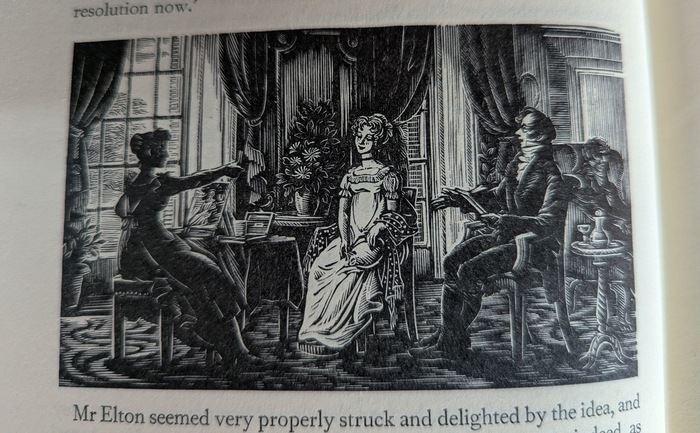 Thanks for sharing that image! It is interesting to see Harriet highlighted in that way.
 I am another contributor who has read this novel many times, yet even though I knew what to expect, as this section progressed the words ‘EMMA IS A SNOB’ kept shouting out at me, getting louder and louder each chapter.
 The other words I would use to describe Emma is ‘precociously deaf to any opinion but her own,’ probably the result of (yet again in a Jane Austen novel) not having the guidance of an effective mother. In fact it seems that she has had very little guidance, even by her governess/buddy/best mate/whipping
As a result of this lack of guidance it seems that she has become a self proclaimed marital missionary, stalking through the jungle society of Highbury and setting her sights on likely partners to join together. Whilst looking down the gun-barrels of her perceived shotgun weddings, her blinkered vision leaves her oblivious to almost everything else going on around her.
Emma’s capture and caging of poor Harriet and feeding her the chunks of rancid meat that poisoned her love for Mr. Robert Martin was one of her most terrible acts. Her super snobbish dismissal of Robert as not being good enough for Harriet was a disgrace, as we all found out when Mr. Knightly described the man as he really was.
Despite the somewhat overfamiliarity between Emma and the brother of her brother-in-law, my real enjoyment in this section was when Knightly was laying into Emma with all his might to show how much he disapproved of her actions. But having developed a rhino hide of indifference to everyone else’s opinion, only a tiny amount of discomfort percolated through to Emma’s rationale.
I have fashioned a pair of AI snob defenders to wear over my glasses for the rest of the book. Hopefully they will tone down the snobbery or at least alleviate the after effects by making ridiculous excuses for snobbish outbursts. That might allow me to complete the novel relatively peacefully.
Well, aren’t snobs useful to juxtapose oneself with? That done, I can forgive the protagonist for being a snob and look forward to her comeuppance .
From an article in No. 38, 2016 of the The Jane Austen Journal called “Liking” Emma Woodhouse", by ELAINE BANDER.Her [Jane Austen's] collections of “Opinions,” while revealing her keen interest in how people responded to her novels, do not betray any need to control those responses, nor even frustration when some of her readers clearly fail to “get” what she is doing. Rather, she appears to anticipate, and even to tolerate, deviant readings from dull elves who cannot read her works with sufficient ingenuity.
Mod
You are absolutely right, and if the novel ended here we might all despise her. Since it was over 50 years ago that I first read this book, I can't remember if I hated Emma at this point.
Robin P wrote: "There's also schadenfreude when higher-up people get involved in scandals or are shown to have flaws! But in this case, Harriet treats Emma like a movie star or famous influencer ..."Interesting what you say about today’s celebrities and movie stars and influencers, giving this novel a modern context.
Ginny wrote: "I found this while researching another novel: Under English common law a child born of unmarried parents was indelibly filius nullius (‘nobody’s child’), and while under canon law (still in operation in Scotland) and European civil law children could become legitimate if their parents married, the English child remained illegitimate for life. ...."How interesting Ginny!!!!, and seriously, things didn't change until 1987. I had that a sense that Emma was protesting about something, because this is in all of Jane Austen's novels.
Ginny wrote: "Emma may be unlikeable, but she is such an interesting mix of contradictions. I had forgotten how naive she is. So unsophisticated and unworldly. They live only 16 miles from London, yet she really..."the image is from one of my favourite scenes, and what follows, just v funny
 Robin P wrote: "You are absolutely right, and if the novel ended here we might all despise her. Since it was over 50 years ago that I first read this book, I can't remember if I hated Emma at this point."
That is my problem with Emma: I read the book first when I was long past the age of heartfelt hate or contempt for a young woman. I could only feel something between shame and pity, and most of the humour was lost on me. (... a bit like a mother who can only stand by and cringe, watching her child make all the errors that are unavoidable on the way to growing up). So I could not really enjoy the book.
Mod
 Mod
Mod
Same, I see her faults but don't particularly dislike her. Her faults make her a pretty interesting character and leave room for a growth arc (esp. compared to someone like, say, Fanny Price).
I’ll defend Fanny Price! She may not act out but internally, she’s a stew of frustration, anger, hurt, and indecision. She grows into courage and determination.
Mod
True, but there is nothing funny about Fanny. At this point in Emma, it doesn't seem funny to Harriet who has been misled, or to Emma, who is astounded at being wrong. But it's funny to me to see her comeuppance.
Abigail wrote: "I’ll defend Fanny Price! She may not act out but internally, she’s a stew of frustration, anger, hurt, and indecision. She grows into courage and determination."I second that! - I know no other main character who lives and develops so intensely between the lines.
 Good evening, I have also read this probably more than 20 times. I am a huge fan of Emma, although I cringe reading a few parts including the part she plays in persuading Harriet to turn Robert Martin down.
 Regarding Mr Woodhouse being managed, I see Emma more as the victim of this as opposed to the upper hand. in Chapter 1 she has to set aside her evening to console him for the 'sad event' of Miss Taylor marrying, even while missing her friend herself.
Chapter 3 makes Mr Woodhouse sound like he has his own way a lot. 'He liked very much for his friends to come and see him;and from various united causes, from his long residence at Hartfield, and his good nature, and his fortune, his house ans his daughter, he could command the visits of his own little circle, in a great measure, as he liked. '
'Mr Frank Churchill was one of the boasts of Highbury'
A boast coming from pride in him, begins an idea that pride comes before a fall. I think this starts the idea that there could be more to him than Mr Weston represents from his yearly visits.
Mod

In these first chapters, we are introduced to a number of characters
Emma, whose blessings are also her faults, as the author tells us on the first page
Mr. Woodhouse, a hypochondriac and creature of habit
Mrs. Weston, formerly Miss Taylor, who was more a companion than a director of Emma's youth
Mr. Weston, an older man with a grown son taken in by relatives
Mr. Elton, the vicar, an attractive young man
Harriet Smith, an innocent girl, younger than Emma, with a mysterious parentage, who Emma take on as a project
Mr. Knightley, a neighbor and friend, who seems to be the only one who questions Emma's behavior
There is a brief glimpse of Robert Martin, but he seems to be immediately dismissed from the story (especially by Emma.)
There are mentions of other characters who we will see later.
What is your impression of these people?
Do you think Emma's matchmaking will continue to succeed?
Is Emma a terrible snob, or is she just teaching Harriet the realities of the age and place they live in?