
Works of Thomas Hardy discussion
Poetry
>
A Spellbound Palace
date newest »
newest »
 Hampton Court Palace is located within the London Borough of Richmond upon Thames. It was originally built in 1514 for Cardinal Thomas Wolsey, Archbishop of York and Lord Chancellor for King Henry VIII during the first half of his reign. The cardinal had excellent administrative skills and was very loyal to the king. But he was unable to secure an annulment of Henry's marriage to Catherine of Aragon, his first wife, from the Pope. (The Pope was under the control of Catherine's nephew, Holy Roman Emperor Charles V, so a favorable ruling was impossible.) This enraged the king, and Wolsey was striped of his offices and great wealth in 1529.
Cardinal Wolsey gave the palace to Henry VIII in the hopes that the gift might save his life. The palace became one of Henry's favorite residences and he enlarged it.
In 1530 Wolsey was arrested for treason, but he died from severe illness while traveling to London to face the King's judgment.

Ego Et Rex Meus (My King And I), by Sir John Gilbert, 1888
Painting of King Henry VIII and Cardinal Wolsey
https://www.thecollector.com/cardinal...
 Mod
Mod
Thomas Hardy seems to record his impressions; the first parts are all internalising his own experience, the birdsong, the peace, and the "spacious pathways". Either the palace or the poet, is "spellbound".
Perhaps he feels it is like a fairytale - he is using quite archaic phrasing, especially in the latter, "historic" part of the poem. I like the term "enfeebled fountain" - it is exactly like that at this time of year, when the rain becomes less frequent and fountains dry up. "We" makes me think Thomas Hardy is either there with someone else - or perhaps more likely it is a literary device; he's sharing it with us, the readers.
I've visited Hampton Court Palace twice, and each time I was sharing the experience. 😊
Visiting - off topic so under (view spoiler)
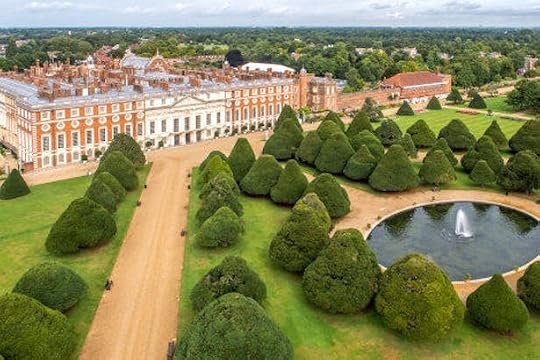
You can't really tell from an aerial view, but it is actually quite a low building, although very extensive with open grounds, as Thomas Hardy seemed to like. And just in case you're wondering how this palace fits into things, here's a little more ...
Mod
More about royal palaces under (view spoiler)
(link to poem in place)
Jean, thank you for sharing your experiences and the information about the palaces.If anyone would like to see more photos of the Hampton Court Palace, including the rooms inside:
https://www.hrp.org.uk/hampton-court-...
https://livinglondonhistory.com/ten-s...
Mod
The more I think about this, the more I think Thomas Hardy is suggesting that the palace itself is spellbound. Yet what we pick up from the poem is his own sense of magic. He even sees a ghost - a "Shade" - in his imaginings. And "an insistent numbness" makes me think the poet has been captivated by a frozen moment in time. The further we read, the further he seems to be charmed - i.e. is under a spell - by what has happened there in the past. It even affects his language (e.g. "and lo!" is archaic).
There is a fanciful theory that places, and buildings, can soak up the emotions of the past. Perhaps this is what Thomas Hardy is expressing?
I'd love to know what others think of the poem. Connie - Was this sense of magic what drew you to the poem? Or its historical connections? Or something else?
(I've added spoilers to my earlier posts, to clarify, but left my first thoughts about the poem there.)
The first part of the poem shows the palace as a peaceful, beautiful place as the narrator is approaching the building. The third stanza introduces the palace as the asile (sanctuary) of History. Then the last stanza brings in the ghosts of King Henry VIII and Cardinal Wolsey. The King is swaggering and the Cardinal is self-centered. The King had brought each of his wives to the palace, and then killed them if they did not produce a male heir. I liked the contrast between the peaceful exterior of the palace and the history of what went on inside. It does seem like the palace is haunted, and its history is like a violent fairy tale. People will never be able to think of Hampton Court without thinking about his many wives. (Of course, this set off all the violence between religions for years, but I'm trying to limit it to Hampton Court.)
Mod
 Mod
Mod
I visited Hampton Court back in the 90's on my first trip to London. Jean is right, it's such an easy walk from the tube station. It was a rainy day in January when I visited. Not at all the spring day of sunshine Hardy describes. Still, I remember lots of birds singing, even though it was winter.
These lines struck me as such an accurate description of my memory of the palace:
"Across the spacious pathways stretching spires of shadow run,
And the wind-gnawed walls of ancient brick are fired vermilion."
I would have called it "red brick", but vermillion is a much better word choice. And I remember the spires of the building casting lots of shadows. It adds to the haunted feeling of the place.
Perhaps because I was there off season, there weren't many other visitors. My friend and I had the place almost to ourselves, and I remember feeling like it was haunted. As Jean says, it probably is fanciful, but when I was there, I really did feel like there was a kind of spell over the whole palace. That history had somehow embedded itself into the bricks and tapestries. I especially felt that when we visited the kitchen. I kept thinking of all the common people that worked there making the great palace function
Thank you, Connie and Jean, for the history context and the art. I loved all that. I had completely forgotten about Cardinal Wosley being the first owner!
Do we think the fountain in the picture Connie posted is the one Hardy refers to in the poem? And are those the yew trees of "stirless depth"? (yet another wonderful phrase in this poem).
Connie - I'm also curious (like Jean) what drew you to this poem? I'm so glad you shared it this week!
Bridget, I also think that "vermilion" sounds much more poetic than "brick." It's wonderful that both you and Jean were actually visitors at Hampton Court! Both beauty of the palace and gardens, and its history interested me. The palace is said to be haunted by several female ghosts including Jane Seymour (3rd wife of Henry VIII), Cathering Howard (5th wife), and Sybil Penn (nurse to Elizabeth I). The history of the palace is also very haunting.There are at least three different fountains at Hampton Court that I saw online at various sites. This link has lovely photos of the gardens, including the yew trees, most of which were commissioned by royalty after the time of Henry VIII:
https://www.hrp.org.uk/hampton-court-...
The photo I posted earlier is one picturing the Great Fountain Garden which William III and Mary II (1689-1702) created on the East Front to complement their elegant new baroque palace. "Their gardener, Daniel Marot, created a garden containing 13 fountains and planted two radiating avenues of Yew trees in the fashionable form of a goose foot. After being opened to the public on the orders of Queen Victoria in 1838, the Great Fountain Garden became the highlight of a visit to Hampton Court Palace."
 Another wonderful poem. Thanks so much for sharing, Connie, as well as the historic references and details. I appreciate it all.
Pamela wrote: "Another wonderful poem. Thanks so much for sharing, Connie, as well as the historic references and details. I appreciate it all."
Another wonderful poem. Thanks so much for sharing, Connie, as well as the historic references and details. I appreciate it all.
Pamela wrote: "Another wonderful poem. Thanks so much for sharing, Connie, as well as the historic references and details. I appreciate it all."We've read quite a few poems by Hardy this year that have references to history. His epic poem, "The Dynasts," is about the Napoleonic Wars. So we can see how history was a subject of great interest to him.
 I read online that this is considered one of his best poems. He does have some great word choice.
It seems to me that he contrasts physical nature around him with the history he imagines of the place. Sun, yew tree, finches are all visible while the King and minister are mere shades.
And yes, as others have mentioned, Hardy gives us a view through his own experience of the palace.
Natalie wrote: "I read online that this is considered one of his best poems. He does have some great word choice.It seems to me that he contrasts physical nature around him with the history he imagines of the pla..."
Natalie, I also like his vibrant, unusual word choice. "Low-traveling winter sun" and "wind-gnawed walls" stood out when I read the poem again today, and other phrases were noticed more in May. Hardy is a great wordsmith! There is a contrast between the peace he views and the palace's bloody history.

Works of Thomas Hardy
Authors mentioned in this topic
Thomas Hardy (other topics)Thomas Hardy (other topics)
Thomas Hardy (other topics)
(Hampton Court)
On this kindly yellow day of mild low-travelling winter sun
The stirless depths of the yews
Are vague with misty blues:
Across the spacious pathways stretching spires of shadow run,
And the wind-gnawed walls of ancient brick are fired vermilion.
Two or three early sanguine finches tune
Some tentative strains, to be enlarged by May or June:
From a thrush or blackbird
Comes now and then a word,
While an enfeebled fountain somewhere within is heard.
Our footsteps wait awhile,
Then draw beneath the pile,
When an inner court outspreads
As ’twere History’s own asile,
Where the now-visioned fountain its attenuate crystal sheds
In passive lapse that seems to ignore the yon world’s clamorous clutch,
And lays an insistent numbness on the place, like a cold hand’s touch.
And there swaggers the Shade of a straddling King, plumed, sworded, with sensual face,
And lo, too, that of his Minister, at a bold self-centred pace:
Sheer in the sun they pass; and thereupon all is still,
Save the mindless fountain tinkling on with thin enfeebled will.
From Human Shows, Far Phantasies, Songs, and Trifles, which was published in November 1925.