
Reading the 20th Century discussion

This topic is about
M. John Harrison
Favourite Authors
>
M. John Harrison
date newest »
 I loved The End of Everything and have been wanting to read The Sunken Land for years...but keep telling myself I should read The Water Babies first, as I believe they're linked.
 Mod
I would say reading The Water Babies first is far from essential (so far at any rate)
Nigeyb wrote: "Ah, that makes senseI would say reading The Water Babies first is far from essential (so far at any rate)"
Yes but then I got randomly given a copy of The Water Babies so I really don't think I can proceed without reading it. ;-)
Mod
The house - an end-of-terrace originally as spacious though not perhaps quite as tall as Victoria's - had fitted itself tightly into the north bank of the river. Behind it the hillside steepened rapidly through coppiced woodland and old ironmaster estates. Deeper than the rest of the terrace, and with a bleak little parking space on the open side, it stood somehow foursquare and apart; had flooded once every February since 1802 - events that were preserved not as a smell but as something prior to smell, something more fundamental. In the same way, recent layers of fitted carpet and damp wallpaper maintained the record of dead pets, tobacco, takeaway food. A private hotel between the wars, it had lain disused until the construction of Telford New Town saw it divided into bedsitter accommodation for semi-skilled labour. Stuffy with the past yet endlessly restructured, it remained a memorial to disconnected use, a warren of low-ceilinged rooms where the light flowed slowly from wall to wall like silt. Once you had stepped inside and spent a moment in the hall you began to hear televisions in distant rooms, all tuned to different stations.
P92 The Sunken Land Begins to Rise Again
Mod
Mod
https://www.goodreads.com/review/show...
4.5/5
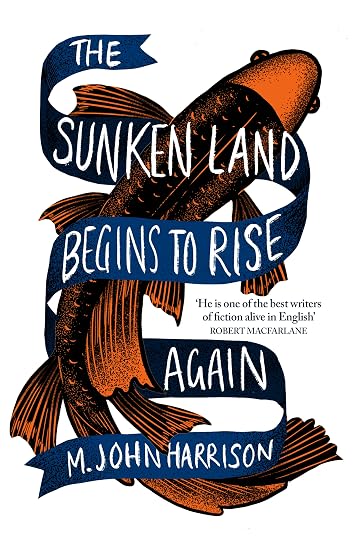 I definitely want to read this... now to wait until January when my total book-buying ban expires.
Mod
I was lucky enough to be able to get it out of my local library service
Mod
The End of Everything (2026)
Needless to say feeling excited to be starting this one
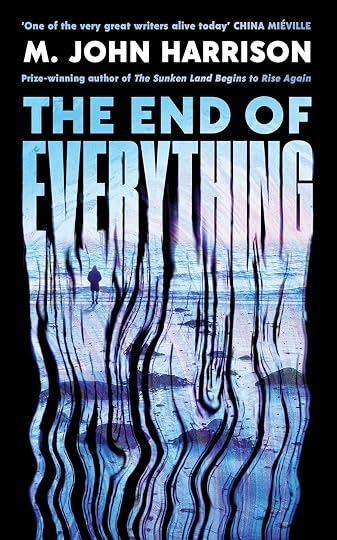
Phillip Tennent makes his living at the tideline, collecting artefacts that wash up from the Channel. It's been years since the crisis changed everything, but its exact nature remains obscure. Government barely functions, the seas are full of new creatures, Europe has been mislaid. It feels like the end.
Now Phillip has fished out of the water an object he can't keep. A creature that keeps changing. An artefact he must take inland, before it destroys everything he thinks he knows. The End of Everything is a slyly satirical and unsettling post-apocalyptic adventure into the limits of human understanding from the peerless master of contemporary fiction.
 Mod
I like how for M. John Harrison the end of the world is not some one off catastrophe but a slow, administrative, and quiet process. Here it looks like broken public transport, frayed supply chains, shifting weather, and bureaucratic indifference. Life doesn't stop, people just adjust their expectations downward, lower their standards and carry on complaining state of the roads etc
Nigeyb wrote: "I’m closing in on the ending of The End of EverythingI like how for M. John Harrison the end of the world is not some one off catastrophe but a slow, administrati..."
True, but there's more to it than that. There has been some sort of invasion, even if not necessarily hostile, that makes it hard for society to hang together. That was my feeling anyway.
Mod
Yes, It appears that something has happened. Perhaps an invasion? But certainly not in the traditional sense.
I enjoyed reading it, but feel that the key to the experience is to treat it as some kind of experiential mood piece that is designed to evoke the sensation of drift, cognitive decay, and a subtle unspooling rather than as any kind a puzzle with a definitive solution
Perhaps the logical end point for the modern post-truth world? We don’t go out with a bang but a long slow confused whimper?
Either way it’s very good
Review here...
https://www.goodreads.com/review/show...
Mod
How does it compare with these two books?
What would you recommend?
 Mod
Thanks Hugh
In the absence of any replies here I out the query into Google
This is what came back….
Across his six-decade career, M. John Harrison has been one of English literature’s most relentless anti-genre writers. If you enjoyed The Sunken Land Begins to Rise Again (2020) and The End of Everything (2026), you have already met Harrison at his most settled and refined—where the uncanny is treated not as a spectacle to be solved, but as a quiet, domestic atmosphere that seeps through the cracks of everyday British life.
Comparing his broader bibliography to those two recent novels reveals how his work has evolved, alongside specific recommendations for where to go next.
How His Broader Work Compares
Harrison’s career generally divides into three distinct phases, each approaching his core themes (epistemological dread, failed narratives, and the refusal to offer neat closure) with varying degrees of genre framework:
* Early Career & Deconstructed Fantasy (Viriconium series, 1971–1984):
* The Difference: Where Sunken Land and The End of Everything ground their strangeness in real British geographies (London, Shropshire, the Kent coast), Viriconium is set in a dying, far-future city. However, rather than writing standard high fantasy, Harrison actively subverts epic tropes. The world’s history changes arbitrarily from book to book, explicitly mocking the idea of neat fantasy worldbuilding.
* Subversive Space Opera (The Kefahuchi Tract trilogy, 2002–2012):
* The Difference: Books like Light and Nova Swing feature faster-than-light travel, quantum phenomena, and alien artifacts. But unlike conventional space opera, the focus remains on deeply flawed, messy humans who take their mundane neuroses into deep space. The tone is sleeker, faster, and more explosive than the slow, damp drift of Sunken Land, but shares the same refusal to give a "scientific" explanation for the cosmic anomalies.
* Mid-Career Realism & Mundane Weirdness (Climbers, The Course of the Heart, 1989–1997):
* The Difference: This phase bridges straight literary realism with quiet psychological horror. It is the closest thematic ancestor to Sunken Land—focusing on ordinary people obsessed with something just beyond their reach.
Key Recommendations
1. For the most direct thematic match: The Course of the Heart (1992)
* Why read it: If what you loved about Sunken Land was its heavy, damp, English mood and the sense of characters being haunted by an intangible event, this is its direct spiritual precursor.
* The premise: It follows three Cambridge students who perform a vague, amateur occult ritual in their youth. Decades later, their lives are quietly ruined by the memory and aftermath of what happened—or what they think happened.
* How it compares: Like Sunken Land, it deals with unanchored belief, middle-aged drift, and the psychological weight of an uncanny occurrence that never quite explains itself.
2. For his absolute masterpiece in genre-deconstruction: Light (2002)
* Why read it: Widely considered one of the defining science fiction novels of the 21st century.
* The premise: It weaves three timelines together: a serial-killing quantum physicist in 1999 who is haunted by a terrifying entity called the "Crayne," a female starship captain in 2400 fused to her vessel, and an addicted VR-scavenger living in the shadow of an unknowable space anomaly called the Kefahuchi Tract.
* How it compares: It is much faster-paced and visually dazzling than The End of Everything. However, the core thematic engine is identical: characters trying—and failing—to make sense of a universe that does not care about human logic.
3. For a sharper, condensed experience: His Short Story Collections
* Recommended titles: Settling the World: Selected Stories (2020) or You Should Come With Me Now (2017).
* Why read them: Harrison is arguably at his most potent in short fiction. His stories function like sudden, eerie glimpses out of a train window—offering razor-sharp vignettes of ordinary British life interrupted by unexplainable glitches, strange artifacts, or shifting realities.
* How it compares: If you felt The End of Everything was effective as an impressionistic "mood piece," his short fiction distills that exact quality into 10-to-20-page doses.
4. For his non-fiction perspective: Wish I Was Here (2023)
* Why read it: Described as an "anti-memoir," this book combines diary entries, reflections on writing, landscape studies, and fragments of memory. It provides a fascinating look into the mind behind Sunken Land and The End of Everything, showing how Harrison views terrain, aging, and the craft of fiction.
Suggested Reading Order
[The Sunken Land (2020) / The End of Everything (2026)]
│
▼
The Course of the Heart (1992)
(For damp, psychological English dread)
│
▼
Light (2002)
(For a high-concept, cosmic expansion)
│
▼
Settling the World / Short Stories (2020)
(For quick, uncanny vignettes)

Reading the 20th Century
Books mentioned in this topic
The End of Everything (other topics)The Sunken Land Begins to Rise Again (other topics)
The End of Everything (other topics)
The End of Everything (other topics)
The Sunken Land Begins to Rise Again (other topics)
More...
Authors mentioned in this topic
M. John Harrison (other topics)M. John Harrison (other topics)
M. John Harrison (other topics)
M. John Harrison (other topics)
China Miéville (other topics)
Positive comments about The Sunken Land Begins to Rise Again inspired me to read it. I’m 66 pages in and very impressed. It’s easy to understand why it won The Goldsmith Prize
I’m also hoping to read his Booker 2026 short listed The End of Everything before much longer