
The History Book Club discussion
THE FIRST WORLD WAR
>
FIRST WORLD WAR - TRENCH WARFARE

 Mod
Mod
What were conditions like for the men who lived in these trenches? If one goes to the thread which deals with health issues; some of the images are rather disturbing regarding some of the ailments that the men suffered as the result of being confined to these trenches.
Mod
http://www.spartacus.schoolnet.co.uk/...
Mod
"Indeed, the Great War - a phrase coined even before it had begun - was expected to be a relatively short affair and, as with most wars, one of great movement.
The First World War was typified however by its lack of movement, the years of stalemate exemplified on the Western Front from autumn 1914 until spring 1918.
Not that there wasn't movement at all on the Western Front during 1914-18; the war began dramatically with sweeping advances by the Germans through Belgium and France en route for Paris.
However stalemate and trench warfare soon set in and the expected war of movement wasn't restored until towards the close of the war, although the line rippled as successes were achieved at a local level. (See Chapter Six - The First World War - Stalemate)
So what was life actually like for the men serving tours of duty in the line, be they front line, support or reserve trenches?
The Race to the Sea ended with the onset of trench warfare on the Western front:
http://www.firstworldwar.com/atoz/rac...
Here is "brief" footage of German soldiers preparing trenches in 1914:
http://www.firstworldwar.com/video/ge...
This is an example of the "trench cycle":
As an example - and the numbers varied widely - a man might expect in a year to spend some 70 days in the front line, with another 30 in nearby support trenches. A further 120 might be spent in reserve. Only 70 days might be spent at rest. The amount of leave varied, with perhaps two weeks being granted during the year.
The Barb Wire - Wiring Parties:
http://www.firstworldwar.com/atoz/wir...
Source: http://www.firstworldwar.com/features...
Mod
A century of mud and fire
http://news.bbc.co.uk/2/hi/in_depth/5...
Mod
http://en.wikipedia.org/wiki/Trench_w...
Source: Wikipedia
Hubpages:
http://hubpages.com/hub/World_War_1_T...
Mod
It is called Trench Warfare: A Manual for Officers and Men.
 Joseph Shuter Smith
It was published by Second Lieutenance Joseph Shuter Smith of the British Expeditionary Force in 1917.
It is quite complete and discusses the construction of trenches, dugouts, revetments, traverses, recesses, reliefs, gas warfare, you name it.
Here is the google link: (all terminology explained in detail)
http://books.google.com/books?id=sx_C...
Here is another one of his books:
http://books.google.com/books?id=rv5q...
 Joseph Shuter Smith
Mod
Joseph Shuter Smith
Mod
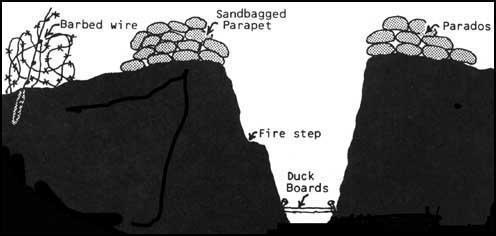
Cross-section of a front-line trench
Source: http://www.spartacus.schoolnet.co.uk/...
For more detailed information regarding the various elements of the trenches, refer to link.
Mod
"Yet there was no standard trench system. The pattern varied from place to place, front to front, the design depending upon the nature of the terrain, the ratio of troops to space - hight in the west, low in the east -tactical doctrine and the course of the fighting which had caused the line to rest where it did."
Mod
http://www.spartacus.schoolnet.co.uk/...
Mod
http://www.spartacus.schoolnet.co.uk/...
This link shows some great diagrams of traverses:
http://www.worldwar1.com/tlbtw.htm
Mod
New York Times Article - February 21, 1915
http://query.nytimes.com/mem/archive-...
Mod
http://images.google.com/imgres?imgur...
Mod
By Martin Kitchen
Last updated 2009-11-05
How did the German experience of World War One trench warfare differ from that of the Allies? Professor Martin Kitchen investigates.
http://www.bbc.co.uk/history/worldwar...
Source: BBC
Mod
"On 13th September, Franchet d'Esperey signalled in his evening report to Joffre at GQG that Fifth Army had encountered a new phenomenon, an organized trench system extending beyond the city of Rheims on both sides, which his advance guards could neither turn nor penetrate."
"On 15 September, Focj reported from Ninth Army that he had been stopped by an entrenched line stretching eastward from Fifth Army's flank.
"On 16 September Sarrail from Third Army, signalled that it was in continuous contact with the enemy who had surrounded Verdun with a network of trenches which he could not carry by infantry assault."
"Castelnau, on his right, found the same day that his Sixth Army was faced by a continuous trench line he could not outflank, while on 17 September Dubail, First Army, reported that his front was crossed by a continuous line of trenches thrown up by labourers the Germans had impressed from the local population."
Thus from Rheims to the Swiss frontier, the Germans had succeeded in carrying out Moltke's order of 10 September to "entrench and hold" the positions reached after the retreat from the Marne."
Page 179
Mod
"The British, who had learnt recent and important lessons in South Africa, where the Boers had taught them at the Modder and Tuggela rivers the value of complicating any trench system, compensated for the inferiority of their overlooked positions in Flanders by digging in duplicate and triplicate, an insurance both against sudden infantry assault and artillery damage.
The Germans, who had last dug earthworks around Paris in 1871 and otherwise derived their knowledge of trench warfare from indirect studies of the Russo-Japanese War, had a different doctrine. In two instructions, issues on 7 and 25 January 1915, Falkenhayn ordered that the western armies were to fortify the front in a strength sufficient to assure that it could be held with small numbers against attack by superior forces for a long time."
Page 179
Mod
The trenches were fortified, were built deep, fortified by machine guns, heavily walled with timber, iron and concrete. Parapets were thick and high, trench interiors floored with wooden walkways, electric light was appearing, fixed bedsteads, planked floors, panelled walls, even carpets and pictures (lol). Rearward from their underground command posts ran telephone lines to their supporting artillery batteries. "The Germans were settling in for the long stay."
Patricrk..why should the Germans resort to a peace treaty...they were beginning to have all of the comforts of home (smile).
Page 180 - Keegan
Mod
Why was this the case? Why did each side have different priorities, different outlooks?
Keegan alludes to the fact that "Occupation was worse, moreover, than a violation of the national territory."
"It was a grave disruption of French economic life."
Page 181
Were these the only reasons for the differences in perspectives of the French from the Germans?
 Bentley wrote: "This shows the parapet, the position of the sandbags on the parapet, the parados, the fire step, the barbed wire, the duckboards, etc.
Cross-section of a front-line trench
Source: http://www.sp..."
This is a great graphic, Bentley. I was especially interested in what the parados were for. It was to keep you from being outlined for enemy snipers, and also to protect you from friendly fire from the rear. All these things to think about when building an ideal trench.
Mod
 I believe that the difference in philosophies between the Germans and French was due primarily to the French leadership's obsessive belief that nothing could resist a spirited offensive, as contrasted with the Germans' awareness that a network of trenches, barbed wire, machine guns, and artillery could resist it quite effectively; the Germans were more realistic about their expectations once the Race to the Sea ended and with it the war of rapid movement and flanking attacks.
There were a couple of other details that demonstrated the greater practicality of the Germans; first, when they initially dug in they made a point of choosing high ground with good drainage and superior fields of fire (giving up small amounts of ground if necessary to do so), because they knew they'd be there a long time. Second, the Germans were the first to realize the value and menace of snipers - they got a head start on introducing trained snipers to the fight and on giving them quality equipment - the most accurate rifles from the Mauser factory and quality scopes. The Germans, despite their reputation for being fixated on order, also made life easier for their troops by deliberately arranging their parapets to have a rather chaotic appearance from the Allied vantage point, which made it hard for the Brits and French to spot the German snipers' firing points. The Brits, on the other hand, were obsessed with parade-ground-style neatness in the arrangement of sandbags and so on, which meant that any opening or firing loop their snipers set up was out of place and glaringly conspicuous to the Germans. Often, the first time a British sniper even went to look for a target, he was shot through the head as soon as he took his position behind the firing point. The British officers resisted changing this, though. That tidy appearance meant more to them than the lives of their men.
 An excellent comment on the different philosophies between the different combatants there James. You might appreciate this set of orders given by Lieutenant Frank Bethune to an Australian machine-gun crew just prior to the German offensive on 21st March 1918. I had read these orders before many years back in another book but could never find them again. This was taken from my current book; "Anzacs".
1. This position will be held, and the section will remain here until relieved.
2. The enemy cannot be allowed to interfere with this programme.
3. If the section cannot remain here alive, it will remain here dead, but in any case it will remain here.
4. Should any man, through shell shock or other cause, attempt to surrender, he will remain here dead.
5. Should all guns be blown out, the section will use Mills grenades, and other novelties.
6. Finally, the position, as stated, will be held.
 by Peter Pedersen
'Novelties'? Sounds as if they're talking about party favors.
by Peter Pedersen
'Novelties'? Sounds as if they're talking about party favors.For a machine gun crew whose position has become untenable, it's a lot more effective to pull back a short distance and keep the gun in action than to end up dead on the ground next to it while the enemy who just overran you turns it around to use on your own people. That lieutenant must either not have been in the line more than about five minutes or been an idiot or moral coward. It's a leader's duty to his superiors to question bad orders rather than carry them out robotically. I know I was saved from mistakes a few times by my NCOs, staff NCOs, and junior officers who pointed out why they were bad ideas.
Hi James, these orders were given in the spirt of 'Aussie' humour which I know is a bit different. "Directed to hold an exposed post 'at all costs', Lieutenant Frank Bethune gave orders to his machine-gun section that caught the Australian mood".
It was around the same time as Haig issued his famous 'back-to-the-wall' order.
Ah. That makes sense, then. I'd have added a number 7 - "In the case of any doubt or confusion, refer to order number 1."Our Marine Corps has a set of eleven general orders for sentry duty, some of which have that kind of repetitive flavor; the short and informal version was "To walk my post from flank to flank, and take no shit from any rank."
Hi James, I like the informal version of the USMC sentry duty, very much to the point :)
 'Aussie Rick' wrote: "Hi James, these orders were given in the spirt of 'Aussie' humour which I know is a bit different.
 "Directed to hold an exposed post 'at all costs', Lieutenant Frank Bethune gave orders to his ..."
That quote had me immediately add the book to my to-read list.
Hi Erick,I've just finished the book and I found it a great read, if you manage to get a copy I'm pretty sure you will enjoy it.
by Peter Pedersen
Mod
It's a great book Bentley and not 'nationalistic' in any sense, a very fair and non-biased account. I found this summary:"This important book traces the evolution of the Australian Imperial Force from the enthusiastic amateurs of Gallipoli to the skilled warriors of the Western Front, where fighting in conditions of unspeakable horror and brutality they won their legendary reputation as 'the best infantrymen of the war and perhaps of all time'. By war's end the Australian Corps - a mere 9 per cent of the total British force - accounted for 22 per cent of total captures: a massive, and disproportionate, contribution to victory. Combining detailed battle narratives with soldiers' accounts, Peter Pedersen moves from Gallipoli through Palestine to the Western Front, graphically recreating the campaigns of a war in which over 200,000 Australians - two out of every three combatants - were killed or wounded. Including the New Zealanders at every stage, he also covers the war in the air and at sea, in dressing posts and hospitals, and on a home front devastated by casualty rates and riven over conscription. Illustrated with over 300 photographs and artworks, this epic work recalls to memory the forgotten heroes, and the bloody campaigns, of a war that brought glory to the Australian nation but tragedy to every Australian family."
by Peter PedersenI truly hope that many of my countrymen take the time to read this book and to always remember what these men and the others from all nations gave to secure peace.
Mod
 Mod
Mod
 by John Ellis (no photo)
Synopsis:
Millions of men lived in the trenches during World War I. More than six million died there. In Eye-Deep in Hell, the author explores this unique and terrifying world—the rituals of battle, the habits of daily life, and the constant struggle of men to find meaning amid excruciating boredom and the specter of impending death.
Mod
 by Nicholas Murray (no photo)
Synopsis:
Nicholas Murray’s The Rocky Road to the Great War examines the evolution of field fortification theory and practice between 1877 and 1914. During this period field fortifications became increasingly important, and their construction evolved from primarily above to below ground. The reasons for these changes are crucial to explaining the landscape of World War I, yet they have remained largely unstudied.
The transformation in field fortifications reflected not only the ongoing technological advances but also the changing priorities in the reasons for constructing them, such as preventing desertion, protecting troops, multiplying forces, reinforcing tactical points, providing a secure base, and dominating an area. Field fortification theory, however, did not evolve solely in response to improving firepower or technology. Rather, a combination of those factors and societal ones—for example, the rise of large conscript armies and the increasing participation of citizens rather than subjects—led directly to technical alterations in the actual construction of the fieldworks. These technical developments arose from the second wave of the Industrial Revolution in the late nineteenth century that provided new technologies that increased the firepower of artillery, which in turn drove the transition from above- to belowground field fortification.
Based largely on primary sources—including French, British, Austrian, and American military attaché reports—Murray’s enlightening study is unique in defining, fully examining, and contextualizing the theories and construction of field fortifications before World War I.
 I think it is difficult to imagine the horror of trench warfare. This book covers some of the major battles that accomplished little but massive death tolls.
Stalemate: Great Trench Warfare Battles
 by J. H. Johnson (no photo)
Synopsis
A new look at the horrors of the First World War reveals how the tactics of trench warfare came into being (for better or worse); the significant roles played by commanders; and one by one, how each catastrophic offensive unfolded, leading to countless deaths. First-hand accounts and personal writings by those who fought bring "The Great War" to life. Among the battles covered are Neuve Chapelle, Loos, The Somme, Arras, Ypres, and Cambrai.
Mod
 by Stephen Bull (no photo)
Synopsis:
In this new book, First World War trench expert Stephen Bull provides a complete picture of trench warfare on the Western Front, from the construction of the trenches and their different types, to the new weaponry and tactics employed in defense and attack. In addition, the book describes the experience of life in the trenches, from length of service, dealing with death and disease, to uniforms and discharge. Alongside his compelling narrative of the campaigns fought in the trenches from 1914 to 1918, annotated trench maps highlight particular features of the trenches, while photographs, documents, and first-hand accounts combine to give a full and richly detailed account of war in the trenches.
I think that most people don't realize the complexity of the trench system in WWI. They were not just ditches....some stretched for miles and often had several rooms. There were also the sapper trenches where explosives were placed under the enemy trenches. This book looks fascinating to me, Jerome, and goes on my never-ending TBR list.
Mod
I wonder if the book looks at the methods of attack from a trench. It appears to me that the same old 'shelling and then ranks of men walking forward' approach was used throughout the war and this led to the slaughter of the millions. Was anything different attempted as the defensive role of the machine gun was recognised, I wonder?Actonbooks.com
message 40:
by
Jerome, Assisting Moderator - Upcoming Books and Releases
(last edited Jul 12, 2014 09:01PM)
(new)
Mod
So there were actually a lot of different tactics used in trench warfare, but the nature of it made it almost impossible for either side to really use them to decisively beat the other.
I was thinking about major strategic advances employing tens of thousands rather than tactical patrolling with the occasional trench skirmish.And a creeping barrage is still an attempt at shelling the defensive positions.
I wondered that even before the advent of the tank any improvised form of armour was ever used to in some way shield the enfilading machine gun fire to hold a position in No Man's Land. Horses used to shell fire could have been used. I also wonder whether infantry made use of tank protection? Again, some form of wheeled towed vehicle with some side protection behind each tank. Seeing the effect that "funnies" as they were called had on the success of D-Day landings, I suppose I was wondering about the inventiveness of strategic planners faced with more and more deaths from the variety of similar tactics they were then using.
Mod
Thanks for that. Related to the strategic conundrum of four years of trench warfare, I briefly saw historian Max Arthur on, of all networks Russia Today's English service(I am not a fan, I pressed the wrong button), he wasn't trotting out the 'lions led by donkeys' line, but he was outlining how little impact the industrialisation of both small arms rate of fire and artillery accuracy -- plain to see from the Civil War 1861-5 -- had on strategic thinking.His view was they were building on experience of regimental-sized engagements with a guerilla army in South Africa rather than the mechanised killing of the American war of 50 years previously.
This leads me to wonder what impact the American entry into WW1 had on strategic doctrines. It must have been bringing in direct experience of the war, though it seemed to make little difference to the 'shell, blow a whistle, climb out of trenches and advance' waste of humanity.
Mod
The American troops were green and lacked the proper weapons. General Pershing did not get along with any of the Allied powers so I don't think that tactics were changed by America's entry into the war. But the addition of 1 million men in a war of attrition was more than Germany could match.Re: tanks. They played a minor part in the battle plan. As Jerome stated, they were used to support the infantry but were extremely undependable. More broke down and got stuck in the mud than actually enjoined the enemy.
Thanks for that. The thought that Arthur made about where the strategic command drew its philosophy of war from is still valid though, I feel. It seems that germans recongised industrialised ground warfare much before the allies. I do not recognise any strategy change from either side in 1918, with the German Spring offensives based on 'shell first, then charge'. The tank had improved in reliability in two years, perhaps, as they were using nearly 500 of them in August. Air power also began to play a part, so the strategists were recognising tecnological advance. I wonder if there is any written investigation of this point in any of the plethora of books pu blished or imminent
I should read these things before I post to avoid any confusion. The "they" I referred to in connection with tanks in 1918 is of course the allies
I remember something I read in the book cited below (which I would highly recommend) that resonated with me about the differences in the British and German armies and how they approached battle. I paraphrase:"The British democracy had a very autocratic chain of command regarding battle plans while the German autocracy had a democratic army which often allowed officers at the front to make their own decisions".
It's an interesting thought.
 by
by
 G.J. Meyer
A look at the futility and attrition of the stalemated war in the trenches
G.J. Meyer
A look at the futility and attrition of the stalemated war in the trenchesThe War in the Trenches
 by Alan Lloyd(no photo)
Synopsis:
The war fought on the Western Front between 1914 and 1918 has no precedent in history. It was a war between two stubborn enemies, each dug into the wet earth of Northern France and Belgium and facing each other across a merciless no-man's land. In a single day of trench warfare the British lost more men than their battle casualties of the Crimean and Boer wars combined, and far more than their worst losses for any day in World War II.(
 I just heard about this book on Radio Lab. Here's the audio: http://www.radiolab.org/story/103951-...
Here's the book:
 by Tony Ashworth

The History Book Club
Books mentioned in this topic
That's War (other topics)Early Trench Tactics in the French Army: The Second Battle of Artois, May-June 1915 (other topics)
Aisne 1914: The Dawn of Trench Warfare (other topics)
Sapper Dorothy Lawrence (other topics)
Trench Warfare, 1914-1918: The Live And Let Live System (other topics)
More...
Authors mentioned in this topic
William Arthur Sirmon (other topics)Jonathan Krause (other topics)
Paul Kendall (other topics)
Dorothy Lawrence (other topics)
Tony Ashworth (other topics)
More...

In chapter six Stalemate, Keegan begins to discuss the vastness of the trench fortifications during World War I.
Keegan states about the World War I fortifications in comparison to everything that came before in previous battles: "None compared in length, depth, or elaboration with Europe's new frontier of 1915. Measured from Memel on the Baltic to Czernowitz in the Carpathians and from Nieuport in Belgium to the Swiss border near Frieburg, the line of earthworks stretched for nearly 1,300 miles!. Barbed wire, an invention of American cattle ranchers in the 1870s, had begun to appear, strung in belts between the opposing trenches by the spring. So, too had underground shelters, "dugouts" to the British, and support and reserve lines to the rear of the front. In essence, however, the new frontier was a ditch dug deep enough to shelter a man, narrow enough to present a difficult target to plunging artillery fire and kinked at intervals into "traverses," to diffuse blast, splinters or shrapnel and prevent attackers who entered a trench from a commanding more than a short stretch with rifle fire."
-Page 176
All aspects of trenches, their construction, terminology, their fortification, strengths and weakness as well as this form of warfare and tactical positioning should be discussed on this thread.