
Terminalcoffee discussion
Books / Writing
>
Black Authors...
date newest »
newest »

 I generally have no idea about the ethnicity of the authors whose material I read. Many times I'm not even sure what sex they are. And if I saw the name "Wao" on a book, I would think Asian before Latino.
 I don't care who wrote the book, I just care if it sounds interesting. I may read more books by women simply because their interests match mine more than men do.
Isabelle Allende is good, and you get a two-fer with her being both a woman and South American. Walter Dean Myers is a fantastic YA author. Who is black.
And then there's Malcolm Gladwell, who is lots of stuff, Jamaican, Jewish, Scottish, Irish, and who's a Canadian, too.
 Jackie "the Librarian" wrote: "And then there's Malcolm Gladwell, who is lots of stuff, Jamaican, Jewish, Scottish, Irish, and who's a Canadian, too."
I saw a picture of him in the Globe & Mail while I was in Toronto last week. It was in the section my mother was reading, which was upside down from my side of the table. He looked like a classical musician from upside down. I was surprised to find out that was Malcolm Gladwell.

 I haven't noticed the enthnicities of the authors I read but the sex. I read more male than female authors. But I tend to gravitate more toward the horror, dark fantasy genres and those are more dominated by men.
I love Carlos Ruiz Zafon. I fell in love with
 and just had to read everything he's ever written. But at the time that was the only book of his out in English.
I just read Octavia Butler's
 a month or so ago. I loved it. I agree with KD; she died way too young. I felt like she could have continued that storyline. I have Kindred but haven't read it yet.
Jean Toomer's modernist "Cane"?? is popular again...
 i loved The Book of Night Women by marlon james and Giovanni's Room by james baldwin. i also liked Native Son.
 You might like Colson Whitehead, Mat Johnson, Leonard Pitts, Jr. For those looking for new authors try my blog White Readers Meet Black Authors welcomewhitefolks.blogspot.com
 Mod
Mod
As for nonfiction, I read more black authors there. Orlando Patterson. And I bought a collection of W.E.B. DuBois's writings and Harold Cruse's The Crisis of the Negro Intellectual.
 Jackie "the Librarian" wrote: "I don't care who wrote the book, I just care if it sounds interesting. I may read more books by women simply because their interests match mine more than men do.
Isabelle Allende is good, and you ..."
I have really enjoyed Gladwell's books
 You might try The Intuitionist by Colson Whitehead, which I thought was an excellent book. If for any reason you hate it, though, please don't tell me. I went to college with the author and liked him a lot.
Mod
Sag Harbor was his foray into the autobiographical novel, and I agree that it doesn't play to his strengths, although it's not a bad book by any means. The Intuitionist has more of a sense of humor: it involves elevators and ESP. Chip (he was called Chip, not Colson, in college) is easily one of the funniest people I've ever met, just incredibly clever.
Mod
Oh. Well then maybe pass on Chip's stuff.
You might try The Intuitionist by Colson Whitehead, which I thought was an excellent book. If for any reason you hate it, though, please don't tell me. I went to college with the author and liked him a lot.
Mod
Sag Harbor was his foray into the autobiographical novel, and I agree that it doesn't play to his strengths, although it's not a bad book by any means. The Intuitionist has more of a sense of humor: it involves elevators and ESP. Chip (he was called Chip, not Colson, in college) is easily one of the funniest people I've ever met, just incredibly clever.
Mod
Oh. Well then maybe pass on Chip's stuff.You're so strict.
Mod
Mod
It's not magical realism, although it is somewhat quirky. Without giving away the entire plot, I would say it revolves around someone's claim of being able to sense the operations of complex systems through non-rational means, and there's a good deal of ambiguity about whether this claim is true or false. There's a certain impishness to the book's humor, but he was around 24 when he wrote this one. It's not a recent book--although it's not from the '30s.Some of the elevators in it are from the '30s, nice Art Deco elevators.
I liked Louise Erdrich 'Love Medicine' She has American Indian ancestry-Chippewa I think.
Mod
Then I think we can safely conclude that this is not a book for you, LG. Forget I ever mentioned it. And if I've ever said anything about how much I like the Art Deco spire of the Chrysler Building, forget about that too.
 Mod
Mod
 We have a lovely example of Art Deco here in Omaha (Union Station)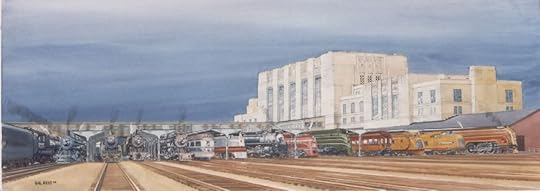
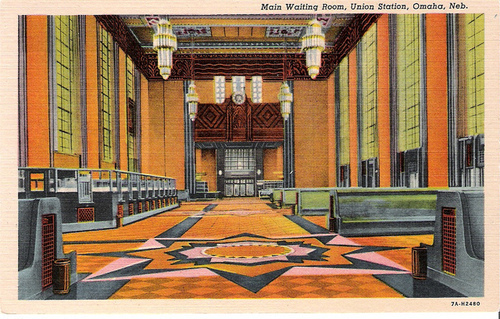 That's really impressive, Larry. The waiting room reminds me a little of 30th Street Station in Philadelphia. Do you know that one?
I know it very well. I commuted in and out of 30th St for a few years.
That's really impressive, Larry. The waiting room reminds me a little of 30th Street Station in Philadelphia. Do you know that one?
I know it very well. I commuted in and out of 30th St for a few years.  Oh, yes, that's it. I guess it was mostly the light fixtures and the design of the side windows that made me think it was similar. The floor at your station in Omaha is much more elaborate.
 Gabby wrote: "The Book of Negroes by Lawrence Hill:
This book may not an entirely accurate account of a historic part of negroes slavery but overall it was an enjoyable one with a decent dose of history and ..."
I've been unable to find a website that discusses the historical inaccuracies of this novel. Can you point the way?
 Chimamanda Ngozi Adichie writes about African issues,
 should be great - I haven't read it yet but bought it highly recommended. I also heard a BBC book podcast with her, and she had a lot of interesting things to say.
There's also Eric Jerome Dickey.
Lobstergirl wrote: "Honestly I kind of only want to read books from the 30s."Have you read
 or anything else by Elizabeth Taylor (not the actress). Or W. Somerset Maugham? ( a little newer I admit - but still cool stuff!)
 I read "The Color Purple" without knowing the author was black.
 I really enjoyed The Color Purple. I also enjoyed Their Eyes Were Watching God. I think I connected with theose two stories because I may have a bit of a built in gender bias. I simply find myself connecting mre with female authors, female characters and the related struggles that, at time, seem unique to being a woman. I don't think I intentionally seek out to read ' only women', but for me, the experiences of the female characters transcend ethic background or race.
BunWat wrote: "Outside of Canada that book is published as Someone Knows My Name, Janice, you might try searching under that title too.
I really enjoyed The Color Purple. I also enjoyed Their Eyes Were Watching God. I think I connected with theose two stories because I may have a bit of a built in gender bias. I simply find myself connecting mre with female authors, female characters and the related struggles that, at time, seem unique to being a woman. I don't think I intentionally seek out to read ' only women', but for me, the experiences of the female characters transcend ethic background or race.
BunWat wrote: "Outside of Canada that book is published as Someone Knows My Name, Janice, you might try searching under that title too.I haven't read it yet, so I can't speak to its accuracy or lack thereof e..."
That's right. I didn't think to search on that title. Thanks Bun
 I don't generally look at the author until after I have read a book. I mostly read fantasy; I don't believe many black authors write in this genre. I have only read one book by a black author.
 Just something I picked up when I worked at the college library for a time. I really enjoyed it.
Ha! First link to my query on Someone Knows My Name brought up his author's note from the book. For the most part, the book is accurate. He cites 4 inaccuracies that he intentionally made and they are minor. He also cites his extensive research.
Just something I picked up when I worked at the college library for a time. I really enjoyed it.
Ha! First link to my query on Someone Knows My Name brought up his author's note from the book. For the most part, the book is accurate. He cites 4 inaccuracies that he intentionally made and they are minor. He also cites his extensive research.I loved this book. I had no idea about Canada's role with slavery until this book. I had always patted ourselves on the back about our role in the underground railroad.
 I've read Their Eyes Were Watching God and The Perpetrators and Bangers and didn't care for any of them. I liked Pimp: The Story of My Life and Dopefiend a lot.
We're having a similar discussion in another group about the accuracy of historical fiction and the author's responsibility in being accurate.
I've read Their Eyes Were Watching God and The Perpetrators and Bangers and didn't care for any of them. I liked Pimp: The Story of My Life and Dopefiend a lot.
We're having a similar discussion in another group about the accuracy of historical fiction and the author's responsibility in being accurate.It would be very hard for an author to get all his/her facts straight. Some do take literary license to the extreme and rewrite the history. (In my opinion, that would not be classified as historical fiction.)
Now that I've done my homework, I can say that he historical facts are mostly accurate in The Book Of Negroes. Aminata is a fictional character and the escapes that she had were part of that fiction and in no way casts doubts on the validity of the historical events.
I realize that you were not saying that the book was full of historical mistakes. I was just wondering what parts you thought were inaccurate.
Mod
Have you read
or anything else by Elizabeth Taylor (not the actress). Or W. Som..."No, I haven't.
 just thought about this and i don't always look at the back jacket with author pics and i really don't know what authors i read are black. never really thought about it.
Oh I love art deco - if I were really rich I'd have my living room decorated in that style!
Louise wrote: "Chimamanda Ngozi Adichie writes about African issues, should be great - I haven't read it yet but bought it highly recommended. I also heard a BBC ..."
just thought about this and i don't always look at the back jacket with author pics and i really don't know what authors i read are black. never really thought about it.
Oh I love art deco - if I were really rich I'd have my living room decorated in that style!
Louise wrote: "Chimamanda Ngozi Adichie writes about African issues, should be great - I haven't read it yet but bought it highly recommended. I also heard a BBC ..."I'm not sure I'd say she writes about 'African issues' since it's a big continent. Most of her protagonists are Nigerian women, either in Nigeria or the US. Being Nigerian and female does inform the stories, but the cultural observations are largely linked to that particular country or to life for a Nigerian woman here. It's an excellent collection.
 Before I begin reading a book, I always read about the author and look at the copywright date.
I like fiction. I've enjoyed Richard Wright, Alice Walker, Walter Mosley, Toni Morrison, Sister Souljah, and Zora Neale Hurston. Any suggestions for other black fiction writers?
 Malorie Blackman gets read a lot in schools now.
I'm not usually too aware of an author's ethnicity when checking out a book unless its an author I like and become familiar with. Having said that, some publishers love to display pictures of the authors on the books, publicity material, etc. I'm sure a photo of me would put readers off!
Then there's the story about J.K. Rowling going under this name as she was advised not to advertise her gender in order to make the books appeal to boys more.
 Hey,
Hey, I'm going to add a comment to this discussion -- even though it ended more than two years ago! :-)
When I glance through the comments, I get the impression that most of the African-American authors being read are either long dead or among the ones taught in college level courses. It's always the same names over and over again.
The other impression is that there's this perception that black authors are only writing about "the" black experience and people don't want to hear about it.
I'll address the second impression first. Maybe it's a holdover from the 1960s civil rights movement, but the perception that the only thing black authors want to talk about is how "miserable" blacks are or what "the Man" has done to them is absolutely, totally WRONG. African American authors have always written about the human experience, what it feels like when someone you love, doesn't love you back; when your child is ill and you don't know where to get help; when your neighbor dies and your wonder if her husband killed her. These are experiences that everyone has (well, maybe not the last) -- and everyone can relate to.
As part of this, there is the impression that black authors are marketing their books to blacks only. That is also as wrong as wrong can be. I mean, think about it. Writers want to be read, as widely as possible. That means by EVERYBODY.
The fact is publishers tend to market books written by blacks only to blacks and book stores tend to immediately put many books by black authors in the "black authors" section of the store. Works by black authors that have nothing to do with the specificities of ethnicity are lobbed together -- whether the topic is fiction or non-fiction, history or philosophy or mystery -- just because the author is black. The same is done with books by other minority groups. As a result, books by non-whites (and other authors considered non-mainstream) are hidden and virtually invisible to your everyday buyer. You can't blame black authors for this, but you can imagine the frustration.
Now, I'll go back to the first perception: that many, too many, of the authors mentioned here are dead and/or part of a canon that goes back to the 1920s. I mean, seriously, people. I love those writers too. But what about the younger ones? There are good African-American mystery writers, other than Walter Mosley. Like Gar Anthony Haywood and Austin Camacho. There are excellent family/generational story writers, too! Take Bernice McFadden and Carleen Brice, award winners. Then, there are black romance writers, too. How about Sugar Jamison?
Last, but not least, have you considered the possibility that there is a frustrating circle in which publishers believe that whites will only buy white authors, so they publish mainly works by white authors? Are you aware that because of this self-fulfilling perception, they hesitate to buy works by black authors and when they do only market those books to black audiences? So the general white audience is again left with the notion that the only black authors worth reading are the aged or dead ones?
I'm going to end this mini-rant with a link. It's great for a smile. Hope you'll check it out.
http://welcomewhitefolks.blogspot.com
Persia, I've read the mainstream Black writers. In addition to Gar Anthony Haywood, Austin Camacho, Bernice McFadden and Carleen Brice, are there other modern writers you'd recommend?

Terminalcoffee
Books mentioned in this topic
Poe: A Life Cut Short (other topics)The Thing Around Your Neck (other topics)
In a Summer Season (other topics)
The Book of Negroes (other topics)
Dopefiend (other topics)
More...
Authors mentioned in this topic
Stephen L. Carter (other topics)Orlando Patterson (other topics)
Chinua Achebe (other topics)
David Bradley (other topics)
Oscar Hijuelos (other topics)
More...
http://www.goodreads.com/book/show/64...
I had glanced at a copy at Borders, read the first page, thought it looked pretty cool, and requested a copy through the library system. After I finished my last book, I started this one. It's pretty good. About twenty pages in I looked at the author bio/pic to see if he had written anything else and I discovered the author was African-American. Now, of course this didn't bother me, and I might have guessed, because the main character is black, but the book wasn't market as a "book by a black author about the black experience". I think that's a good thing, although I'm sure the marketing of "books by a black author about the black experience" has its place, too.
And then I thought about it and I realized I hadn't read a book by a black author in a while. I've read Latino authors (that Oscar Wao guy) and women recently (just finished Virginia Woolf), but if I'm going to be honest, I read mostly books by white guys. I don't do this on purpose; I don't look at the jacket pics for white guys. But most of the books written by black (I'm not saying African-American because they might not all be American) and Latino authors oversell the "this is by a black/Latino author" facet, I think, so it's hard to get past that element and to the actual book. What have I liked? The Oscar Wao book, for example, and I used to read Walter Mosley a lot.
Anyway, I'm just trying to say, I don't do this on purpose, I think, and I'm looking for good black, Latino authors, although, again if I'm going to be honest, the book has to have more to it than just "written by someone of a particular ethnicity".
Comments? I know I'm on dangerous ground here and I'm trying not to sound offensive...