
The History Book Club discussion
CIVIL RIGHTS
>
FAIR HOUSING ACT
date newest »
newest »
 How Much Do We Know: Public Awareness of the Nationªs Fair Housing Laws (no cover photo) by Martin D. Abravanel
The U.S. Department of Housing and Urban Development ( HUD ) is the federal agency with primary responsibility for enforcing the Fair Housing Act. HUD investigates jurisdictional complaints of discrimination and attempts to resolve each complaint informally, as required by the Fair Housing Act. When a complaint cannot be resolved through such informal conciliation, HUD completes its investigation and makes a determination on the merits. If HUD finds discrimination or " reasonable cause " to believe the law has been violated, HUD brings the matter before an Administrative Law Judge who may order injunctive relief, compensatory damages, and civil penalties. To learn what the general public knows and how it feels about fair housing law, a national survey of 1,001 persons was conducted during December 2000 and January 2001. It was funded by HUD, designed and analyzed by the Urban Institute, and administered by the University of Michigan's Survey Research Center. The survey satisfies a HUD Annual Performance Plan commitment to assess the level of public awareness of fair housing law and establish a baseline for future performance measurement purposes. The survey was designed to represent all adults in the nation. The survey's questionnaire includes ten brief scenarios describing decisions or actions taken by landlords, home sellers, real estate agents, or mortgage lenders - eight of which involve conduct that, as stipulated in the scenarios, is illegal under federal fair housing law. For rental housing, the scenarios deal with treating families with children differently, opposing construction of a wheelchair ramp, advertising a religious preference, or disapproving applicants based on their mental condition or religion. Home sale scenarios involve restricting a sale to white buyers only, a real estate agent ...
 Mod
Mod
 Current News: The Wall Street Journal
Texas Housing Case Tests Civil-Rights Doctrine
By ROBBIE WHELAN and JESS BRAVIN
Jan. 20, 2015 10:33 p.m. ET
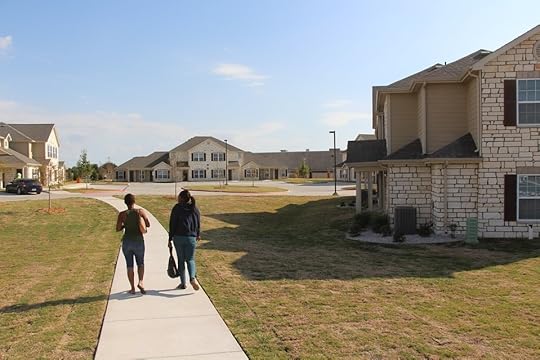
DALLAS—Demetria Johnson, a 32-year-old beautician, used to sleep on a couch at her cousin’s apartment in Pleasant Grove, a low-income neighborhood in south Dallas. When she came home from work, she said, she was often greeted by drunks in the parking lot and the occasional sound of gun shots.
On a wait list for her own place at the time, the single mother of four worried about her luck of the draw. “My next house doesn’t have to be the biggest house or the nicest house,” she said. “I just want somewhere nice and clean and peaceful.”
But for years, real-estate developers have built the vast majority of this city’s government-subsidized, low-income housing in poor, minority communities where land is relatively inexpensive and local opposition is limited.
That pattern has long come under attack by housing advocates who argue that developers who receive subsidies should be held to account, in part by building more low-income housing in the city’s wealthier, predominantly white communities.
On Wednesday, the Supreme Court will take up the matter when it hears oral arguments about whether the current system for doling out tax subsidies promotes racial segregation and violates the Fair Housing Act of 1968—a civil-rights landmark signed by President Lyndon Johnson a week after the assassination of the Rev. Martin Luther King Jr.
(Read more here: http://www.wsj.com/articles/texas-hou...)
Mod
Fair Housing ActPresident Johnson signed the Fair Housing Act in 1968. (2 minutes, only part of the speech)
Video: http://www.history.com/topics/black-h...
Source: History.com
 A Fighting Chance
 by
by
 Elizabeth Warren
Synopsis:
A NEW YORK TIMES BESTSELLER An unlikely political star tells the inspiring story of the two-decade journey that taught her how Washington really works—and really doesn’t—in A Fighting Chance
As a child in small-town Oklahoma, Elizabeth Warren yearned to go to college and then become an elementary school teacher—an ambitious goal, given her family’s modest means. Early marriage and motherhood seemed to put even that dream out of reach, but fifteen years later she was a distinguished law professor with a deep understanding of why people go bankrupt. Then came the phone call that changed her life: could she come to Washington DC to help advise Congress on rewriting the bankruptcy laws?
Thus began an impolite education into the bare-knuckled, often dysfunctional ways of Washington. She fought for better bankruptcy laws for ten years and lost. She tried to hold the federal government accountable during the financial crisis but became a target of the big banks. She came up with the idea for a new agency designed to protect consumers from predatory bankers and was denied the opportunity to run it. Finally, at age 62, she decided to run for elective office and won the most competitive—and watched—Senate race in the country.
In this passionate, funny, rabble-rousing book, Warren shows why she has chosen to fight tooth and nail for the middle class—and why she has become a hero to all those who believe that America’s government can and must do better for working families.
The Suffragette: The History of the Women's Militant Suffrage Movement by Sylvia Pankhurst (no photo) and Estelle Sylvia Pankhurst (no photo)
Synopsis:
By 1903, more than fifty years of peaceful campaigning had brought British women no closer to attaining the right to vote. In that year activist Emmeline Pankhurst founded the Women's Social and Political Union, a militant organization dedicated to achieving women's suffrage. The union's motto, "Deeds not words," reflected its radical approach, consisting of stone-throwing, window-breaking, arson, and physical confrontation with authorities.
The Suffragette, written by Emmeline Pankhurst's daughter, Sylvia, offers an insider's perspective on the union's growth and development as well as the motives and ideals that inspired its leaders and followers. She chronicles the protesters' tactics as well as the consequences of their actions: arrests, imprisonment, hunger strikes, and the mental and physical ordeals of forced feeding. Vintage photographs illustrate the demonstrations, courtroom trials, and other dramatic incidents from the history of the women's militant suffrage movement.
Race and Real Estate(no image) Race and Real Estate by Adrienne R Brown (no photo)
Synopsis:
Race and Real Estate brings together new work by architects, sociologists, legal scholars, and literary critics that qualifies and complicates traditional narratives of race, property, and citizenship in the United States. Rather than simply rehearsing the standard account of how blacks were historically excluded from homeownership, the authors of these essays explore how the raced history of property affects understandings of home and citizenship. While the narrative of race and real estate in America has usually been relayed in terms of institutional subjugation, dispossession, and forced segregation, the essays collected in this volume acknowledge the validity of these histories while presenting new perspectives on this story.

 by Various Authors
 While this new ebook covers various articles related to civil rights, some of the more lengthy articles pertain to housing discrimination, the two notable articles are The Contract Buyers League by
 and The Case For Repatriations by
 both of which talk about the discriminatory housing policy practiced in Chicago.
Evicted: Poverty and Profit in the American City
both of which talk about the discriminatory housing policy practiced in Chicago.
Evicted: Poverty and Profit in the American City by
by
 Matthew Desmond
Synopsis:
From Harvard sociologist and MacArthur "Genius" Matthew Desmond, a landmark work of scholarship and reportage that will forever change the way we look at poverty in America
In this brilliant, heartbreaking book, Matthew Desmond takes us into the poorest neighborhoods of Milwaukee to tell the story of eight families on the edge. Arleen is a single mother trying to raise her two sons on the $20 a month she has left after paying for their rundown apartment. Scott is a gentle nurse consumed by a heroin addiction. Lamar, a man with no legs and a neighborhood full of boys to look after, tries to work his way out of debt. Vanetta participates in a botched stickup after her hours are cut. All are spending almost everything they have on rent, and all have fallen behind.
The fates of these families are in the hands of two landlords: Sherrena Tarver, a former schoolteacher turned inner-city entrepreneur, and Tobin Charney, who runs one of the worst trailer parks in Milwaukee. They loathe some of their tenants and are fond of others, but as Sherrena puts it, “Love don’t pay the bills.” She moves to evict Arleen and her boys a few days before Christmas.
Even in the most desolate areas of American cities, evictions used to be rare. But today, most poor renting families are spending more than half of their income on housing, and eviction has become ordinary, especially for single mothers. In vivid, intimate prose, Desmond provides a ground-level view of one of the most urgent issues facing America today. As we see families forced into shelters, squalid apartments, or more dangerous neighborhoods, we bear witness to the human cost of America’s vast inequality—and to people’s determination and intelligence in the face of hardship.
Based on years of embedded fieldwork and painstakingly gathered data, this masterful book transforms our understanding of extreme poverty and economic exploitation while providing fresh ideas for solving a devastating, uniquely American problem. Its unforgettable scenes of hope and loss remind us of the centrality of home, without which nothing else is possible.
 Housing Policy in the United States
 by Alex F. Schwartz (no photo)
Synopsis:
The most widely used and most widely referenced "basic book" on Housing Policy in the United States has now been substantially revised to examine the turmoil resulting from the collapse of the housing market in 2007 and the related financial crisis. The text covers the impact of the crisis in depth, including policy changes put in place and proposed by the Obama administration. This new edition also includes the latest data on housing trends and program budgets, and an expanded discussion of homelessness of homelessness.
American Apartheid: Segregation and the Making of the Underclass by Douglas S. Massey (no photo)
Synopsis:
This powerful and disturbing book clearly links persistent poverty among blacks in the United States to the unparalleled degree of deliberate segregation they experience in American cities.
American Apartheid shows how the black ghetto was created by whites during the first half of the twentieth century in order to isolate growing urban black populations. It goes on to show that, despite the Fair Housing Act of 1968, segregation is perpetuated today through an interlocking set of individual actions, institutional practices, and governmental policies. In some urban areas the degree of black segregation is so intense and occurs in so many dimensions simultaneously that it amounts to "hypersegregation."
The authors demonstrate that this systematic segregation of African Americans leads inexorably to the creation of underclass communities during periods of economic downturn. Under conditions of extreme segregation, any increase in the overall rate of black poverty yields a marked increase in the geographic concentration of indigence and the deterioration of social and economic conditions in black communities.
As ghetto residents adapt to this increasingly harsh environment under a climate of racial isolation, they evolve attitudes, behaviors, and practices that further marginalize their neighborhoods and undermine their chances of success in mainstream American society. This book is a sober challenge to those who argue that race is of declining significance in the United States today.
 Mod
Mod
By ADAM LIPTAK May 1, 2017
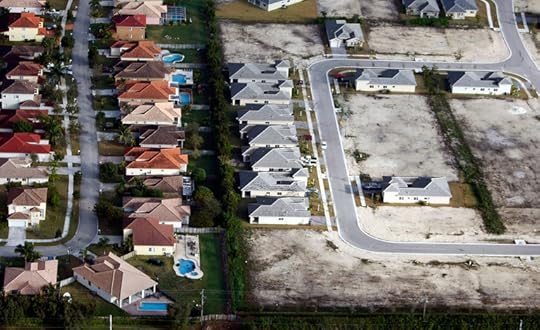
Empty housing lots next to newly constructed homes in Homestead, Fla., in 2009. Credit Joe Raedle/Getty Images
WASHINGTON — The Supreme Court ruled on Monday that Miami can sue two banks for predatory lending under the Fair Housing Act of 1968.
The case arose from the 2008 financial crisis. Miami sued Bank of America and Wells Fargo, saying that their discriminatory mortgage lending practices had led to a disproportionate number of defaults by minority home buyers and, in turn, to financial harm to the city.
Even as the majority of justices ruled that Miami was entitled to sue under the housing law, the court declined to decide whether the city had asserted a direct enough connection between the banks’ actions and the harm it claimed. The court sent the case back to the federal appeals court in Atlanta for further exploration of that question.
When the case was argued in the Supreme Court in November, it seemed headed for a 4-4 tie. But the vote on the question of whether Miami could sue under the law was 5 to 3, with Chief Justice John G. Roberts Jr. joining the court’s four-member liberal bloc to form a majority.
Miami said the banks had intentionally and disproportionately issued risky mortgages on unfavorable terms to black and Hispanic borrowers. That led, the city said, to segregation and foreclosures, hurting its property tax base and requiring it to provide additional municipal services.
Read the remainder of the article at: http://cleanupcityofstaugustine.blogs...
Discussion Topics:
a) Discuss the effects of banks' predatory lending practices culminating in the 2008 financial crisis.
b) Discuss why the majority of U.S. Supreme Court justices ruled that Miami was entitled to sue under the Fair Housing Act of 1968.
Source: The New York Times
Mod
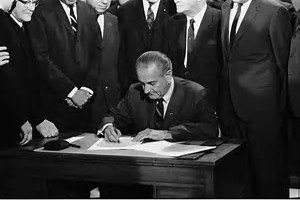
The Civil Rights Act signed into law in April 1968–popularly known as the Fair Housing Act–prohibited discrimination concerning the sale, rental and financing of housing based on race, religion, national origin and sex. Intended as a follow-up to the Civil Rights Act of 1964, the bill was the subject of a contentious debate in the Senate, but was passed quickly by the House of Representatives in the days after the assassination of civil rights leader Martin Luther King Jr. The act stands as the final great legislative achievement of the civil rights era.
STRUGGLE FOR FAIR HOUSING
Despite Supreme Court decisions, including Shelley v. Kraemer (1948) and Jones v. Mayer Co. (decided in June 1968), barring the exclusion of African Americans or other minorities from certain sections of cities, race-based housing patterns were still in force by the late 1960s, and those who challenged them often met with resistance, hostility and even violence. Meanwhile, while a growing number of African-American or Hispanic members of the armed forces fought and died in Vietnam, on the home front their families had trouble renting or purchasing homes in certain residential areas because of their race or national origin. In this climate, organizations such as the National Association for the Advancement of Colored People (NAACP) the G.I. Forum and the National Committee Against Discrimination in Housing lobbied for new fair housing legislation to be passed.
The proposed civil rights legislation of 1968 expanded on and was intended as a follow-up to the historic Civil Rights Act of 1964. The bill’s original goal was to extend federal protection to civil rights workers, but it was eventually expanded to address racial discrimination in housing. Title VIII of the proposed Civil Rights Act was known as the Fair Housing Act, later used as a shorthand description for the entire bill. It prohibited discrimination concerning the sale, rental and financing of housing based on race, religion, national origin and sex.
PASSAGE BY THE SENATE AND HOUSE
In the Senate debate over the proposed legislation, Senator Edward Brooke of Massachusetts–the first African-American ever to be elected to the Senate by popular vote–spoke personally of his return from World War II and his inability to provide a home of his choice for his new family because of his race. In early April 1968, the bill passed the Senate, albeit by an exceedingly slim margin, thanks to the support of the Senate Republican leader, Everett Dirksen, which defeated a southern filibuster. It then went to the House of Representatives, from which it was expected to emerge significantly weakened; the House had grown increasingly conservative as a result of urban unrest and the increasing strength and militancy of the Black Power movement.
On April 4–the day of the Senate vote–the civil rights leader Martin Luther King Jr. was assassinated in Memphis, Tennessee, where he had gone to aid striking sanitation workers. Amid a wave of emotion–including riots, burning and looting in more than 100 cities around the country–President Lyndon B. Johnson increased pressure on Congress to pass the new civil rights legislation. Since the summer of 1966, when King had participated in marches in Chicago calling for open housing in that city, he had been associated with the fight for fair housing. Johnson argued that the bill would be a fitting testament to the man and his legacy, and he wanted it passed prior to King’s funeral in Atlanta. After a strictly limited debate, the House passed the Fair Housing Act on April 10, and President Johnson signed it into law the following day.
IMPACT OF THE FAIR HOUSING ACT
Despite the historic nature of the Fair Housing Act, and its stature as the last major act of legislation of the civil rights movement, in practice housing remained segregated in many areas of the United States in the years that followed. From 1950 to 1980, the total black population in America’s urban centers increased from 6.1 million to 15.3 million. During this same time period, white Americans steadily moved out of the cities into the suburbs, taking many of the employment opportunities blacks needed into communities where they were not welcome to live. This trend led to the growth in urban America of ghettoes, or inner city communities with high minority populations that were plagued by high unemployment, crime and other social ills.
In 1988, Congress passed the Fair Housing Amendments Act, which expanded the law to prohibit discrimination in housing based on disability or on family status (pregnant women or the presence of children under 18). These amendments brought the enforcement of the Fair Housing Act even more squarely under the control of the U.S. Department of Housing and Urban Development (HUD), which sends complaints regarding housing discrimination to be investigated by its Office of Fair Housing and Equal Opportunity (FHEO).
Link to article: http://www.history.com/topics/black-h...
Link to videos: http://www.history.com/topics/black-h...
Link to audios/ speeches: http://www.history.com/topics/black-h...
Other:
 by Nick Kotz (no photo)
Source: The History Channel
Mod
Mod
By JAMES H. CARR April 11, 2018

Housing market discrimination has been illegal for a half-century yet housing equality remains a distant dream. A broad range of barriers remain that must be addressed by strong federal action if housing equality is to be achieved.
Today, Senator Tim Kaine and the National Fair Housing Alliance (NFHA) are convening a briefing on Capitol Hill to commemorate the 50th Anniversary of the 1968 Fair Housing Act and discuss the challenges that remain to achieve equal housing opportunity for all Americans.
The event is designed to inform Members of Congress, their staffs and the public about the history, effectiveness, weaknesses and future prospects for the Act, as well as the future of equal housing access in our nation.
The significance of the Fair Housing Act cannot be overstated; the community in which a family resides significantly determines the quality of access they will have to education, employment, health care, credit, food, and recreation services. Housing location also determines the overall safety and stability of the environment in which they live.
The Fair Housing Act has eliminated the most blatant and overt forms of housing discrimination that were routine a half-a-century ago. Yet our nation’s housing markets, rental and owner-occupied, remain awash in racial bias and denial of equal access.
NFHA estimates that each year, there are more than 4 million acts of housing discrimination, very few of which are ever challenged in court or an administrative tribunal. The pervasiveness of housing discrimination is exhibited in continuing hyper-segregation in many of our nation’s largest cities and vast disparities in the rates of homeownership between non-Hispanic Whites and people of color.
The homeownership rate for Blacks, for example, at 42%, is roughly only 60% of that for non-Hispanic Whites. In fact, the Black homeownership rate is virtually unchanged from its level in 1968 and less than the national homeownership rate during the Great Depression, 80 years ago.
The disparity in homeownership rates between Latinos and non-Hispanic Whites is similarly large; 47% and 73%, respectively.
Since overt and obvious forms of discrimination have diminished, housing discrimination has taken much more subtle forms that are difficult to detect and challenge. Detecting discrimination can be daunting because often it cannot be detected at the individual homeseeker level.

The reasons for continued housing discrimination and concentrated segregation are complex and require comprehensive responses.
In a recently released book, The Fight for Fair Housing, sponsored by NFHA and edited by George Washington University professor, Dr. Gregory Squires, many of the nation’s most knowledgeable and prolific experts on the subject of housing discrimination discuss the many ways in which real estate agents, financial institutions, landlords and other housing market participants continue, illegally, to deny housing access to people of color.
One of the major challenges to the success of the Fair Housing Act is the fact that in order to gain sufficient votes for its passage, the Act lacked any enforcement provisions for its first 20 years. "According to the Fair Housing Act, HUD was authorized only to investigate complaints of housing discrimination and had just 30 days to decide whether to pursue or dismiss the allegations. If HUD chose to pursue a claim of discrimination, it was empowered only to engage in 'conference, conciliation, and persuasion' to resolve the problem."
Moreover, some of the law’s most important regulations were not promulgated until as recently as the Obama Administration.
Link to the remainder of the article: https://www.forbes.com/sites/jameshca...
Other:
 by Gregory D Squires (no photo)
Source: Forbes
Mod
-- The mobilization of the unemployed during the Great Depression that gave rise to the Workers' Alliance of America
-- The industrial strikes that resulted in the formation of the CIO
-- The Southern Civil Rights Movement
-- The movement of welfare recipients led by the National Welfare Rights Organization
Mod
 by Frances Fox Piven (no photo)
Synopsis:
Have the poor fared best by participating in conventional electoral politics or by engaging in mass defiance and disruption? The authors of the classic Regulating The Poor assess the successes and failures of these two strategies as they examine, in this provocative study, four protest movements of lower-class groups in 20th century America:
-- The mobilization of the unemployed during the Great Depression that gave rise to the Workers' Alliance of America
-- The industrial strikes that resulted in the formation of the CIO
-- The Southern Civil Rights Movement
-- The movement of welfare recipients led by the National Welfare Rights Organization
Mod
Without a Home, Everything Else Falls Apart
https://justshelter.org
Source: Just Shelter
Mod
 by Beryl Satter (no photo)
Synopsis:
Part family story and part urban history, a landmark investigation of segregation and urban decay in Chicago—and cities across the nation
The "promised land" for thousands of Southern blacks, postwar Chicago quickly became the most segregated city in the North, the site of the nation’s worst ghettos and the target of Martin Luther King Jr.’s first campaign beyond the South.
In this powerful book, Beryl Satter identifies the true causes of the city’s black slums and the ruin of urban neighborhoods throughout the country: not, as some have argued, black pathology, the culture of poverty, or white flight, but a widespread and institutionalized system of legal and financial exploitation.
In Satter’s riveting account of a city in crisis, unscrupulous lawyers, slumlords, and speculators are pitched against religious reformers, community organizers, and an impassioned attorney who launched a crusade against the profiteers—the author’s father, Mark J. Satter.
At the heart of the struggle stand the black migrants who, having left the South with its legacy of sharecropping, suddenly find themselves caught in a new kind of debt peonage.
Satter shows the interlocking forces at work in their oppression: the discriminatory practices of the banking industry; the federal policies that created the country’s shameful "dual housing market"; the economic anxieties that fueled white violence; and the tempting profits to be made by preying on the city’s most vulnerable population.
A monumental work of history, this tale of racism and real estate, politics and finance, will forever change our understanding of the forces that transformed uurban America.
Note: Although nationally representative historical data on eviction do not exist, these historical accounts of the first half of the twentieth century depict evictions as rare and shocking events. Some local studies from the second half of the twentieth century, however, document nontrivial rates of involuntary displacement in American cities.
Desmond, Matthew. Evicted (p. 343). Crown/Archetype. Kindle Edition.
Mod
by Beryl Satter (no photo)Synopsis:
Part family story and part urban history, a landmark investigation of segregation and urban decay in Chicago—and cities across the nation
The "promised land" for thousands of Southern blacks, postwar Chicago quickly became the most segregated city in the North, the site of the nation’s worst ghettos and the target of Martin Luther King Jr.’s first campaign beyond the South.
In this powerful book, Beryl Satter identifies the true causes of the city’s black slums and the ruin of urban neighborhoods throughout the country: not, as some have argued, black pathology, the culture of poverty, or white flight, but a widespread and institutionalized system of legal and financial exploitation.
In Satter’s riveting account of a city in crisis, unscrupulous lawyers, slumlords, and speculators are pitched against religious reformers, community organizers, and an impassioned attorney who launched a crusade against the profiteers—the author’s father, Mark J. Satter.
At the heart of the struggle stand the black migrants who, having left the South with its legacy of sharecropping, suddenly find themselves caught in a new kind of debt peonage.
Satter shows the interlocking forces at work in their oppression: the discriminatory practices of the banking industry; the federal policies that created the country’s shameful "dual housing market"; the economic anxieties that fueled white violence; and the tempting profits to be made by preying on the city’s most vulnerable population.
A monumental work of history, this tale of racism and real estate, politics and finance, will forever change our understanding of the forces that transformed uurban America.
Note: Although nationally representative historical data on eviction do not exist, these historical accounts of the first half of the twentieth century depict evictions as rare and shocking events. Some local studies from the second half of the twentieth century, however, document nontrivial rates of involuntary displacement in American cities.
Desmond, Matthew. Evicted (p. 343). Crown/Archetype. Kindle Edition.
Mod
 by
by
 Kathryn Edin
Synopsis:
Welfare mothers are popularly viewed as passively dependent on their checks and averse to work.
Reformers across the political spectrum advocate moving these women off the welfare rolls and into the labor force as the solution to their problems.
Making Ends Meet offers dramatic evidence toward a different conclusion: In the present labor market, unskilled single mothers who hold jobs are frequently worse off than those on welfare, and neither welfare nor low-wage employment alone will support a family at subsistence levels.
Kathryn Edin and Laura Lein interviewed nearly four hundred welfare and low-income single mothers from cities in Massachusetts, Texas, Illinois, and South Carolina over a six year period.
They learned the reality of these mothers' struggles to provide for their families: where their money comes from, what they spend it on, how they cope with their children's needs, and what hardships they suffer.
Edin and Lein's careful budgetary analyses reveal that even a full range of welfare benefits—AFDC payments, food stamps, Medicaid, and housing subsidies—typically meet only three-fifths of a family's needs, and that funds for adequate food, clothing and other necessities are often lacking.
Leaving welfare for work offers little hope for improvement, and in many cases threatens even greater hardship.
Jobs for unskilled and semi-skilled women provide meager salaries, irregular or uncertain hours, frequent layoffs, and no promise of advancement.
Mothers who work not only assume extra child care, medical, and transportation expenses but are also deprived of many of the housing and educational subsidies available to those on welfare.
Regardless of whether they are on welfare or employed, virtually all these single mothers need to supplement their income with menial, off-the-books work and intermittent contributions from family, live-in boyfriends, their children's fathers, and local charities. In doing so, they pay a heavy price.
Welfare mothers must work covertly to avoid losing benefits, while working mothers are forced to sacrifice even more time with their children.
Making Ends Meet demonstrates compellingly why the choice between welfare and work is more complex and risky than is commonly recognized by politicians, the media, or the public.
Almost all the welfare-reliant women interviewed by Edin and Lein made repeated efforts to leave welfare for work, only to be forced to return when they lost their jobs, a child became ill, or they could not cover their bills with their wages.
Mothers who managed more stable employment usually benefited from a variety of mitigating circumstances such as having a relative willing to watch their children for free, regular child support payments, or very low housing, medical, or commuting costs.
With first hand accounts and detailed financial data, Making Ends Meet tells the real story of the challenges, hardships, and survival strategies of America's poorest families.
If this country's efforts to improve the self-sufficiency of female-headed families is to succeed, reformers will need to move beyond the myths of welfare dependency and deal with the hard realities of an unrewarding American labor market, the lack of affordable health insurance and child care for single mothers who work, and the true cost of subsistence living.
Making Ends Meet is a realistic look at a world that so many would change and so few understand.
Mod
 by Nicolas P. Retsinas (no photo)
Synopsis:
Rental housing is increasingly recognized as a vital housing option in the United States.
Government policies and programs continue to grapple with problematic issues, however, including affordability, distressed urban neighborhoods, concentrated poverty, substandard housing stock, and the unmet needs of the disabled, the elderly, and the homeless.
In Revisiting Rental Housing, leading housing researchers build upon decades of experience, research, and evaluation to inform our understanding of the nation's rental housing challenges and what can be done about them.
It thoughtfully addresses not only present issues affecting rental housing, but also viable solutions. The first section reviews the contributing factors and primary problems generated by the operation of rental markets.
In the second section, contributors dissect how policies and programs have—or have not—dealt with the primary challenges; what improvements—if any—have been gained; and the lessons learned in the process.
The final section looks to potential new directions in housing policy, including integrating best practices from past lessons into existing programs, and new innovations for large-scale, long-term market and policy solutions that get to the root of rental housing challenges.
Contributors include William C. Apgar (Harvard University), Anthony Downs (Brookings), Rachel Drew (Harvard University), Ingrid Gould Ellen (New York University), George C. Galster (Wayne State University), Bruce Katz (Brookings), Jill Khadduri (Abt Associates), Shekar Narasimhan (Beekman Advisors), Rolf Pendall (Cornell University), John M. Quigley (University of California–Berkeley), James A. Riccio (MDRC), Stuart S. Rosenthal (Syracuse University), Margery Austin Turner (Urban Institute), and Charles Wilkins (Compass Group).
Mod
October 23, 2018
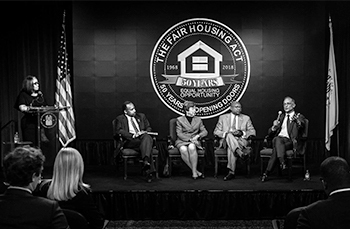
50th Anniversary of the Fair Housing Act Opening Ceremony.
The Civil Rights Act of 1968, more commonly known as the Fair Housing Act, was the third major civil rights law passed in the 1960s. It followed the Civil Rights Act of 1964, which outlawed discrimination and Jim Crow segregation in employment, schools and public places, and the Voting Rights Act of 1965, which outlawed racial discrimination in voting. The Fair Housing Act, passed a week after the assassination of Dr. Martin Luther King Jr., has a complicated history.
The Fair Housing Act prohibits discrimination in the sale, rental, and financing of housing based on race, color, national origin, religion, sex, familial status, and disability. The act has two main purposes—prevent discrimination and reverse housing segregation. The part of the law that calls for the reversal of segregation is necessary because decades of unjust government practices have led to the presence of housing segregation today. Research shows that people of color are most likely to live in neighborhoods with limited access to good jobs, healthy food, adequate schools, and other resources needed for success. Jurisdictions enforcing desegregation is one way to work towards a more integrated society where everyone has equal access to opportunity.
Since the passage of the Fair Housing Act, people have brought many cases of housing discrimination to court and have won those legal battles. There has also been an increase in accessible housing available to individuals with disabilities. And recently under the Obama administration, the definition of fair housing enforcement expanded.
Though we have made some progress, many challenges to fair housing remain. There are still extreme racial disparities in homeownership and wealth. In 1968, 65.9% of white families owned their homes, a rate that was 25% higher than the 41.1% of black families that owned their homes. Today, the black homeownership rate has not changed, while the rate of white homeownership has increased five percentage points to 71.1%. These homeownership disparities contribute to the shocking racial wealth gap in America. In 2017, the typical white family held ten times the amount of wealth as the typical black family ($171,000 for whites to $17,409 for blacks, on average). These numbers have worsened since 1968 and point to the fact that housing discrimination continues to determine life outcomes.
In 2017 more than 28,000 complaints of housing discrimination were filed across the country. Some of these complaints resulted in lawsuits against cities, banks, and landlords for discrimination in housing and lending. While some cases were reported and sanctioned, others went unreported.
The changing political landscape is also a major challenge. Protecting fair housing was once a bipartisan effort, but political support for this goal has decreased in recent decades. Under the Trump administration and the direction of Secretary Ben Carson, HUD has ignored its responsibility to enforce antidiscrimination policies and actively work towards integration.
There are actions we can take as housing advocates to create a society that is less discriminatory and more integrated:
- We must hold HUD accountable for enforcing fair housing policies by providing public comment on changes to their policies and bringing them to court if warranted.
- We must improve access to credit and fight for stronger consumer protections, especially for people of color and low income individuals. It is unacceptable that in 2018 individuals still face discrimination when they try to get loans from banks or apply for housing.
- We must update the Fair Housing Act to provide legal protection against discrimination based on sexual orientation, gender identity, marital status, source of income, veteran status, domestic violence survivor status, or criminal record.
- We must continue to collect data and establish clear goals to determine if we are making progress in ending housing discrimination and segregation.
As activists who fought for the civil rights protections of the 1960s said, the road to justice is long and freedom is a constant struggle. It has been 50 years since the passage of the Fair Housing Act and while we have made progress that is worth celebrating, we have more work to do. We must work to end discrimination in housing because everyone deserves equal access to a safe, decent, and affordable home. We must work towards integration and creating a society in which where one lives does not determine one’s outcomes.
Together, we continue the fight.
Link to article: https://nlihc.org/resource/fair-housi...
Other:
 by
Matthew Desmond
by
Matthew DesmondSource: National Low Income Housing Coalition
Mod
 Lorna wrote: "Fair Housing Act Overview and Challenges
October 23, 2018
50th Anniversary of the Fair Housing Act Opening Ceremony.
The Civil Rights Act of 1968, more commonly known as the Fair Housing Act, ..."
Lorna, Thank you so much for the history lesson — I, to my shame, was unaware!
Regards,
Andrea
Mod

The History Book Club
Books mentioned in this topic
Evicted: Poverty and Profit in the American City (other topics)Revisiting Rental Housing: Policies, Programs, and Priorities (other topics)
Making Ends Meet: How Single Mothers Survive Welfare and Low-Wage Work (other topics)
Family Properties: Race, Real Estate, and the Exploitation of Black Urban America (other topics)
Family Properties: Race, Real Estate, and the Exploitation of Black Urban America (other topics)
More...
Authors mentioned in this topic
Matthew Desmond (other topics)Nicolas P. Retsinas (other topics)
Kathryn J. Edin (other topics)
Beryl Satter (other topics)
Beryl Satter (other topics)
More...

On April 11, 1968 President Lyndon B. Johnson signed the Civil Rights Act of 1968 (commonly known as the Fair Housing Act, or as CRA '68), which was meant as a follow-up to the Civil Rights Act of 1964.
While the Civil Rights Act of 1866[1] prohibited discrimination in housing, there were no federal enforcement provisions. The 1968 act expanded on previous acts and prohibited discrimination concerning the sale, rental, and financing of housing based on race, religion, national origin, and as of 1974, gender; as of 1988, the act protects the disabled and families with children. It also provided protection for civil rights workers.
Victims of discrimination may use both the 1968 act and the 1866 act (via section 1983) to seek redress. The 1968 act provides for federal solutions while the 1866 act provides for private solutions (i.e., civil suits).
Types of banned discrimination
The Civil Rights Act of 1968 (Fair Housing Act) prohibited the following forms of discrimination:
1. Refusal to sell or rent a dwelling to any person because of his race, color, religion or national origin. People with disabilities and families with children were added to the list of protected classes by the Fair Housing Amendments Act of 1988.
2. Discrimination against a person in the terms, conditions or privilege of the sale or rental of a dwelling.
3. Advertising the sale or rental of a dwelling indicating preference of discrimination based on race, color, religion or national origin (and, as of 1988, people with disabilities and families with children.)
4. Coercing, threatening, intimidating, or interfering with a person's enjoyment or exercise of housing rights based on discriminatory reasons or retaliating against a person or organization that aids or encourages the exercise or enjoyment of fair housing rights.
Source: Wikipedia
http://en.wikipedia.org/wiki/Fair_Hou...