
James Joyce Reading Group discussion
Finnegans Wake
>
Finnegans Wake

 I read it and start falling into a dream trance, often picking up thoughts and imagery that JJ probably had no intention to invoke!
 Mod
Mod
Mod
Mod

I would be quite interested in looking at FW in some depth if anyone else is prepared to join in. I have been reading it sporadically for many years now, with the usual mixture of exasperation and delight that seems to be a common reader response. But I have not read the whole book (probably one half).
My own feeling is that the best approach is to share a passage, and for everybody to contribute their understanding of it. The passage might be a page, or perhaps just a couple of lines. The difficulty with the familiar "props" offered for getting into the work is that you begin to doubt them as soon as you're into the work itself. So, yes, it has a circular structure, perhaps, but in other ways it's like a box, or cube, or something, carefully divided into sections. The end famously joins on to the beginning, and yet the beginning is very different from the end.
Again, Vico: Vico is in some ways straightforward, in others obscure. Russell (in "Wisdom of the West") says of his Scienza Nuova "to the modern reader the book is somewhat of a problem, for it is a mixture of various ingredients that are not always properly distinguished." It can certainly mean different things to different people. I have often thought that Vico is not after all so very important in getting to grips with FW.
An obvious difficulty with FW is that some readers can make it mean anything (I have noticed this trying, once before, to read the book at the rate of a page a week with a group communicating by email). I'm not sure what one can do about that.
Then there is the question of meaning, in the larger sense. What is the book about? Three answers are plausible,
(1) it isn't about any one thing, any more than the Works of Shakespeare are about any one thing, or can be given some sort of distilled "meaning",
(2) FW is about FW. This is plausible, since so much of FW is about the book itself: the process of writing it, of reading it, what it might mean and so on,
(3) FW is about Joyce himself.
I incline to (3), since it embraces (2). After all, a book that took over Joyce's life is bound to figure prominently in something about Joyce.
But the starting point, I believe, is just sharing a reading experience.
Is anyone else interested? If so let me know.
(We will need many threads...!)
It would be nice to get a group thing going (sorry haven't checked in awhile)! I've gotten some resources on what FW is supposed to be "about" but get admittedly lost in the meanderings. Perhaps a 3,4 or 5 page system would be more productive for reviewing in meetings. However, I would also recommend a start perhaps at the New Year, when everybody's calendars are lightened up from after the holidays.
 You know what? I'll post about this at Spriral Bound, a discussion group at Yahoo! Groups that has a bounty of Joyce fans, and let them know to come here if they have an interest.
 I'm not certain I can participate
in my usual active manner
I've been reading the Wake intensively
since 2000
for several years putting in
5-8 hours a day at it
(the years I ran a FW group)
currently working on a couple of papers
for the ezine Flashpoint
which will release a FW special issue
Bloomsday, 2009
(sings)Oh Susannah, for you it's nice to see!
I can hardly wait to see that 'zine...keep us updated, could you please? [that is, here or at Spiral Bound:] Thanks!
I'm exploring the notionthat FW was James Joyce's "final exam"
to be prime Ollav (chief bard/duid)
of all the Celts
not just the Irish ones
including in FW
all those works the bards
were trained to be adepts in:
histories, geneologies, heraldry, praise poems,
satires, and foretellings
I'm currently doing research
in the Celtic "race" pre-Ireland
where they started
where they went
tying together all the Wakean
allusions to the Hebrews, the Egyptians
et cetera.
My favorite "take" on the wake
is George Cinclair Gibson's Wake Rites
the most important book I've read about FW
to date.
He'll have an article in Flashpoint too
and we are discussing writing one together
 I am all for giving it a go after the new year. It has been sitting on my bookshelf for over a year now and this is a good excuse to put my other books down and give it a try.
Suzanahhh, are you trying to write poetry, or do you just press the ENTER button at random?
neither.when I write poetry
I don't try
I do
this is just the way
I write
Suzanahhh wrote: about Wake RitesI was going to tell the group how glad I was that Suzanne had brought up
Wake Rites. I would even like to go further and do something totally out of
character and suggest that we should have a group read of Gibson's book -
moving back and forth between it and Finnegans Wake - and seeing how we
can enrich our own reading of FW and find parallel themes to Gibson's as we
go.
This is a sign of how much I respect Gibson's book and its sense of the
Architecture and fundamental themes.
It is also probably a sign of my frustration at the looseness of so many
people coming new to the Wake with the same old popular themes.
(This does not refer to the fascinating discussions of the old hands.)
Actually we could do the back and forth with a number of odd commentaries.
For Vico - since that is the starting point of the Goodreads group, we could
do it with Beckett's short piece in Our Exagmnation.
This is just a thought.
Maybe somebody who knows how could put it up in the Goodreads discussion.
Or somebody else might want to take on the ideas above. If that is any of us still
have the time.
I have put up two of my attempts at FW along the Affrian Way at
http://fadograph.wordpress.com/finneg...
along with a set of JPGs of the pages of _Tom Kittle's Wake_, one of Joyce's sources
not otherwise visible on the internet or easy to get.
Bryllars
JBryllars@Bryllars.CNC.net
James Joyce on Obama and Lincoln167.24 Genius to Careous Caseous! Moriture, te salutat! My phemous
167.25 themis race is run, so let Demoncracy take the highmost! (Abra-
167.26 ham Tripier. Those old diligences are quite out of date.
Haha, Karl...:)Folks, thanks for the responses!
I was trying to post Beckett's article here - but there isn't enough room.
So if you don't have the article
drop me an email at JBryllars@Bryllars.CNC.net
Then when we all have it - let's do
an exploration on what it is saying!!
Karl
Mod
susanahhh, i quite liked the following books on the wake: joyce's book of the dark, and john gordon's book. do you know those?
nice to have you here! please keep us informed with the progress of of the flashpoint zine.
and,
i
like the
way
you
write.
 Have been trying to gear up to start this endeavor. Haven't picked it up yet.
 Suzanahhh wrote: "I'm exploring the notion
that FW was James Joyce's "final exam"
to be prime Ollav (chief bard/duid)
of all the Celts
not just the Irish ones
including in FW
all those works the bards
were tr..."
You might take a look at "The White Goddess" by Graves. That's the book that got me going.
 Hello!
I have made several attempts at FW but have not "broken through." It has been several years since I tried and I am getting the urge to try again at some point. A dedicated group of co-readers would be nice to find.
I keep thinking it would be helpful to set aside a year, maybe starting on Jan 1, and to have a set schedule for getting through. Perhaps a certain number of pages a week.
All I know is that my attempts to read it as normal book have failed, so I need to develop some unorthodox ways to read it.
 Hi.
Hi.I have been active in the Proust Project Group, and have just finished Proust. One of our group was going to read Ulysses with me. How active is this group now?
Also, if the Wake topic is active, I'd be more than happy to give out a few pointers. I read Finnegans Wake two times and have reread some chapters since then. Eventually I want to reread it, possibly making use of some of the scholarship that has rearrived since then.
It is NOT a normal book.
In terms of "breaking through" Wake, it really takes some patience in that you may read a hundred pages or more before it starts to "kick in". This is because the book is composed in such a way that every part references every other part, including some that have not yet been read. A reading schedule really helps so that every day some of the images and rhythms start feeding into your brain.
It is a very difficult book and nobody should worry about getting their egos bruised if they get stuck from time to time. In fact, despite the fact that I usually don't like to oversprinkle my reading with lots of reading of the critical literature, in the case of Wake it is absolutely essential to use a reader's guide, such as Skeleton Key to Finnegans Wake. A warning though, there is a lot of the critical literature that makes cheap use of Joyce's polysemy, to crank out possibly connected but highly misleading interpretations.
The good news is that Joyce has deliberately overdetermined his imagery, because he expects his reader to miss parts. Therefore, do not drive yourself crazy if you miss something--you will. But you will encounter echoes of anything Joyce considers important over and over again.
The other tip I'd give is that despite the fact that the language has many many focii at once, there is always a focus or main subject or two where in any passage where all otehr references are subsidiary.
Great advice, Ed!After my post in early Oct, which as you see got little response, I decided to go it alone, for my third serious attempt in 10 years. I am happy to report that this time it is working. You are spot-on about the observation that one will need to read x number of pages before it starts to become natural. That is exactly what happened when I got to the Shem the Penman chapter. I am now just starting Book II, loving it, and asking myself why I ever thought the book was so difficult before (yes, it is still 'difficult' but I've learned not to be bothered by what I don't immediately 'get' - and paradoxically I feel like I'm getting more out of it).
I'm using the Campbell book as my primary guide, and the further I go the less I seem to need it.
Yes, that's it exactly. If you wait to understand, you won't get to the critical mass of images.By the way, although the structure is based on Vico, I have never found that information too helpful. Here's why. It defines a very broad structure, and that is fairly obvious from the style and subject matter anyway.
The local structure is much more determined by character, and that is what gets readers lost. This is because each character and incident, Shem, Shaun, the thunder, Finnegan, Anna Livia, Humphrey, Issy, Kate, the hen scratching, etc. has their own themes which appear when they are "near" much like in Wagner. So a sentence that is wholly nonsensical syntactically, can actually be loaded with meaning.
 Hi, all. Became a member here today and am pleased to see the spark of a discussion going. In regard to general guides I'd like to mention some which are invaluable:
Annotations to Finnegans Wake by Roland McHugh
Joyce's Book of the Dark by John Bishop (also suggested by Phillip)
How Joyce Wrote Finnegans Wake: A Chapter-by-Chapter Genetic Guide by Luca Crispi
A Reader's Guide to Finnegans Wake by William York Tindall
Yes, I have the McHugh book (but rarely consult it), the Tindall (I thinks it is okay), and Anthony Burgess' Re:Joyce, which isn't a guide book so much, but it is worth consulting. All in addition to Campbell/Robinson.My approach has evolved into the following: I basically go one paragraph at a time - I read it, let it sort of flow over me, then I go to Campbell to see if I missed any of the main points (usually, yes, I always miss something). Then I go back and re-read it, and underline and mark up the text to indicate the main ideas of the paragraph. I check it off and proceed to the next one and repeat.
I found that now, being totally immersed in this book, I'm thinking of it all the time throughout the day - the characters, the symbols, the language, the events. The style is becoming more and more normal to me.
McHugh's book is designed to be read alongside the Wake. As you know, it's a page by page and line by line "translation" of the Wake allowing you to move from an obscurity in Joyce's book to the same page and line in McHugh for clarification. It's useful that way, but I'm not sure it helps that much to explain the Wake's structure or mythologies or meaning. To be honest, I don't use McHugh much. I like to read the Wake without so much help, pronouncing the words before me exactly as they look on the page. A lot of meaning comes from that, and it's a lot of fun to read, too.
I think that one of the issues with all of these skeleton key books, starting from the, great granddaddy of them all, Campbell and Robinson, is that the main focus of many passages, is the most easily discerned, so that you read something and go "WTF, I am not sure about this but it had something to do with Osirus and Isis", and then you look in the commentary and it says something like "this passage uses themes from ancient Egypt, Osirus and Isis", and you were really trying to figure out what "esthemetley ugrnothugglencely in riggin produddulddulduywise er olse fruuuuuuuuuu" (not a real quote :) ) means.Don't you hate that? :)
I do like having a Sherpa, though, to lay out the trail.
I prefer to pick out an edible length, say three or four pages and read it straight through, and read the corresponding passage in the commentary as well, so that the flow of the text is not interrupted. If it looks like it is going to be especially obscure based on the first glance, I will read the commentary first, if it looks fairly easy, I will read it second.
Everybody will figure out what works for them
Everybody has their own way.
One time through the book, I read my insomniac girlfriend to sleep every night by reading Wake with a sketchy Irish accent. I am not sure what effect this had on her dreams!
I like sherpa. I didn't mean to imply I don't use guides. I do. My main one has been Tindall's A Reader's Guide to Finnegans Wake. And this year I read How Joyce Wrote Finnegans Wake by Luca Crispi. It was a big help, and covers the book chapter by chapter, too.Reportedly Thornton Wilder was a big Wake fan. He's supposed to have read a little of it every day, selecting a page at random. Earlier this year I tried to read a little each night in bed before turning out the light. It didn't give me nightmares.
Not inquizzing master page, a diet of sherpert is besser than wurms, though, not a regular of any wilder irregular random house finnifishiness, methinks, you could rede sequantly: once a knight is enough.:)
I promise, no more portmanteau words. Will leave them to the Master. :)
But back to Vico. Has anyone here actually read him? Read enough of him as a philosophy of history rather than as someone used as a literary device?
Ah, to be reading FW when a noted and acclaimed athlete that had ascended to such towering heights takes such a spectacular fall because of his dalliance with a couple of maggies (or maybe the 28 would be more accurate?)... The cycle continues...
Mod
the book is structured in four parts, perhaps we could pace ourselves and read one part each month.
i've read the book numerous times and wrote on joyce for my grad thesis, but it's been awhile since i really read much joyce. a wake group would be fun.
 I would be interested in doing fw in the begining of 2010. I've been reading it alone and it would be great to have some discussions.
I'd welcome an organized discussion of the novel. To reply to Phillip's suggestion that we do a part a month, perhaps that's too ambitious. Part I is 8 chapters while Part IV is only a single chapter. Because we're all aware of its density and because all of those interested are of unequal experience with the book, maybe we shouldn't try to be to ambitious with our discussion. Maybe we should try for something like a chapter a month beginning in January. Even at that pace I think we'd only scratch the surface of FW. Ideas? Thoughts?
Two pages a day is most reasonable, that would allow you to finish (pun possible) in one year.
I would be interested in doing fw in the begining of 2010. I've been reading it alone and it would be great to have some discussions.
I'd welcome an organized discussion of the novel. To reply to Phillip's suggestion that we do a part a month, perhaps that's too ambitious. Part I is 8 chapters while Part IV is only a single chapter. Because we're all aware of its density and because all of those interested are of unequal experience with the book, maybe we shouldn't try to be to ambitious with our discussion. Maybe we should try for something like a chapter a month beginning in January. Even at that pace I think we'd only scratch the surface of FW. Ideas? Thoughts?
Two pages a day is most reasonable, that would allow you to finish (pun possible) in one year. Right now I am committed as a Ulysses sherpa, so I'd be interested in starting in Feb or March. I have just read the first three chapters more carefully than I have ever before (this is my 4th time), and I am really enjoying it.
I could still comment or read segments if you guys and gals want to get started.
I'll do it in any way we think is the best and most comprehensive, if we can get more ideas as to how we think it should be conducted. Imo, 2 pages a day is pretty quick and allows only a surface skim of the text. It might allow time for someone to post what they think is contained in the 2 pages followed by a couple of comments from others.
Heh. Actually at a real base camp, just knitting your socks is a very very important part of your journey, first of all, because socks can be a life and death matter, alongside all your equipment, and secondly, because you have to spend time at base camp getting acclimated to higher altitudes, lest you suffer some hideous edema by gaining attitude too soon.
This may sound off topic but actually the point is:
Perseverance furthers.
Baby steps.
Elephant one bite at a time.
 Ed - you make some really neat points here ... thanks
Phillip wrote: "I've heard some readers say that when you read Ulysses and Finnegans Wake, it doesn't matter where you start and finish - it's all scrambled. ..."
Ed - you make some really neat points here ... thanks
Phillip wrote: "I've heard some readers say that when you read Ulysses and Finnegans Wake, it doesn't matter where you start and finish - it's all scrambled. ..."Some of you might want to check out Julio Cortazar's Hopscotch. It has an interesting spin on the idea of sequence. See my review if you are curious.
Well, I'm currently in the middle of the "Triv and Quad" chapter, with all the marginal and footnotes, and I'm sorry to say that I'm getting a bit peeved with JJ here. This chapter is so dense compared to some of the previous ones (like Shem the Penman, which I really loved) that I'm losing patience with it. I'm all for the method in which this book is written, but it seems that this chapter is so intentionally dense and difficult that I'm not getting *anything* from it.
I may need to step away from it for a bit...
This one is density squared. It peeves off almost everybody.
Mod
sorry, i was away for a bit.
Which portion of the FW discussion do you mean?
Enjoy Berninni's statue, when you get to the end of the Washers at the Ford chapter: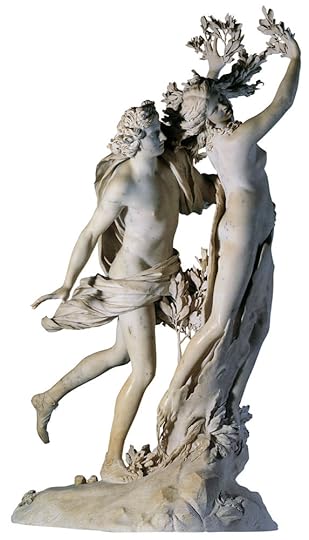 Well, I think I am ready to fin again.
It has been calling to me.
Mod
i'm taking forever re-reading pynchon's mason and dixon. but if you want to make comments on FW, i'll be happy to chime in.

It is considered one of the most difficult books in the English language to read, but like Anthony Burgess said in his chapters from Re:Joyce on the novel, the humor is rich and rewarding despite any questions of comprehension. Indeed, the book is designed to challenge your faith!
I've heard some readers say that when you read Ulysses and Finnegans Wake, it doesn't matter where you start and finish - it's all scrambled. While structure is cirular in FW, that isn't the case the case in Ulysses. While FW is meant to be a circular text, a design that is meant to represent the cyclical nature of time itself, Ulysses is a journey through a single day - from morning until night; and should be read from beginning to end.