
The History Book Club discussion
SUPREME COURT OF THE U.S.
>
JUDICIAL INDEPENDENCE
date newest »
newest »
 Mod
Mod
Summary
Judicial Independence
Location: Georgetown University Law Center
Washington, D.C
Date: 09.28.06
Event Speakers:
Justice Stephen G. Breyer,
Sandra Day O'Connor,
Chief Justice John G. Roberts,
Charlie Rose
As part of a conference titled, "Fair and Independent Courts: A Conference on the State of the Judiciary, Chief Justice Roberts delivers the keynote address.
Justices O'Connor and Breyer, the chairs of the conference, introduce the Chief Justice.
Topics include the responsibilities of judges, judicial independence, and the history of the Separation of Powers.
The session ends with music by the Georgetown University Gospel Choir.
Here is the link:
http://fora.tv/2006/09/28/Chief_Justi...
Source: C-Span - American Perspectives
Mod
BIO
Justice Stephen G. Breyer
Stephen G. Breyer, Associate Justice, was born in San Francisco, California, August 15, 1938.
He received an A.B. from Stanford University, a B.A. from Magdalen College, Oxford, and an LL.B. from Harvard Law School. He served as a law clerk to Justice Arthur Goldberg of the Supreme Court of the United States during the 1964 Term, as a Special Assistant to the Assistant U.S. Attorney General for Antitrust, 1965-1967, as an Assistant Special Prosecutor of the Watergate Special Prosecution Force, 1973, as Special Counsel of the U.S. Senate Judiciary Committee, 1974-1975, and as Chief Counsel of the committee, 1979-1980.
He was an Assistant Professor, Professor of Law, and Lecturer at Harvard Law School, 1967-1994, a Professor at the Harvard University Kennedy School of Government, 1977-1980, and a Visiting Professor at the College of Law, Sydney, Australia and at the University of Rome.
From 1980-1990, he served as a Judge of the United States Court of Appeals for the First Circuit, and as its Chief Judge, 1990-1994. He also served as a member of the Judicial Conference of the United States, 1990-1994, and of the United States Sentencing Commission, 1985-1989.
President Clinton nominated him as an Associate Justice of the Supreme Court, and he took his seat August 3, 1994.
Sandra Day O'Connor
Sandra Day O'Connor is a retired Associate Justice. She was born in El Paso, Texas, March 26, 1930. She received her B.A. and LL.B. from Stanford University. She served as Deputy County Attorney of San Mateo County, California from 1952-1953 and as a civilian attorney for Quartermaster Market Center, Frankfurt, Germany from 1954-1957. From 1958-1960, she practiced law in Maryvale, Arizona, and served as Assistant Attorney General of Arizona from 1965-1969. She was appointed to the Arizona State Senate in 1969 and was subsequently reelected to two two-year terms. In 1975 she was elected Judge of the Maricopa County Superior Court and served until 1979, when she was appointed to the Arizona Court of Appeals. President Reagan nominated her as an Associate Justice of the Supreme Court, and she took her seat September 25, 1981. Justice O'Connor retired from the Supreme Court on January 31, 2006.
Chief Justice John G. Roberts
John G. Roberts, Jr., Chief Justice of the United States, was born in Buffalo, New York, January 27, 1955. He received an A.B. from Harvard College in 1976 and a J.D. from Harvard Law School in 1979.
He served as a law clerk for Henry J. Friendly of the United States Court of Appeals for the Second Circuit from 1979-1980 and as a law clerk for then Associate Justice William H. Rehnquist of the Supreme Court of the United States during the 1980 Term.
He was Special Assistant to the Attorney General, U.S. Department of Justice from 1981-1982, Associate Counsel to President Ronald Reagan, White House Counsel's Office from 1982-1986, and Principal Deputy Solicitor General, U.S. Department of Justice from 1989-1993.
From 1986-1989 and 1993-2003, he practiced law in Washington, D.C. He was appointed to the United States Court of Appeals for the District of Columbia Circuit in 2003.
President George W. Bush nominated him as Chief Justice of the United States, and he took his seat on September 29, 2005.
Charlie Rose
Emmy award winning journalist Charlie Rose has been praised as "one of America's premier interviewers."
He is the host of Charlie Rose, the nightly PBS program that engages America's best thinkers, writers, politicians, athletes, entertainers, business leaders, scientists and other newsmakers.
Mod
However, this is discussing judicial independence at lower levels than the Supreme Court which may prove interesting in comparison. This deals with the thorny topic of judicial elections and whether they are a thread to judicial independence.
Summary
Are Judicial Elections a Threat to Judicial Independence?
A conversation between State Supreme Court Justices Harold F. See, Jr. and Randall T. Shepard. Moderated by Tim O'Brien.
Biographies:
Professor Tim O'Brien
Distinguished Visiting Professor of Law, Nova Southeastern Law School; covered the United States Supreme Court for ABC News for almost 25 years.
Justice Harold F. See Jr.
Justice, Alabama State Supreme Court
Chief Justice Randall T. Shepard
Chief Justice, Indiana State Supreme Court
Location:
The Federalist Society
Washington, D.C.
Event Date:
10.24.06
Topics covered:
* Two kinds of independence
* Money in Judiciary Elections
* Interest Groups as Mediators
* Justice See Opening
* Merit Election
* Problems with Appointments
* Trusting Voters
* Federal Confirmations and Elections
* Senate Overstepping
* Responding to Criticism
* Judges as Policy Makers
* Retention Elections
* Candidate Restrictions
* Studies
* Foreign Judicial Systems
* Federal Judges
* Term Lengths
* Recusal
This is the link:
http://fora.tv/2006/10/24/Judicial_In...
Source: Fora TV
In the discussions, there were quite a few quotes bandied about that were quotes of Justice Clarence Thomas and Chief Justice Roberts considering this very subject.
Alabama is the top state where the most money is paid on judicial elections.
Here is an excerpt from Equal Justice which is mind boggling:
The study singled out Alabama as having the highest spending in the nation - $43.6 million - on state supreme court campaigns for the decade examined. Alabama Supreme Court justices far outspent even those in the second-highest state, Ohio, where high court elections cost $29.8 million. The authors determined that election money created a far more business-friendly Alabama Supreme Court by 2009 because, “a select club of state and national special interests emerged to bankroll Supreme Court elections and fundamentally reshape the court.”
The record amounts of cash poured into Alabama’s judicial elections provide stark contrast to the state’s spending on legal services for people who cannot contribute to these elections. One commentator in the study noted that while Alabama is first in the country in money spent on judicial races, the state ranks last in the funding of legal access for the poor.
Alabama’s cash-fueled judicial elections are particularly problematic in the context of the death penalty because of judicial override. Fueled by "tough on crime" rhetoric in partisan judicial elections, judicial override in Alabama is on the rise. More than a quarter of Alabama’s current death row prisoners were condemned to death by an elected judge through override of a jury life verdict. In 2008, an election year, 30% of the death sentences were imposed by judicial override of jury life verdicts.
Polls consistently show that the American public is concerned by judicial campaign spending trends and believes justice is often for sale, according to the study. About three in four Americans believe campaign spending influences courtroom decisions. Nearly half of state court judges share this view. “This crisis of confidence in the impartiality of this judiciary is real and growing,” retired United States Supreme Court Justice Sandra Day O’Connor wrote in the report. “Left unaddressed, the perception that justice is for sale will undermine the rule of law that the courts are supposed to uphold.” Justice O’Connor and others are working for reforms to take political pressure out of the judicial selection process, including public financing of campaigns, campaign disclosure laws, and recusal reforms.
Source: Equal Justice Initiative
 Thank you for these additions and thread.
Mod
Thank you for these additions and thread.
Mod
 This looks rather interesting:
 J. Harvie Wilkinson III
Info:
American constitutional law has undergone a transformation. Issues once left to the people have increasingly become the province of the courts. Subjects as diverse as abortion rights and firearms regulations, health care reform and counterterrorism efforts, not to mention a millennial presidential election, are more and more the domain of judges.
What sparked this development? In this engaging volume, Judge J. Harvie Wilkinson argues that America's most brilliant legal minds have launched a set of cosmic constitutional theories that, for all their value, are undermining self-governance. Thinkers as diverse as Justices William Brennan and Antonin Scalia, Professor John Hart Ely, Judges Robert Bork and Richard Posner, have all produced seminal interpretations of our Founding document, but ones that promise to imbue courts with unprecedented powers. While crediting the theorists for the sparkling quality of their thoughts, Judge Wilkinson argues they will slowly erode the role of representative institutions in America and leave our children bereft of democratic liberty.
The loser in all the theoretical fireworks is the old and honorable tradition of judicial restraint. The judicial modesty once practiced by Learned Hand, John Harlan, and Oliver Wendell Holmes has given way to competing schools of liberal and conservative activism seeking sanctuary in Living Constitutionalism, Originalism, Process Theory, or the supposedly anti-theoretical creed of Pragmatism. Each of these seemingly disparate theories promises their followers an intellectually respectable route to congenial political outcomes from the bench. Judge Wilkinson calls for a plainer, simpler, self-disciplined commitment to judicial restraint and democratic governance, a course that alas may be impossible so long as the cosmic constitutionalists so dominate contemporary legal thought.
 Judicial Independence in the Age of Democracy
 by Peter H. Russell (no photo)
Synopsis:
This collection of essays by leading scholars of constitutional law looks at a critical component of constitutional democracy--judicial independence--from an international comparative perspective. Peter H. Russell's introduction outlines a general theory of judicial independence, while the contributors analyze a variety of regimes from the United States and Latin America to Russia and Eastern Europe, Western Europe and the United Kingdom, Australia, Israel, Japan, and South Africa. Russell's conclusion compares these various regimes in light of his own analytical framework.
 The Politics of Judicial Independence: Courts, Politics, and the Public
 by Bruce Peabody (no photo)
Synopsis:
The judiciary in the United States has been subject in recent years to increasingly vocal, aggressive criticism by media members, activists, and public officials at the federal, state, and local level. This collection probes whether these attacks as well as proposals for reform represent threats to judicial independence or the normal, even healthy, operation of our political system.
In addressing this central question, the volume integrates new scholarship, current events, and the perennial concerns of political science and law. The contributors—policy experts, established and emerging scholars, and attorneys—provide varied scholarly viewpoints and assess the issue of judicial independence from the diverging perspectives of Congress, the presidency, and public opinion. Through a diverse range of methodologies, the chapters explore the interactions and tensions among these three interests and the courts and discuss how these conflicts are expressed—and competing interests accommodated. In doing so, they ponder whether the U.S. courts are indeed experiencing anything new and whether anti-judicial rhetoric affords fresh insights. Case studies from Israel, the United Kingdom, and Australia provide a comparative view of judicial controversy in other democratic nations.
A unique assessment of the rise of criticism aimed at the judiciary in the United States, The Politics of Judicial Independence is a well-organized and engagingly written text designed especially for students. Instructors of judicial process and judicial policymaking will find the book, along with the materials and resources on its accompanying website, readily adaptable for classroom use.
Reconstructing the Commercial Republic: Constitutional Design after Madison by Stephen L. Elkin (no photo)
Synopsis:
James Madison is the thinker most responsible for laying the groundwork of the American commercial republic. But he did not anticipate that the propertied class on which he relied would become extraordinarily politically powerful at the same time as its interests narrowed. This and other flaws, argues Stephen L. Elkin, have undermined the delicately balanced system he constructed. In Reconstructing the Commercial Republic, Elkin critiques the Madisonian system, revealing which of its aspects have withstood the test of time and which have not.
The deficiencies Elkin points out provide the starting point for his own constitutional theory of the republic—a theory that, unlike Madison’s, lays out a substantive conception of the public interest that emphasizes the power of institutions to shape our political, economic, and civic lives. Elkin argues that his theory should guide us toward building a commercial republic that is rooted in a politics of the public interest and the self-interest of the middle class. He then recommends specific reforms to create this kind of republic, asserting that Americans today can still have the lives a commercial republic is intended to promote: lives with real opportunities for economic prosperity, republican political self-government, and individual liberty.
 Mod
Mod
By TERRY CARTER February 6, 2017

Linda Klein. Mitch Higgins / ABA Media Relations
ABA President Linda A. Klein, speaking to the association’s House of Delegates on Monday, issued a call to arms for lawyers to defend the rule of law in response to a spate of attacks on law in general and the judiciary in particular by the Trump Administration, though the name went unmentioned.
“Make no mistake, personal attacks on judges are attacks on our Constitution,” Klein said during the ABA Midyear Meeting in Miami. “Let us be clear. The independence of the judiciary is not up for negotiation.”
Klein, an Atlanta lawyer and senior managing shareholder of Baker Donelson, noted that there has been a lot of talk about protecting borders, and that every country has a right to do so. But the United States has due process protections even for noncitizens. Klein said lawyers need to take the lead in what is “our defining season.”
In response to President Donald Trump’s recent executive order on refugees and immigrants, Klein said that those swept up in immigration enforcement should be given hearings before impartial immigration judges. “We are very proud of lawyers around the nation who flocked to airports where immigrants were detained,” she said. “It is important that lawyers represent their clients’ interests—even unpopular interests—without fear of retaliation or persecution.”
Klein defined another, most important border: “It’s our Constitution and the rule of law it embodies. And we as lawyers are called upon to protect it. As Winston Churchill put it, ‘Never give in. Never, never, never, never!’”
Klein’s speech preceded resolutions, filed after the midyear meeting was underway, concerning alleged breaches of law and other problems with President Trump’s executive order on immigration. Those resolutions are scheduled to be considered by the ABA House of Delegates during its afternoon session.
Klein said the association is concerned about significant portions of recent executive orders that “jeopardize fundamental principles of justice, due process and the rule of law.”
“It is vital that our judiciary remains independent and free from political pressure—independent from party politics, independent from Congress and independent from the president of the United States himself,” Klein said. “There are no ‘so-called judges’ in America. There are simply judges—fair and impartial. And we must keep it that way.”
Klein also spoke of the need for Congress to fill vacant seats in the federal judiciary with qualified, vetted candidates; the need for adequate funding for the Legal Services Corporation; and the need for bipartisan criminal justice reform.
Read the remainder of the article at:
http://www.abajournal.com/news/articl...
Other:
Videotape of Linda A. Klein's Speech to House of Delegates at the American Bar Association's Midyear Meeting
Link: http://bcove.me/4icaqaik
Source(s): ABA Journal
message 13:
by
Lorna, Assisting Moderator (T) - SCOTUS - Civil Rights
(last edited Apr 10, 2018 04:07PM)
(new)
Mod
by Bruce Peabody (no photo)Synopsis:
The judiciary in the United States has been subject in recent years to increasingly vocal, aggressive criticism by media members, activists, and public officials at the federal, state, and local level. This collection probes whether these attacks as well as proposals for reform represent threats to judicial independence or the normal, even healthy, operation of our political system.
In addressing this central question, the volume integrates new scholarship, current events, and the perennial concerns of political science and law. The contributors—policy experts, established and emerging scholars, and attorneys—provide varied scholarly viewpoints and assess the issue of judicial independence from the diverging perspectives of Congress, the presidency, and public opinion. Through a diverse range of methodologies, the chapters explore the interactions and tensions among these three interests and the courts and discuss how these conflicts are expressed—and competing interests accommodated. In doing so, they ponder whether the U.S. courts are indeed experiencing anything new and whether anti-judicial rhetoric affords fresh insights. Case studies from Israel, the United Kingdom, and Australia provide a comparative view of judicial controversy in other democratic nations.
A unique assessment of the rise of criticism aimed at the judiciary in the United States, The Politics of Judicial Independence is a well-organized and engagingly written text designed especially for students. Instructors of judicial process and judicial policymaking will find the book, along with the materials and resources on its accompanying website, readily adaptable for classroom use.
Bruce Peabody is a constitutional law scholar at Fairleigh Dickinson University. He writes frequently about politics and the judiciary in scholarly journals and the popular press.
Source: Johns Hopkins University Press
Mod
Mod
The Supreme Court squanders a chance to check a reckless president.
By GARRETT EPPS June 26, 2018
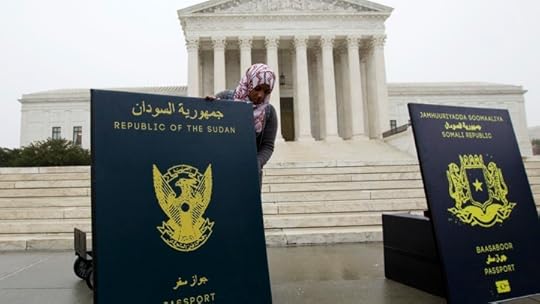
Poster sized enlargements of passports are on display during an anti-Muslim ban rally at the Supreme Court on April 25, 2018.JOSE LUIS MAGANA/ AP
On Tuesday, as Chief Justice John Roberts read an oral summary of his opinion in Trump v. Hawaii, President Trump’s Solicitor General, Noel Francisco, sat a few feet away at counsel table.
Observers could not see Francisco’s lips move, but Roberts’s majority opinion—upholding the administration’s “travel ban” against entrants from a number of countries, most of them majority Muslim—adopted almost verbatim the arguments Francisco had made to the Court during oral argument in April.
Roberts was joined by the Court’s other four conservatives: Justices Anthony Kennedy, Clarence Thomas, Samuel Alito, and Neil Gorsuch. At the time of argument, an observer, no matter the view of the case, could easily have felt compassion for conservative judges seeking to apply traditional legal concepts amid the current poisonous political atmosphere. But on Tuesday, that same observer might very well conclude that the chief justice and the majority had resolved that genuine dilemma poorly.
This is not only a bad result; it is a bad opinion, and a bad omen for those who look to an independent judiciary as a stabilizing force amid the current chaos.
At oral argument, Francisco had begun by telling the Court, “After a worldwide multi-agency review, the president’s acting homeland security secretary recommended that he adopt entry restrictions on countries that failed to provide the minimum baseline of information needed to vet their nationals.”
It is a beguiling narrative, though not a soul in the courtroom or the wide world beyond it believed it. In reality, where lawyer’s fictions garner little respect, there was no secret that the idea of “entry restrictions” came from the president and that they were understood both by him and by his supporters to embody his best attempt at a promised “total and complete shutdown of Muslims entering the United States.”
On Tuesday, however, the Court’s majority accepted the official version almost in toto. Though Roberts’s opinion reviewed the earlier, botched executive orders that tried to close the country’s doors to entrants from a number of Muslim countries, it recited their promulgation, lower-court rejection, and withdrawal in solely bureaucratic terms. Only 25 pages later did it mention “a series of statements by the President and his advisers casting doubt on the official objective of the Proclamation.” Before any serious reckoning with the outright bigotry of Trump’s campaign and his statements as president, the majority conducted a dense discussion of the president’s authority under the Immigration and Nationality Act.
That statutory argument was always a heavy lift for the challengers, because, as Roberts phrased it Tuesday, the statutory scheme “exudes deference to the President in every clause.” Chiefly at issue is a provision of the act, § 1182(f), that permits the president to “suspend entry of all aliens or any class of aliens” or impose restrictions on those he chooses. The challengers had argued that this language had to be read against the entire act, which reposes principal responsibility for creating “classes” of foreign entrants with Congress, with delegation to the president limited to emergency responses to foreign events.
But that restriction is not in the text, and Roberts was at pains to read the statute in the most pro-executive way possible—and, indeed, to go beyond the text to imagine a context of all but total deference to the executive, citing both “the broad statutory text and the deference traditionally accorded the President in this sphere.” The challengers had argued that previous presidential orders had been more closely tailored than the current version of Trump’s ban, suggesting that the statute was limited in scope; a few pages later, Roberts rejected that argument, citing the president’s “sweeping authority to decide whether to suspend entry, whose entry to suspend, and for how long.”
By this point, a reader had gotten the idea.
Roberts only took notice of Trump’s statements in the second part of the opinion. The plaintiffs claimed that, by expressing and embodying hatred and disapproval of Islam, the order violated the prohibition on “an establishment of religion.” Roberts rejected this claim as well.
He began this section by noting many pious presidential proclamations in favor of religious freedom. Of course, those statements were made by other presidents, beginning with George Washington and moving forward to George W. Bush in the aftermath of 9/11. As for Trump’s own words, Roberts wrote, “the issue before us is not whether to denounce the statements.” Instead, “we must consider not only the statements of a particular President, but also the authority of the Presidency itself.”
After that, the statements more or less disappeared from the opinion, to be replaced by a general discussion of judicial review of immigration matters. Under a 1972 case called Kleindienst v. Mandel, the Court evaluated exclusion of a particular alien solely to determine whether the executive branch had given a “facially legitimate and bona fide reason.” Roberts read that as requiring the court to “look behind the face” of the order to determine whether it “is plausibly related to the Government’s stated objective to protect the country and improve vetting procedures.” After that cursory look, the majority concluded that “there is persuasive evidence that the entry suspension has a legitimate grounding in national security concerns, quite apart from any religious hostility.” Note the last phrase: The opinion does not say there was no religious hostility; it said, instead, that the Court may and should ignore it.
Kennedy, in a two-page concurrence, obliquely engaged with that choice: When the case is sent back to the lower court, he wrote, that court might still examine the record for “religious animus,” but should do so with the utmost caution, in proceedings that “would not themselves intrude on the foreign affairs power of the Executive.” But he added a kind of plea for mercy that seemed to be directed toward Trump himself:
The First Amendment prohibits the establishment of religion and promises the free exercise of religion. From these safeguards, and from the guarantee of freedom of speech, it follows there is freedom of belief and expression. It is an urgent necessity that officials adhere to these constitutional guarantees and mandates in all their actions, even in the sphere of foreign affairs. An anxious world must know that our Government remains committed always to the liberties the Constitution seeks to preserve and protect, so that freedom extends outward, and lasts.
Thomas wrote a separate concurrence directed to arguing that district courts lack the authority to issue nationwide injunctions against policies like the “travel ban”—an issue that remains alive in current cases challenging the Affordable Care Act and the “deferred action” program for aliens brought to the U.S. as minors. The opinion will surely be closely read by the advocates and judges below, and may prove more influential than many of Thomas’s separate opinions.
The Court’s four moderate liberals produced two dissents. Justices Stephen Breyer and Elena Kagan politely suggested that an issue remains to be resolved: Is this order a flat ban on all entry from the affected countries? The government at oral argument insisted that there is a “waiver” program by which potential entrants can demonstrate that their specific circumstances—family ties, illness, the need to study, or business matters, for example—should entitle them to entry despite the formal ban on entrants from their sending country. Objectors, and news reports, have since suggested that that the State Department has never actually produced any guidance for consular officers who are asked to provide waivers. On this question, Breyer wrote, “the Court’s decision leaves the District Court free to explore these issues on remand.”
The show-stopper, however, was Justice Sonia Sotomayor’s dissent, joined by Justice Ruth Bader Ginsburg. Sotomayor is a passionate presence on the bench even on the palmiest of days; Tuesday she was on fire, palpably outraged at her colleagues and their deference, not to the “the presidency” but to Donald J. Trump. And in her written dissent, she made clear that she and Ginsburg were unwilling to adopt a judicial indifference to what any newspaper reader knows—that Trump reached office on a promise to punish Muslim immigrants, that he has repeatedly tried to keep that pledge, and that he regards, and has consistently claimed, the current order as yet another attempt to do so. The majority, she wrote, had piously declared less than three weeks ago that a few comments by one state official impermissibly tainted a decision to enforce an anti-discrimination law against a religious baker who refused service to a same-sex couple.
Read the remainder of the article: https://www.theatlantic.com/ideas/arc...
Other:
 by Thomas S. Clark (no photo)
Source: The Atlantic
Mod
And bravo for a venerable history in doing so:
A 160-YEAR TRADITION
Since 1857, The Atlantic has been challenging assumptions and pursuing truth.
WHO WE ARE
As we reflect on our past and look toward the future—in a world where ideologically narrow or simple answers are less adequate, and can even be more destructive, than ever—we decided to put to words a handful of ideas we thought represented authentic guiding commitments for us and to our audience.
Look for the truth above looking for a story.
We know great storytelling is part of great journalism. But honest reporting and analysis, and the integrity they represent, are what matter most to us, even if their pursuit requires giving up on an alluring narrative.
Continue to explore rather than imagining we’ve arrived.
Certainty can be comforting, but it can also get in the way of understanding. For us, the end of every story or argument should be the beginning of a conversation, and the end of every conversation the beginning of another—or even another story or argument.
Go beyond what happens to what matters.
We see it as part of our job to help keep our audience up-to-date on the most important news and current events across the United States and around the world. But the bigger part of our job is to work out—through reporting, argument, and debate—what that news means now, and what it could mean for the future.
Embrace a diversity of perspectives.
No story is ever complete, no argument is ever perfect, and debates worth having tend to shift and turn more than they end. So we can never rely on a single point of view, or even on a “balance” of two. Important ideas, observations, points, and counterpoints can come from anywhere—from across the political spectrum—so we have to look everywhere for them.
Immerse ourselves, and our audience, in the world—instead of escaping from it.
People are connected today in ways they’ve never been before, through established media, new media, social media, or otherwise. But these kinds of connection have also balkanized, filtered, alienated, and inspired retreat—into private concerns, into entertainment, into ideological comfort zones, and so on. We want to connect with the world by fully engaging with it, and with people who see it differently from how others see it.
Our hope is that these commitments orient us in a way that not only is genuine for The Atlantic, but that helps us be as meaningful as possible to you in your life, and as good a force as possible for the world around us.
WHERE WE COME FROM
When the founders of The Atlantic gathered in Boston in the spring of 1857, they wanted to create a magazine that would be indispensable for the kind of reader who was deeply engaged with the most consequential issues of the day. The men and women who created this magazine had an overarching, prophetic vision—they were fierce opponents of slavery—but they were also moved to overcome what they saw as the limits of partisanship, believing that the free exchange of ideas across ideological lines was crucial to the great American experiment. Their goal was to publish the most urgent essays, the most vital literature; they wanted to pursue truth and disrupt consensus without regard for party or clique.
Here is the mission statement published in the very first issue of The Atlantic, in November 1857, and signed by many of the greats of American letters, including Ralph Waldo Emerson, Herman Melville, Harriet Beecher Stowe, and Nathaniel Hawthorne:
First: In Literature, to leave no province unrepresented, so that while each number will contain articles of an abstract and permanent value, it will also be found that the healthy appetite of the mind for entertainment in its various forms of Narrative, Wit, and Humor, will not go uncared for. The publishers wish to say, also, that while native writers will receive the most solid encouragement, and will be mainly relied on to fill the pages of The Atlantic, they will not hesitate to draw from the foreign sources at their command, as occasion may require, relying rather on the competency of an author to treat a particular subject, than on any other claim whatever. In this way they hope to make their Periodical welcome wherever the English tongue is spoken or read.
Second: In the term Art they intend to include the whole domain of aesthetics, and hope gradually to make this critical department a true and fearless representative of Art, in all its various branches, without any regard to prejudice, whether personal or national, or to private considerations of what kind soever.
Third: In Politics, The Atlantic will be the organ of no party or clique, but will honestly endeavor to be the exponent of what its conductors believe to be the American idea. It will deal frankly with persons and with parties, endeavoring always to keep in view that moral element which transcends all persons and parties, and which alone makes the basis of a true and lasting national prosperity. It will not rank itself with any sect of anties, but with that body of men which is in favor of Freedom, National Progress, and Honor, whether public or private.
In studying this original mission statement, we came to understand that its themes are timeless. The core principles of the founders are core principles for us: reason should always guide opinion; ideas have consequences, sometimes world-historical consequences; the knowledge we have about the world is partial and provisional, and subject to analysis, scrutiny, and revision.
MILESTONES
FEBRUARY 1862
Julia Ward Howe’s “Battle Hymn of the Republic” makes its first public appearance, on the front page of The Atlantic.
APRIL 1862
Ralph Waldo Emerson, in “American Civilization,” calls for the emancipation of slaves, and praises President Abraham Lincoln for his principled moves in that direction.
APRIL 1870
Anna Harriette Leonowens publishes “English Governess at the Siamese Court,” her memoir of her time in Siam, which is later fictionalized by Margaret Landon as Anna and the King of Siam—and, in 1951, turned into the hit musical The King and I.
AUGUST 1897
W. E. B. Du Bois, in “The Strivings of the Negro People,” introduces his idea of the African American's experience of “double consciousness,” setting in motion a conversation on race and identity that continues today.
AUGUST 1897
In the same issue, John Muir argues passionately, in “The American Forests,” for the central role federal government must play in the preservation of nature, later inspiring President Theodore Roosevelt to establish the National Park Service.
AUGUST 1915
The magazine publishes “The Road Not Taken,” which Robert Frost had given to then-editor Ellery Sedgwick as a handwritten note.
AUGUST 1932
Far ahead of her time, Helen Keller, in the form of humorous Depression-era business advice-giving, encourages more men to do housework in “Put Your Husband in the Kitchen.”
JULY 1945
In “As We May Think,” Vannevar Bush writes one of the most influential think pieces in modern technological history, offering the first vision of what would decades later become hypertext—a building block of email and the World Wide Web.
APRIL 1963
The Atlantic publishes Martin Luther King Jr.’s “Letter From Birmingham Jail,” then titled “The Negro Is Your Brother,” for the first time nationally, a document that would serve as one of the defining texts of the civil-rights movement.
MARCH 1982
James Q. Wilson and George L. Kelling publish “Broken Windows,” which would go on to—for better and for worse, some might argue—define the next three decades of criminology, and continues to remain influential, and hotly debated, today.
SEPTEMBER 1990
Bernard Lewis writes his hallmark essay, “The Roots of Muslim Rage,” presaging the rise of Islamic extremism.
NOVEMBER 2002
With uncanny prescience, and against the tide of much popular opinion, James Fallows projects, in “The Fifty-First State?”—published six months before the start of the Iraq War—that “the day after a war ended, Iraq would become America’s problem.”
JULY/AUGUST 2013
Anne-Marie Slaughter reframes the gender-and-work debate with “Why Women Still Can’t Have It All,” arguing that true equality entails sweeping policy changes.
JUNE 2014
In “The Case for Reparations,” Ta-Nehisi Coates argues that America must “reckon” with its “compounding moral debts,” sparking international debate on how governments and citizens should confront systemic injustice, both past and present.
MARCH 2015
Graeme Wood, in “What ISIS Really Wants,” offers a sweeping, in-depth analysis of the terrorist organization’s motivations and worldview, and his arguments find their way into both the White House and popular culture.
More:
https://www.theatlantic.com/magazine/...
Mod
Will the Supreme Court’s conservative majority do anything to stop him?
By GARRETT EPPS March 4, 2020
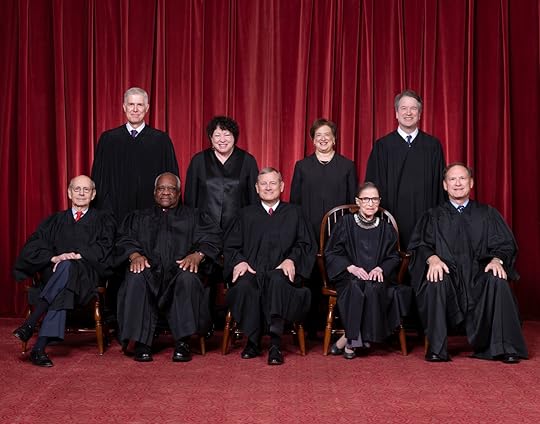
Front row, left to right: Associate Justice Stephen G. Breyer, Associate Justice Clarence Thomas, Chief Justice John G. Roberts, Jr., Associate Justice Ruth Bader Ginsburg, Associate Justice Samuel A. Alito. Back row: Associate Justice Neil M. Gorsuch, Associate Justice Sonia Sotomayor, Associate Justice Elena Kagan, Associate Justice Brett M. Kavanaugh. /Credit: Fred Schilling, Collection of the Supreme Court of the United States
It is now all but mandatory for commentators to peer into the future and predict that history will revile congressional Republicans who have tied their fate to Donald Trump’s, embracing by degrees his verbal brutality, xenophobia, corruption, lawlessness, and contempt for the very institution in which they serve.
I doubt they care. Politicians worry about the next election, not history.
Another group does care, though. Supreme Court justices serve for life, and tend to consider whether they will be remembered well or ill.
How will history view Trump’s four most important judicial enablers—Justices Clarence Thomas, Samuel Alito, Neil Gorsuch, and Brett Kavanaugh? If the Court’s conservatives really do care about their historical legacy, they should take heed that Trump has pushed them and the Court onto very dangerous ground, and shows no sign that he will stop pushing.
As I’ve noted before, the conservative majority—those four justices plus Chief Justice John Roberts—has taken on the role of Trump’s enforcer, ensuring that controversial priorities such as the border wall and the immigration “public charge” rule take effect even before they can be fully considered by lower courts. In a dissent from the decision granting a stay in the immigration case last week, Justice Sonia Sotomayor wrote that “the Court’s recent behavior on stay applications has benefited one litigant [the government] over all others.”
Will anything cause the conservatives to rethink? Will they, for example, become less eager to salivate at the president’s bell if he intensifies his assault on the independence of the courts?
Let’s hope so—because in recent weeks he has done exactly that, opening two new fronts in this sordid war. He is at swords’ points with the federal courts generally, with individual judges who have displeased him, with private citizens who as jurors defy his preferences, and now with the Supreme Court. If the nation were not numb from the shocks of the past three years, this remarkable vendetta would be prompting an uproar.
The war goes back years. Even before he was elected president, Trump attacked Gonzalo P. Curiel, the trial judge in a civil-fraud case against Trump University, as a “Mexican judge” who should not be permitted to hear cases about Trump, because “I’m building a wall.” (Curiel was born in Indiana.) When Judge James Robart of the Western District of Washington halted Trump’s first travel ban, the president dismissed him as a “so-called judge,” and when the Ninth Circuit agreed with Robart, the president actually threatened to dismantle that court. When Judge Derrick K. Watson of the District of Hawaii stayed a later version of the ban, Trump archly asked the angry crowd at one of his rallies, “You don’t think this was done by a judge for political reasons, do you?” When Judge Jon S. Tigar of the Northern District of California stayed new rules barring asylum applications from immigrants who had entered the United States unlawfully, Trump responded, “That’s not law. This was an Obama judge.”
After that last salvo, Chief Justice Roberts, in a remarkable Thanksgiving-eve rebuke, pushed back against the president. “We do not have Obama judges or Trump judges, Bush judges or Clinton judges,” he said, adding pointedly that an “independent judiciary is something we should all be thankful for.” Trump was neither thankful nor deterred—he issued a tweet condemning Roberts by name and mocking the very notion of an “independent judiciary” (scare quotes Trump’s).
Surprising as Roberts’s criticism of Trump was, Trump’s refusal to shut up was more so; the chief justice responded obliquely in his year-end State of the Judiciary message: “We should celebrate our strong and independent judiciary, a key source of national unity and stability.”
But so far, Trump has not joined the celebration. In fact, it’s fair to say that the independent judiciary hasn’t faced such a direct attack since the Jeffersonians tried and failed to purge the bench of Federalists during Thomas Jefferson’s first term. Franklin D. Roosevelt attacked the high court—but not the entire federal bench.
In February, Trump picked a fight with U.S. District Judge Amy Berman Jackson as she was pondering the proper sentence for his friend and confidant Roger Stone, who was convicted of lying to Congress. “Is this the Judge that put Paul Manafort in SOLITARY CONFINEMENT, something that not even mobster Al Capone had to endure?” Trump tweeted. “How did she treat Crooked Hillary Clinton? Just asking!” After Jackson imposed a sentence of three years and four months, Trump shifted his fire to a private citizen who had served as foreperson of the jury: “There has rarely been a juror so tainted as the forewoman in the Roger Stone case. Look at her background. She never revealed her hatred of ‘Trump’ and Stone. She was totally biased, as is the judge … Miscarriage of justice. Sad to watch!” Jackson responded that this kind of attack on a juror—one who was approved for service by both sides in the Stone trial—might actually put her physical safety at risk. And when Jackson added, without specifying any individual, that the Stone jurors “served with integrity,” Stone’s lawyers immediately demanded that she take herself off the case because of “bias.” Trump seconded this demand on Twitter.
Trump then escalated again. On February 21, Sotomayor issued her stinging dissent in a case called Wolf v. Cook County. In Wolf, a district court had blocked the implementation of the “public charge” immigration rule, which makes it much harder for people who entered the country lawfully to become citizens if they have ever used government programs such as food stamps, within its Illinois district. The court of appeals was considering the case and had not ruled. Nonetheless, the five conservatives issued an “emergency” order allowing the rule to go into effect. Sotomayor pointed out what should have been obvious: that in recent years, “the Government has come to treat ‘th[e] exceptional mechanism’ of stay relief ‘as a new normal.’”
Link to remainder of article: https://www.theatlantic.com/ideas/arc...
More:
 by Jed Shugerman (no photo)
Source: The Atlantic
Mod

The History Book Club
Books mentioned in this topic
The People's Courts : Pursuing Judicial Independence in America (other topics)The politics of judicial independence: Court-curbing and the separation of powers. (other topics)
The Politics of Judicial Independence: Courts, Politics, and the Public (other topics)
Reconstructing the Commercial Republic: Constitutional Design after Madison (other topics)
The Politics of Judicial Independence: Courts, Politics, and the Public (other topics)
More...
Authors mentioned in this topic
Jed Shugerman (other topics)Tom S. Clark (other topics)
Bruce Peabody (other topics)
Stephen L. Elkin (other topics)
Bruce Peabody (other topics)
More...
Independence of the judiciary (also judicial independence) is the idea that the judiciary needs to be kept away from the other branches of government. That is, courts should not be subject to improper influence from the other branches of government, or from private or partisan interests.
Different nations deal with the idea of judicial independence through different means of judicial selection, or choosing judges. One way to promote judicial independence is by granting life tenure or long tenure for judges, which ideally frees them to decide cases and make rulings according to the rule of law and judicial discretion, even if those decisions are politically unpopular or opposed by powerful interests.
In some countries, the ability of the judiciary to check the legislature is enhanced by the power of judicial review. This power can be used, for example, when the judiciary perceives that legislators are jeopardizing constitutional rights such as the rights of the accused.