
The History Book Club discussion
SUPREME COURT OF THE U.S.
>
#15 - CHIEF JUSTICE WARREN E. BURGER

 Mod
Mod
 Books on the Chief Justice:
The Burger Years(no cover photo) by Herman Schwartz
From Publishers Weekly
Despite its conservatism, the Supreme Court under Chief Justice Warren E. Burger continued many traditions of the Warren Court, with notable exceptions, observes Schwartz. In this lucid overview, based on a special issue of the Nation magazine, liberal lawyer-activists examine the Burger Court's major decisions and its impact on 15 crucial issues related to the First Amendment, equality, criminal justice and federal regulation of the economy. Contributors find, for example, that the Burger Court favored business and property rights and deferred to the executive branch in national security matters. Yet there were no essential changes in such existing guarantees as church-state separation and minority rights. The writers include New York University scholar Burt Neuborne, journalist-lawyer Sidney Zion and ACLU Washington director Morton Halperin. Schwartz teaches law at American University.
 by Earl M. Maltz
In The Chief Justiceship of Warren Burger, 1969-1986, Earl M. Maltz offers a comprehensive summary and analysis of the Supreme Court's impact on American law and government during Burger's tenure. Undoubtedly one of the most interesting periods in Supreme Court history, the Burger Court generally holds a place in America's judicial memory as a centrist or mildly conservative institution that followed the liberal constitutionalism of the Warren Court and preceded the conservative ideology of the Rehnquist Court. Maltz demonstrates, however, that under Burger the Court's ideological transition was far from immediate and certainly not regular or universal in process. Maltz contends that in many areas of constitutional law the Burger Court produced the most liberal jurisprudence in history -- even more liberal than that of its predecessor. Acknowledging that the decision-making complexities of Burger's era have spawned widely varied interpretations of the Court, Maltz insists that discernible patterns explain the doctrinal positions adopted by the majority of justices in any given case. He advances the controversial thesis that Burger Court activism occurred almost entirely in a liberal direction, even after the appointment of Justices Harry A. Blackmun, Lewis F. Powell, Jr., and William H. Rehnquist. Maltz demonstrates that in cases involving issues such as religion and nonracial discrimination, the Court moved in a liberal direction. Looking beyond the delineation of doctrinal positions, Maltz considers the personalities and complex political attitudes of the justices, the inability of conservative justices to institutionalize their ideology because of their rejection of judicialactivism, and Burger's leadership of the Supreme Court
A book authored by the Chief Justice:It Is So Ordered: A Constitution Unfolds(no cover photo available) by
 Warren E. Burger
The Constitution of the United States affects the daily life of every American in powerful and often unrecognized ways. Yet ever since the Constitution's adoption in 1787, its meaning - the way it is applied in actual cases - has been hotly debated. For more than two hundred years, the Supreme Court of the United States has been responsible for interpreting and defining the Constitution's meaning. In It Is So Ordered, Retired Chief Justice Warren E. Burger, who led the Supreme Court during his seventeen-year tenure, examines fourteen of the pivotal cases and historical events that defined the Constitution's real-life application. With this series of richly crafted stories, Chief Justice Burger explains how our nation's charter evolved. Here are the triumphs and tragedies of American constitutional law. In Gibbons v. Ogden (1824) the Court assured that states could not burden interstate commerce, paving the way for phenomenal commercial growth in America. In Dred Scott v. Sandford (1857), the Court ruled against the freedom of a slave and set the stage for the horrors of the Civil War. In Plessy v. Ferguson (1896), the Court endorsed the nightmare of state-sponsored segregation of the freed slaves. Taken together, the great cases Chief Justice Burger has chosen to explore have laid the foundation for the most successful political and economic system in history. Nevertheless, they remind us that democracy, with its often inconvenient checks and balances, is not always neat and orderly. Instead, Chief Justice Burger believes democracy is people - men and women with all their virtues and flaws - working together to produce ordered liberty. Throughout It Is So Ordered, Chief Justice Burger brings alive the historical figures who helped shape the United States - Thomas Jefferson, Aaron Burr, and Harry Truman, among many others. And he brings to light "forgotten" heroes like Chief Justice John Marshall, who as the fourth Chief Justice gave the unproven judicial branch
Mod
Five Chiefs
 by
by
 John Paul Stevens
Synopsis:
When he resigned last June, Justice Stevens was the third longest serving Justice in American history (1975-2010)--only Justice William O. Douglas, whom Stevens succeeded, and Stephen Field have served on the Court for a longer time.
In Five Chiefs, Justice Stevens captures the inner workings of the Supreme Court via his personal experiences with the five Chief Justices--Fred Vinson, Earl Warren, Warren Burger, William Rehnquist, and John Roberts--that he interacted with. He reminisces of being a law clerk during Vinson's tenure; a practicing lawyer for Warren; a circuit judge and junior justice for Burger; a contemporary colleague of Rehnquist; and a colleague of current Chief Justice John Roberts. Along the way, he will discuss his views of some the most significant cases that have been decided by the Court from Vinson, who became Chief Justice in 1946 when Truman was President, to Roberts, who became Chief Justice in 2005.
Packed with interesting anecdotes and stories about the Court, Five Chiefs is an unprecedented and historically significant look at the highest court in the United States.
More books about his reign as Chief Justice and the influence of the Burger Court: by Leo Pfeffer
 by Anthony Lewis
 by Tinsley E. Yarbrough
The Ascent of Pragmatism: The Burger Court in Action(no cover) by Bernard Schwartz
Mod
Thanks, I'm working on getting all of them up. Have several to go, but we'll get there.
 I really enjoyed this book. I was lucky enough to be invited to a reception given by our Governor where Mr. Woodward gave an address about his years as a reporter. He was a very entertaining and friendly man and I had taken my copy of this book with me for him to sign which he kindly did. I felt rather silly until I saw one of our own State Supreme Court Justices carrying around his own copy!!
The Brethren
 by
by
 Bob Woodward
Synopsis
This book by former reporter Bob Woodward, covers the first few years of the Burger court(1969-75). You would think that Woodward was a fly on the wall inside the courtroom which in fact is closed to reporters. He paints a less than complimentary picture of some of the Justices and he fills the pages with descriptions of some of the milestone cases and the workings of our country's most exclusive court.
Jill, thanks for the add. It was quite the ground breaking book when it was written and somewhat controversial for the image it portrayed of some of the Justices, as you noted. Still a great book though and Woodward is a worthy author. If you liked The Brethren you would probably also like The Nine by Jeff Toobin. It is an insiders view of the modern Court - very compelling.
by
Bob Woodward by
by
 Jeffrey Toobin
 Chief Justice Warren Burger swears in President Richard Nixon
Chief Justice Warren Burger swears in President Richard Nixon during inaugural ceremony in Washington DC. (no sound)
President Richard Nixon's Inauguration ceremony at United States Capitol building in Washington DC. Mrs Nixon holds bible as Chief Justice Warren Burger swears in President Nixon. Crowd watches the ceremony from stand. Flags at half-staff. Location: Washington DC. Date: January 20, 1973.
https://www.youtube.com/watch?v=cLB-o...
Mod
Chief Justice Burger Retrospective
Warren Burger served as Chief Justice of the U.S. Supreme Court from 1969 to 1986, during the terms of four presidents. He died in June 1995. In an overview of his life and career, a clip was shown of the former Chief Justice speaking at the 1990 dedication of the Burger Library of the Mitchell College of Law in St. Paul, Minnesota, of which he was a graduate. Next, excerpts were read from a tribute written by former Justice Blackmun about his life-long friendship with Warren Burger. Following a 1993 speech, former Chief Justice Burger answered questions on some of the important issues which came before the Court during his tenure. In a 1986 interview, Chief Justice Burger talked about his philosophy of government.
Here is the link to the C-Span presentation video:
http://www.c-span.org/video/?67037-1/...
PEOPLE IN THIS VIDEO
Harry A. Blackmun - Associate Justice (Former)
U.S. Supreme Court - Warren Earl Burger Chief Justice (Former) - U.S. Supreme Court
Mark Cannon - Administrative Assistant (Former) U.S. Supreme Court->Burger, W., Chief Justice
Bruce Collins - Vice President - C-SPAN
Lew Ketcham - Host - C-SPAN
Brian Lamb - Host - C-SPAN
Mark V. Tushnet - Professor - Georgetown University Law Center
Note: Associate Justice Harry Blacknum and Chief Justice Warren Burger were lifelong friends for over 80 years. Blacknum had also been Burger's best man at his wedding. They were children together and their mothers had packed them off to Sunday school at 5 or 6 years of age. How odd both of them ended up on the Supreme Court. Burger was responsible for many innovations in the court; he brought back the busts of the Chief Justices and the paintings - changed the shape of the bench, brought in the first xerox machine, brought in electronic typewriting, put header summaries for the journalists for each case. He enjoyed cooking (black bean soup) and he painted and did sculpture.
Mod
Chief Justice Earl Warren was succeeded by Warren E. Burger, who served from 1969 to 1986. The Burger Court is best remembered for its ruling in Roe v. Wade (1973), which held that there is a constitutionally protected right to have an abortion in some circumstances. The Court also made important decisions relating to the First Amendment. In Lemon v. Kurtzman (1971), it established the "Lemon test" for determining if legislation violates the establishment clause. Similarly, it established the "Miller test" for laws banning obscenity in Miller v. California (1973).
Other rulings include Landmark Communications v. Virginia in which the court ruled for fining a newspaper for revealing the identity of a judge under investigation by state commissioner H. Warrington Sharp. The Burger Court also established a moratorium on capital punishment in Furman v. Georgia (1972), holding that states generally awarded death sentences arbitrarily and inconsistently. The moratorium, however, was lifted four years later in Gregg v. Georgia (1976). Also in United States v. Nixon (1974), the court ruled that the courts have the final voice in determining constitutional questions and that no person, not even the President of the United States, is completely above law.
Source: Wikipedia
Mod
from Collections at the Gerald R. Ford Presidential Library and Museum
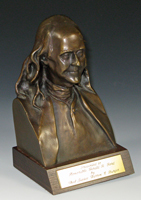
Benjamin Franklin Bust (2007.8.14)
In 1923 a young Warren Burger sculpted a bronze bust of Benjamin Franklin. In 1969 Burger become Chief Justice of the United States Supreme Court, and his bust of Franklin came to the attention of the Franklin Mint. The Mint, headquartered in Franklin’s adopted home town of Philadelphia, cast twenty bronze and three silver copies of Burger’s work in 1987, entrusting them to the artist to give as gifts to whomever he wished.
The Chief Justice gave one bronze replica to Gerald Ford sometime in his post-presidential years. Indeed, it was Burger who had administered the presidential oath to Ford in 1974. Ford had found Burger’s conduct on the bench impressive, and when a seat of the Supreme Court had to be filled, Ford kept Burger’s judicial views in mind. “Under Chief Justice [Earl] Warren, the Court had begun legislation by judicial decree instead of interpreting the law. Chief Justice Warren Burger had tried to limit federal jurisdiction and let state courts make more final judgments themselves. I thought his course was correct, and I sought someone who would agree with that view.” Ford wanted to nominate someone who would work well with his Chief Justice.
The wooden base which the bust is affixed features a plaque inscribed with, “Presented to Honorable Gerald R. Ford by Chief Justice Warren E. Burger”.
Written by Museum Intern April Conant
Molotsky, Irvin. “Washington Talk: Avocations; Burger, a Molder of Law and Clay”. The New York Times, April 21, 1987. http://www.nytimes.com/1987/04/21/us/...
Ford, Gerald R. A Time To Heal: The Autobiography of Gerald R. Ford. Harper & Row: The Readers Digest Association Inc, 1979. 334-35.
Source: Gerald Ford Presidential Library site
Mod
http://news.google.com/newspapers?nid...
Mod

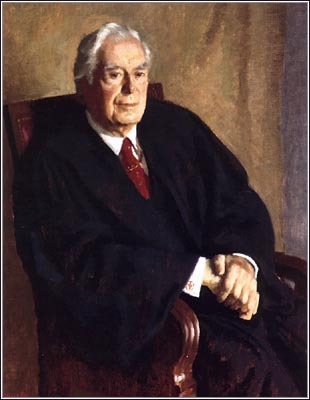
Chief Justice Warren E. Burger (1983), U. S. Supreme Court Building, Washington, D.C.
Walker Hancock was the sculptor:
http://en.wikipedia.org/wiki/Walker_H...
Mod
 Mod
Mod
Biography:
Biographical Information
Warren E. Burger (1907-1995) grew up under modest circumstances in St. Paul, Minnesota, where he attended the University of Minnesota and then the St. Paul College of Law as a night student while working fulltime during the day. After graduating magna cum laude in 1931, he joined the reputable law firm of Boyeson, Otis, Brill & Faricy in St. Paul, becoming a partner in 1935. He actively managed Harold Stassen's campaign for the Republican presidential nomination, but when it became apparent at the 1952 GOP convention that Stassen would not get enough votes, he decided at the last minute to give Minnesota’s votes to one of the leading contenders, Dwight D. Eisenhower, and thereby decided the nomination. This move contributed to his becoming Assistant Attorney General, Civil Division, in the United States Department of Justice under the Eisenhower administration in 1953.
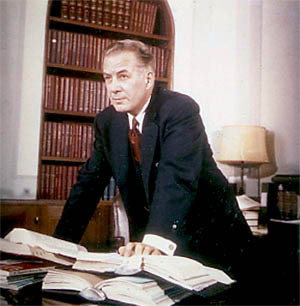
Snapshot of Warren E. Burger during his time as Judge at the Federal Court of Appeals, District of Columbia Circuit, 1957.
In 1955 he was nominated as a judge for the Federal Court of Appeals, District of Columbia Circuit, a position he held from 1956 until 1969, when President Nixon appointed him Chief Justice of the United States. His nomination was confirmed by an overwhelming margin in June of the same year. During his seventeen years as Chief Justice, he not only presided over the Court's many historic decisions but also worked tirelessly to improve the way the judiciary functions and justice is administered throughout the nation's courts.
In 1986, Warren E. Burger retired from the Supreme Court and devoted himself to his role as the chairman of the Commission on the Bicentennial of the United States Constitution. All facets of Warren E. Burger’s career and life are well represented in the approximately 1,200 cubic feet of papers, 1,500 photographs and more than 300 artifacts in custody at Swem Library’s Special Collections
Source: http://cf.swem.wm.edu/exhibits/burger...
Source: The College of William and Mary
Mod
http://cf.swem.wm.edu/exhibits/burger...
Source: The College of William and Mary
Mod
During his school years, Warren E. Burger was involved in a variety of intra- and extracurricular activities. He headed the student council and student court, worked for the school newspaper, played several sports and at least two instruments - while at the same time contributing to the family income through jobs as paperboy, camp counselor, and lifeguard. So it comes as no surprise that he stayed actively involved in community affairs and politics. As a young lawyer in Minnesota, while still teaching classes at the St. Paul College of Law, he was the president of the local junior chamber of commerce. In the late 1940s, Burger was a member of the governor of Minnesota’s interracial commission and president of St. Paul’s Council for Human Relations, demonstrating an early interest in civil rights. Throughout the greater part of his career, the Chief Justice pursued his ideas of a reform of the American penal system. He actively lobbied on behalf of rehabilitation of prisoners and tirelessly promoted his vision of prisons as “Factories with Fences.”
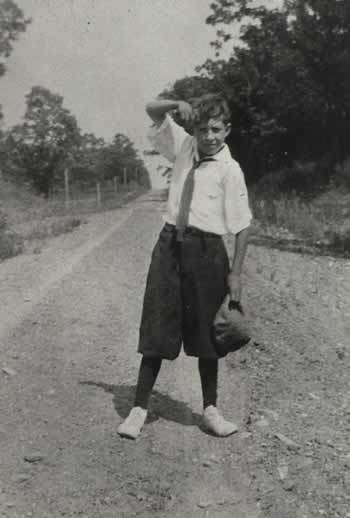
Warren E. Burger (1920)
Link: http://cf.swem.wm.edu/exhibits/burger...
Source: The College of William and Mary
Mod
Chief Justice Burger’s remarkable contributions to the improvement of the administration of justice in our country are widely recognized. In addition to streamlining procedures at the Supreme Court, he initiated the founding of the National Center for State Courts in 1971.
The Center, whose mission it is to improve the efficiency of state courts, has been located in Williamsburg since 1978. Another example of Warren Burger’s tireless work for the nation’s judicial system is his involvement with the Anglo-American exchange of lawyers and judges, which led to the formation of the first American Inns of Court in the 1980s, modeled after the British example. In 1985, the American Inns of Court Foundation was formally organized, to help the newly created Inns fulfill their goals of “legal excellence, civility, professionalism and ethics on a national level.”
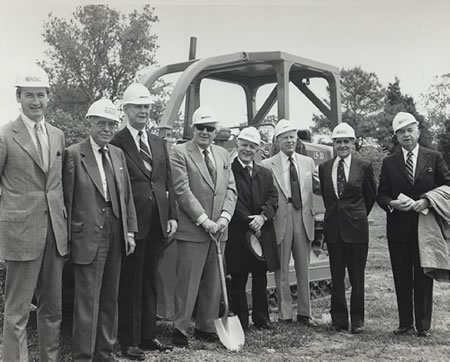
Ground breaking ceremony for the National Center for State Courts, Williamsburg, VA, May 8, 1976. Photographer Unknown.
Source: The College of William and Mary
Mod
1985-1991
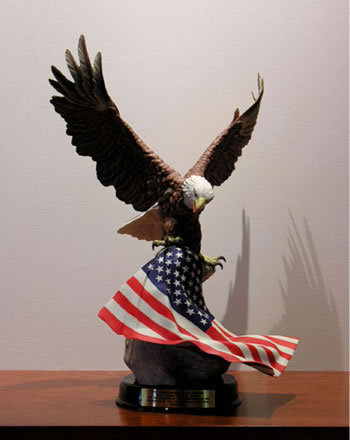
Porcelain Eagle with American Flag, n.d. (Angelus H. Bockstruck Company Switzerland). Gift of the members of the Commission on the Bicentennial of the United States Constitution to Warren E. Burger, who was chairman of the commission from 1985-1991.
The Commission on the Bicentennial of the U.S. Constitution was established in 1983 “to plan and develop activities appropriate to commemorate the signing of the U.S. Constitution on September 17, 1787, the formation of the three branches of government, and the Bill of Rights.” The Chief Justice, its chairman since 1985, had always felt very passionately about the Constitution and the founding history of the United States and saw the Bicentennial Commission as a chance for a civic history lesson that could reach all Americans and especially the younger generation. Under his guidance, the Commission initiated, sponsored and endorsed a large variety of scholarly and educational programs all over the country. These included, among others, history teaching projects from elementary to college level; essay and map contests; videotaped interviews with former presidents Nixon, Ford, Carter and Reagan; the publication and distribution of books and pamphlets; and, of course, festivities and parades. After the Bicentennial Commission officially expired at the end of 1991, Warren E. Burger created the Trust for the Bicentennial of the United States Constitution to continue this mission.
Source: The College of William and Mary
Mod
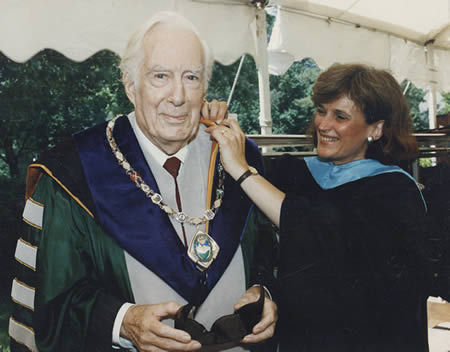
Warren E. Burger, 1993. Chief Justice Burger, Chancellor of the College of William & Mary and Professor and Dean of the School of Education, Virginia McLaughlin, adjusting his Chancellor’s badge at the Commencement celebration. Photograph by C. James Gleason/VISCOM.
Even before Chief Justice Burger became the twentieth chancellor of the College in 1986, he had visited Williamsburg and William & Mary on several occasions: In 1971, as the speaker at the First National Conference of the Judiciary, he had called for the creation of the National Center for State Courts; in 1973 he delivered the College’s commencement address and received an honorary doctorate. He was presented with the John Marshall Award for Excellence in American Legal History by the Marshall-Wythe student chapter of the College’s Law School in 1978. In 1979, he was the speaker at the Law Day Ceremonies at the Marshall-Wythe School of Law. During the 1980s, several meetings of the Commission on the Bicentennial of the U.S. Constitution, over which the Chief Justice presided, were held in Williamsburg as well.
Link: http://cf.swem.wm.edu/exhibits/burger...
Source: The College of William and Mary
Mod
Warren E. Burger, the Artist
Warren E. Burger had a keen interest in art, and always made time in his busy schedule to visit museums and art galleries. By virtue of being Chief Justice, he was the chairman of the board of the National Gallery of Art, as well as chancellor of the Smithsonian Institution. And the Chief Justice was artistically creative himself. He sculpted, drew and painted throughout his lifetime.
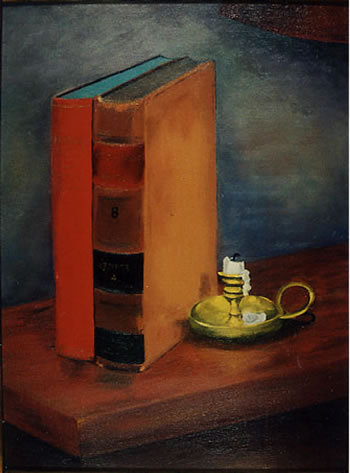
Warren E. Burger: U.S. v. Aaron Burr, 1807, 1953
Photo reproduction of oil on canvas board. Burger painted this still life in the spring of 1953 when he was assistant attorney general. The volume of the U. S. Reports he chose as an inspiration contains the 1807 case U.S. v. Aaron Burr. Aaron Burr (1756-1836), a lawyer and politician from New York, was Vice President under Thomas Jefferson from 1801-1805. Burr killed Alexander Hamilton in a duel in 1804 and was indicted for treason in 1807, after he had been involved in schemes of rebellion against the United States. Burr was acquitted by Chief Justice John Marshall, who ruled that two witnesses are needed for a treason conviction. Original on loan from Leonora Burger
More:
http://cf.swem.wm.edu/exhibits/burger...
Source: The College of William and Mary
Mod
Justice Burger discussed the political philosophy of the nation’s founding fathers, his personal judicial views, and some of the challenges facing U.S. courts.
http://www.c-span.org/video/?65891-1/...
Mod
 by
by
 Warren E. Burger
Synopsis:
In recognition of the bicentennial of the Constitution of the United States, former chief justice Warren E. Burger, Justice Antonin Scalia, ACLU president Norman Dorsen, and others delivered papers at the first annual DeWitt Wallace Conference on the Liberal Arts, held at Macalester College, St. Paul. Wideman, Gray, Lifton, and Norton maintain that social forces determine freedom of expression.
Mod
On the twenty-fifth anniversary of the day Chief Justice Warren Burger retired from the U.S. Supreme Court, many of the men and women who served as his judicial clerks gathered at William Mitchell to discuss his decisions, share personal stories, and celebrate his life.
Burger graduated from St. Paul College of Law (now William Mitchell) in 1931 and went on to become the fifteenth chief justice of the United States. He is arguably William Mitchell’s most accomplished graduate—only seven law schools have alumni who have become chief justices. He brought to the high court the same traits that made him successful in law school: grit, determination, a keen understanding of the law, and modesty.
Modesty was a common theme discussed among his former clerks who attended the event. Several, including Chief Judge of the U.S. Court of Appeals Alex Kozinski; Reece Bader, a partner in the Munich office of the Orrick law firm; and Candace Kovacic, a law professor at the Washington College of Law of American University, participated in a panel discussion that drew hundreds of people to William Mitchell.
“If I had to pick one word to describe Chief Justice Burger and his judicial legacy it would be modesty,” said Kozinski. “He as a man was genuinely humble and genuinely modest.”
Burger was born in St. Paul, Minn., Sept. 17, 1907, the 120th anniversary of the signing of the U.S. Constitution. As a child, he hawked newspapers and worked construction. He attended the University of Minnesota night-school division, then entered St. Paul College of Law, a William Mitchell predecessor, where he graduated magna cum laude.
After earning his degree, Burger joined a law firm, taught law school classes at his alma mater, and became involved in politics. In 1952, he helped Dwight D. Eisenhower win the Republican presidential nomination. After the election, Burger was named assistant U.S. attorney general in charge of the civil division. He was later appointed to the U.S. Court of appeals, and, in 1969, President Richard Nixon Nominated him to become the 15th chief justice of the United States.
According to his clerks, he was widely viewed as a symbol of “law and order.” After retiring from the court in 1986, he headed the Commission on the Bicentennial of the U.S. Constitution and frequently returned to his law school to meet with students.
The reunion was presented by the National Security Forum at William Mitchell College of Law.
Video of the event
http://web.wmitchell.edu/national-sec...
Source: William Mitchell College of Law
Mod
Law clerks have assisted Supreme Court Justices in various capacities since the first one was hired by Justice Horace Gray in 1882. By the traditions and rules that have developed around this procedure today Associate Justices on the Supreme Court of the United States have the opportunity to select four law clerks each term of the court. The Chief Justice is allowed five clerks, though Chief Justice Rehnquist usually hired only three.
The following is an incomplete table of Supreme Court law clerks serving the Chief Justice.
http://en.wikipedia.org/wiki/List_of_...
Mod
By LINDA GREENHOUSE
Published: June 26, 1995
WASHINGTON, June 25— Warren E. Burger, who retired in 1986 after 17 years as the 15th Chief Justice of the United States, died here today at age 87. The cause was congestive heart failure, a spokeswoman for the Supreme Court said.
An energetic court administrator, Chief Justice Burger was in some respects a transitional figure despite his tenure, the longest for a Chief Justice in this century. He presided over a Court that, while it grew steadily more conservative with subsequent appointments, nonetheless remained strongly influenced by the legacy of his liberal predecessor, Chief Justice Earl Warren. The constitutional right to abortion and the validity of busing as a remedy for school segregation were both established during Chief Justice Burger's tenure, and with his support.
The country knew Chief Justice Burger as a symbol before it knew much about him as a man or a judge.
He was President Richard M. Nixon's first Supreme Court nominee, and Mr. Nixon had campaigned on a pledge to find "strict constructionists" and "practitioners of judicial restraint" who would turn back the activist tide that the Court had built under Chief Justice Warren, its leader since 1953.
The nomination on May 21, 1969, immediately made Mr. Burger, a white-haired, 61-year-old Federal appeals court judge, a lightning rod for those who welcomed as well as those who feared the end of an era of judicial activism.
It was a central contradiction of Mr. Burger's tenure as Chief Justice that long after he became one of the most visible and, in many ways, innovative Chief Justices in history he remained, for many people, the symbol of retrenchment that Mr. Nixon had presented to the public on nominating him.
In fact, the Supreme Court in the Burger years was in its way as activist as the Court that preceded it, creating new constitutional doctrine in areas like the right to privacy, due process and sexual equality that the Warren Court had only hinted at.
"All in all," one Supreme Court scholar, A. E. Dick Howard, wrote in the Wilson Quarterly in 1981, "the Court is today more of a center for the resolution of social issues than it has ever been before."
While there were some substantial changes of emphasis, the Burger Court -- a label liberals tended to apply like an epithet -- overruled no major decisions from the Warren era.
It was a further incongruity that despite Chief Justice Burger's high visibility and the evident relish with which he used his office to expound his views on everything from legal education to prison management, scholars and Supreme Court commentators continued to question the degree to which he actually led the institution over which he so energetically presided.
His important opinions for the Court included the decision that validated busing as a tool for school desegregation, the one that struck down the "legislative veto" used by Congress for 50 years to block executive branch actions, and the one that spurred President Nixon's resignation in 1974 by forcing him to turn over White House tape recordings for use in the Watergate investigations. Yet Chief Justice Burger was just as often in dissent on major decisions. In that, he differed from Chief Justice Warren, who voted with the majority in nearly all important cases.
Those seeking to identify the sources of intellectual leadership on the Court usually pointed to William H. Rehnquist, another Nixon appointee to whom Chief Justice Burger assigned many important opinions, and to William J. Brennan Jr., the Court's most senior and, with Thurgood Marshall, most liberal member.
As the senior Associate Justice, Justice Brennan had the right to assign the opinion in any case in which he was in the majority and the Chief Justice was in dissent, and he often exercised that prerogative by assigning major opinions to himself, particularly in the area of individual rights.
As the years passed, Chief Justice Burger seemed to assign himself the opinions in relatively straightforward and uncontroversial cases, avoiding those in which the Court was deeply split and in which it would have required considerable effort to marshal or hold a fragile majority. As a result, his personal imprint on the Court's jurisprudence was not always readily identifiable. An Innovator In Administration
But his imprint was distinct in the area to which he gave his most sustained attention, judicial administration.
Mr. Burger liked to say that he took his title seriously. He was Chief Justice of the United States, not just of the Supreme Court, and he took as his mandate the stewardship of the entire judicial system, state as well as Federal.
An array of institutions were created under his aegis, including the National Center for State Courts, the Institute for Court Management and the National Institute of Corrections. The common purpose of those organizations was to improve the education and training of participants in nearly all phases of the judicial process, whether judges, court clerks or prison guards.
The Chief Justice turned the small Federal Judicial Center, for which he served by statute as chairman of the board, into a major center for research and publishing about the courts.
He believed that judges could be helped to be more efficient if professional management techniques were imported to the courts, from clerks' offices to judges' chambers. The Institute for Court Management set up a six-month program for training court managers and administrators.
The Supreme Court itself became one of the first fully computerized courts in the country; in 1981, the Justices all received computer terminals on which to compose their opinions.
The Chief Justice campaigned tirelessly for better pay for judges, better education for lawyers and help for the Court's ever-growing caseload. From his earliest years in office, he warned that the Federal courts and the Supreme Court in particular were becoming dangerously overworked.
In 1983, he asked Congress to create an appellate panel that could relieve some of the Supreme Court's caseload by resolving conflicting opinions among the Federal appeals courts. Many Admirers, But Detractors as Well
Judges and others interested in these long-ignored administrative issues responded with gratitude. One of the Chief Justice's warmest admirers on the Federal bench was Frank M. Johnson Jr., a Federal appeals court judge from Alabama who won praise from civil rights advocates for his orders on prison issues and other rulings.
"Warren Burger has redefined the nature of his office," Judge Johnson wrote in the early 1980's. "He has concentrated his energy not simply on exploring the subtleties of constitutional doctrine but on reforming the mechanics of American justice. More than any of his 14 predecessors, he has invested the prestige of the Chief Justiceship in efforts to make the American judicial system function more efficiently. He has used his position not as an excuse to withdraw from public affairs but as an opportunity to furnish public leadership."
But the priority that Chief Justice Burger assigned to administration also had its detractors, who complained that he trivialized his office by emphasizing the mechanics of justice at the expense of its substance.
Occasionally, too, his enthusiastic lobbying was seen as overbearing by those at whom it was directed. In 1978, for example, he became deeply involved in the effort in Congress to overhaul the bankruptcy system.
One Democratic senator, Dennis DeConcini of Arizona, whose subcommittee had jurisdiction over the bill, complained publicly that a "very, very irate and rude" Chief Justice had telephoned him to object to a legislative development and "not only lobbied but pressured and attempted to be intimidating."
The Chief Justice could also be rather intimidating from the bench, particularly when a relatively inexperienced lawyer was arguing a position with which Mr. Burger disagreed. While Chief Justice Warren's favorite question from the bench was, "Yes, but was it fair?" Chief Justice Burger often asked: "Yes, but why is this case in the courts? Isn't this a matter for the Legislature to address?" Working to Limit The Judiciary's Scope
Chief Justice Burger believed in a limited role for the courts and reserved some of his sharpest criticism for those who looked to them to resolve social and political problems that, in his view, were not the province of judges. "If we get the notion that courts can cure all injustices, we're barking up the wrong tree," he liked to say.
A speech he gave while he was still a judge on the Court of Appeals for the District of Columbia provided a useful summary of the view he held throughout his career: "That courts encounter some problems for which they can supply no solution is not invariably an occasion for regret or concern. This is an essential limitation in a system of divided power."
Some of the more important decisions while he was Chief Justice were those that limited litigants' access to Federal court by using the doctrines of standing, mootness and deference to state courts.
He seemed to regard suits for small monetary stakes as a waste of judges' time, and many of his speeches complained about the disproportionate cost to the system of trying the lawsuits brought by prisoners or consumers over modest losses of money or property.
His questioning of one lawyer, who argued in 1982 on behalf of 168,000 consumers, each with a claim for $7.98 against the Gillette Company, was the talk of the Court for weeks. "What is the economic justification for this kind of lawsuit in the Federal courts under any circumstances?" the Chief Justice demanded.
"We are in state court, judge, in this case," the lawyer, Robert S. Atkins, replied.
"In state or Federal court?" the Chief Justice persisted.
"The problem," Mr. Atkins said, "is that if you cheat people a little bit but do it a lot, you can go free ----"
The Chief Justice interrupted to interrogate him about the proportion of the recovery that would go for legal fees. Inviting Attention, Some of the Time
Chief Justice Burger's effort to police the moral character of lawyers who sought to become eligible to argue before the Court rankled some of the other Justices and in 1982 provided a rare public glimpse of internal disagreements over the Chief Justice's administrative approach.
He singled out several applicants by name and accused them of seeking membership in the Supreme Court bar to "launder" tarnished credentials. But he failed to persuade a majority of the Court to block the admissions and provoked one Justice, John Paul Stevens, to write that the Court should grant applicants with questionable credentials a "fair hearing" before publicly labeling them as unworthy.
There were contradictory strains in Chief Justice Burger's attitude toward the public, including the press. At times he seemed to welcome and even invite public attention. He took pride in having made the Supreme Court a more attractive place for tourists to visit, transforming the cold marble ground floor into an area for historical exhibits.
Yet he alone of all the Justices refused, when announcing one of his opinions from the bench, to provide tourists and lawyers in the audience with a brief oral description of the case and the decision.
Mod
The other Justices either read aloud from a memorandum explaining the case or gave a more casual oral account. When the Chief Justice's turn came, he would simply announce that in a case with a particular name, the judgment of the lower court was affirmed, or reversed. When asked why he refused to join the others in explaining his opinions, he once said, "It's a waste of time."
He was adamant about preserving the secrecy of the Court's internal operations, even to the extent of refusing to make public the names of his four law clerks. A law firm recruiter or other member of the public who called the Court's public information office seeking a list of the current law clerks would receive the names of all the clerks except the Chief Justice's.
He mailed copies of his speeches to hundreds of journalists around the country and would telephone particular columnists to make sure his message was clear. Defining the Limits Of Speech and Press
Occasionally, usually in connection with his annual "State of the Judiciary" address to the American Bar Association, a tradition that he inaugurated, he would invite journalists for informal "deep background" briefings, sessions that were often relaxed and informative.
But he seemed to hold much of the press corps in low repute. Asked by a lawyer at a Smithsonian Institution symposium what he thought of the reporters who covered the Court, he replied, as he often did: "I admire those who do a good job, and I have sympathy for the rest, who are in the majority."
Special scorn was reserved for television, which he regarded as an intrusive annoyance. He once knocked a television camera out of the hand of a network cameraman who followed him into an elevator. He vowed that he would never allow oral arguments at the Supreme Court to be televised.
Yet he wrote the opinion for the Court in the 1981 case Chandler v. Florida, holding that a state could permit a criminal trial to be televised, even over the defendant's objection, without depriving the defendant of the constitutional right to a fair trial.
Chief Justice Burger wrote several of the Court's most important opinions interpreting the free speech and free press guarantees of the First Amendment.
His opinion in a 1976 case, Nebraska Press v. Stuart, effectively prohibited judges from ordering the press not to publish information in its possession about a crime, a confession or the like. The opinion said that judges could take less drastic steps to protect criminal defendants from negative pretrial publicity, like sequestering the jury or changing the site of the trial.
A 1973 opinion by the Chief Justice ended roughly 15 years of turmoil over the legal definition of obscenity by changing the focus to local communities, rather than the entire country.
That opinion, in Miller v. California, said obscene materials were "works which, taken as a whole, appeal to the prurient interest in sex, which portray sexual conduct in a patently offensive way and which, taken as a whole, do not have serious literary, artistic, political or scientific value." The Chief Justice added that it was up to local juries applying "contemporary community standards" to decide whether a particular work fit that definition.
"It is neither realistic nor constitutionally sound to read the First Amendment as requiring that the people of Maine or Mississippi accept public depiction of conduct found tolerable in Las Vegas or New York City," he wrote. "People in different states vary in their tastes and attitudes, and this diversity is not to be strangled by the absolutism of imposed uniformity." Religion, Rights And Veto Power
Chief Justice Burger was also one of the Court's most prolific writers on another aspect of the First Amendment, the clause prohibiting establishment of an official national religion. In a 1971 opinion, Lemon v. Kurtzman, he set forth the test for deciding whether a given law or government program that conferred some benefit on religion nonetheless passed muster under the First Amendment.
"First," he wrote, "the statute must have a secular legislative purpose; second, its principal or primary effect must be one that neither advances nor inhibits religion; finally, the statute must not foster an excessive government entanglement with religion." This "three-part test," as it came to be known through later refinements and elaborations, defined the Court's approach to the establishment clause in a variety of contexts.
The 1983 decision that struck down the legislative veto, Immigration Service v. Chadha, altered the balance of power between the executive and legislative branches.
It invalidated a procedure, which Congress had incorporated into some 200 laws, permitting one or both houses to block executive branch action. The procedure, Chief Justice Burger wrote, was not within Congress's constitutional authority because it did not follow the rules the Constitution set out for "legislation": passage by both houses and presentment to the President for his signature.
The Chadha opinion in many ways summarized the Chief Justice's view of American Government. He wrote, "With all the obvious flaws of delay, untidiness and potential for abuse, we have not yet found a better way to preserve freedom than by making the exercise of power subject to the carefully crafted restraints spelled out in the Constitution."
Chief Justice Burger wrote relatively few of the Court's criminal law decisions, and some of the more important decisions on the rights of criminal suspects found him in bitter dissent.
For example, in the 1977 case Brewer v. Williams the Court ruled, in a 5-to-4 opinion by Justice Potter Stewart, that the police had violated a murder suspect's constitutional right to counsel. The police officers, knowing that the suspect was deeply religious, delivered what came to be called the Christian burial speech, musing aloud on the wish of the victim's parents to give their daughter a Christian burial. The suspect, who had previously said he would talk only after seeing a lawyer, then led the officers to the victim's body.
The majority's decision overturning the murder conviction was "bizarre," the Chief Justice wrote in a dissent that was a stinging attack on the so-called exclusionary rule barring the use at trial of illegally seized evidence.
"The result reached by the Court in this case ought to be intolerable in any society which purports to call itself an organized society," he said. "Failure to have counsel in a pretrial setting should not lead to the 'knee-jerk' suppression of relevant and reliable evidence." A Conservative On Crime Issues
The Chief Justice dissented from the Court's 1972 decision that invalidated all death penalty laws then in force. After the Court permitted executions to resume four years later, the Chief Justice grew increasingly impatient with the legal obstacles that lawyers and judges continued to place in the way of executions.
When the Court refused to block the execution of a murderer whose appeals had lasted 10 years, Chief Justice Burger wrote a concurring opinion excoriating lawyers for condemned inmates. He said the lawyers sought to turn the administration of justice into a "sporting contest."
Although Chief Justice Burger's views on criminal law did not always garner a majority on the Supreme Court, those views had probably been more responsible for his being nominated to the High Court than any other factor.
In 13 years on the United States Court of Appeals for the District of Columbia Circuit, he was known as a conservative, law-and-order judge. He enhanced that reputation with speeches and articles. A speech in 1967 at Ripon College in Wisconsin came to Richard Nixon's attention after it was reprinted in U.S. News & World Report.
The White House distributed copies of the speech at the time of Judge Burger's nomination, and the Supreme Court press office handed it out for years when asked for information about his views. In the speech, he compared the American system of justice with the systems of Norway, Sweden, Denmark and the Netherlands.
"I assume that no one will take issue with me when I say that these North European countries are as enlightened as the United States in the value they place on the individual and on human dignity," he said.
Yet, he continued, those countries "do not consider it necessary to use a device like our Fifth Amendment, under which an accused person may not be required to testify."
"They go swiftly, efficiently and directly to the question of whether the accused is guilty," he added.
"No nation on earth," he said, "goes to such lengths or takes such pains to provide safeguards as we do, once an accused person is called before the bar of justice and until his case is completed." A Modest Start In Minnesota
Chief Justice Burger's speechmaking style changed little in subsequent years. He often returned to the theme and imagery of the Ripon speech and often used the Scandinavian countries, which he visited frequently, as benchmarks against which to compare the American system.
Warren Earl Burger was born Sept. 17, 1907, in St. Paul. His parents, of Swiss-German descent, were Charles Joseph Burger and the former Katharine Schnittger. His paternal grandfather, Joseph Burger, emigrated from Switzerland and joined the Union Army at the start of the Civil War, when he was 14. He was severely wounded in combat and received both a battlefield commission and the Medal of Honor.
Mod
Warren Burger was one of seven children. The family lived on a 20-acre truck farm on the outskirts of St. Paul. In addition to farming, his father sold weighing scales; the family's financial circumstances were modest.
At John A. Johnson High School, from which Warren Burger graduated in 1925, he edited the school newspaper, was president of the student council and earned letters in hockey, football, track and swimming. He earned extra money by selling articles on high school sports and other news to the St. Paul newspapers.
The rest of his formal education took place in night school while he worked days selling insurance for the Mutual Life Insurance Company of New York. He attended the night school division of the University of Minnesota for two years, then began night law classes at the St. Paul College of Law, now known as the William Mitchell College of Law. He received his degree with high honors in 1931.
He joined the faculty of the law school and taught for 12 years while practicing law with the firm of Boyesen, Otis & Faricy. He remained with the firm, one of the oldest in the state, for 22 years; after he became a partner, the firm was known as Faricy, Burger, Moore & Costello. He handled probate, trial and appellate cases, arguing more than a dozen before the United States Supreme Court and many more in the Minnesota Supreme Court.
He married Elvera Stromberg in 1933. They had a son, Wade Allen, and a daughter, Margaret Elizabeth.
As a young lawyer, Mr. Burger became active in community affairs. He was president of the Junior Chamber of Commerce and the first president of the St. Paul Council on Human Relations. That group, which he helped to organize, sponsored training programs for the police to improve relations with minority groups. For many years, he was a member of the Governor's Interracial Commission.
He also became involved in state politics, working on Harold E. Stassen's successful campaign for governor. He went to the 1948 Republican National Convention to help Governor Stassen's unsuccessful bid for the Presidential nomination. Making the Move To Washington
In 1952, he was at the Republican convention again, still a Stassen supporter. But he helped Dwight D. Eisenhower's forces win a crucial credentials fight against Senator Robert A. Taft of Ohio. On the final day, with General Eisenhower lacking nine votes for the nomination, Mr. Burger helped swing the Minnesota delegation and gave Eisenhower the votes that put him over the top. Cheers broke out on the convention floor as an organ played the University of Minnesota fight song.
His reward was a job in Washington, as Assistant Attorney General in charge of the Civil Division of the Justice Department. He supervised all the Federal Government's civil and international litigation. He told a young Justice Department lawyer years later that he would have been content to continue running the Civil Division for the rest of his career.
One of his assignments was somewhat unusual for the Civil Division chief. He agreed to argue a case in the Supreme Court, usually the task of the Solicitor General's Office. The case involved a Yale University professor of medicine, John F. Peters, who had been discharged on loyalty grounds from his job as a part-time Federal health consultant.
The Solicitor General, Simon E. Soboloff, disagreed with the Government's position that the action by the Civil Service Commission's Loyalty Review Board was valid and refused to sign the brief or argue the case. Mr. Burger argued on behalf of the board and lost. Among the lawyers who filed briefs on the professor's behalf were two who would precede Mr. Burger on the Supreme Court, Abe Fortas and Arthur J. Goldberg.
After two years, Mr. Burger resigned from the Justice Department, and he was preparing to return to private practice in St. Paul when Judge Harold Stephens of the United States Court of Appeals for the District of Columbia Circuit died. President Eisenhower nominated him for the vacancy, and he joined the court in 1956.
His elevation to the Supreme Court 13 years later was made possible by President Lyndon B. Johnson's failure to persuade the Senate to accept Abe Fortas as Chief Justice. A Beneficiary Of the 1968 Election
On June 13, 1968, Earl Warren had announced his intention to resign after 15 years as Chief Justice. President Johnson nominated Mr. Fortas, then an Associate Justice, as Chief Justice. But the nomination became a victim of the 1968 Presidential election campaign and was withdrawn on Oct. 2, the fourth day of a Senate filibuster that followed acrimonious confirmation hearings.
Chief Justice Warren agreed to delay his retirement, and it was clear that whoever won the Presidential election would choose the next Chief Justice. Justice Fortas remained on the Court until May 1969, when he resigned after the disclosure that he had accepted a $20,000 fee from a foundation controlled by Louis E. Wolfson, a friend and former client who was under Federal investigation for violating securities laws.
On May 21, a week after the Fortas resignation, President Nixon nominated Mr. Burger to be Chief Justice. The nomination went smoothly in the Senate, and he was sworn in as Chief Justice on June 23, 1969.
The Chief Justice and his wife lived in a renovated pre-Civil War farmhouse on several acres in McLean, Va. According to the annual financial disclosure statements required of all Federal judges, he had assets of more than $1 million. His largest investment was the common stock of the Minnesota Mining and Manufacturing Company.
He was a gardener and a serious wine enthusiast who took pride in his wine cellar and occasionally sponsored wine-tasting dinners at the Supreme Court.
By statute, the Chief Justice is Chancellor of the Smithsonian Institution and chairman of the board of trustees of the National Gallery of Art, duties that, as an art and history buff, he enjoyed. He visited antiques stores to look for good pieces for the Court and took an active role in the Supreme Court Historical Society.
He and his wife led an active social life in Washington and spent part of nearly every summer in Europe, usually in connection with a conference or other official appearance.
Chief Justice Burger cut an imposing figure, and it was often said that he looked like Hollywood's image of a Chief Justice. He was nearly six feet tall, stocky but not heavy, with regular features, a square jaw and silvery hair.
Proper appearance was important to him. He once sent a note to the Solicitor General's Office complaining that a Deputy Solicitor General had worn a vest the wrong shade of gray with the formal morning attire required of Government lawyers who argue before the Court.
In 1976, he appeared at a Bicentennial commemoration in a billowing robe with scarlet trim, a reproduction of the robe worn by the first Chief Justice, John Jay. He later put the robe on display in the Court's exhibit area.
A book by Chief Justice Burger, "It Is So Ordered" (William Morrow), was published earlier this year. It is an account of 14 cases that helped shaped the interpretation of the Constitution.
Mr. Burger's wife died in May 1994. He is survived by his son, of Arlington, Va.; his daughter, of Washington, and two grandchildren. Funeral arrangements were incomplete today.
Source: The New York Times
http://www.nytimes.com/1995/06/26/obi...
Mod
Former Chief Justice Burger Funeral
Funeral services were held for former U.S. Supreme Court Chief Justice Warren Burger at National Presbyterian Church. He was appointed by President Nixon and then served as chief justice for 17 years. President Clinton was visible in the congregation paying his last respects although he did not speak.
http://www.c-span.org/video/?65948-1/...
Mod
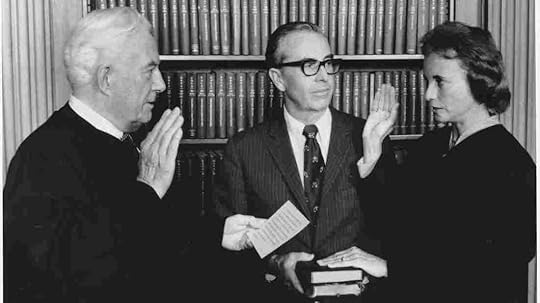
Sandra Day O'Connor is sworn in as an associate justice by Chief Justice Warren Burger on Sept. 25, 1981. Holding two family Bibles is husband John Jay ...
Mod

Mrs. Burger, Warren E. Burger (the President's nominee for Chief Justice of the U.S. Supreme Court) and President Nixon at the announcement of Burger's nomination.
Date: May 21, 1969
Roll-Frame number: WHPO 1117-08A
Mod
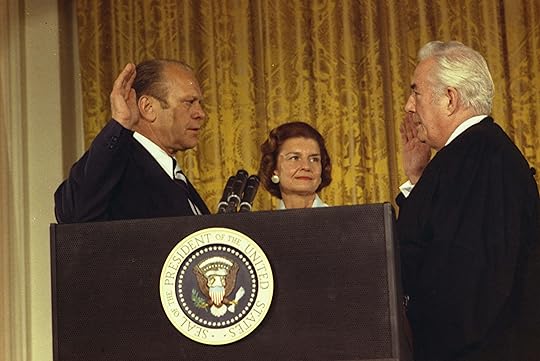
The swearing in of President Gerald Ford by Supreme Court Chief Justice Warren Burger
 Mod
Mod
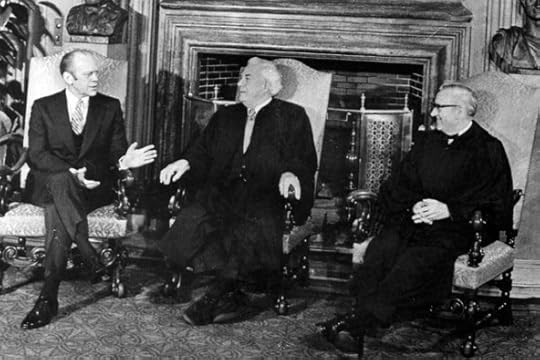
Gerald Ford, Warren Burger, and John Paul Stevens
Mod
 Mod
Mod

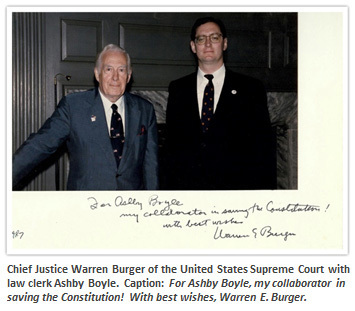 Mod
Mod
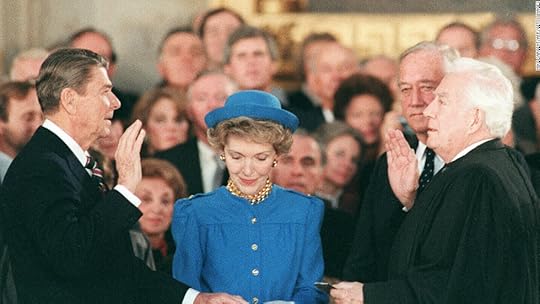
Ronald Reagan is sworn in on January 21, 1985, at the U.S. Capitol for his second term by Supreme Court Chief Justice Warren Burger.
Mod
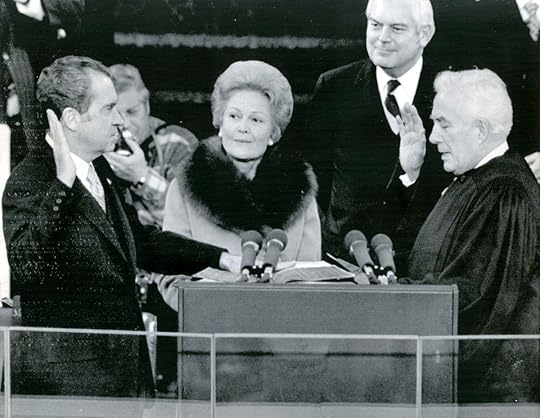
January 20, 1973 — President Richard M. Nixon takes the oath of office today from Chief Justice Warren E. Burger for the President's second term.
Mod
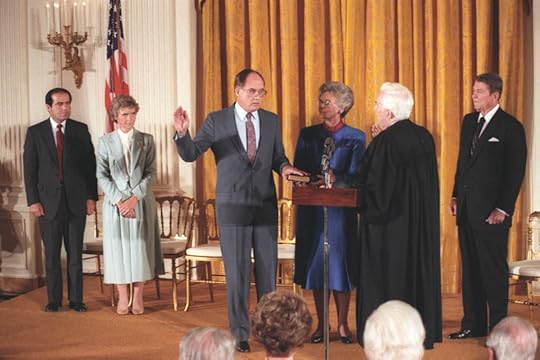
William Rehnquist (left) takes the oath as Chief Justice from retiring Warren Burger at the White House in 1986, as his wife, Natalie, holds a Bible, President Ronald Reagan and Justice Antonin Scalia look on
Mod
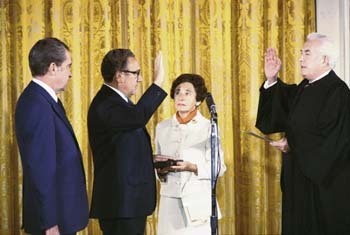
Chief Justice Warren Burger swears Henry Kissinger in as Secretary of State as President Nixon looks on. East Room, White House.
Date: September 22, 1973
Roll-Frame number: WHPO E1518c-06
Mod
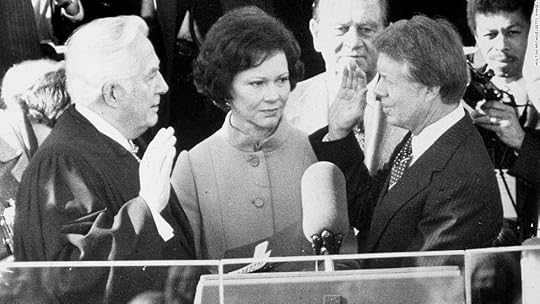
Chief Justice Warren Burger swears Jimmy Carter into office on January 20, 1977, while Rosalynn looks on
Mod
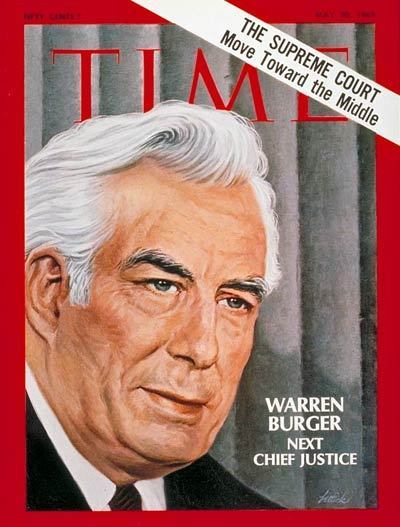
TIME Magazine Cover: Warren Burger -- May 30, 1969
 Imprisoned by the Past: Warren McCleskey and the American Death Penalty
 by Jeffrey L Kirchmeier(no photo)
Synopsis:
Imprisoned by the Past: Warren McCleskey and the American Death Penaltyconnects the history of the American death penalty to the case of Warren McCleskey. By highlighting the relation between American history and an individual case, Imprisoned by the Past provides a unique understanding of the big picture of capital punishment in the context of a compelling human story.
McCleskey's criminal law case resulted in one of the most important Supreme Court cases in U.S. legal history, where the Court confronted evidence of racial discrimination in the administration of capital punishment. The case marks the last that the Supreme Court realistically might have held that capital punishment violates the Eighth Amendment of the U.S. Constitution.
As such, the constitutional law case also created a turning point in the death penalty debate in the country. The book connects McCleskey's case -- as well as his life and crime -- to the issues that have haunted the American death penalty debate since the first executions by early settlers and that still affect the legal system today.
Imprisoned by the Past ties together three unique American stories in U.S history.
First, the book considers the changing American death penalty across centuries where drastic changes have occurred in the last fifty years.
Second, the book discusses the role that race played in that history. And third, the book tells the story of Warren McCleskey and how his life and legal case brought together the other two narratives.
Mod
 Historical Dictionary of the U.S. Supreme Court
 by
by
 Artemus Ward
Synopsis:
The U.S. Supreme Court is an institution that operates almost totally behind closed doors. This book opens those doors by providing a comprehensive look at the justices, procedures, cases, and issues over the institution s more than 200-year history. The Court is a legal institution born from a highly politicized process. Modern justices time their departures to coincide with favorable administrations and the confirmation process has become a highly-charged political spectacle played out on television and in the national press. Throughout its history, the Court has been at the center of the most important issues facing the nation: federalism, separation of powers, war, slavery, civil rights, and civil liberties. Through it all, the Court has generally, though not always, reflected the broad views of the American people as the justices decide the most vexing issues of the day. The Historical Dictionary of the U.S. Supreme Court covers its history through a chronology, an introductory essay, appendixes, and an extensive bibliography. The dictionary section has over 700 cross-referenced entries on every justice, major case, issue, and process that comprises the Court s work This book is an excellent access point for students, researchers, and anyone wanting to know more about the Supreme Court."

The History Book Club
Books mentioned in this topic
Eisenhower vs. Warren: The Battle for Civil Rights and Liberties (other topics)The Chief Justiceship of Warren Burger, 1969-1986 (other topics)
The Chief Justiceship of Warren Burger, 1969-1986 (other topics)
The Chief Justiceship of Warren Burger, 1969-1986 (other topics)
Historical Dictionary of the U.S. Supreme Court (other topics)
More...
Authors mentioned in this topic
James F. Simon (other topics)Earl M. Maltz (other topics)
Earl M. Maltz (other topics)
Earl M. Maltz (other topics)
Artemus Ward (other topics)
More...

Biography:
Warren Earl Burger was born in St. Paul Minnesota. In a family of seven children, Burger earned his way through college and law school. He engaged in private legal practice for more than twenty years, but during this period he became active in state Republican Party matters. He worked in the Justice Department under President Eisenhower, who nominated Burger in 1956 to the United States Court of Appeals for the District of Columbia Circuit.
Burger was named by President Richard Nixon in 1969 to replace Earl Warren as Chief Justice. Burger was a strong advocate of "strict construction" to the interpretation of the Constitution. He identified with the Court's conservative wing and frequently voted to limit the liberal decisions of the Warren period. Burger was not one-dimensional. He authored the Court's opinion upholding the right of trial judges to order busing as a remedy for school segregation and he spoke for a unanimous Court upholding a subpeona for the Watergate tapes which resulted in President Nixon's resignation.
Personal Information
Born: Tuesday, September 17, 1907
Died: Sunday, June 25, 1995
Childhood Location: Minnesota
Position:
Chief Justice
Seat: 1
Nominated By: Nixon
Commissioned on: Sunday, June 22, 1969
Sworn In: Sunday, June 22, 1969
Left Office: Thursday, September 25, 1986
Reason For Leaving: Retired
Length of Service: 17 years, 3 months, 3 days
Home: Virginia
source: http://oyez.org/justices/warren_e_burger