
Homework Study Helpers! =P discussion
Science
>
Biology
date newest »
newest »
message 1:
by
Hanna[h], ))DORK((
(new)
Apr 22, 2011 10:57PM
![Hanna[h] Cumberbatch (andthetheyburiedmemummble) | 805 comments](https://images.gr-assets.com/users/1403470362p1/4536256.jpg) Mod
Mod
reply
|
flag
 Uhm Kind of Panicking on my Biology Final next week...
So please help on EVERYTHING!
Okay I should be more specific:
What I really don't understand at all (I probably need help beyond this but this list is long enough? lol) :
Operons
Protein Structure (Primary, Secondary, Tertiary and Quaternary)
Cell Signalling
Monocot vs. Dicot
Plant Structure
Plant Hormones
Apical Dominance
Membrane Proteins/Functions
Chemiosmosis
Photosynthesis in CAM and C4 plants
Viruses
Virus Reproduction
A million other things...
With eternal gratitude,
Eirian
 I'll help! It'll take me a while to type all this out though lol
Thank you so much *hugs* <3 Biology just has been uhm murderous this year :S
I took Bio last year so I'll try to help! (If only I had my Bio book with me! DX)
I'll help! It'll take me a while to type all this out though lol
Thank you so much *hugs* <3 Biology just has been uhm murderous this year :S
I took Bio last year so I'll try to help! (If only I had my Bio book with me! DX)PART ONE:
Operons- This is how my dictionary defines them:
 set of genes: in bacteria, a segment of a chromosome containing the genes that specify the
 structure of a given protein, alongside the genes that regulate its manufacture.
Operons are relatively simple units of genetic control and are found only in bacteria.
Protein Structure (photo with info)-
http://www.umass.edu/molvis/workshop/...
Cell Signaling:
"Cell signaling is part of a complex system of communication that governs basic cellular activities and coordinates cell actions" -Wikipedia
There's a lot about cell signaling, anything specific you need to know?
Monocot vs. Dicot
(Remember that Mono means "one" and Di means "two")
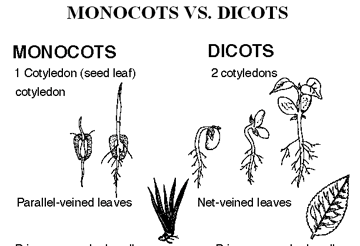
plant structure:


Plant Hormones-
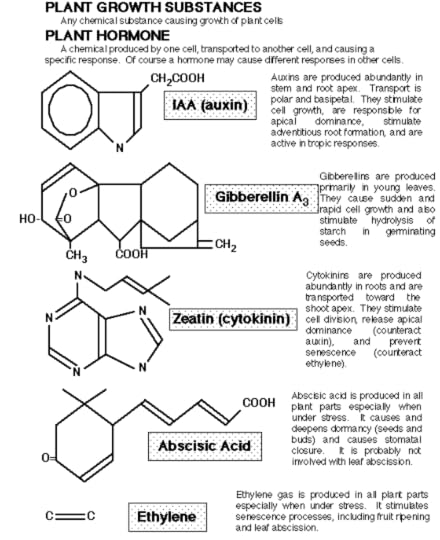 Will continue...(i hope the pictures help, pictures always help me lol)
PART TWO:
Will continue...(i hope the pictures help, pictures always help me lol)
PART TWO:Apical Dominance-
I tried explaining it and failed, but I found someone who explains it better:
"Apical dominance goes like this.
Imagine the growing tip of a branch on a tree. At that very tip is a bud. In that bud is a protected APICAL MERISTEM, where cells actively divide producing new tissue. In this region the plant hormone AUXIN is localized. The presence of auxin HERE and not in the 'axillary' or 'auxilliary' buds below this growing tip bud, renders those buds dormant. They do not actively grow.
If you were to remove that growing tip, with all it's AUXIN, it would remove the "no-grow" lock on those axilllary buds. Auxin would then flow to THOSE buds. The buds would then "wake up" and grow."
ahh im sorry I have to go! I'll finish this tomorrow! I hope what I've given you so far has helped!
Thanks so much =) The pictures definitely help ^.^ My book makes it so confusing x.X
What's the difference between an Inducer and Repressor in Operons? The only thing I remember is that Tryptophan is a reducing operon found in e.coli lmao O_o and that Operons regulate RNA synthesis. Not sure about the differences or how they control the production of RNA
Thanks for the pictures to allow even my idiot self to see :p
 Oh man soo cool! Girl your theorys are gonna help me ace my test!!!
we're doing alleles and codominant and incomplete dominant traits.. i have a project to do on that :P
Independent is what you can change. (( Idependent ))
Dependent is what changes because of that.
Does that make any sense?
Dependent is what changes because of that.
Does that make any sense?

 Scarlet wrote: "PART TWO:
Apical Dominance-
I tried explaining it and failed, but I found someone who explains it better:
"Apical dominance goes like this.
Imagine the growing tip of a branch on a tree. At..."
I was needing explanation bout auxins too! LOL
 Abby wrote: "What is the Rh Factor?"
substance in red blood cells: a group of antibody-producing substances antigens present in most people's red blood cells.
Rh compatibility is important in matching blood for transfusions and between pregnant women and their fetuses.

 Abby wrote: "What is the Rh Factor?"
on red blood cells, there's these antigens (came from immune system to fight foreign substances) that adhered to the cellular membrane. Rh factors is inheritable.
Its important in cases where mother is Rh- while the second child (or rest) is Rh+. Within the fetal circulation, there's an exchange between mother and fetus's blood. When fetal blood enters mother's circulation, the mother's immune system didn't recognize this Rh antigen and start producing antibodies against this antigens. Usually, the antibodies gave clinical effects on second child (if the first child is Rh+). In clincal condition, the antibodies enter fetal circulation and starts attacking fetal blood cells leaving it hemolysed and cause jaundice and liver/renal failure. Its commonly known as Hemolytic Disease of Newborn, because during child birth, some of mother's blood tend to leak into amnion fluid and enter circulation.
source : my memory... and I have a degree in biomedicine and just recently got A in "Advance Hematology and Transfusion Meds" and the Wikipedia explanation is too complicated for a rather easy question.
Eirian wrote: "Thanks so much =) The pictures definitely help ^.^ My book makes it so confusing x.X
What's the difference between an Inducer and Repressor in Operons? The only thing I remember is that Tryptoph..."
hmm.. I cant remmeber mol.bio much but I'll try
Repressor is an inhibitor. Some genes continuously expressing the genes, and an inhibitor block operator gene from RNA polymerase binding. Hence no gene transcription
Inducer basically started the gene transcription. There's types of inducers (read below) and depends on what kind of operons you are learning. Wiki-able
there's :positive/negative/inducible/repressible operons... that refer to wiki
