
The History Book Club discussion
SPORTS HISTORY/ HOBBIES/GAMES
>
CRICKET
date newest »
newest »
message 1:
by
Bentley, Group Founder, Leader, Chief
(new)
May 04, 2011 07:39PM
 Mod
Mod
reply
|
flag
 I have these two books to read and have heard good things about both.
  by John Major
 by Derek Birley
Sir John Major's charts the history of the game from its earliest days to the outbreak of World War One, whereas John Birley's covers areas a such as the industrial revolution, relationships between upper and working classes, the development of one day cricket and of course even the weather .

 Thanks Marren. Cricket has quite a history and is very facinating, yet I know little about it. Thanks for the suggestions and proper posting.
 It is a great sport, although I have been watching less of it,lately (shame on me). I would love to read more on the game. I added the first book Geevee suggested to my To Read List, the summary sparked an interest.
Mod
It is a great sport, although I have been watching less of it,lately (shame on me). I would love to read more on the game. I added the first book Geevee suggested to my To Read List, the summary sparked an interest.
Mod
I guess we are an impatient lot. (smile)
You get a winner after one day if it is a One Day match or a T20( 20 overs are bowled in that game). The One Day and T20 are popular for some, whilst others rather the Test Matches. The Test Matches in my opinion shows the endurance of a player. Imagine batting all day in blazing heat or cold weather.
Mod
haha, lol. You are a sport Bentley, haha
Mod
I once briefly watched the locals in Saint Lucia playing cricket on an old field that was not manicured, yet they were all having a great time. They had very good movement and hand-eye coordination.
Mod
:) yes Mark,cricket is enjoyed here regardless of the conditions.Yes Stamina as well Bentley. I no longer think cricket is a gentleman's game. I may be in a minority in that opinion. I believe the termed was widely used when the game gained popularity in Britain and the West Indies. In the West Indies, at first only gentlemen played the game. They owned the plantations, they did not work (well not manually) therefore they were called gentlemen. Since they introduced the game, it was called the gentleman's game.
Mod
"There are quite a few common expressions in English derivied from Cricket; the greatest game invented by man.
1. To bowl over. To be astonished, greatly surprised and excited, left speechless. I saw the Stones live in concert last month and I was bowled over by their performance. In cricket: You bowl (throw) the ball at the wicket (sticks) if you hit them the batsman must leave the field.
2. To hit for six. To be deeply shocked or hurt (by someone/thing). When my wife left me it really hit me for six . In cricket: To hit the ball over the boundary without it bouncing on the ground (which gets six runs (points).
3. A sticky wicket. A difficult situation. "We only have £20 to last us 'til the end of the month", "Yes, it's a sticky wicket". In cricket: The wicket area (ground in front of the stumps) has become sticky due to rain making in difficult to play on.
4. It's not cricket. To play unfairly or against the rules of fair play (cricket has a reputation as a gentlemen's game played by honest people). "In order to get the job he lied about his experience and criticised the other candidates,"
"Yes, it's not cricket"
5. To stump (to be stumped). To have no idea, to be confronted by a problem you can't find the solution to. The exam was going well until they asked me a question about the Russian Revolution and I was completely stumped. In cricket: To remove the bails in a game meaning the batsman is out (has to leave the game).
6. A good innings. For a batsman, depends on how many runs they make (and in what fashion) during a particular stay at the crease. But the term can be applied to life in general: someone who has had a long, fulfilling life can be described as having had "a good innings".
7. Plays with a straight bat. Someone who can be trusted. In cricket, usually a careful defensive shot not meant to score runs but to avoid making a mistake.
8. Safe pair of hands. Someone who is reliable and can be depended on. In cricket a fielder unlikey to miss or drop a catch.
9. Bowled a googly. To be exposed to the unexpected usually in an interview or conversation. In cricket, a googly is a type of delivery bowled by a right-arm leg spin bowler. While a normal leg break spins from the leg to the off side, away from a right-handed batsman, a googly spins the other way, from off to leg, into a right-handed batsman (and is distinct from an off break delivery).
10. Caught out -Discovered doing or having done something wrong. When a fielder catches a batted ball before it touches the ground the batsman is 'caught out'.
Source: http://www.thegearpage.net/board/inde...
That is an interesting read Bentley. One of the beauties of cricket,is it's vocabulary. I still do not understand some terms in the game, I usually bug my brother to explain.
Mod
What part of the world are you from Marren? Curious as to the cricket influence.
Mod
Marren wrote: "St.Lucia, West Indies."I posted a reply pertaining to St. Lucia on the History Club thread “Coffee, Tea and Conversation: The History of Where You Live”
http://www.goodreads.com/topic/show/6...
As I read a biography of George Washington, I found it interesting that during the Revolutionary War the general found a moment to take a break and play cricket.“Washington even played cricket with younger officers.” (pg. 336) by
by
 Ron Chernow
In the early days of cricket in the Americas, America did whoop West Indies butt in one test game that I can remember. I found that interesting since cricket died in on the continent but flourish in the islands. It is only now that some people are trying to spread the game in Florida.
Ron Chernow
In the early days of cricket in the Americas, America did whoop West Indies butt in one test game that I can remember. I found that interesting since cricket died in on the continent but flourish in the islands. It is only now that some people are trying to spread the game in Florida.
 by Hilary McD. Beckles (no photo)
 by Hilary McD. Beckles (no photo)
(no image)A History Of West Indies Cricket by Michael Manley (no photo)
Mod
It is odd how then with the British influence of the founding fathers - that cricket was popular in the US - probably as much as in England but as time when on - not as much. But in any country where the English had established a presence - cricket is thriving.
Thank you so much Marren for the citations and a wonderful job on them indeed.
My understanding is whenever the British colonized they came with their customs: sports, religion, governance etc hence the establishment of cricket. However when America fought for their independence they were determine to get rid of every British influence to create their own. Cricket had to go, replaced with baseball.One of the difference between USA and mostly all other British Colonies is that USA fought for their independence but the others were granted it, like a gift. The colonies were therefore more passive to British customs. For example, in the Caribbean our law structure is still modelled after Britain. Our courts and parliament as well. It is only recently that the plea to establish our own Appeal Court came into being, however not more than 5 countries signed the agreement.
Mod
Mod
http://en.wikipedia.org/wiki/History_...
http://en.wikipedia.org/wiki/Cricket_...
From the Smithsonian - good article:
http://www.smithsonianmag.com/people-...
Walter Newhall - International Cricketer - died in Civil War
http://www.espncricinfo.com/cricketer...
Journal of Sport History:
http://library.la84.org/SportsLibrary...
American Cricket in the 1860s: Decade of Decline or New Start?
http://ourgame.mlblogs.com/2012/09/04...
I think that cricket was a casualty of the Civil War.
Bats, Balls and Bullets
http://opinionator.blogs.nytimes.com/...
Patriot game
The England batsman and author on how cricket, once so popular in America, was squeezed out by baseball.
by Ed Smith
The Observer, Saturday 2 July 2005
http://www.theguardian.com/sport/2005...
 For some time now, I have been trying to understand cricket, it's rules and scoring system.
I have dropped a fortune in Indian restaurants to get one-on-one tutoring from the waiters with a match on in the background, but do not feel I have even a rudimentary handle on the basics.
Can someone make a recommendation of a book, or even better an online resource(s)?
Mod
 by Julian Knight (no photo)
http://justinelarbalestier.com/blog/2...
Youtube:
https://www.youtube.com/watch?v=hEbOL...
From Cricket America: (Scoring)
https://www.youtube.com/watch?v=QK6OA...
Same source - Batting
https://www.youtube.com/watch?v=JipHE...
Same source - Bowling
https://www.youtube.com/watch?v=Anw6E...
Same source: Fielding
https://www.youtube.com/watch?v=8biIO...
Same source: Wicket Keeping
https://www.youtube.com/watch?v=lCDD6...
Same Source: Catching
https://www.youtube.com/watch?v=nM5Mj...
Bleacher Report (India)
http://bleacherreport.com/articles/86...
Top 10 Cricket Books:
http://www.theguardian.com/books/2012...
More:
 by
by
 C.L.R. James
 by Marcus Berkmann (no photo)
 by
by
 Lawrence Booth
 by
by
 Mike Marqusee
 by Gideon Haigh (no photo)
This book is not showing up in Goodreads: (no book, no photo, no author's link)
Essaying Cricket: Sri Lanka and Beyond by Michael Roberts
Searched the ISBN number as well.
(no image) The Art Of Cricket by Don Bradman (no photo)
 by Simon Barnes (no photo)
 by Simon Hughes (no photo)
 by David Frith (no photo)
 by
by
 Imran Khan
 Mod
Mod
 by
by
 Dan Waddell
Synopsis:
Adolf Hitler despised cricket, considering it un-German and decadent. And Berlin in 1937 was not a time to be going against the Fuhrer's wishes. But hot on the heels of the 1936 Olympics, an enterprising cricket fanatic of enormous bravery, Felix Menzel, somehow persuaded his Nazi leaders to invite an English team to play his motley band of part-timers.
That team was the Gentlemen of Worcestershire, an ill-matched group of mavericks, minor nobility, ex-county cricketers, rich businessmen and callow schoolboys - led by former Worcestershire CC skipper Major Maurice Jewell. Ordered 'not to lose' by the MCC, Jewell and his men entered the 'Garden of Beasts' to play two unofficial Test matches against Germany.
Against a backdrop of repression, brutality and sporadic gunfire, the Gents battled searing August heat, matting pitches, the skill and cunning of Menzel, and opponents who didn't always adhere to the laws and spirit of the game. The tour culminated in a match at the very stadium which a year before had witnessed one of sport's greatest spectacles and a sinister public display of Nazi might.
Despite the shadow cast by the cataclysmic conflict that was shortly to engulf them, Dan Waddell's vivid and detailed account of the Gentlemen of Worcestershire's 1937 Berlin tour is a story of triumph: of civility over barbarity, of passion over indifference and hope over despair.
 W.G.Grace is the man when mentioning the history of cricket. Here is a short bio from Wikipedia
______________________________________________________
William Gilbert "W. G." Grace, MRCS, LRCP (18 July 1848 – 23 October 1915) was an English amateur cricketer who was important in the development of the sport and is widely considered one of its greatest-ever players. Universally known as "W. G.", he played first-class cricket for a record-equalling 44 seasons, from 1865 to 1908, during which he captained England, Gloucestershire, the Gentlemen, Marylebone Cricket Club (MCC), the United South of England Eleven (USEE) and several other teams. He came from a cricketing family: the appearance in 1880 of W. G. with E. M. Grace, one of his elder brothers, and Fred Grace, his younger brother, was the first time three brothers played together in Test cricket.
Right-handed as both batsman and bowler, Grace dominated the sport during his career. His technical innovations and enormous influence left a lasting legacy. An outstanding all-rounder, he excelled at all the essential skills of batting, bowling and fielding, but it is for his batting that he is most renowned. He is held to have invented modern batsmanship. Usually opening the innings, he was particularly admired for his mastery of all strokes, and his level of expertise was said by contemporary reviewers to be unique. He generally captained the teams he played for at all levels because of his skill and tactical acumen.
Grace qualified as a medical practitioner in 1879. Because of his medical profession, he was nominally an amateur cricketer but he is said to have made more money from his cricketing activities than any professional cricketer. He was an extremely competitive player and, although he was one of the most famous men in England, he was also one of the most controversial on account of his gamesmanship and moneymaking.
He took part in other sports also: he was a champion 440-yard hurdler as a young man and also played football for the Wanderers. In later life, he developed enthusiasm for golf, lawn bowls and curling.
This entry is a part of the glossary for the Raj Quartet group read....but for those of you who aren't involved in particular book read, I am putting this here for your information.Cricket
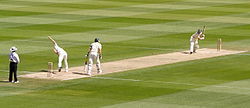
Cricket is a bat-and-ball game played between two teams of 11 players each on a field at the centre of which is a rectangular 22-yard long pitch. Each team takes its turn to bat, attempting to score runs, while the other team fields. Each turn is known as an innings.
The bowler delivers the ball to the batsman who attempts to hit the ball with his bat away from the fielders so he can run to the other end of the pitch and score a run. Each batsman continues batting until he is out. The batting team continues batting until ten batsmen are out, or a specified number of overs of six balls have been bowled, at which point the teams switch roles and the fielding team comes in to bat.
In professional cricket the length of a game ranges from 20 overs per side to Test cricket played over five days. The Laws of Cricket are maintained by the International Cricket Council (ICC) and the Marylebone Cricket Club (MCC) with additional Standard Playing Conditions for Test matches and One Day Internationals.
Cricket was first played in southern England in the 16th century. By the end of the 18th century, it had developed to be the national sport of England. The expansion of the British Empire led to cricket being played overseas and by the mid-19th century the first international match was held. ICC, the game's governing body, has 10 full members. The game is most popular in Australasia, England, the Indian subcontinent, the West Indies and Southern Africa. (Source: http://en.wikipedia.org/wiki/Cricket)
More:
http://sports.espn.go.com/espn/eticke...
http://www.smithsonianmag.com/ist/?ne...
http://www.youtube.com/watch?v=fzqh6_...
http://www.cricket-rules.com/
http://www.lords.org/mcc/laws-of-cric...
http://news.bbc.co.uk/sportacademy/hi...
 by William McInnes (no photo)
 by Simon Hughes(no photo)
 by Jeff Fletcher (no photo)
by Marcus Berkmann(no photo)
by Jeff Fletcher (no photo)
by Marcus Berkmann(no photo) by
by
 Ramachandra Guha
 by
by
 Neville Cardus
Cricket
Neville Cardus
CricketCricket is a bat-and-ball game played between two teams of 11 players each on a field at the centre of which is a rectangular 22-yard long pitch. Each team takes its turn to bat, attempting to score runs, while the other team fields. Each turn is known as an innings.
The bowler delivers the ball to the batsman who attempts to hit the ball with his bat away from the fielders so he can run to the other end of the pitch and score a run. Each batsman continues batting until he is out. The batting team continues batting until ten batsmen are out, or a specified number of overs of six balls have been bowled, at which point the teams switch roles and the fielding team comes in to bat.
In professional cricket the length of a game ranges from 20 overs per side to Test cricket played over five days. The Laws of Cricket are maintained by the International Cricket Council (ICC) and the Marylebone Cricket Club (MCC) with additional Standard Playing Conditions for Test matches and One Day Internationals.
Cricket was first played in southern England in the 16th century. By the end of the 18th century, it had developed to be the national sport of England. The expansion of the British Empire led to cricket being played overseas and by the mid-19th century the first international match was held. ICC, the game's governing body, has 10 full members. The game is most popular in Australasia, England, the Indian subcontinent, the West Indies and Southern Africa. (Source: http://en.wikipedia.org/wiki/Cricket)
Mod
 by Christopher Sandford (no photo)
Synopsis:
August 1914 brought an end to the 'Golden Age' of English cricket. At least 210 professional cricketers (out of a total of 278 registered) signed up to fight, of whom thirty-four were killed. However, that period and those men were far more than merely statistics: here we follow in intimate detail not only the cricketers of that fateful last summer before the war, but also the simple pleasures and daily struggles of their family lives and the whole fabric of English social life as it existed on the eve of that cataclysm: the First World War.
With unprecedented access to personal and war diaries, and other papers, Sandford expertly recounts the stories of such greats as Hon. Lionel Tennyson, as he moves virtually overnight from the round of Chelsea and Mayfair parties into the front line at the Marne; the violin-playing bowler Colin Blythe, who asked to be moved up to a front-line unit at Passchendaele, following the death in action of his brother, with tragic consequences; and the widely popular Hampshire amateur player Robert Jesson, whose sometimes comic, frequently horrific and always enthralling experiences of the ill-fated Gallipoli campaign are vividly brought to life. The Final Over is undoubtedly a gripping, moving and fully human account of this most poignant summer of the twentieth century, both on and off the field of play.
Mod
 by
by
 Gideon Haigh
Synopsis:
It is arguably the most famous photograph in the history of cricket. In George Beldam's picture, Victor Trumper is caught in mid stroke, the personification of cricketing grace, skill and power, about to hit the ball long and hard. Yet this image, 'Jumping Out', is important not only because of who it depicts, but also what it illustrates about the changing nature of the game and how it has been seen.
Now, in Gideon Haigh's brilliant new book, Stroke of Genius , we learn not only about the man in the picture but also the iconography of Trumper's powerful position in cricket's mythology. For many, Australian batsman Trumper was the greatest ever. Neville Cardus wrote: 'I have never yet met a cricketer who, having seen and played with Victor Trumper, did not describe him without doubt or hesitation as the most accomplished of all batsmen of his acquaintance.' Like Lionel Messi or Roger Federer today, he defied the obvious bounds of affiliation. Unlike the current generation of sporting stars, however, there were no memoirs or papers, very few interviews, no action footage - even his date of birth is a matter of debate and conjecture. What isn't in doubt, though, is the impact he had on the game and on his nation. Haigh reveals how Trumper, and 'Jumping Out', helped to change cricket from the Victorian era of static imagery to something much more dynamic, modern and compelling. As such, Trumper helped not only transform cricket but even the way his country viewed itself.
Thanks, Jerome. I don't understand the rules of cricket and the terms used. I have read them and they still are a mystery to me.
 Playing It My Way: My Autobiography
  by
by
 Sachin Tendulkar
This is an autobiography of perhaps the greatest cricketer in the history of cricket. Sachin Tendulkar, also referred as 'the god of cricket' holds the most records in the game. Born to a middle class family in Mumbai, Sachin spend his childhood playing cricket on the iconic 'Shivaji Park' in Mumbai
Sachin Tendulkar made his Test debut in Pakistan at the age of 16 in 1989. His career spanned around 25 years and he made his footprint in 4 different decades. One of the most gifted and entertaining batsmen to have played international cricket, he scored more runs and made more centuries than any other player in history - in both Tests and ODIs. He made his international debut at the tender age of 16. Standing at just 5'5 he faced super fast Pakistani bowlers in his first match and made his first Test century at the age of 17, at the age of 36 he became the first player to make a one-day double century and in 2012 he scored his 100th international hundred. With India he won the World Cup in 2011 and reached the top of the world Test rankings in the same year. In 2013, he retired from cricket after playing his 200th and final Test in front of his home crowd in Mumbai.
At the height of his career, he was the most loved person in the country and perhaps more famous than the PM of India. He is to cricket what Michael Jordan is to basketball, Schumacher to Racing, Undertaker to WWE and Federer to Tennis. One of the very few sportspersons to have a quarter century of a career without any controversies.Even though he has retired, for most Indians its still "Cricket is our religion and Sachin is our god"
Mod
Mod
Here is an excerpt from an interview on FiveBooks which discussed this book - Nigel Warburton interviews Philosophy professor and sports enthusiast - David Papineau.
Why would somebody have a hopping race then, because most people have got two legs, and can run. Why would you have a hopping race ever?
"A hopping race is an interesting case. Let me say what I think is of value in sport, and that will then put Suits’s idea of games in context. I don’t know anything about Suits personally, but reading the book, you certainly get an impression of somebody who’s never hit a sweet cover drive, or hit a backhand crosscourt, or driven a golf ball 250 yards.
There’s no sense in the book anywhere of the pride, pleasure, enjoyment, and value, that people get out of the exercise of physical skills.
My view is that what’s valuable about sports is nothing to do with games, and nothing to do with overcoming arbitrary obstacles: it’s the enjoyment and value that people get out of the exercise of physical skills.
You can get a pretty good definition of ‘sport’ by saying it’s any activity, the primary purpose of which is to allow the exercise of physical skills.
The nature of sport is the exercise of physical skills, and the value of sport is just the value that human beings find in that. I think this goes very deep in human nature – developing, exercising, extending physical skills, and displaying them.
“Wittgenstein said the concept of a ‘game’ was indefinable.”
Not all sports are games, and not all games are sports. Suits seems to think you can just characterise sports as that sub-class of games that involves physical activity. In fact, when you think of sport in the way I’ve just defined it, then it becomes clear that there are quite a lot of sports that really aren’t games at all.
While I believe Suits gives a good analysis of games, in the book he tries to extend his analysis to cover sports like rowing, sprinting, boxing, and windsurfing, which just aren’t games at all. They’re sports in my sense, they’re activities that allow the exercise of physical skills.
Suits should never have started trying to make them games. They don’t fit his definition very well. He should have recognised that some sports fall outside of his definition of games, but then he would have had to acknowledge that sports have a value that doesn’t consist in their being games.
Some sports are games—tennis is a game, cricket is a game—and the skills that you exercise in the context of those games wouldn’t really exist outside the games: there wouldn’t be any crosscourt backhands if there wasn’t tennis.
But what makes hitting a crosscourt backhand valuable is that it’s a physical skill that you can take pride in, and not that it’s part of a game, that’s incidental to what makes it valuable.
If you look at the overall range of games, the thing I’ve just said about games and sports applies to other games as well: many games don’t involve physical skills, but involve intellectual skills—think of bridge, chess, and so on—and people enjoy and find value in those activities not because they involve overcoming arbitrary obstacles, but because they allow the exercise of intellectual skills, which are things to take pride in, things that are important. Then there are games that are valuable because they engender a certain kind of excitement, like gambling games.
That’s what makes them valuable, again, not because they are the arbitrary overcoming of obstacles, but because they give rise to something which independently has value, namely the excitement, absorption, and so on. I want to say about games in general that the games that have value, if they have value, have value for some other reason than the one that Suits focuses on.
More:
https://fivebooks.com/best-books/davi...
Source: FiveBooks
Mod
 by Bernard Suits (no photo)
Synopsis:
In the mid twentieth century the philosopher Ludwig Wittgenstein famously asserted that games are indefinable; there are no common threads that link them all.
"Nonsense," says the sensible Bernard Suits: "playing a game is a voluntary attempt to overcome unnecessary obstacles."
The short book Suits wrote demonstrating precisely that is as playful as it is insightful, as stimulating as it is delightful. Suits not only argues that games can be meaningfully defined; he also suggests that playing games is a central part of the ideal of human existence, so games belong at the heart of any vision of Utopia.
Originally published in 1978, The Grasshopper is now re-issued with a new introduction by Thomas Hurka and with additional material (much of it previously unpublished) by the author, in which he expands on the ideas put forward in The Grasshopper and answers some questions that have been raised by critics.
Review:
Here is an excerpt from an interview on FiveBooks which discussed this book - Nigel Warburton interviews Philosophy professor and sports enthusiast - David Papineau.
"Now, let’s go to the first of your book choices, Bernard Suits’s The Grasshopper which, for a long time, was a very-little-known classic, and now it’s probably just a little-known classic.
My first choice is a book about the nature and value of sport. I wanted to look at this via Suits because his is probably the best-known full-length work in this area. It’s a wonderfully engaging, eccentric, ingenious book, which has a terrific idea in it, but I think it’s completely wrongheaded about the nature and value of sport.
So I’ll start by explaining the good idea, and then explain why I think it’s not as helpful for understanding sport as many of its enthusiasts suggest.
The book is a quasi-Socratic dialogue with the grasshopper as the main character, and the grasshopper’s idea is that the highest virtue is playing, that he is going to spend all his time playing, doesn’t care if he dies, and the overall argument of the book is that in utopia, where humans have all their material needs satisfied at the push of a button, what we would do would be play games, and therefore playing games is the ideal of human activity.
Freed from all the necessities of having to do things we don’t want to do in order to get the material means of life, we’d do nothing but play games. That’s the main thesis."
More:
https://fivebooks.com/best-books/davi...
Source: FiveBooks
Mod
 by Peter Oborne (no photo)
Synopsis:
Peter Oborne's outstanding biography of Basil D'Oliveira is the story of how a black South African defied incredible odds and came to play cricket for England, of how a single man escaped from apartheid and came to fulfil his prodigious sporting potential.
It is a story of the conquest of racial prejudice, both in South Africa and in the heart of the English sporting establishment.
The story comes to its climax in the so-called D'Oliveira Affair of 1968, when John Vorster, the South African Prime Minister, banned the touring MCC side because of the inclusion of a black man. This episode marked the start of the twenty-year sporting isolation of South Africa that ended only with the collapse of apartheid itself.
Award:
William Hill Sports Book of the Year (2004)
Review:
In an interview and review by David Papineau, a philosophy professor and sports enthusiast for Five Books.
Let’s move from empirical, statistics-based analysis of sport, to a personal story which had a really serious political background to it, and implications for many people. Your fourth book is a biography of the cricketer Basil D’Oliveira.
It’s partly biography, but it also focuses, in the second half of the book, on the wider issues in, and background to, the D’Oliveira affair in 1968.
I wanted to include something about race and sport. I thought of Beyond a Boundary by C. L. R. James, a great West Indian writer and activist. It’s a memoir, it’s focused a lot on his life in the West Indies, in Trinidad, in the 1920s, and then going to Lancashire with Learie Constantine in the early 1930s. That’s very interesting and illuminating about overturning the white domination of cricket in the West Indies.
But it’s all so long ago, and it’s a bit quaint and almost Edwardian, the colonies and imitation-public schools. I decided to go for D’Oliveira instead because that’s more recent, it’s certainly in my memory.
It’s surprising to look back now and see how much racism there was in sport.
Did you know that New Zealand sent a segregated rugby team to South Africa in 1960? In 1960, New Zealanders were still prepared to leave the Maoris out of their rugby team in order to play rugby against South Africa. It’s quite hard to believe.
More:
https://fivebooks.com/best-books/davi...
Source: FiveBooks
Mod
by
C.L.R. JamesSynopsis:
C L R James, one of the foremost thinkers of the twentieth century, was devoted to the game of cricket. In this classic summation of half a lifetime spent playing, watching and writing about the sport, he recounts the story of his overriding passion and tells us of the players whom he knew and loved, exploring the game's psychology and aesthetics, and the issues of class, race and politics that surround it.
Part memoir of a West Indian boyhood, part passionate celebration and defence of cricket as an art form, part indictment of colonialism, Beyond a Boundary addresses not just a sport but a whole culture and asks the question, 'What do they know of cricket who only cricket know?
Mod
Please keep posting about cricket and add more information but not the links to your blog. Please also add interesting books about cricket as well that our members might enjoy.
I have reposted your post minus those links.
Ronan posted:
The history of United States cricket begins in the 18th century. Among early Americans, cricket was as popular a bat and ball game as baseball. Though Americans generally never played cricket in great numbers, it did enjoy an initial period of sustained growth. Around the time of the United States Civil War, the game began competing with baseball for participants, but then slowly declined in popularity. This was followed again by a brief golden age with the Philadelphian cricket team. This lasted until roughly the start of World War I, at this time cricket again became less popular. In the latter part of the 20th-century immigrants from cricket playing nations in South Asia and the West Indies helped spark a resurgence in the game's popularity. This led to participation and success in several International Cricket Council events. In 2007, the United States of America Cricket Association was suspended by the ICC because of problems with its administration but was again recognized beginning in 2008.
source -http://en.wikipedia.org/wiki/History_...
Cricket has really become a famous game, Especially in Asia and in America also people will love watching the game it could be more Short.
Note: I have included the links Ronan that were not self promotional. Please do not add self promotional links again. Thank you for your cooperation.
https://www.icc-cricket.com
https://en.wikipedia.org/wiki/Interna...
 Cricket is a bat-and-ball game played between two teams of 11 players each on a field at the centre of which is a rectangular 22-yard long pitch. Each team takes its turn to bat, attempting to score runs, while the other team fields. Each turn is known as an innings.
The bowler delivers the ball to the batsman who attempts to hit the ball with his bat away from the fielders so he can run to the other end of the pitch and score a run. Each batsman continues batting until he is out. The batting team continues batting until ten batsmen are out, or a specified number of overs of six balls have been bowled, at which point the teams switch roles and the fielding team comes in to bat.
In professional cricket the length of a game ranges from 20 overs per side to Test cricket played over five days. The Laws of Cricket are maintained by the International Cricket Council (ICC) and the Marylebone Cricket Club (MCC) with additional Standard Playing Conditions for Test matches and One Day Internationals.
Cricket was first played in southern England in the 16th century. By the end of the 18th century, it had developed to be the national sport of England. The expansion of the British Empire led to cricket being played overseas and by the mid-19th century the first international match was held. ICC, the game's governing body, has 10 full members. The game is most popular in Australasia, England, the Indian subcontinent, the West Indies and Southern Africa. (Source: http://en.wikipedia.org/wiki/Cricket)
More:
http://sports.espn.go.com/espn/eticke...
http://www.smithsonianmag.com/ist/?ne...
http://www.youtube.com/watch?v=fzqh6_...
https://iccworldcup2019schedules.com/
Mod
Thank you so much for your post but we do not allow any self promotion - links to threads or blogs that are self promoting - please keep posting here about cricket - but with no links - you can add books too that are great books about cricket or its players too.
Ronan posted - "Cricket has it's own history and it make it most popular sports of Asia, especially in India. Some Big cricketers like Sachin tendulkar, Anil Kumble, Kapil dev and many more put their everything in the cricket to make it a heart beat of people. The events like cricket world cup and Champions trophy and also T20 have also made this game a big success among the people. Cricket has made it's own place among the world sports with the time and today it has become the most famous sports of India. for Indians its more than just a game, it is above the religion for fans and the biggest festival of this religion starting soon in 2019".
Mod
You may want to check your links and edit the post.

The History Book Club
Books mentioned in this topic
Beyond a Boundary (other topics)Basil D'Oliveira Cricket and Conspiracy: The Untold Story (other topics)
The Grasshopper: Games, Life and Utopia (other topics)
Playing It My Way: My Autobiography (other topics)
Stroke of Genius: Victor Trumper and the Shot that Changed Cricket (other topics)
More...
Authors mentioned in this topic
C.L.R. James (other topics)Peter Oborne (other topics)
Bernard Suits (other topics)
Sachin Tendulkar (other topics)
Gideon Haigh (other topics)
More...