
The History Book Club discussion
date newest »
newest »
message 1:
by
Bentley, Group Founder, Leader, Chief
(new)
May 04, 2011 07:42PM
 Mod
Mod
reply
|
flag
 I'm not quite sure where to put this but I think she was best known for her prowess as a golfer, even though she was a multi-dimensional athlete. What a gal!
 by Don Van Natta
This is the extraordinary story of a nearly forgotten American superstar athlete.
Texas girl Babe Didrikson never tried a sport too tough and never met a hurdle too high. Despite attempts to keep women from competing, Babe achieved All-American status in basketball and won gold medals in track and field at the 1932 Olympics.
Then Babe attempted to conquer golf.
One of the founders of the LPGA, Babe won more consecutive tournaments than any golfer in history. At the height of her fame, she was diagnosed with cancer. Babe would then take her most daring step of all: go public and try to win again with the hope of inspiring the world.
A rollicking saga, stretching across the first half of the 20th century, WONDER GIRL is as fresh, heartfelt, and graceful as Babe herself
 Here are some more interesting books:
 Mark Frost
Product info:
The bestselling author of The Greatest Game Ever Played returns with the story of the little-known match that forever changed the history of golf.
The year: 1956. Four decades have passed since Eddie Lowery came to fame as the ten-year-old caddie to U.S. Open Champion Francis Ouimet. Now a wealthy car dealer and avid supporter of amateur golf, Lowery has just made a bet with fellow millionaire George Coleman. Lowery claims that two of his employees, amateur golfers Harvie Ward and Ken Venturi, cannot be beaten in a best-ball match. Lowery challenges Coleman to bring any two golfers of his choice to the course at 10 a.m. the next day to settle the issue.
Coleman accepts the challenge and shows up with his own power team: Ben Hogan and Byron Nelson, the game's greatest living professionals, with fourteen major championships between them.
In Mark Frost's peerless hands, complete with the recollections of all the participants, the story of this immortal foursome and the game they played that day--legendarily known in golf circles as the greatest private match ever played--comes to life with powerful, emotional impact and edge-of-your-seat suspense.

 James Dodson
Publisher's Weekly:
Ben Hogan is widely credited with ushering in the modern era of golf. His legendary practice sessions, intense perfectionism and iron determination helped turn a lazy gentleman's game into a high-stakes, competitive sport. Yet Hogan's unprecedented achievements on the golf course were often overshadowed by his fierce demeanor and public reticence, which fueled wild speculations about every aspect of his guarded life and gave birth to countless myths and misrepresentations. Dodson (Final Rounds) resurrects the flesh-and-blood man from the ashes of apocrypha, providing the most intimate and richly textured portrait of the famous golfer to date. Although reverential, Dodson doesn't shy away from the darker aspects of the Hogan story, exposing a vulnerable and pathologically obsessive man whose dogged resolve and incomparable success were matched only by his hidden shame and self-doubt. Reared in Depression-era Texas, nine-year-old Hogan witnessed his father's suicide, a formative event that Dodson believes spurred Hogan's prodigious ambition and drive, as well as his compulsive tendencies and extreme need for privacy. All the mesmerizing stories-including Hogan's near-miraculous comeback and triumph at the 1950 U.S. Open after a debilitating car crash, and his record-setting 1953 season in which he won the Masters, U.S. Open and British Open-are related in lush and loving detail, without overlooking anecdotes about the era's other great players and colorful personalities, such as Sam Snead, Byron Nelson and Jimmy Demaret. As much about the game as about Hogan himself, Dodson's nuanced and engrossing biography adds new depth to a figure who has been excessively scrutinized but rarely understood.
 Tom Clavin
Booklist:
Professional golfers often give credit to Arnold Palmer for turning the sport into the big-money spectacle it is today. That's all true, but Tiger Woods and company should also tip their logo-bedecked hats to Walter Hagen, who, as Clavin makes clear in this long-overdue biography, almost single-handedly created the idea of the golf pro as sports star. When Hagen, a working-class boy from Rochester, New York, decided to make his living winning golf tournaments, the sport was reserved for well-bred amateurs like Bobby Jones. Professionals weren't allowed in the clubhouses at the courses where tournaments were held. Clavin carefully sets that context and then shows how Hagen changed it all. It was the Roaring Twenties, and the Haig, as he came to be called, quickly established himself as the Babe Ruth of golf: partying all night, arriving at the course in his tux, and changing clothes in his limousine. The public loved it, and with on-course heroics to match off-course flamboyance, Hagen soon pried open the clubhouse doors. A fascinating slice of golf history that has the panache of a Preston Sturges movie. Bill Ott
Copyright © American Library Association.
 Steve Eubanks
Booklist:
A champion golfer whose dalliances with women outside his marriage cause his personal life to implode, wreaking havoc on all concerned? No, not Tiger Woods. Tiger’s philanderings have attracted more headlines than those of J. Douglas Edgar, but their effects were nowhere near as lethal: Edgar, one of many Scottish golf pros to immigrate to the U.S. in the early twentieth century—and arguably the creator of the modern golf swing—was murdered in Atlanta in 1921. The crime remains unsolved, but journalist Eubanks makes a compelling case that Edgar’s death was not the result of a hit-and-run, the assumption at the time, but, rather, was a cold-blooded murder committed by men determined to exact revenge for one of the golfer’s affairs. Edgar is almost totally unknown today, and Eubanks’ effectively reprises his career and innovative teaching techniques, which influenced, among others, the great Bobby Jones. Edgar’s death, just as he was hitting his competitive stride, may have robbed golf of a potential all-time great. A fine slice of golf history and a nifty true-crime tale. --Bill Ott
Golfers may find this upcoming release of interest. by
by
 Neil Sagebiel
The inspirational story of the unknown golfer from Iowa who beat his idol in the 1955 U.S. Open.
With the overlooked Jack Fleck still playing the course, NBC-TV proclaimed that the legendary Ben Hogan had won his record fifth U.S. Open and signed off from San Francisco. Undaunted, the forgotten Iowan rallied to overcome a nine-shot deficit over the last three rounds—still a U.S. Open record—and made a pressure-packed putt to tie Hogan on the final hole of regulation play. The two men then squared off in a tense, 18-hole playoff from which Fleck emerged victorious in one of the most startling upsets in sports history.
On par with the classic golf narratives of Mark Frost and John Feinstein, The Longest Shot will surprise and delight fans as they trace the improbable journey of an unheralded former caddie who played his way into the record books by out-dueling the sport's greatest champion of his time.
The Big Miss: My Years Coaching Tiger Woods by Hank Haney
Synopsis
Hank Haney's candid, surprisingly insightful account of his tumultuous six-year journey with Tiger Woods, during which the supremely gifted golfer collected six major championships and rewrote golf history. Hank was one of very few people allowed behind the curtain and observed Tiger in nearly every circumstance. There's never been a book about Tiger that is as intimate and revealing--or as wise about what it takes to coach a star athlete.
From 2004 to the spring of 2010, Hank Haney was Tiger Woods's coach, and Tiger was Haney's only client. In that period, Tiger won more than a third of the tournaments he entered and six of his fourteen major titles. Haney felt hugely honored to help Tiger with his swing, and he approached the job with intense absorption and attention to detail. Haney was with Tiger 110 days a year, spoke to him over 200 days a year, and stayed at Tiger's house up to 30 days a year--sometimes affording him more contact with Tiger than either the athlete's agent or caddy. Haney saw his student in nearly every circumstance: in the locker room; on the course; with his wife, Elin; and relaxing with friends. Haney was there through it all, observing how Tiger's public identity sometimes meshed awkwardly with the roles of husband and friend, and how the former child prodigy came to have a conflicted relationship with the game that made him famous.
Mod
Bentley wrote: "Yes, I read the above book and liked it although I have to agree that Haney in my estimation came off worse than Woods."Huh, well, that's unfortunate for Hank Haney.
Mod
 Hooray for Phil Mickelson for winning the British Open. I thought he might be on the way out since he didn't even make the cut at the Greenbrier Classic two years in a row. Wrong again!!!
 Mod
Mod
 by
by
 Neil Sagebiel
Synopsis:
In 1969, the 42-year history of biennial golf matches between the United States and Great Britain reached its climax. The U.S., led by Jack Nicklaus, had dominated competitive golf for years; Great Britain, led by Tony Jacklin, was the undisputed underdog. But in spite of having lost 14 of 17 Ryder Cups in the past, the British entered the 1969 Ryder Cup as determined as the Americans were dominant. What followed was the most compelling, controversial, and contentious Ryder Cup the sport had ever seen.
Draw in the Dunes is a story of personal and professional conflict, from the nervousness displayed at the very beginning of the Ryder Cup matches—when one man could not tee his golf ball—to the nerve displayed by Nicklaus and Jacklin, who battled each other all the way to the final moment of the final match. Throughout the Cup, 17 of the 32 matches were not decided until the final hole. Most electrifying was Nicklaus and Jacklin’s contest, which decided the fate of the Ryder Cup. At the last putt, Nicklaus conceded to Jacklin, keeping the cup for the Americans while letting the British walk away with their most successful Ryder Cup result in years. From this event, which came to be known as “The Concession,” Nicklaus and Jacklin forged a lifelong friendship and ushered in a new era of golf.
From the author of the critically acclaimed golf history The Longest Shot, Draw in the Dunes is the gripping account of a legendary Cup competition, and the story of golf’s greatest act of sportsmanship.
It just goes to show that sports ability is in the genes. Brooks Koepke, nephew of Dick Groat, 1960 NL Batting Champion, MVP, and captain of the Pittsburgh Pirates who won the series in 1960 against the heavily favored Yankees, just won the PGA Phoenix Open. The announcers said, "Watch this kid......he's got athletic genes". Way to go, Brooks.
Mod
 by David B. Barrett (no photo)
Synopsis
Legendary sportswriter Red Smith characterized Ben Hogan’s comeback from a near-fatal automobile crash in February 1949 as “the most remarkable feat in the history of sports.” Nearly sixty years later, that statement still rings true. The crowning moment of Hogan’s comeback was his dramatic victory in the 1950 U.S. Open at Merion Golf Club near Philadelphia, where his battered legs could barely carry him on the 36-hole final day. Miracle at Merion tells the stirring story of Hogan’s triumph over adversity—the rarely-performed surgery that saved his life, the months of rehabilitation when he couldn’t even hit a golf ball, his stunning return to competition at the Los Angeles Open, and, finally, the U.S. Open triumph that returned him to the pinnacle of the game.
While Hogan was severely injured in the accident, fracturing his pelvis, collarbone, rib, and ankle, his life wasn’t in danger until two weeks later when blood clots developed in his leg, necessitating emergency surgery. Hogan didn’t leave the hospital until April and didn’t even touch a golf club until August. It wasn’t until November, more than nine months after the accident, that he was able to go to the range to hit balls. Hogan’s performance at the Los Angeles Open in early January convinced Hollywood to make a movie out of his life and comeback (Follow the Sun, starring Glenn Ford). Five months later, Hogan completed his miraculous comeback by winning the U.S. Open in a riveting 36-hole playoff against Lloyd Mangrum and George Fazio, permanently cementing his legacy as one of the sport’s true legends.
Mod
 by David Barrett (no photo)
Synopsis:
Contested the second weekend in April each year since 1934, the Masters is the world’s most prestigious golf tournament and most-watched tournament on television. Tickets are in such demand that even the waiting list is closed, and players value the title above all others. In Making the Masters, award-winning golf writer David Barrett focuses his attention on how the Masters was conceived, how it got off the ground in 1934, and how it fully established itself in 1935. The key figure in the tournament’s creation and success was Bobby Jones, who was a living legend after winning the Grand Slam in 1930 and immediately retiring at the age of twenty-eight. He went on to found Augusta National and sought a high-profile tournament for his new course. But nearly as important was Clifford Roberts, a banker friend of Jones who not only embraced Jones’s vision but became his right-hand man in working to bring that vision to reality.
Barrett explores how Jones and Roberts built the Masters from scratch, creating a golf institution embellished by the often surprising details of what that entailed as they were trying to establish a golf club and golf tournament in tough economic times. It also vividly chronicles the events of the 1934 and 1935 Masters, with Gene Sarazen’s spectacular victory in 1935 providing the climax. Set against the backdrop of golf, and America, in the 1930s, the book provides an informative and entertaining read for fans of the Masters and students of golf history.
Mod
 by David Owen (no photo)
Synopsis:
"If you asked golfers what tournament they would rather win over all the others," golfing great Sam Snead once said, "I think every one of them to a man would say the Masters." Played on the magnificent course designed by Bob Jones and Alister MacKenzie for the Augusta National Golf Club, the Masters has become the dividing line between winter and spring for even the casual golf fan -- and the hallmark of greatness for the pros who walk its fairways. Unlike the three other major tournaments that define the golf season, the Masters is not run by a national governing body, either of the game or of its professionals. It is run by a private club, which sets the requirements for qualification. The prize is not a championship title but the club's green blazer. So how is it that this private gathering has become the most glamorous, most watched, and most imitated golf tournament in the world?
The usual answers to this question are: the prestige brought to the tournament from its beginnings by the presence of Bobby Jones, still listed on the Club's masthead as President in Perpetuity nearly three decades after his death; the beauty of the golf course, with its dogwoods and azaleas in dazzling April bloom; and the drama that develops on the back nine every annual Sunday, as the magnificent risk-reward aspects of the course permit great things to be achieved by great players.
But the hidden and greatly misunderstood figure in the history of the Masters and Augusta National is Clifford Roberts, the club's chairman from its founding in 1931 until shortly before his suicide in 1977. Roberts's meticulous attention to detail, his firm authoritarian hand, and his skill at constantlyimagining improvements where others already saw perfection helped build the Masters into the tournament it is today, and Augusta National into every golfer's view of how heaven should look.
It was Roberts who saw the club through its troubled early years -- for, hard as it is to realize today, the survival of Augusta National was an open question until well after World War II. Roberts's was the most powerful voice in all club matters; business meetings were generally brief, since only one opinion mattered, and the meetings themselves were often a pretense to draw in members for friendly if fiercely waged matches. His friendship with Jones is what brought the club into being; his bond with Dwight D. Eisenhower gave the club its greatest cachet. And his dealings with CBS, which has televised the tournament since 1956, guided the network into the modern era of sports broadcasting.
To tell the story of the club, the Masters, and its idiosyncratic founder, acclaimed author David Owen was granted unprecedented access to the archives, records, and membership of Augusta National Golf Club. Owen found Roberts to be a character every bit as intriguing and vibrant as his more celebrated co-founder. And he uncovered a wealth of evidence debunking the popular perception that all that is best about Augusta National should be credited primarily to Jones. As it was written of Sir Christopher Wren, architect of London's St. Paul's Cathedral, so it may be said of Clifford Roberts on Masters Sunday at the club he built and loved: "If you seek his monument, look around you."
Golf Great Arnold "Arnie" Palmer dies at age 87. Find complete story at link below.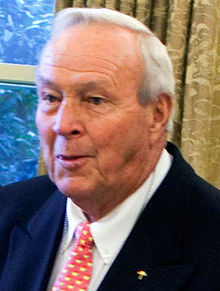
http://www.cnn.com/2016/09/25/us/arno...
(Source: CNN)
Mod
Release date: August 15, 2018
Born on the Links: A Concise History of Golf
 by John Harvey Williamson (no photo)
Synopsis:
Golf has been around for over 600 years, its origins tracing back to the links in Scotland in the fifteenth century. Since then, the game has spread worldwide, with millions of fans and players from all walks of life.
Born on the Links: A Concise History of Golf encompasses the entire history of this popular sport, from the fifteenth century up to the present. It covers the development of golf equipment, rules, and playing fields, and shows how the game changed from a pastime exclusively for the rich to a sport that is played by millions of people of all classes, ages, and backgrounds. In addition, this book details the lives and accomplishments of the many iconic players of the game—including Walter Hagen, Gene Sarazen, Babe Didrikson Zaharias, Ben Hogan, Charlie Sifford, Arnold Palmer, Jack Nicklaus, Annika Sorenstam, and Tiger Woods—and their greatest moments on the golf course. Additional chapters focus exclusively on the history of African Americans and women in the sport, recognizing their distinct struggles for equality and recognition, as well as their ultimate triumphs.
A comprehensive yet readable resource, Born on the Links also features a timeline of golf history, lists of the winners and runners-up of every major professional and amateur golf championship held since 1860, the winner of every major international team and cup competition held since 1922, and more. The most up-to-date history of golf, this book will entertain and inform all fans and historians of the game.
Mod
Mod
 by Bernard Suits (no photo)
Synopsis:
In the mid twentieth century the philosopher Ludwig Wittgenstein famously asserted that games are indefinable; there are no common threads that link them all.
"Nonsense," says the sensible Bernard Suits: "playing a game is a voluntary attempt to overcome unnecessary obstacles."
The short book Suits wrote demonstrating precisely that is as playful as it is insightful, as stimulating as it is delightful. Suits not only argues that games can be meaningfully defined; he also suggests that playing games is a central part of the ideal of human existence, so games belong at the heart of any vision of Utopia.
Originally published in 1978, The Grasshopper is now re-issued with a new introduction by Thomas Hurka and with additional material (much of it previously unpublished) by the author, in which he expands on the ideas put forward in The Grasshopper and answers some questions that have been raised by critics.
Review:
Here is an excerpt from an interview on FiveBooks which discussed this book - Nigel Warburton interviews Philosophy professor and sports enthusiast - David Papineau.
"Now, let’s go to the first of your book choices, Bernard Suits’s The Grasshopper which, for a long time, was a very-little-known classic, and now it’s probably just a little-known classic.
My first choice is a book about the nature and value of sport. I wanted to look at this via Suits because his is probably the best-known full-length work in this area. It’s a wonderfully engaging, eccentric, ingenious book, which has a terrific idea in it, but I think it’s completely wrongheaded about the nature and value of sport.
So I’ll start by explaining the good idea, and then explain why I think it’s not as helpful for understanding sport as many of its enthusiasts suggest.
The book is a quasi-Socratic dialogue with the grasshopper as the main character, and the grasshopper’s idea is that the highest virtue is playing, that he is going to spend all his time playing, doesn’t care if he dies, and the overall argument of the book is that in utopia, where humans have all their material needs satisfied at the push of a button, what we would do would be play games, and therefore playing games is the ideal of human activity.
Freed from all the necessities of having to do things we don’t want to do in order to get the material means of life, we’d do nothing but play games. That’s the main thesis."
More:
https://fivebooks.com/best-books/davi...
Source: FiveBooks
Mod
Here is an excerpt from an interview on FiveBooks which discussed this book - Nigel Warburton interviews Philosophy professor and sports enthusiast - David Papineau.
"And at the heart of this, there is this apparent critique of Wittgenstein’s notion that you can’t define what a game is, give its essence, because ‘game’ is a family resemblance term. The alleged impossibility of defining the concept of a game was the main example Wittgenstein used to illustrate his notion of a family resemblance term.
"Suits does two things. He defines ‘games’ and, following on from that, he argues that the playing of games is the highest form of human activity.
But the first part of the book, as you say, is a head-on attempt to meet Wittgenstein’s challenge. Wittgenstein said the concept of a ‘game’ was indefinable: you can’t give a set of necessary and sufficient conditions that pick out all and only games, because games have nothing in common.
Rather, they have a set of overlapping similarities, like the resembling faces within someone’s family. Suits comes up with this very neat definition of ‘game’ to refute this. I won’t give you the long version: in the shorter version, he explains that a game is any voluntary attempt to overcome unnecessary obstacles.
So, his idea is that in a game there’s some aimed at end point, or target. With Snakes and Ladders it’s getting your counter onto the final ‘100’ square; in golf, it’s getting this little white ball into a hole; in a 100-metre sprint, it’s breasting the tape ahead of the others.
So there’s some target of the activity, and then, Suits says, what picks these activities out as games is that we put arbitrary restrictions on how to achieve that target: you have to do it by rolling a dice and going up the ladders and down the snakes; or you have to do it using golf clubs of a certain specification, and you can’t pick the ball up; and you have to get across the tape first by running, and not by shooting the others, or by getting on a motorbike or anything like that.
So there are arbitrary restrictions on how you’re allowed to achieve the end, and Suits says whenever you’ve got a game, you’ve got that setup, and anything that fits that setup counts as a game.
With a kind of awkwardness that I’ll come back to in a bit, he then spends the rest of the book with all kinds of strange fables and odd characters, defending the thesis that he’s produced a very neat set of necessary and sufficient conditions for something being a game, and I think he’s pretty close to achieving that.
He does a very good job of showing that not just standard games, but games like hide-and-seek, and role-playing games, and so on, all fit his definition, and that part is pretty convincing.
More:
https://fivebooks.com/best-books/davi...
Source: FiveBooks

The History Book Club
Books mentioned in this topic
The Grasshopper: Games, Life and Utopia (other topics)Born on the Links: A Concise History of Golf (other topics)
The Making of the Masters: Clifford Roberts, Augusta National, and Golf's Most Prestigious Tournament (other topics)
Making the Masters: Bobby Jones and the Birth of America's Greatest Golf Tournament (other topics)
Miracle at Merion: The Inspiring Story of Ben Hogan's Amazing Comeback and Victory at the 1950 U.S. Open (other topics)
More...
Authors mentioned in this topic
Bernard Suits (other topics)John Harvey Williamson (other topics)
David Owen (other topics)
David Barrett (other topics)
David B. Barrett (other topics)
More...