
The History Book Club discussion
SUPREME COURT OF THE U.S.
>
#4 - CHIEF JUSTICE JOHN MARSHALL
date newest »
newest »
 I hear good things about this and I have used this for work:
 Jean Edward Smith
Product info
A New York Times Notable Book of 1996
It was in tolling the death of Chief Justice John Marshall in 1835 that the Liberty Bell cracked, never to ring again. An apt symbol of the man who shaped both court and country, whose life “reads like an early history of the United States,” as the Wall Street Journal noted, adding: Jean Edward Smith “does an excellent job of recounting the details of Marshall’s life without missing the dramatic sweep of the history it encompassed.”
Working from primary sources, Jean Edward Smith has drawn an elegant portrait of a remarkable man. Lawyer, jurist, scholars; soldier, comrade, friend; and, most especially, lover of fine Madeira, good food, and animated table talk: the Marshall who emerges from these pages is noteworthy for his very human qualities as for his piercing intellect, and, perhaps most extraordinary, for his talents as a leader of men and a molder of consensus. A man of many parts, a true son of the Enlightenment, John Marshall did much for his country, and John Marshall: Definer of a Nation demonstrates this on every page.
 Bryan wrote: "I hear good things about this and I have used this for work:Jean Edward Smith
Product i..."
Thanks Bryan. I have heard good things about this as well.
 The Supreme Court Under Marshall and Taney
 by R. Kent Newmyer
Synopsis
In preparing the long-awaited second edition of his well-liked text, Kent Newmyer consulted the best and most relevant of the recent scholarship on the antebellum Court, prompting him to revise important points in the story of the CourtÂ’s evolution. Nevertheless, the revised edition of the text retains the basic format and the conceptual premise of the original: the unique contributions of the Marshall and Taney courts taken together laid the foundation for the modern institution. Understanding the Supreme Court during its formative period provides useful insights into its continued (and hotly debated) involvement in shaping American society. Seminal cases that came before the Court, such as Marbury v. Madison and Dred Scott v. Sanford are examined in detail. Besides touting a thoroughly revised bibliographical essay, the second edition of The Supreme Court under Marshall and Taney includes an entirely new bank of illustrations and an index of important cases, making it perfect as supplementary reading for the U.S. history survey as well as courses in U.S. legal history and the history of the Early Republic.
message 6:
by
Jerome, Assisting Moderator - Upcoming Books and Releases
(last edited Jul 20, 2017 03:11PM)
(new)
 Mod
Mod
Release date: September 30, 2014
John Marshall: The Supreme Court's Chief Justice Who Transformed the Young Republic
 by Harlow Giles Unger (no photo)
Synopsis:
A soul–stirring biography of John Marshall, the young republic’s great chief justice who led the Supreme Court to power and brought law and order to the nation.
In the political turmoil that convulsed America after George Washington’s death, the surviving Founding Fathers went mad–literally pummeling each other in Congress and challenging one another to deadly duels in their quest for power. Out of the political intrigue, one man emerged to restore calm and dignity to the government: John Marshall. The longest–serving chief justice in American history, Marshall transformed the Supreme Court from an irrelevant appeals court into the powerful and controversial branch of government that Americans today either revere or despise.
Drawing on rare documents, Harlow Giles Unger shows how, with nine key decisions, Marshall rewrote the Constitution, reshaped government, and prevented Thomas Jefferson from turning tyrant. John Adams called his appointment of Marshall to chief justice his greatest gift to the nation and “the pride of my life.”
 Mod
Mod
Mod
Mod
 by Charles F. Hobson (no photo)
Synopsis:
John Marshall remains one of the towering figures in the landscape of American law. From the Revolution to the age of Jackson, he played a critical role in defining the "province of the judiciary" and the constitutional limits of legislative action. In this masterly study, Charles Hobson clarifies the coherence and thrust of Marshall's jurisprudence while keeping in sight the man as well as the jurist.
Hobson argues that contrary to his critics, Marshall was no ideologue intent upon appropriating the lawmaking powers of Congress. Rather, he was deeply committed to a principled jurisprudence that was based on a steadfast devotion to a "science of law" richly steeped in the common law tradition. As Hobson shows, such jurisprudence governed every aspect of Marshall's legal philosophy and court opinions, including his understanding of judicial review.
The chief justice, Hobson contends, did not invent judicial review (as many have claimed) but consolidated its practice by adapting common law methods to the needs of a new nation. In practice, his use of judicial review was restrained, employed almost exclusively against acts of the state legislatures. Ultimately, he wielded judicial review to prevent the states from undermining the power of a national government still struggling to establish sovereignty at home and respect abroad.
No chief justice and only one associate justice (William Douglas) served longer on the Supreme Court. But, as Hobson clearly shows, Marshall's deserved place in the pantheon of great American jurists rests far more upon principles than longevity. This book better than any other tells us why that's true and worthy of our attention.

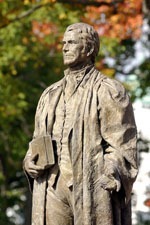
The statue of Justice Marshall at his namesake university and my alma mater, Marshall University, Huntington, WV. WE ARE MARSHALL
Mod
 by
by
 Lawrence Goldstone
Synopsis:
Among the many momentous decisions rendered by the Supreme Court, none has had a greater impact than that passed down in 1803 by Chief Justice John Marshall in the case of Marbury v. Madison. While the ruling itself was innocuous—denying the plea of a minor functionary named William Marbury on constitutionally technical grounds—its implications were enormous. For Marshall had, in essence, claimed for the Supreme Court the right to determine what the Constitution and our laws under it really mean, known formally as the principle of “judicial review.” Yet, as Lawrence Goldstone shows in his compelling narrative, that right is nowhere expressed in the Constitution and was not even considered by the Framers or the Founding Fathers, who would never have granted such power in a checks-and-balances system to unelected officials serving for life.
The Activist underscores the drama that occurred in 1803 by examining the debates that took place during the Constitutional Convention of 1787—among the most dramatic moments in American history—over the formation and structure of our judicial system. In parallel, Goldstone introduces in brief the life and ambition of John Marshall, and the early, fragile years of the Supreme Court, which—until Marshall’s ascension to Chief Justice—sat atop the weakest of the three branches of government. Marshall made the Court supreme, and while judicial review has been used sparingly, without it the Court would likely never have intervened in the 2000 presidential election. Indeed, the great irony Goldstone reveals is that judicial review is now so enfranchised that Justice Antonin Scalia could admit, as he has, that the Supreme Court “made it up” in the same breath as he insists that justices must adhere steadfastly to the exact words of the Constitution.
Nobody brings the debates of the Constitutional Convention to life as does Lawrence Goldstone, and in this election year, no more interesting book on the Supreme Court will appear than The Activist, which makes the past come alive in the present.
Mod
 John Marshall: Writings
 by
by
 John Marshall
Synopsis:
"It is emphatically the province and duty of the judicial department," John Marshall wrote in Marbury v. Madison, "to say what the law is." As its Chief Justice from 1801 to 1835, Marshall made the Supreme Court a full and equal branch of the federal government. In so doing, he joined Washington, his mentor, and Jefferson, his ideological rival, in the first rank of American founders. His legacy extends far beyond Marbury, which held for the first time that the Supreme Court has the power to declare acts of Congress unconstitutional. Under his leadership, the Court upheld the constitutionality of a national bank, established the supremacy of the federal judiciary over state courts and legislatures in matters of constitutional interpretation, and profoundly influenced the economic development of the nation through vigorous interpretation of the contract and interstate commerce clauses. His major judicial opinions are eloquent public papers, written with the conviction that "clearness and precision are most essential qualities," and designed to inform and persuade the citizens of the new republic about the meaning and purpose of their Constitution.
This volume collects 200 documents written between 1779 and 1835, including Marshall's most important judicial opinions, his influential rulings during the Aaron Burr treason trial, speeches, newspaper essays, and revealing letters to friends, fellow judges, and his beloved wife, Polly. It follows Marshall's varied career before becoming Chief Justice: as an officer in the Revolution, a supporter of the ratification of the Constitution, an envoy to France during the notorious "XYZ Affair," a congressman, and secretary of state in the Adams administration. The personal correspondence gathered here reveals the conviviality, good humor, and unpretentiousness that helped him unite the Court behind many of his landmark decisions, while selections from his biography of George Washington offer vivid descriptions of battles he fought in as a young man.
 American Hero: John Marshall, Chief Justice of the United States
 by
by
 David Bruce Smith
Synopsis:
John Marshall was a good son, a kind older brother, a loving father and husband, and a dear friend to many. He was a soldier for the Revolutionary Army, a successful lawyer, a congressman, and Secretary of State. Most importantly, he was Chief Justice of the United States. As Chief Justice, John Marshall made the Supreme Court the strong and powerful body it is today. Richly illustrated in graphite and watercolor, American Hero tells the life story of the founding father history almost forgot--John Marshall, the Great Chief Justice.
What Kind of Nation: Thomas Jefferson, John Marshall, and the Epic Struggle to Create a United States by James F. Simon (no photo)
Synopsis:
The bitter and protracted struggle between President Thomas Jefferson and Supreme Court Chief Justice John Marshall defined the basic constitutional relationship between the executive and judicial branches of government. More than one hundred fifty years later, their clashes still reverberate in constitutional debates and political battles.
In this dramatic and fully accessible account of these titans of the early republic and their fiercely held ideas, James F. Simon brings to life the early history of the nation and sheds new light on the highly charged battle to balance the powers of the federal government and the rights of the states. A fascinating look at two of the nation's greatest statesmen and shrewdest politicians, What Kind of Nation presents a cogent, unbiased assessment of their lasting impact on American government.
John Marshall: Definer of a Nation by
by
 Jean Edward Smith
Synopsis:
It was in tolling the death of Chief Justice John Marshall in 1835 that the Liberty Bell cracked, never to ring again. An apt symbol of the man who shaped both court and country.
Working from primary sources, Jean Edward Smith has drawn an elegant portrait of a remarkable man. Lawyer, jurist, scholars; soldier, comrade, friend; and, most especially, lover of fine Madeira, good food, and animated table talk: the Marshall who emerges from these pages is noteworthy for his very human qualities as for his piercing intellect, and, perhaps most extraordinary, for his talents as a leader of men and a molder of consensus. A man of many parts, a true son of the Enlightenment, John Marshall did much for his country, and John Marshall: Definer of a Nation demonstrates this on every page.
 I think this sounds like an interesting book. I knew the part about the Liberty Bell cracking at Marshall's funeral, but I thought I read somewhere that they also tapped the bell with a special hammer to celebrate the success of D-Day. If so, it would seem to be an appropriate occasion to rejoice in liberty.
 Alisa wrote: "This thread is about the 4th Chief Justice of the US Supreme Court: John Marshall.
Biography:
John Marshall was born in a log cabin on the Virginia frontier, the first of fifteen children. He w..."
John Marshall may also have been the most affable man of the early Republic. He was a great lover of picnicking and was quite accomplished at the horseshoes-like game of quoits. There were very few people, even bitter political enemies like his distant cousin Thomas Jefferson, who didn't like him personally.
He came from a remarkably long-lived and healthy family. He and all 14 of his siblings survived to adulthood. Only one of his siblings predeceased the parents and that was in her twenties.
His father, Thomas Marshall, was an impressive man. He surveyed Lord Fairfax's estate, often with George Washington, served as a colonel in the Continental Army, and migrated west after the war to become one of the founding fathers of the Commonwealth of Kentucky.
Marshall had very little formal schooling, really limited to less than a year at a boarding school run by Rev Archibald Campbell and somewhere between six and eight weeks of law lectures at William & Mary. He was tutored at home and his parents were both educated, his mother being the daughter of a Scottish minister and a Randolph daughter.
His contemporaries often noted that "Mr Marshall was not very learned in the law." This was fact, not insult. As such, Marshall would often request to go last in oral arguments, allowing him to listen to the legal precedents cited by co-counsel and opposing counsel. He was, however, noted as having a very keen and analytical mind, able to synthesize complex arguments and present them cogently.
Mod
message 19:
by
Jerome, Assisting Moderator - Upcoming Books and Releases
(last edited Feb 06, 2020 06:38PM)
(new)
Mod
Release date: February 20, 2018
Without Precedent: Chief Justice John Marshall and His Times
 by Joel Richard Paul (no photo)
Synopsis:
No member of America's Founding Generation had a greater impact on the Constitution and the Supreme Court than John Marshall, and no one did more to preserve the delicate unity of the fledgling United States. From the nation's founding in 1776 and for the next forty years, Marshall was at the center of every political battle. As Chief Justice of the United States - the longest-serving in history - he established the independence of the judiciary and the supremacy of the federal Constitution and courts. As the leading Federalist in Virginia, he rivaled his cousin Thomas Jefferson in influence. As a diplomat and secretary of state, he defended American sovereignty against France and Britain, counseled President John Adams, and supervised the construction of the city of Washington. D.C.
This is the astonishing true story of how a rough-cut frontiersman - born in Virginia in 1755 and with little formal education - invented himself as one of the nation's preeminent lawyers and politicians who then reinvented the Constitution to forge a stronger nation. Without Precedent is the engrossing account of the life and times of this exceptional man, who with cunning, imagination, and grace shaped America's future as he held together the Supreme Court, the Constitution, and the country itself.
Mod
 Mod
Mod
Mod
Mod
Release date: November 15, 2018
John Marshall: The Man Who Made the Supreme Court
 by
by
 Richard Brookhiser
Synopsis:
In 1801, a genial and brilliant Revolutionary War veteran and politician became the fourth Chief Justice of the United States. He would hold the post for 34 years (still a record), expounding the Constitution he loved. Before he joined the Court, it was the weakling of the federal government, lacking in dignity and clout. After he died, it could never be ignored again. Through three decades of dramatic cases involving businessmen, scoundrels, Native Americans, and slaves, Marshall defended the federal government against unruly states, established the Supreme Court's right to rebuke Congress or the president, and unleashed the power of American commerce. For better and for worse, he made the Supreme Court a pillar of American life.
In John Marshall, award-winning biographer Richard Brookhiser vividly chronicles America's greatest judge and the world he made.
Mod
Mod
Chief Justice Interview on the Constitution Chief Justice John Roberts talked about the U.S. Constitution at the Supreme Court.
He talked about his early interest in constitutional law, the role of the constitution in the operation of government, structure of the Constitution and its Amendments, and the process of judicial review.
The interview was part of a C-SPAN Classroom project designed to interest middle and high school students in the Constitution.
https://www.c-span.org/video/?193515-...
Source: C-Span and Youtube
message 25:
by
Lorna, Assisting Moderator (T) - SCOTUS - Civil Rights
(last edited Feb 04, 2019 03:17PM)
(new)
Mod
Chief Justice of the Supreme Court of the United States - February 4, 1801 to July 6, 1835
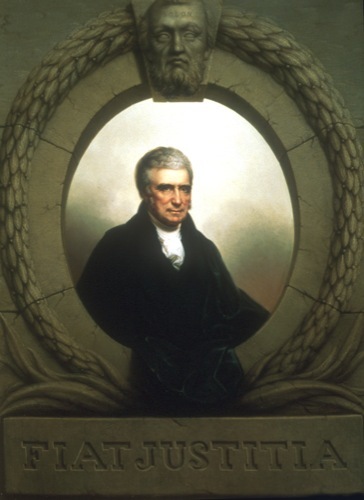
The Collection of the Supreme Court of the United States (Artist: Rembrandt Peale)
John Marshall is one of the most influential justices to have served on the Supreme Court of the United States, if not the most influential. Growing up in Virginia as the oldest of fifteen children, Marshall’s parents were both politically connected, and his interaction with prominent government figures began at a very young age. On Marshall’s mother’s side, he was distantly related to Thomas Jefferson. In addition to working in the Virginia House of Burgesses, Marshall’s father assisted a young George Washington survey land for purchase, thus introducing Marshall to another future president. Marshall started his schooling at the Westmoreland County Academy, a school also attended by future president James Monroe. When war interrupted Marshall’s education, he served as a lieutenant in Virginia’s Minute Men, eventually rising to the rank of captain for his service in some of the Revolution’s more famous battles.
When the war ended, Marshall returned to his studies. After completing his law degree at the College of William and Mary, Marshall was admitted to the Virginia bar and moved to Richmond to practice. Richmond housed Virginia’s most prominent courts, including the Court of Appeals. Marshall started a legal practice that grew as he argued increasingly more prominent cases in the Court of Appeals. After the Constitution was ratified in 1788, Marshall further expanded his practice by defending Virginia debtors against British businesses. Marshall’s practice was so successful that he was chosen as lead counsel for Supreme Court of the United States case Ware v. Hylton, in which Marshall defended the poor American farmers that British creditors sued for pre-war debts.
Marshall’s political career was focused in Richmond until President Adams appointed him to a diplomatic mission to France in 1797. Marshall and the other diplomats were meant to negotiate an amity treaty with the French Republic. Negotiations in France did not go well, and when the diplomatic party was unable to reach an agreement with the French, the diplomats returned to America. Amidst high anti-French sentiments, Marshall’s refusal to give in to French demands earned him a well-respected reputation. In 1800 President Adams appointed him Secretary of State, a position he would continue to hold in a limited capacity at the beginning of his tenure as Chief Justice of the United States Supreme Court in 1801.
John Marshall’s tenure on the Court can be divided into four phases. The first phase began in 1801 and included Marbury v. Madison, a case that established the Court’s power to review the constitutionality of congressional acts. Marbury placed the judiciary in a position of primary authority on constitutional law and established judicial review as a fundamental principle and powerful responsibility of the Court. Marshall wrote the opinion for this case, giving him the power to frame this issue and influence its future implementation. The second phase began in 1813. The Court in this phase adjusted to include Jeffersonian inclined appointees, leading to dissonance on the Court. Few decisions of long-term impact occurred during this phase.
The third phase began in 1819, otherwise known as Marshall’s “golden period.” Most of Marshall’s famous decisions occurred during this period, wherein he defined the boundaries of the necessary and proper clause of the Constitution, advocated for a strong federal government by alleviating burdens of federal taxation, and worked to realize a healthy and diverse economy by concluding that monopolies were unconstitutional. By 1822, Marshall’s power began to decline, marking the beginning of the final phase. There were enough Jeffersonian thinkers who favored states' rights on the Court that their consensus left Marshall and his values on a strong federal government in the minority. Marshall spent his last years working diligently in the Supreme Court, remaining as long as his health permitted until February 1835. Many mourned his death in July 1835, and he was remembered well for his devotion to the nation and the courts.
Other:
 by Joel Richard Paul (no photo)
Source: Oyez
Mod
 Excellent summary of Marshall's life. One footnote. About 100 years after Marshall's death, Louis Brandeis -- then sitting on the Supreme Court -- lamented with his friend Felix Frankfurter that many Justices had stayed on the Court too long, saying there "can't be too much apprehension about [the] evil effects of old age." He pointed to Marshall as a case in point. Brandeis' concern was not that the older Justices were senile and unable to fulfill their responsibilities. His concern "was a failure to grow with the times, to adapt settled principles to new circumstances." A case in point for Brandeis was the refusal of his brethren to approve New Deal legislation in the early years of Franklin D. Roosevelt's tenure. For Brandeis, the Depression required the Court to give the government some flexibility in dealing with the crisis. To him, the Court's unwillingness to give the government that flexibility reflected a refusal to bend with the times. President Roosevelt was ultimately saved by the willingness of one conservative Justice (Owen Roberts) to support a New Deal law in 1937 and then the death of other Justices (which gave FDR a chance to appoint Justices with views in line with his).
message 28:
by
Jerome, Assisting Moderator - Upcoming Books and Releases
(last edited Jun 25, 2020 01:11PM)
(new)
Mod
Release date: March 1, 2021
John Marshall: The Final Founder
 by Robert Strauss (no photo)
Synopsis:
Eighteenth- and 19th-century contemporaries believed Marshall to be, if not the equal of George Washington and Benjamin Franklin, at least very close to that pantheon.
John Marshall: The Final Founder. demonstrates that not only can Marshall be considered one of those Founding Fathers, but that what he did as the Chief Justice was not just significant, but the glue that held the union together after the original founding days. The Supreme Court met in the basement of the new Capitol building in Washington when Marshall took over, which is just about what the executive and legislative branches thought of the judiciary.
John Marshall: The Final Founder advocates a change in the view of when the “founding” of the United States ended. That has long been thought of in one or the other of the signing of the Constitution, the acceptance of the Bill of Rights or the beginning of the Washington presidency. The Final Founder pushes that forward to the peaceful change of power from Federalist to Democrat-Republican and, especially, Marshall’s singular achievement -- to move the Court from the basement and truly make it Supreme.
Mod

The History Book Club
Books mentioned in this topic
John Marshall: The Final Founder (other topics)Without Precedent: Chief Justice John Marshall and His Times (other topics)
John Marshall: The Man Who Made the Supreme Court (other topics)
Without Precedent: Chief Justice John Marshall and His Times (other topics)
John Marshall: Definer of a Nation (other topics)
More...
Authors mentioned in this topic
Robert Strauss (other topics)Joel Richard Paul (other topics)
Richard Brookhiser (other topics)
Joel Richard Paul (other topics)
Jean Edward Smith (other topics)
More...

Biography:
John Marshall was born in a log cabin on the Virginia frontier, the first of fifteen children. He was a participant in the Revolutionary War as a member of the 3d Virginia Regiment. He studied law briefly in 1780, and was admitted to practice the same year. He quickly established a successful career defending individuals against their pre-War British creditors.
Marshall served in Virginia's House of Delegates. He also participated in the state ratifying convention and spoke forcefully on behalf of the new constitution to replace the Articles of Confederation.
Marshall contemplated several offers to serve in the Washington and Adams administrations. He declined service as attorney general for Washington; he declined positions on the Supreme Court and as secretary of war under Adams. At Washington's direction, Marshall ran successfully for a seat in the U.S. House of Representatives but his tenure there was brief. Adams offered Marshall the position of secretary of state, which Marshall accepted. When Ellsworth resigned as chief justice in 1800, Adams turned to the first chief justice, John Jay, who declined. Federalists urged Adams to promote associate justice William Paterson to the spot; Adams opted for Marshall.
Marshall's impact on American constitutional law is peerless. He served for more than 34 years (a record that few others have broken), he participated in more than 1000 decisions and authored over 500 opinions. As the single most important figure on constitutional law, Marshall's imprint can still be fathomed in the great issues of contemporary America. Other justices will surpass his single accomplishments, but no one will replace him as the Babe Ruth of the Supreme Court!
Personal Information
Born: Wednesday, September 24, 1755
Died: Monday, July 6, 1835
Childhood Location: Virginia
Childhood Surroundings: Virginia
Position: Chief Justice
Seat: 1
Nominated By: Adams, John
Commissioned on: Saturday, January 31, 1801
Sworn In: Wednesday, February 4, 1801
Left Office: Monday, July 6, 1835
Reason For Leaving: Death
Length of Service: 34 years, 5 months, 2 days
Home: Virginia
The Oyez Project, Justice John Marshall
available at: (http://oyez.org/justices/john_marshall)