
Art Lovers discussion
Monthly Book Challenge
>
Leaving van Gogh: A Novel

 I'm so backlogged with books I want to read, but this looks like a very interesting book. I put it in my to-read, but not for this month. Thanks, Heather.
 No problem, Aloha. Hope yo enjoy it when you do get the chance to read it!
Thank you, Heather. I like your Sargent icon.
No problem, Aloha. Hope yo enjoy it when you do get the chance to read it!
Thank you, Heather. I like your Sargent icon.
 I didn't vote because I didn't think I'd have time to participate, but this one might be too good to pass up. I've ordered a copy from the library.
 my hands are full nowadays, but I'll free them when the group is reading this book
Thank you Heather for this thread...sounds interesting
 Author Carol McD. Wallace
[image error]
"Leaving van Gogh" is Wallace's 21st book and her first historical novel. Previous titles have included humor, parenting, and social history. In 2006 Wallace received a M.A. in art history from Columbia University. The research for her M.A. thesis provided the foundation for Leaving van Gogh. A 1977 graduate of Princeton University, Wallace lives in New York.
"Dear Readers letter" half way down the amazon page at
http://www.amazon.com/Leaving-Van-Gog...
She blogs at
http://carolwallace.wordpress.com/201...
Facebook page at http://www.facebook.com/leaving.van.gogh
More information on Leaving Van Gogh is at http://www.carolwallacebooks.com
 A. wrote: "my hands are full nowadays, but I'll free them when the group is reading this book
Thank you Heather for this thread...sounds interesting"
Welcome, Amal! You've been missed! Glad you are going to join us!
 This book looks interesting. Am just finishing up the Woman in White by Wilkie Collins, so may give it a go.
 I picked up a copy of the book recently at the Border's sale. I'll really miss that store.
Interesting links, Carol.
 I miss Borders too. I worked there part-time for 13 years. Of course, most of (nah, all of) my salary went to buying books.
I got my book today! I got my book today!
got my book few days ago :)
I miss Borders too. I worked there part-time for 13 years. Of course, most of (nah, all of) my salary went to buying books.
I got my book today! I got my book today!
got my book few days ago :)love the cover but I'll not start until the group starts
I came home from work early for minor medical ailments and jumped right in to this book. I couldn't put it down but alas, I did desperately need to go to the grocery store. I want to comment on it now, but I will wait. Three more days!
I enjoyed reading about Vincent Van Gogh from the point of view of Dr Gachet. The physician came across as being a very caring person who felt hopeless when he could diagnose the illnesses of his own wife, Vincent, and his brother Theo, but he did not have any way of curing them with 19th Century medicine. I learned some details about the relationship between Vincent and Theo's family. I loved reading the descriptions about Vincent creating his artworks. He was very much an artist ahead of his time. The parts about the asylums and mental illness were very informative too.*****Spoiler*****
I was thinking about how accurate historical fiction has to be. The book was well researched. According to the author's notes at the end of the book, there was no historical evidence where the suicide weapon came from. But in the story, the author has Dr Gachet plant a weapon for his patient Vincent to use. (In Vincent's case, suicide may have been the alternative to years of mental suffering.) It's a novel and it is fiction, and that added to the drama of the story. But does it bother anyone else when a very important detail is invented?
 I just started reading and have finished the very short prologue. But I had to stop mid-way through because I had tears in my eyes and couldn't see. Vincent's brilliance and his suffering always has an effect on me whenever I think about it. But this time what made me tear up was the mention of his brother Theo, with Dr. Gachet saying that the sunflowers he had planted on Vincent's grave might have been a source of comfort to that poor man (Theo).
 Theo was also a fascinating person who stood by and supported his brother for all his adult life. Without Theo, Vincent probably would not have been able to paint and achieve what he did. I would like to see more written about Theo. Another historical fiction on that subject would suit me fine.
I loved the way the author described how Vincent painted both Dr Gachet and his daughter. I was looking through an art book where the paintings were labeled on a separate page, but as soon as I saw the eyes in the painting of Dr Gachet, I knew it was him. You could just feel that the man had to deal with a lot of heartache (especially with the death of his beloved wife) but was bearing it with dignity. Vincent captured his emotions beautifully.
I'm in the first chapter and am reminded of the question (in my mind, at least) of the difference between madness and mental illness. Someone on this forum remarked once that Vincent was mad. I responded by saying that he wasn't mad but mentally ill, possibly with some form of epilepsy or bi-polar disorder.But what really is the difference between madness and mental illness. Or is there a difference? Now there are more diagnoses for illnesses than before, but does that mean that there is no madness, only mental illness?
Somehow I don't accept that. There are those who are crazy or mad or have gone mad. Something just let loose and they lost their reason. And there are those who are ill.
What do the rest of you think?
I finished my SciFi forum's 2 reads for this month, so I will be participating in this. I have the book.
Dvora wrote: "...Someone on this forum remarked once that Vincent was mad. I r..."I believe like "Good" and "Bad" the word "Mad" is nonspecific and diffidently not a scientific term
Dvora, the word "Mad" was used years ago when very little was known about mental illness, and there were not good treatments. It must have been awful for those people because many of them never improved.I've worked in internal medicine physicians' offices, and have never seen it used. Specific mental illnesses are diagnosed, and there are medications to treat patients that were not available in Vincent Van Gogh's lifetime. There is still so much to be learned about mental illness, and the medications have many side effects. Some people would still be a danger to themselves and other people because they do not take their meds, they are not diagnosed correctly, or because the meds are not working for them.
I've seen people with depression, anxiety, bipolar, panic attacks, schizophrenia, nervous breakdowns, etc. improve and do very well. I would imagine that Vincent could be helped with today's medicine.
Professionals may not use the word, but many ordinary people do. And of course it was used in other times when madness was thought to be possession by the devil and illness was never considered. In those days barbers were the doctors and they applied leeches for many maladies.Anyway, the word is still used, as is crazy. You could still hear it said that Vincent was mad or crazy. And that made me wonder what the difference was, or if there was any difference between mad and ill. There are some people who I might think of as mad, but really they are merely eccentric or don't follow the normal patterns of behavior or of thinking. But that doesn't mean they are ill.
The fact that "mad" was used years ago when very little was known about mental illness is clearly stated in chapter 1 of the book we are reading.
Yes, the author used the term "madness" throughout the book because that was the word used during Vincent's life. It's interesting how the meanings of words change over time. Also, what would be ordinary language at one time is considered offensive, or not politically correct in another era.I have two dictionaries in my house. The 1968 dictionary has the #1 definition of mad as "mentally disturbed or deranged; insane; demented" and the #2 definition as "enraged, irritated, and angry." The 2001 dictionary has the #1 definition as "very angry" and the #2 definition as "an offensive term meaning affected with a psychiatric disorder." So the way the word is commonly used is going through a change in our lifetime.
Interesting question, Dvora.
 Well, I have it on order at the local bookstore. (The library didn't have it.)
I should be able to start next week.
Connie wrote: "I loved the way the author described how Vincent painted both Dr Gachet and his daughter. I was looking through an art book where the paintings were labeled on a separate page, but as soon as I sa..."I really like how this thread is starting out. Very interesting questions and perspectives.
As to Connie's comment about the fact that van Gogh captured the very emotion Dr. Gachet actually demonstrated, probably subconsciously, makes me wonder if the reason Vincent can recognize different emotions is because he goes through a myriad of feelings himself. I'm not saying he necessarily empathizes in that he hasn't felt every single emotion, but I think the fact that he has painted so many self-portraits, he is trying to capture...something.
I think it's clear that Vincent was a very intelligent and also a very perceptive man. Early in the book Dr. Gachet discusses how he can see that Vincent's portrait (of the art supplier Tanguy) brought out something of the soul of the subject.I am loving this book, partly because I feel such a strong affection for Vincent, and partly because I think this book is wonderfully written. The style of narration and the dialogue fit very well with the subjects and their time. The analysis and comments of paintings so far seem right on. And overall, at least so far, the story fits in very well with what I've learned are the known facts.
I've just read something that I think it critical to any discussion of Vincent. On page 75 Gachet wonders "...would I have been a better artist if I had not retained my sanity? And, would Vincent have been a genius if he had not been mad? Was his madness the price of his talent? I don't believe that it was. And yet the doubt lingers."Vincent wasn't the only artist/genius who was mad. Probably some of you can name many such better than I could. Although not all geniuses are mad, it seems that a disproportionate number of them are. Or are they?
Dvora wrote: "I've just read something that I think it critical to any discussion of Vincent. On page 75 Gachet wonders "...would I have been a better artist if I had not retained my sanity? And, would Vincent..."I think that in order to function he had to be more or less sane in order to be able to paint, and in fact, when Vincent is afflicted, one of the most painful to him appears to be his inability to work. That being said, I am sure that he used the experiences of intense emotion in his work, and that his mental problems built up psychic tensions which he released in his work.
In the biographies I have read, most artists that have severe mental problems created only in periods of lucidity; in the case of bipolar artists, sometimes during a lucid, but somewhat manic phase, but nonetheless, while they are more or less sane. In the case of alcoholics, they often cannot work after touching a drop, even though they have binge drinking episodes between productive periods.
I think the question comes down to if Vincent could be helped with a modern medication, would he have still been able to create?
The answer appears to be, if Vincent had been essentially sane, but with his deep emotional nature, and his desire to be an artist, he would probably have been a very great one regardless. However, he would probably have been a different artist, as he would have had access to different emotional states.
Here's what I consider an amazing case of lucid concentration, apparently all parts of the painting finished all at once in wet thick paint which he has used almost like a drawing medium to create exact, bold contours:
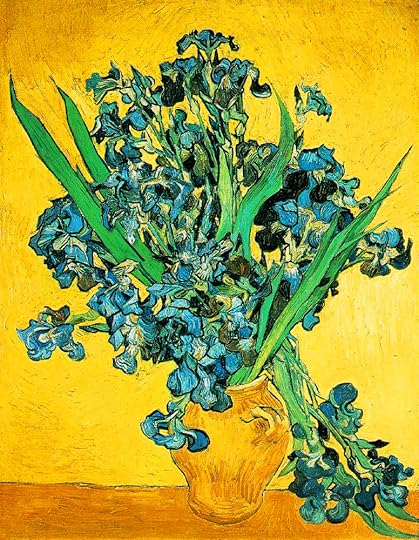
Computer analysis indicates that copyists working from an original have to use significantly more brushstrokes that he did, which seems to indicate a very concentrated focus without many corrections.
That's really interesting, Ed.I know a little bit about bipolar disorder, of which he may at least have symptoms.
There is the
Major depressive episode
A period of two weeks or more during which five or more of the following symptoms are present:
Prolonged sadness or unexplained crying spells
Significant changes in appetite and sleep patterns
Irritability, anger, worry, agitation, anxiety
Pessimism, indifference
Loss of energy, persistent exhaustion
Unexplained aches and pains
Feelings of guilt, worthlessness and/or hopelessness
Inability to concentrate; indecisiveness
Inability to take pleasure in former interests; social withdrawal
Excessive consumption of alcohol or use of chemical substances
Recurring thoughts of death or suicide
Mixed state (also called mixed mania): A period during which symptoms of a manic and a depressive episode are present at the same time. People who experience mixed states describe feeling activated and “revved up,” but also full of anguish and despair. Rapid, pressured speech can co-exist with impulsive, out-of-control thoughts of suicide and self-destruction or aggression. Hopelessness, irritability, uncontrollable swings between racing thoughts and a feeling of “being in blackness” can all happen over the course of minutes.
Hypomania Similar to a manic episode, except that it is less severe and there are no delusions or hallucinations. It is clearly different from an individual’s non-depressed mood with a clear change in activity and attitude, and visible behavior that is unusual or out-of-character. hypo-mania then mania.
Some of these can be exhibited in what is called
Rapid Cycling With rapid cycling, mood swings can quickly go from low to high and back again, and occur over periods of a few days and sometimes even hours. The person feels like he or she is on a roller coaster, with mood and energy changes that are out-of control and disabling. In some individuals, rapid cycling is characterized by severe irritability, anger, impulsivity, and uncontrollable outbursts. While the term “rapid cycling” may make it sound as if the episodes occur in regular cycles, episodes actually often follow a random pattern. Some patients with rapid cycling appear to experience true manic, mild manic, or depressive episodes that last only for a day. If there are four mood episodes within a month, it is called ultra-rapid cycling, and when several mood switches occur within a day, on several days during one week, it is called ultra-ultra-rapid, or ultradian cycling.
Mania
Increased physical and mental activity and energy
Exaggerated optimism and self-confidence
Excessive irritability, aggressive behavior
Decreased need for sleep without becoming tired
Grandiose thoughts, extreme sense of self-importance
Racing speech, racing thoughts ¡ Impulsiveness, poor judgment
Reckless behavior such as spending sprees, impulsive business decisions, erratic driving and sexual indiscretions
In severe cases, delusions and hallucinations
I see all of these in Vincent. I have known of MANY cases of artists, poets, writers, composers, etc. who do their best work in the 'hypo-manic' phase. Once it reached full blown mania, it can then because more chaotic and what I would refer to as 'mad'. That is my opinion, I know that many people with some sort of mental illness actually work best during their stages of highest intensity.
Now that I have looked into the illnesses a little bit more, I might have to begin reading at the beginning! I'm trying to remember the pages where there are finite examples of each or several of the above descriptions.
Here's one: The Night Cafe
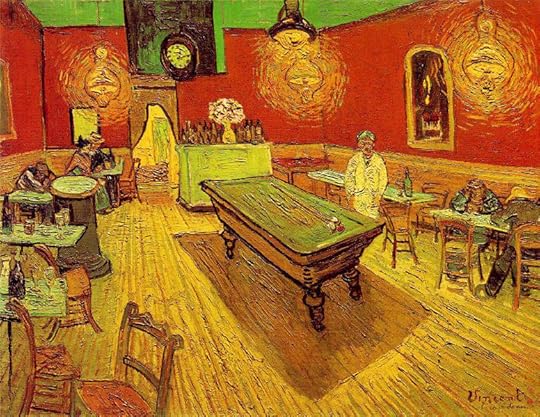
"I hated the way it made me feel--despair, dislocation, and agitation...jangling, buzzing, lopsided room peopled with the vacant and desolate". Dr. Gachet pg.45 And Theo remarked, "I hate to think that this was what his life was like in Arles, where he painted this".
That is when it is said he was especially ill. The doctor in Arles said "he did not know who he was" "at times he would describe his feelings but in just a few hours, he would turn morose".
"Vincent has such force. You can feel his eyes always moving..." Dr. Gachet pg.46
"He painted in a furor...I expected him to be possessed in a way." pg. 49
I wonder to what extent he remembered his emotional states, and then recorded the image when he was more lucid, and to what extent that he recorded them on the spot, no matter how terrible he was feeling?I think it might be possible to assess this from a timeline based on his letters to Theo and his known periods of erratic behavior and hospitalization.
Don't have the book yet....
I read somewhere, a while back, an account of a writer (or maybe it was a painter) who has bi-polar disorder. It may have been in a novel, but I think the facts are correct. This was a contemporary person (meaning in our time). She said that she began to take lithium, which is what they use to treat bi-polar, and it controlled the negative symptoms, but she also lost all her "highs" and lost her inspiration and energy to do any work. She didn't feel it was worth it, and went off the medication.I posed my question because I have wondered if many or even most of our geniuses aren't (or weren't) also people with some kind of mental illness. Although there are some, most of the greats don't seem to have lived normal lives. Could be that normalcy doesn't lead to genius or to greatness.
Dvora wrote: "I read somewhere, a while back, an account of a writer (or maybe it was a painter) who has bi-polar disorder. It may have been in a novel, but I think the facts are correct...."Two books that you might find interesting are:
The Tangled Wing: Biological Constraints on the Human Spirit have seen good reviews, haven't read
Touched with Fire: Manic-depressive Illness & the Artistic Temperament I have read, rate 4*
I think in even in some cases where the creative individual is on a fairly even keel, they will have relatives who have symptoms of mood disorders.
I do wonder though, does being "different" in some particular way, "give permission" to individuals to go outside the ordinary boundaries?
Dvora, currently I'm reading an interesting book about Bipolar disorder.
I've decided to start with it before starting on Van Gogh's thinking it may help me see more into Van Gogh's work
this book affirms what you said earlier...many stop their medications b/c it kills their creativity and makes their spirit flat
so I guess the struggle is not just against their mood changes but also against their creativity
It's a hard choice!
Great idea to read that book first to better understand van Gogh!
Hey, I was just reading a random post on facebook and I found this quote:“Great things are not done by impulse, but by a series of small things brought together.” -Vincent Van Gogh
That ties in with the question of the connection between creativity/genius/brilliance and mental health. I get the feeling that a disproportionate number of creative geniuses are not what we would call normal or mentally healthy or stable. Not all, but many. Then again, what is normal? I know I have my problems and I'm no creative genius!
Famous People and Mental IllnessesVincent Van Gogh, famous painter and artist as labeled peculiar with unstable moods most of his
short life. He suffered from epileptic seizures some believe from excesses of absinthe, very strong
liquor popular among talented people for inspiring greater creativity. Many have tried to give a
definitive diagnosis of his illness through reading his personal letters. From them it seems clear that
his depressive states were also accompanied by manic episodes of enormous energy and great
passion. Van Gogh committed suicide at age 37.
Ludwig van Beethoven, composer, had bipolar disorder which some have said gave him such
creative power that his compositions broke the mold for classical music forever. He was a child
prodigy which his father tried to exploit. His “manic” episodes seemed to fuel his creativity. He
wrote his most famous works during times of torment, loneliness, and suffering psychotic delusions.
It took him 12 years to finish his last and 8th Symphony in total deafness. He then medicated
himself with the only drugs available in that day to bring some relief –opium and alcohol- and died
several years later of liver disease.
Virginia Woolf, the British novelist, born of privilege, experienced the mood swings of bipolar
disorder her entire life. She wrote to make sense out of her mental chaos and gain control of
madness; and was greatly admired for her creative insight into human nature. She was tolerated by
friends and family, receiving great care and understanding during her entire life and because of this, never had to face institutionalization, the only medical “treatment” in those days. She died at her own hand by filling her pockets with stones and walking into a nearby river. The cause of death was
determined as "Suicide, while the balance of her mind was disturbed."
Leo Tolstoy, author
Charles Dickens, English author
John Keats, poet
Michelangelo, artist
Peter Illyich Tchaikovsky, composer
Ernest Hemingway, Pulitzer Prize-winning novelist
Illness: the pathway to creative genius?Disease, rather than being a barrier to greatness, may be its wellspring
by Roger Dobson
New research in fields as diverse as music, art, science and literature suggests that we’re wrong to think that great men and women achieve despite disease. Their illness in many cases is a path, rather than an obstacle, to genius. Einstein, Warhol, Newton, Cézanne, Goya, Michelangelo, Turner and Berlioz are among many whose achievements are now thought to have been influenced by disease. Conditions such as depression, autism, myopia, anxiety, chronic pain, gout, stroke and dementia heavily influenced their paths to creativity.
http://www.timesonline.co.uk/tol/news...
Suffering for their art?
Francisco de Goya, artist, 1746-1828. A 1792 illness, possibly bacterial meningitis, left Goya deaf and depressed. The gaiety disappeared from his work and he began to paint dark, disturbing, private pieces, according to Professor Henry Claman, of the University of Colorado’s Health Sciences Centre, and an expert on medicine and art.
Andy Warhol, artist, 1928-87. The grid pattern of art he pioneered, as well as his extreme shyness and repetitious behaviour, may be clues to a mild form of autism, according to Professor Ioan James, of Oxford University. “The absolute flatness of his voice and his peculiar locutions are also indications.”
Mervyn Peake, writer and artist, 1911-68. He had a degenerative illness of the nervous system, similar to Alzheimer’s, called dementia with Lewy bodies. “Visual hallucinations are portrayed in sketches and together with paranoid delusions are apparent in poetry composed during his illness,” says the neurologist Dr DJ Sahla of the University of Toronto.
Hector Berlioz, composer 1803-69. Opium, taken to relieve agonising toothaches, may have contributed to the creativity of the French composer, according to the clinical pathologist Dr Paul Wolf (see main piece).
Albert Einstein, physicist 1879-1955. Evidence of impairments in social relationships, communication and obsessional and routine-based behaviour suggest Asperger’s syndrome, according to a commentary in the Journal of the Royal Society of Medicine.
The only caveat I'd have is that I would't want to discourage anyone from exploring their creativity thinking that they were "too normal".I think there is a part of certain syndromes that have an affinity for minds that are creative, and creativity may indeed be something that is urgently ameliorative for such people, but I also think that people who are very creative, but not as unstable, can use other experiences other than their own psychopathology to create.
OK, I have the book! I just read the first chapter, and I'm enjoying it so far.I am always a little worried when the subject is van Gogh, that it will be over-romanticized, as he was very intelligent and had an absolutely brilliant understanding of art and wanted to be kind and good, though mentally ill, and there's plenty of drama there already without ignoring the other aspects of his character.
I see no conflict between knowing that many of the real geniuses suffered from mental illnesses and being creative in your own life. I doubt that most of us consider ourselves geniuses or compare ourselves to those very special people like Michaelangelo or Van Gogh or Einstein. They are one in a million and yet we also have creativity and energy and our role to play in the world.
haven't started yetI can understand the need to create or produce some type of art
what I still don't understand is the ability to giveaway or share such art
Van Gogh's couldn't sell his painting but he gave away many of them...so how did he reach that level of giving?
I'm about 3/4 done with the book. Wow! There are some great research. I will have to scroll up to catch up. Interesting thread. Thank you.
I'm finding it interesting telling the story from the perspective of Dr. Gachet. He has connection to both the threads of insanity and art. If you try to tell it about van Gogh directly as a first person narrative or a narrative in the present tense it gets all tangled up. And I think that is one of the problems with Lust for Life.But Dr. Gachet reflecting backwards can take up one thread and then another in turn.
I also think that the best way to get into van Gogh's (broken down hobnailed) shoes is to read his letters.
The complete letters are online:
http://www.webexhibits.org/vangogh/
Does it seem to anybody else a little trite that Dr. Gachet immediately recognizes that van Gogh is a genius?Remember, in the context of his time, van Gogh's work, when first seen would be very shocking. I fully buy that Gachet would immediately recognize something remarkable, and feel that Vincent had a lot of raw ability, but remember he had some reservations about Cezanne and pointilism.
I would have thought that he would have found Vincent remarkable, and highly intelligent (and high strung), but I would have expected that he would have taken maybe looking a couple of times before he fully realized how talented his patient was.
This is to take nothing away from Gachet, who was very discerning about what they would call "advanced art", just that it might have taken some getting used to. Nobody, not even Gauguin, who taught that the expression of a painting was due to the relation of pure forms and colors had ever used colors this intense before.
I feel the same way, Ed. I thought that, realistically, that Dr. Gachet would have some reservations before recognizing that Van Gogh is a genius. Think about it. Many people would not have thought much of an insane person relying on his brother for support, and manically painting. If there were another Van Gogh today, people still wouldn't think much of a person like that, except as a huge burden and a fright.

Art Lovers
Books mentioned in this topic
The Bipolar Disorder Survival Guide: What You and Your Family Need to Know (other topics)Touched with Fire: Manic-Depressive Illness and the Artistic Temperament (other topics)
The Tangled Wing: Biological Constraints on the Human Spirit (other topics)

In the summer of 1890, in the French town of Auvers-sur-Oise, Vincent van Gogh shot himself in the chest with a revolver. He died two days later, at the age of thirty-seven, largely unknown despite having completed over two thousand works of art that would go on to become some of the most important and valued in the world.
In this riveting novel, Carol Wallace brilliantly navigates the mysteries surrounding the master artist’s death, relying on meticulous research to paint an indelible portrait of Van Gogh’s final days—and the friendship that may or may not have destroyed him. Telling Van Gogh’s story from an utterly new perspective—that of his personal physician, Dr. Gachet, specialist in mental illness and great lover of the arts—Wallace allows us to view the legendary painter as we’ve never seen him before. In our narrator’s eyes, Van Gogh is an irresistible puzzle, a man whose mind, plagued by demons, poses the most potentially rewarding challenge of Gachet’s career.
Wallace’s narrative brims with suspense and rich psychological insight as it tackles haunting questions about Van Gogh’s fate. A masterly, gripping novel that explores the price of creativity, Leaving Van Gogh is a luminous story about what it means to live authentically, and the power and limits of friendship.