
SFBRP Listeners discussion

This topic is about
Down and Out in the Magic Kingdom
Luke vs. The Magic Kingdom
date newest »
newest »
 VI.
VI.Somewhat off-topic, there's a chapter in Dan Simmons' The Hollow Man where the telepathic protagonist hides out in Disneyworld (for a time disguised in a Goofy suit). Being a telepath, of course, Simmons can speculate on what goes on inside the heads of park visitors. (I only regret he wasn't more imaginative in this chapter.)
VII.
In a sense, Whuffie is already omnipresent -- though the free-market system is rigged in many respects, Doctorow's metaphor is a tongue-in-cheek literalization of the reputation-networks factored into game-theory and other behavioral and economic models. (My favorite treatment of this theme is offered by William Flesch in his amazing book Comeuppance: Costly Signaling, Altruistic Punishment, and Other Biological Components of Fiction.) All of our personal friendships and relationships are based on fuzzy Whuffie algorithms or karmic feedback-loops between different groups and individuals. The idea of formalizing it into the official economic system is just boisterous hippie daydreaming. (And of course Doctorow largely evades the dejected underside of an immortalist gerontocracy explored by Bruce Sterling in Holy Fire.)
But perhaps I'm being close-minded. Perhaps the great SF/Whuffie/Freakonomics mashup novel has yet to be written! =)
In summary, Luke, I agree with you that Doctorow is mostly a shit writer, a Clarion clone whose genuinely engaging ideas are often the only factor that keep his fiction from sinking like a sockful of pennies.
His stories are better than his novels, and though I haven't read DAOITMK since it came out, I think my high rating (4 stars) was due to the relative novelty (in 2003) of the whole Reputation Economy meme, and the somewhat courageous and original pro-Disney stance of the book (i.e. Disneyworld clearly invites cynicism, but on some level, cynicism would just be too damn easy for a SF writer).
Keep the reviews coming!
~A.I.
P.S. Yes, I always assign roman numerals to my brain queefs. You don't?
 That may be the most ostentatious series of brain farts I've ever seen.
 Nicely put Alexander, particularly your discussion of plot vs. story. While plot is a necessary part of any successful story, the extent to which it has been (and I like your use of this term) fetishized is somewhat disturbing. While I contend that SF does need to do something to gain the respect it deserves in literature, the overemphasis on plot risks turning SF into the genre version of "literary" fiction. This can, I think, be laid at the feet not only of writers, but critics and, most especially, the literature students that study genre works.
Often, the most entertaining stories in all forms of literature are those that tell a good story. They accomplish this at the expense of plot. Look at any folk-tale, myth cycle, or camp-fire ghost story; none of these can truly be considered well plotted, but they entertain (and on occasion impart truth). The skalds of Iceland certainly didn't worry about the almighty plot when they conceived the Eddas. The Ramayana wasn't created by writers worried about literary respectability.
Can a work of SF be both well plotted and tell an entertaining story? Certainly, Herbert's Dune is a good example of this (while that novel has some flaws in both plot and story), Stephenson's Anathem may also apply (although I found it to be tiresome and dull).
Overly plotted SF produces things like Anderson's Saga of the Seven Suns. This series tries so very hard to be taken seriously through over-plotting and serious characterization (another fetish of the current crop of genre writers/critics/editors) that it utterly fails to entertain. Simply put, it tries too hard.
The question is whether SF should gain it's literary respectability at expense of it's ability to entertain? Some Clarion writers, critic/editors like Dozois and John Joseph Adams seem to think that it should. And make no mistake, to gain respectability SF will sacrifice entertainment; when was the last time you (a genre reader) were truly entertained by mainstream "literary" fiction?
What we are seeing is the far swing of the pendulum. The "golden" age of SF was (and rightly so) too enamoured of telling stories that entertained that it suffered from a complete want of "literariness" and gained the reputation that it was nothing but worthless escapism. The New Wave writers, followed by the "-punks" and post "-punks" were the transitional state between "story lacking plot" and the current trend of "plot lacking story". A balance can be reached, but we will have to wait for the pendulum to start to swing back.
(As an aside, I might point out that the Brits are producing some SF that nicely balances story and plot, Reynolds and MacLeod being the standouts, and Banks' The Algebraist being a truly excellent example).
As for Doctorow, I find his short stories to be better than his novels, quite a bit better in fact. I think he is simply one of those writers that succeeds most when working at shorter lengths. I must, however, state that his non-fiction is superb. If one were to strip away all of the semi-failed plot/story/characterization one finds in a Doctorow story, leaving only the ideas, you have mined the gems. Check out both Content and Context at craphound.com (they are free to download). Doctorow can be a deep and original thinker, and these books prove it.
 Mod
Mod
But I'll try anyway, as briefly as I can manage:
I. If an author raises an idea, I like the author to address it in some way. If they don't, I can't help but think they are raising an idea without noticing it.
II. I'm not making any statement about Disney, or its importance, or its influence. I'm just saying that to ME it has no influence or interest. I've never visited any Disney park, and have literally no opinion. This makes it very hard for me to give a shit about the main conflict in TWO of the THREE Cory Doctorow novels I've read.
III. In the same way that I don't give a shit about Wikipedia flame wars, I don't give a shit about Disney imagineers of the future. If Doctorow were a better writer, he could MAKE me care, like so many other authors make me care about their protagonists' passions.
I've read other novels set in post-scarcity utopian societies where someone has an obsession like this, and was obsessed in the same measure. I don't remember the author or the title, but one novel that stands out in this regard is one where a train of space ships flies around the solar system, and a musician plays concerts on his "orchestra". It is told from the point of view of a music journalist. In that society even music journalism isn't considered important. And yet I cared from beginning to end.
IV. I literally don't care enough about Disney to even click that link. I just don't care.
V. "Stuff happening is not plot" is not a quote you should attribute to me. I heard it on the Writing Excuses podcast, and even they got it from somewhere else.
Story, plot, narrative, style, whatever. Cory Doctorow just isn't very good at it. He gets by in this novel only because it is so short.
VI. Literally don't care.
VII. Whuffie was the idea I liked most about DAOITMK, and it didn't affect the plot in any way. It was a backdrop only. What I mean is that all characters could use it equally, and so it wasn't a way to differentiate between their methods. I wanted someone to BREAK the system, as only then can we see how ideas really work. Did I mention the Three Laws of Robotics in my review? EVERY story that invokes them only does so to test them to breaking point. And that's what makes them so compelling.
 Alexander wrote: "bathos-soaked efforts like Queen of Angels or The Windup Girl are absurdly touted as "literary." "
The only SF novel I've read that I would call literary in a good way was The Dervish House. The Windup Girl wandered for 100 pages before anything happened, and that shouldn't fly in any circle (ignore the awards).
Also, I didn't care much for this book but Little Brother is awesome. Thank you.
 "Literary" is just a term certain types of people like to throw around to privilege books they like over those they dislike, when in fact the books they like are just as much cliche-filled genre fiction as anything else. The only proper test of literary quality is whether anyone will be reading it in a hundred years time. I really don't see that happening with anything Doctorow has ever done -- everything he writes is too mired in the present; D&OitMK already feels as dated as a Backstreet Boys video.
Sean wrote: ""Literary" is just a term certain types of people like to throw around to privilege books they like over those they dislike, when in fact the books they like are just as much cliche-filled genre fi..."
"Literary" is just a term certain types of people like to throw around to privilege books they like over those they dislike, when in fact the books they like are just as much cliche-filled genre fiction as anything else. The only proper test of literary quality is whether anyone will be reading it in a hundred years time. I really don't see that happening with anything Doctorow has ever done -- everything he writes is too mired in the present; D&OitMK already feels as dated as a Backstreet Boys video.
Sean wrote: ""Literary" is just a term certain types of people like to throw around to privilege books they like over those they dislike, when in fact the books they like are just as much cliche-filled genre fi..."When I use literary, I mean that it is more than just plot, more than just a formula. That the language is beautiful, that the novel and characters are well-crafted. Maybe that it does something different or makes me think. That I don't feel dumber after reading it. I agree that Doctorow is not literary, but I can enjoy some of what he writes just the same. (But I don't see literary as negative, while some people use it that way).
I'm thinking of the Harold Bloom types who throw hissy-fits when Stephen King wins the National Book Award or Lord of the Rings makes a list of the Greatest Books of All Time -- they have very set ideas about what literature needs to do, and anything that doesn't do it is an affront to the written word because no author should ever strive for any other goals. You can usually identify such people by their insistence that 1984 can't be science fiction because it's good. They fail to realize that what matters is whether a book is able to speak to readers from different backgrounds in different times. I'd argue that Lord of the Rings is more literary than Catcher in the Rye since people who read Catcher today typically find Holden a pretentious bore, while readers are still finding LotR relevant to their lives. All a critic can do is try to identify what qualities allow a book to pass that test. I doubt either D&OitMK or The Windup Girl will do so.
@Chris: You mean smelt. =)@Mouldy Squid: Perfectly put. Thank you. I only take issue with your question of finding literary authors "entertaining." Absolutely I do. My peak aesthetic experiences would mostly fall into that category. But perhaps you mean "entertaining" in the sense of effortless enjoyment, like really good sketch-comedy or a first-person shooter or viral FAIL videos of skateboarders doing faceplants.(?) The authors I find most reliably engaging are "middlebrow" practitioners who temper their immense intellect and sensitivity to the world with polished storytelling craft, where "plots" evolve organically from the characters' problems and interrelationships (i.e. I'm distrustful of authors who work from outlines, who know in advance how their characters are going to react to the clockwork-schemata they've devised.) John Crowley, Denis Johnson, Martin Amis, V.S. Naipaul, Norman Rush, Bruce Sterling, to pick a few off the top of my brain.
@Luke: Haha yeah, this was originally a quick three-paragraph riposte intended for your InBox, but the double-helping of baked beans & rice of your podcast just kept my mouth-sphincter flapping, so I figured if this ramble appeared in your email I'd instantly lose all my Whuffie. But to respond briefly to your response: where does all this determined incuriosity come from? Part of the flatulent thrust of my post is that "Disney" is merely a rabid synecdoche for a deeper network of other things. I don't particularly give a Mouseketeer's ass about actual Disney shit, but I find the parallel thematics essential to discussing where we are as a culture. A critical autopsy of Goofy's festering zombie corpse turns over some rich necrotic tissue for further think-tanking. What fascinates me about Doctorow is the psychology of a SF author who does find Disneyworld worthy of obsessive love, a meta-topic which can be engaged independently of one's overt indifference to Disneyworld. That being said, I'll accept that you have bigger fish to fry and stop niggling you over this issue. ;-)
@Sean & Jenny: I agree with both of you, from different angles. Most market-hyped "literary fiction" is written by M.F.A.-toting Stepford Novelists who are reinventing the Chekhovian wheel, and don't generate much enthusiasm in me. I meant "literary" partly in terms of intellectual and artistic ambition and complexity, and partly in the mimetic sense of representing human beings and their narratives in a richly nuanced true-to-life fashion, rather than the cartoony shorthand relied upon by many genre technicians. Another angle to the "literary" imprimatur is experimentation, which is of course much harder to evaluate and judge.
As someone who's tried and failed to write literary SF myself, it may be that there's just too many balls in the air: the structural creative stress of worldbuilding and thematic exploration are hard to balance with "traditional" novelistic concerns of aesthetic breadth and depth. But this may just be me making excuses for a basic lack of talent.
Mod
If I ever have time free in Florida, I'm sure I'll visit Disney and enjoy it. Great. And I'm sure there are all kinds of themes and stuff you can pull out of it.
I listened to a podcast with John Gruber and Merlin Mann, and they went into all kinds of nerdy detail about Disney, and obviously have a great love and respect for the mouse. When those guys talked about it, I found a lot of relevance to my own life, and culture in general. They paralleled Walt's passion for excellence with Steve Jobs, and how it came through with the intense attention to detail, and how this has transformed expectations about other industries too.
They communicated what makes Disney appealing and worthy of loving attention. I don't share that, mainly because I've never visited a park, but it is obviously there. It was one reason I wanted to read DAOITMK!
They even talk about exactly what you want, about the mindset of someone who finds Disney worthy obsessive love, the exact same meta-topic.
And then I read the novel.
Cory Doctorow missed the mark for me, by a long way. He goes in with the mindset that The Haunted Mansion is worth fighting for, but lacks the writing skill to make me care about it. In my head I still have no idea why the Hall of Presidents is worthy of my attention.
And while he MIGHT be using Disney to make comments about our culture, that is a very generous reading. Like the other thematic questions this novel raises, I'm not sure if Doctorow even knows he is raising them. Are the unlikeable and boring characters like that because they live in a post-scarcity world? Well, if that is the case, why are the characters EXACTLY the same in his other novels, and why is the main conflict in this novel (saving rides at Disney) EXACTLY the same as in another novel of his?
The very thing that his character does in the novel (repeatedly iterating design changes on the ride to make it a better experience for the participant) is completely lacking in Doctorow's novels! If he internalized the lessons from Disney, he would probably cut half the text of Makers. And he'd probably realize that the most interesting setting in DAOITMK isn't the fucking Haunted Mansion, but the FLOATING GLOBE IN OUTER SPACE WHERE PEOPLE FLY AROUND AND PLAY MUSIC AND HAVE SEX! What the hell? And it's just left alone after the flashback. His lack of attention to detail also makes it so the character doesn't look up into the night sky one time and SEE the MASSIVE FLOATING GLOBE orbiting the Earth, and have THAT bring back the memory.
There might be stuff out there about Disney that says a lot, and that I might find interesting, but I'm not going to read up on them. Why should I? There are a thousand other topics out there to spend time on. Writing this reply and reading those of other people is probably just as fun. It isn't the case of bigger fish to fry, it's the case of finding stuff relevant to my own life. After I've visited Disney, I might have more interest, but for now it is just one more thing in life I probably don't have time to fit in my finite hours of human perception.
 Luke wrote: "Alexander wrote: "But to respond briefly to your response: where does all this determined incuriosity come from?"
If I ever have time free in Florida, I'm sure I'll visit Disney and enjoy it. Grea..."
Agreed. On all points. Which in itself is some sort of cosmic indicator, considering how strong minded we both are! I like Disney World quite well, actually, but it was really just a device for a very shallow book.
@Alexander:@Mouldy Squid: Perfectly put. Thank you. I only take issue with your question of finding literary authors "entertaining." Absolutely I do. My peak aesthetic experience..."
No criticism was intended. Perhaps you inferred where I did not imply?
As for "middle brow", I am not sure that Sterling deserves that label. Taklamakan and Bicycle Repairman are two of the very best short SF has to offer. These stories succeed in all the ways that Doctorow's fail; Sterling takes the crazy idea and pursues it thoroughly. Would I call these two stories literary? Absolutely. Sterling takes a interesting and refreshing tack with the use of English. There are novel constructions, evocative descriptions (in so few words!) and exciting prose. This is what can happen when a talented "literary" author writes science fiction, or rather, a talented science fiction author writes "literary" science fiction.
Sterling's grasp of literature is quite strong (for those of us who remember when he wrote critically about literature and science fiction way, way back). Sterling is the logical continuation of Spinrad, Ellison and le Guin (all of whom, I think, tried too hard to be "literary" with their work). He is the pendulum swinging back to balance.
Now Gibson; were you to label him as "middle brow" I would certainly not argue.
@Luke: That pretty much clarifies the sh*t outta what I wanted clarified. Thanks, amigo. =)I'll say in closing that before I discovered your blog and YouTube channel, I found "juggling" to be frivolous and pointless, on the level of viral cat videos or party-clowns who tie balloon animals for Down Syndrome kids. Now I see the artistry and richness of your amazing subculture. You are my ball-tossing John the Baptist! But I had to kick through preexisting bias to expand my horizon.
@Mouldy Squid: Sterling is actually my favorite living SF writer. I meant "middlebrow" in the sense of not taking up the legacy of High Modernism, not measuring one's artistic viability against the vertiginous benchmark of Joyce, Proust, Mann, Woolf, et al. I tend to sympathize with blowhard dinosaurs of the Harold Bloom variety, though not to the extent of rubbing out a trollgasm over Stephen King receiving accolades. If I'm disheartened at J.K. Rowling nabbing the Hugo I also realize I'm just shoveling water upstream by bitching about it.
Sterling writes extremely accessible quasi-commercial fiction that meets all my needs for intellectual and imaginative engagement with a virtual world. (His best stuff, anyway. The two stories you mentioned are both high-water marks for me as well.)
And yeah, I still remember Bruce's articles on John Updike and others in Steve Brown's legendary SF EYE, back in the day. He coined the term "slipstream" in issue #5 (1989). =)
http://en.wikipedia.org/wiki/Slipstre...
Alexander wrote:And yeah, I still remember Bruce's articles on John Updike and others in Steve Brown's legendary SF EYE, back in the day. He coined the term "slipstream" in issue #5 (1989). =)For me it was Cheap Truth(obviously not original issues of the fanzine but culled from other sources) and Mirrorshades as well as the shotgunned articles he published seemingly everywhere. I was a just the right age of teen in the 80s for Cyberpunk and the "debate" of whether SF was stale and dead.
It was an exciting and energizing time for me, and definitely instilled a sort of evangelism for SF. Imagine my surprise (and boredom) when the reading list for one my introductory SF courses at post-seondary included things like Left Hand of Darkness. I can understand why it and others of late 60s to late 70s SF perches on the pedestal it does, it was groundbreaking and "game changing" (or at least a significant part of the New Wave movement). But to my post-teenage, cyberpunk self it was dull beyond comprehension.
So, yeah, I really like Bruce Sterling. More for his activism than some of his writing, but I stridently recommend that everyone read Sterling. Especially his short stories.
As for things like Rowling winning SF awards, well, this will sound like sour grapes, but the SFWA is a moribund, navel-gazing, self-congratulation society. It too is overly focused on both gaining literary respected through "being literary", and gaining literary respect by appealing to popularity. It needs a modern day Sterling to shake them up. The SFWA risks becoming irrelevant.
Wow, this should be an example of how to jack a thread. We were talking about Doctorow, right?
Jack away, MS.I also had to play catch-up with classic SF, for the same reasons.
I was a snooty, condescending hipster hoarding my decaying out-of-print Ballard paperbacks while sniggering at the Orson Got Hard fans.
It was like an early exposure to the Misfits or the Stooges put up a barrier to enjoying the Beatles or the Yardbirds.
Imagine my surprise when The Moon is a Harsh Mistress and related classics turned out to be really charming reads.
What a pompous asshat I was. (And am.)
 Lol. I would say more being exposed to Joy Division than the Stooges... Luckily, there were several classics I had devoured already. It was the New Wave writers that left me cold. I still find Uncle Harlan to be a pompous, pretentious ass, for example, but loved Heinlein.
At the end of the day I would rather curl up with a Schroeder or a Sterling.
 Luke: forget Disney _World_. Next time you are in Southern California please go to Disney _Land_. The two have been conflated numerous times in this thread. The former is concentrated evil, the latter still has a bit of soul, if you know where to look.
You mentioned in your review that you admire the earlier Disney films, and I share your opinion. Again, go to Disney _Land_, and you will find some little gems, some places where artists were allowed to express themselves. One completely overlooked example was Sleeping Beauty's Castle, until it was recently renovated. Thankfully they didn't ruin it. Again, there's a lot of the legit Disney legacy at the original park.
-Charles, South of Orange County
Mod
I literally don't care enough to distinguish between the different parks. I think I made that clear enough in my review too ;)
I admire a lot of Disney movies actually, no more the old ones than the new ones. I saw Tangled a few months ago and enjoyed it a lot. These things have an impact on my life. Theme parks? Not so much.
Luke B.
South of Orange County? Me, too!
Chris wrote: "South of Orange County? Me, too!"Hey, man, don't cop my meme :).
It is a game that is fun to play:
I'm South of Orange County, West of Gillespie Field, North of 'Tubs' on El Cajon Blvd (wink, wink, nudge, nudge), and East of 'The Book Place', where I buy my cheap SyFy paperbacks (unsolicited plug).
I sign off my emails with these sorts of silly directional clues because the internet seems to float above my physical experience like a big pink (listen to the album) haze over the entire planet, and I must assume that each person on the internet is a real, physical person. A person made of actual matter that is doing stuff in the physical world. No matter how they scratch and claw against this fact, they are still clawing with claws and scratching with scratches.
Well, I simply point out that I am a real, breathing person by signing each message with a directional referent from my current location on the only known life supporting planet, hoping that others will admit that they share it with me, and have fun chasing down my references.
Which Starbucks are you near to? :)
Love,
Charles, quite near the only 24-Hour taco shop in the 92119 postal zone, that is any good.
Luke wrote: "Dagda, I literally don't care enough to distinguish between the different parks. I think I made that clear enough in my review too ;)
I admire a lot of Disney movies actually, no more the old on..."
Luke,
Absolution for Sins Against Disney are so readily available in Southern California that I expect that if you sat down at a public restaurant in Orange County they would accept your credit card with no questions asked.
However, eating food within a 43.02672435 mile radius of Disney Land will deplete your body's essential store of coppertassium, as well as cavourite, so heed this advice:
Go south to San Diego. Stay inland. the coast is infested with idiots. Fare thee inland and find a "Taco Shop" somewhere south of the '52' freeway. and east of the "5". Stumble out some Spanish words. Be sure to include the words "Carne Asada. Get some salsa from the salsa bar. Eat whatever they give you, with the salsa on top.
Rejoice.
Hoping you will someday get to enjoy a real carne asada burrito,
Charles, near Alberto's
Ha, The Book Place, right near the bestest deli in town. I live just east of Hoffers, and just south-west of the Starbucks in Casa de Oro, which puts me about ten or so minutes drive from you. Small world.
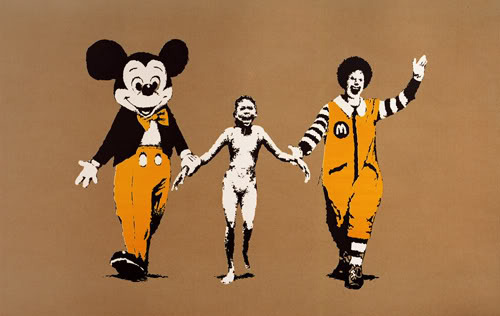
Everyone go stream Exit Through the Gift Shop if you haven't already. I love that movie so hard.If you want to economize, just watch the Disney Secret Police segment:
http://youtu.be/xggauOftlzo
DisneyLand was made to be HACKED.
 Mod
Mod
Other documentaries I've seen recently and enjoyed:
Tabloid - The funniest documentary I've seen in years, due to the totally bonkers subject material.
Senna - The best documentary I've seen in years, and had me in tears many times for many different reasons.
JFK: 3 Shots That Changed America - 3 hours of archive footage, pretty incredible!
As you can probably tell, I sat on a plane for 24 hours on my way back from Australia, and I had a lot of time to fill!
TABLOID was great. Errol Morris dominates his field.Mormonism and cloning? SF delight.
Will check out the others, thanks.
Somebody posted footage of Joyce McKinney crashing the Q&A at the NY premiere. =)
http://youtu.be/eqyO81UZ3Mc
Alexander wrote: "Everyone go stream Exit Through the Gift Shop if you haven't already. I love that movie so hard.If you want to economize, just watch the Disney Secret Police segment:
http://youtu.be/xggauOf..."
Hey, man,
The image in your post is so powerful I'm having trouble typing this. Worthy of Jello Biafra. I bow down.

SFBRP Listeners
Books mentioned in this topic
The Dervish House (other topics)Comeuppance: Costly Signaling, Altruistic Punishment, and Other Biological Components of Fiction (other topics)
The Hollow Man (other topics)
Holy Fire (other topics)
The Windup Girl (other topics)
More...

Some of my reactive brain farts:
I.
Your review raises a beguiling aesthetic question. You claim that 20% of the way into the novel, your accumulated past SF reading had greased the rails for what you thought the book would be, blew open a kind of narratological pocket-universe of an alt-Doctorow doing a kind of Freakonomics riff on the convoluted pinball effect of Whuffie AdHocracy. Essentially, forty pages in, you and Doctorow both entered Telepod 1 and emerged from Telepod 2 a new mutant hybrid that whispered its alt-universe story in parallel to your reading of the original text. The Burrage-Doctorow mashup was so much more entrancing than the raw story that, like the homicidal clone who wants to murder his original, your scales of judgement may have been tipped by a Scanner Darkly-style brain rift.
The question becomes: did you give Doctorow an honest shake in the audition room? Or did your parallel-universe version of the novel pour sugar into the gas-tank of the original text?
II.
You may be underestimating Disneyworld as a massively important SF machine, an astonishing (and discomfiting) consumer simulacrum that SF itself helped imagineer. Park visitors young and old often experience a cult-like swoon into an immersive SF virtual-reality that tore its way out of the pulps and into the thought-control matrices of Marketing and Mood Management. The strain of SF that deals with flipflopping utopia/dystopias has never been taken so far, and so Disneyworld is the closest thing to a SF-novel-come-to-life that we've ever concocted. Love it, hate it, yawn indifferently at it, the Disney pathogens have infected everything. Though perhaps it was Cory's unapologetic pro-Disney boosterism that irked you, like a whoring Mouseketeer who just popped six tablets of E?
Disneyworld is a scripted ecology, a "well-plotted" consumer narrative, the antithesis of Adhocracy. The noteworthy anomaly here is that Doctorow seems sincere in his love for the place, and thus to be seeding his alt-Disney with Adhocratic creative chaos. In one respect, Doctorow is like a happy-go-lucky version of Cypher (Joe Pantolino) from The Matrix, meeting with the evil AIs and saying, "Hey, ya know? Disneyworld is the happiest place on earth because it’s the fakest place on earth. And I don't give a rat's ass. I want a fucking intravenous drip of simulacral magic and I want it now. I want it forever."
This ethics parable of the simulacrum flags many a SF reader, the ones who see themselves as courageous Philip K. Dick protagonists rebelling against the Gnostic archons of illusion and control, but throw a tantrum whenever the author diverges from corn-syrupy escapist story-structures. "No plot and no likeable characters?! Why, I'd give it zero stars if I could! Hmph."
In another respect, Doctorow wants to persuade the reader that the imagineers are something more than very clever propagandists for hedonic virtuality, in telling a story about how and whether DW could survive the AdHoc crowdsourcing of its spectacles.
Thematically, Disney's colossal success in the media-ecology of our times is always ripe for SF culture hacking. "Indifference" to Disneyworld may be indifference to our generation's particular recipe for corn-syrup Orwellianism. 1984's Two Minutes of Hate has been flipped and subsumed by the Magic Kingdom of prozac capitalism -- triumphing over the Stalinist theme-parks of the Cold War.
Or to put it in SF terms, Aldous Huxley's soma has (mostly) whipped George Orwell's panopticon.
Compare DW to the scripted space of the Cruise Ship, an escapist luxury spa and entertainment complex, docking at "exotic" locales but offering the same tour-guide-mediated semi-scripted experiences that are taken to their limit in aggressively-overdesigned theme-parks like DW.
Disneyworld (and its global market tentacles) are a perverse and ongoing archaeology of the SF utopian soul, the hypnagogic poetry of engineered spaces, unwise to ignore or underestimate.
(Note: I'm not deriding your profession, and have nothing but envy for what you do. I'm just invoking familiar-territory to fill the cognitive gap of your never having swooned over DW as a boy.)
III.
The theme of Value as it relates to immortality: If we cheat death, to what extent do we cheat life? Baudrillard wrote that America (or the West), assuming one inhabits the privileged sphere of middle-class or above, may be as close to Utopia as we're going to get. If we achieved a Culture-like post-scarcity economy, would we all become as shallow as a Cory Doctorow character? Would the safety-nets of e-mortality blight the world into a Disneyfied necropolis?
(Image: Celebration, USA. -- a Disney planned community)
So in a sense, DAOITMK is a quietly apocalyptic novel, an "ironic" apocalypse (though it's unclear to what extent Cory is in on his own wily joke) -- a wasteland of superficiality that suffuses Doctorow's characters, and shackles them to his limpid YA prose. To be fair, Doctorow is also mine-crafting the same rich theme of his (quite excellent) short story "Craphound": how a utopian mentality would exalt the aesthetic as a form of non-zero-sum barter, of being a participant in an enriching improvised story or life-narrative as the ultimate metaphysical currency of human value-making.
By these lights, the Whuffie-entrepreneurs would be the ones who enacted the best, most humanly rewarding, life-stirring stories -- Doctorow hovers around a wellspring of SF genius that he may barely be aware of, and perhaps not-quite-talented enough to exploit fully as a writer.
Try analogizing the Disney imagineers bickering over the Hall of Presidents to the flame wars between Wikipedia editors over how the wars in Iraq and Afghanistan should be represented. Or compare the Haunted Mansion schism to culture wars between different theocrat blocs.
It's quite probable that the types of crises and controversies that will burn up the noosphere in a post-death, post-scarcity society will be precisely these type of pop-cult blood-vendettas over the "deep meaning" of cultural mega-kitsch like theme-park rides. Doctorow is mightily prescient here. You may be largely indifferent to Disneyworld, but the archetypes Doctorow is playing with still retain dramatic and satiric depth.
(Image: The Haunted Mansion)
IV.
An interesting angle to approach the Disney meme is the vast semi-underground literature of former employees and disaffected cultists, battle-hardened service-sector workers who trussed up their tired faces with a smile to keep the scripted illusion up and running -- to keep the Philip K. Dick protagonists (i.e. we 21st century consumers) from tearing through the fourth wall.
Here's one fun example:
http://youtu.be/f_WaxuN4o78
Swoozie is on the fence between Doctorow's unabashed Disneyphilia and the healthy auto-immune cynicism any sane adult would have toward the place. It illuminates the question of what I think is the ultimate value of theme-parks for SF readers: exploring the tension between escapist melodrama and the consciousness-raising potential of speculative fictions and environments.
In short, the metaphysics of Plot.
V.
"Stuff happening is not plot." -Luke Burrage
Stuff happening is Life.
And Disneyworld is the most "well-plotted" cultural space in the West.
Since life is mostly plotless, teeming with unlikeable characters, how much of our dignity are we willing to relinquish to escapist formulas of pageturner-melodrama that most genre readers demand (often quite angrily)?
Plots are, after all, mostly fake, outlandish contrivances, just like Disneyworld.
Plots can also be quite fun, even life-affirming, again like Disneyworld.
But both cultivate childish needs for illusory structure and order, of evil getting its comeuppance, of Chaos being hemmed in by apotropaic Law, of events being over-choreographed by the crowd-pleasing Demiurge author, like a pharmacologist designing drug-regimens. You mentioned in your review (correctly) that Doctorow is primarily a YA author -- I would extend this judgement to most SF, however conceptually rich or engaging on other levels. Plots sweeten the pill, but they can also dilute the nutritional value of an ambitious thought-experiment. The bathos of Clarion-approved story-structure can deepen and fortify the Simulacrum, the entertainment-complex that SF helped devise, and should now be re-tooled to tear back down. (Perhaps like J.G. Ballard tried to do in aiming his apocalyptic fiction like a gunbarrel at Asimov, Heinlein, and Clarke.)
(The most disheartening trivia question in SF history: which novel won the Hugo Award in 2001?)
R. Scott Bakker's "The Post-Posterity Writer" wrestles brilliantly with this issue, though I'm wary of his embittered, face-saving conclusions. In a nutshell, Bakker claims he writes epic pulp fantasy because his "social conscience" forbids him from developing into an ambitious artist. Yeeeaaahhh OK, Scott. You passed on the Excalibur of literary virtuosity because you're a nerd-adoring democrat who wants to reach da People. (And make a living.)
http://rsbakker.wordpress.com/essay-a...
Understand, I'm not bashing the concept of story, and enjoy a well-spun yarn as much as anyone. But the fetish for "plot," of losing oneself in an over-designed imaginative space, can plummet a reader into the Matrix of unknowing. Adventurous and open-minded in so many other respects, too many SF consumers freak out at anything not overtly designed to keep the pages turning, even if the destination they arrive at is nowhere and nothing new.
If "story versus plot" is too nebulous, try drama versus melodrama, or pathos versus bathos. These are fuzzy dualisms, and the debate lines have to be redrawn for each book under review. But SF authors are in general so insulated from these concerns that messy, bathos-soaked efforts like Queen of Angels or The Windup Girl are absurdly touted as "literary."
Hey! SF! Time to move out of your parents' basement!
[continued below]