
Art Lovers discussion
Art Related Crime
>
Art Theft
date newest »
newest »
 FBI---Art Theft
http://www.fbi.gov/about-us/investiga...
It’s like stealing history
Art and cultural property crime—which includes theft, fraud, looting, and trafficking across state and international lines—is a looming criminal enterprise with estimated losses running as high as $6 billion annually.
To recover these precious pieces—and to bring these criminals to justice—the FBI has a dedicated Art Crime Team of 13 special agents, supported by three special trial attorneys for prosecutions. And it runs the National Stolen Art File, a computerized index of reported stolen art and cultural properties for the use of law enforcement agencies across the world.
Please note: U.S. persons and organizations requiring access to the National Stolen Art File should contact their closest FBI Field Office; international organizations should contact their closest FBI Legal Attaché Office.
In Depth
Initiatives & Background
- Art Crime Team
- National Stolen Art File
- Jurisdiction/Legislation
Report Stolen Art
- Submit a Tip Online
- Contact Your Local FBI Office
- Contact Your Nearest Overseas Office
Protect Your Treasures
- Advice from an Art Theft Expert
Other Resources
- Interpol Stolen Works of Art
- Museum Security Network
- International Council of Museums
- More
FBI Top Ten Art Crimes
- Iraqi Looted and Stolen Artifacts storm80.jpg
- Isabella Stewart Gardner Museum Theft
- Theft of Caravaggio's Nativity with San Lorenzo and San Francesco
- Theft of the Davidoff-Morini Stradivarius
- The Van Gogh Museum Robbery caravaggio2.jpg
- Theft of Cezanne's View of Auvers-sur-Oise
- Theft of the Gertrude Vanderbilt Whitney Murals, Panels 3-A and 3-B
- Theft from the Museu Chacara do Céu
- Theft of Van Mieris's A Cavalier
- Theft from E.G. Bührle Collection, Zurich
FBI art crimes chief 'ordered theft of Monet and Sisley paintings from French gallery' Seven people go on trial on Monday for the multi-million pound theft of a Monet, Sisley and two Breughels in Nice but their leader claims the FBI's art crimes chief "ordered" the heist.
By Henry Samuel
The Telegraph
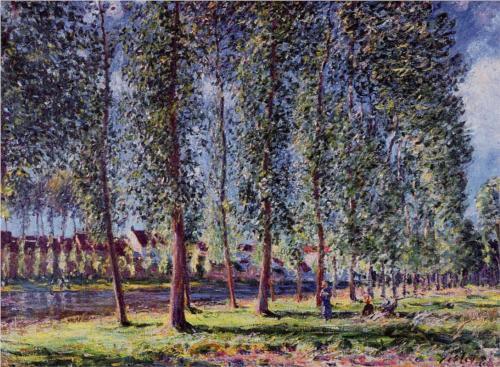
Alfred Sisley's Avenue of Poplars at Moret
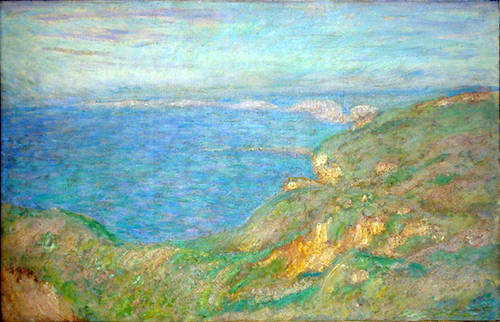
Claude Monet's Cliffs Near Dieppe
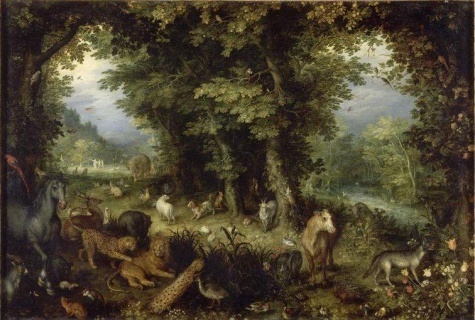
Jan Brueghel the Elder Allegory of Earth
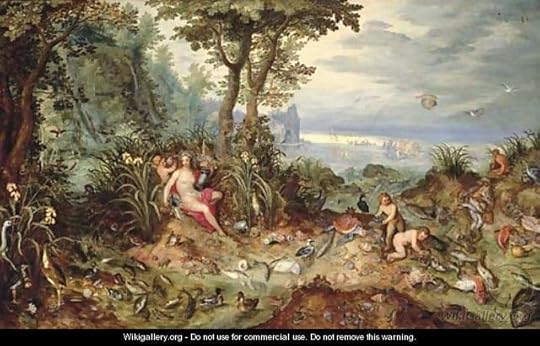
Jan Brueghel the Elder Allegory of Water
The men face maximum sentences of 30 years in prison for armed robbery at the end of the week-long trial in Aix-en-Provence. The leader's lawyer claims they were a bunch of bumbling art amateurs talked into the heist by the world's most notorious art detective bent on catching bigger prey.
At lunchtime on August 5, 2007, thieves dressed in blue overalls and ski masks burst into the poorly guarded Musée des Beaux Arts.
Their leader, Pierre Noël-Dumarais, then 60, pointed a Colt 45 at the welcome desk while four accomplices unhooked four paintings from the museum walls and stuffed them into black bin bags. Five minutes later, they made their escape in a blue Peugeot van.
In the boot were two Breughels – Allegory of Water and Allegory of Earth – Alfred Sisley's Avenue of Poplars at Moret and Claude Monet's Cliffs Near Dieppe. While their combined value has been estimated at 22 million euros, their stolen sale price would be no more than three million euros.
The French police had few leads bar DNA from a cigarette butt and a bin bag, but they would soon receive help from across the Atlantic.
Robert K Wittman, then FBI special agent and chief of its Art Crimes Team, first got wind of the paintings while undercover as a shady American dealer moving stolen art for crime syndicates and drug lords. He was told about the works by Miami-based Frenchman Bernard Jean Ternus, with links to Marseille's Brise de Mer Corsican mafia clan.
Now retired, "Bob" Wittman recovered around $300 million-worth of stolen art and objects in his 20-year career, including Geronimo's war bonnet, one of the original 14 copies of the US Bill of Rights, and works by Rembrandt, Rodin and Rockwell.
But the greatest unsolved art crime in history still eluded him, namely the 1990 theft from the Isabella Steward Gardner Museum in Boston of a long-lost Vermeer, two Rembrandts and five sketches by Degas worth around $500 million.
His pulse raced when his plump, shaggy-haired French connection, Mr Ternus, alias "Sunny" boasted that he could get hold of the Vermeer and a Rembrandt.
To "hook" Sunny, Mr Wittman invited him to a party on a Miami yacht, complete with bikini-clad models and staged the sale of five fake masterpieces to a Colombian drugs baron in exchange for gold and diamonds. The entire crew and cast were FBI agents, but Sunny fell for it.
This is where the version of events diverges.
Mr Wittman says that during subsequent conversations about the Rembrandt and Vermeer, Sunny offered him and his co-agents other works, including two Picassos and the Nice paintings.
"I had no idea about the Nice theft nor had I ever met or spoken to the defendants until after it occurred," Mr Wittman told The Daily Telegraph.
"We couldn't turn down (the sale offer) as they were all crimes."
However, Ludovic Depatureaux, the lawyer of the gang's alleged leader, Mr Noël-Dumarais, claims that Mr Wittman encouraged the theft by expressing an interested in "Dutch paintings".
"In autumn 2006, he effectively placed an order with Bernard Ternus, saying he was interested perhaps in Vermeer and Rembrandt, but in Dutch paintings in general, and had buyers.
"Wittman thought that (via the Nice thefts), he would infiltrate those who stole or still hold the Vermeer and Rembrandt. The Nice heist was just collateral damage.
"My client's modus operandi did not start from the premise: let's steal some paintings then find a buyer. They were a bunch of amateurish 'stooges' some of whom only met on the day of the heist.
"These canvasses disappeared in order to recover two key paintings belonging to US heritage. I'm not sure that the US would appreciate it if French agents acted likewise."
He said Mr Wittman was guilty of "police provocation" and that he would call for charges to be dropped.
Mr Wittman said: "In the US, we law enforcement officers used to call that 'throwing fecal matter against the wall and seeing what would stick'".
"I don't think anything I did 'encouraged' anyone to obtain Chechen hand grenades and semi automatic pistols in order to commit armed robbery. It is a fanciful defence at best, at worst, it is a defence of desperation used only when criminals are caught."
He denied they were amateurish. "They were good criminals, but terrible businessmen."
http://www.telegraph.co.uk/culture/ar...
Hotel chain invites its guests to be art thievesA CNN report says: “Yep, if you manage to nick the Banksy that’s hanging in one of Melbourne’s Art
the Cullen, the Blackman or the Olsen – and stash it until January 15, 2012, you can keep it.
“What’s more, if you’re caught the police won’t get involved. The art just returns to its wall – no questions asked.”
What’s the catch, apart from the possibility of getting caught and having to return the artwork? Well, you have to stay the night in one of the hotels.
Read more: http://www.digitaljournal.com/article...
 Hello Everyone,
I just started a group on Art Crime, we would be discussing art thefts looting, forgery, and everything else art crime related. Also discuss books, blogs, and any other media related to the subject of art crime.
http://www.goodreads.com/group/show/6...
I don't usually condone 'advertising' other groups in this group but Ilana's group is interesting...the topics she would like to discuss and the different threads she has started. For those of you interested in discussing more in depth the topic of art crimes, I highly recommend checking out her group.
Greek national gallery robbed of Picasso, MondrianAlarm system triggered early as decoy
CBC News
Thieves have snatched a trio of valuable artworks from Greece's National Art Gallery in Athens, staging a devious pre-dawn heist and making off with paintings by Pablo Picasso and Piet Mondrian.
The stolen works — all stripped from their frames — included Woman's Head, a 1930s-era cubist bust that was donated to Greece by Picasso himself. The second painting taken was Mondrian's Mill, a 1905 oil canvas of a riverside scene and windmill.
The robbers also grabbed a pen-and-ink sketch of St. Diego de Alcala by 16th century Italian artist Guglielmo Caccia.
Gallery officials have not disclosed the value of the three works.

In this composite image, the Picasso painting Woman's Head is shown at left next to a Guglielmo Caccia drawing. The pair were stolen from Greece's National Art Gallery early Monday. (National Art Gallery/Associated Press)
Triggered alarms in advance
Beginning Sunday evening, the robbers intentionally set off the gallery's alarm system several times without entering the building, according to police.
The security staffers on duty, who investigated and found no disturbances, subsequently disabled at least one alarm. The burglars then entered through a balcony door.
The thieves did, however, trigger a motion sensor in the exhibition area around 4:30 am local time. However, the responding guard just arrived in time to see one of the suspects fleeing.
A fourth work — another 1905 Mondrian work — was targeted, but abandoned as the thieves fled.
The entire heist took about seven minutes, according to police.
The museum, which features mostly 19th and 20th century Greek paintings, had just concluded the exhibition Unknown Treasures. On Monday, it had been scheduled to shut down for an expansion and restoration project.
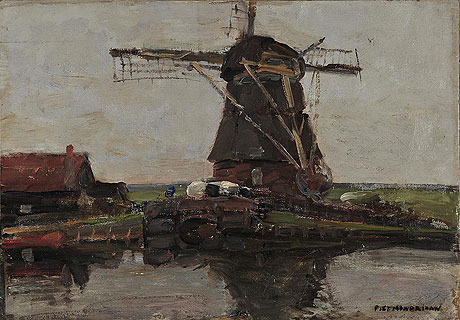
Mill by Piet Mondrian was the third work taken by unknown thieves, who left another Mondrian as they fled the Greek museum. (National Art Gallery/Associated Press)
 Interesting about this very early Mondrian--how it's dominated by verticals and horizontals (or near verticals and near horizontals).
That is interesting seeing as that is the direction his abstract works seem to have taken.
Interesting about this very early Mondrian--how it's dominated by verticals and horizontals (or near verticals and near horizontals).
That is interesting seeing as that is the direction his abstract works seem to have taken.The earliest paintings that show an inkling of the abstraction to come are a series of canvases from 1905 to 1908, which depict dim scenes of indistinct trees and houses with reflections in still water. Although the end result leads the viewer to begin emphasizing the forms over the content, these paintings are still firmly rooted in nature, and it is only the knowledge of Mondrian's later achievements that leads one to search for the roots of his future abstraction in these works.
Mondrian began producing grid-based paintings in late 1919, and in 1920, the style for which he came to be renowned began to appear.
In the early paintings of this style the lines delineating the rectangular forms are relatively thin, and they are gray, not black. The lines also tend to fade as they approach the edge of the painting, rather than stopping abruptly. The forms themselves, smaller and more numerous than in later paintings, are filled with primary colors, black, or gray, and nearly all of them are colored; only a few are left white.
During late 1920 and 1921, Mondrian's paintings arrive at what is to casual observers their definitive and mature form. Thick black lines now separate the forms, which are larger and fewer in number, and more of them are left white than was previously the case. This was not the culmination of his artistic evolution, however. Although the refinements became more subtle, Mondrian's work continued to evolve during his years in Paris.
In the 1921 paintings, many of the black lines (but not all of them) stop short at a seemingly arbitrary distance from the edge of the canvas, although the divisions between the rectangular forms remain intact. Here too, the rectangular forms remain mostly colored. As the years passed and Mondrian's work evolved further, he began extending all of the lines to the edges of the canvas and he also began to use fewer and fewer colored forms, favoring white instead.
http://en.wikipedia.org/wiki/Piet_Mon...
 In my art appreciation class, II use a short reading from a supplementary text (Ocvirk's Art Fundamentals) Art Fundamentals: Theory and Practice to introduce my students to the ideas of abstraction and evolution in art. the text has several pages of artworks by Mondrian, tracing his development from more representational work to more abstract art that focuses on formal elements of color, shape and line.
The book also has a set of images drawn by Picasso. They are all bulls, as you look from drawing to drawing, the bulls evolve from realistic to just a few expressive figurative lines giving the impression of a bull. Students often tell me they thought the most realistic and detailed was the "last" bull, the one Picasso painted last. These students,, who haven't necessarily seen an lot of art before, have trouble recognizing that an artist might move from more detail, more representational to less. Art Fundamentals: Theory and Practice
That looks like a good book, Rachel. I added it, thank you. And interesting that the students thought the 'last' bull was the most realistic.
Rachel wrote: "In my art appreciation class, II use a short reading from a supplementary text (Ocvirk's Art Fundamentals) Art Fundamentals: Theory and Practice to introduce my students to the ideas...The book also has a set of images drawn by Picasso. They are all bulls, as you look from drawing to drawing, the bulls evolve from realistic to just a few expressive figurative lines giving the impression of a bull...."Two other famous series that explore progressive abstraction:
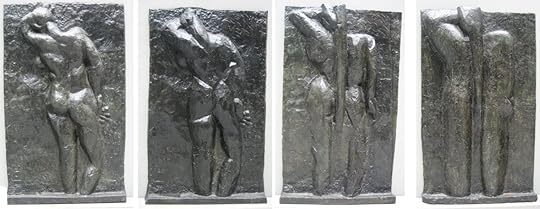
Matisse bronze sculptures, left to right: 'The Back I', 1908-09, 'The Back II', 1913, 'The Back III' 1916, 'The Back IV', c. 1931, all Museum of Modern Art (New York City)
Larger:
http://upload.wikimedia.org/wikipedia...
And the cow series by Theo Van Doesburg
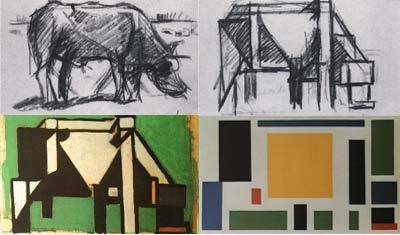
Theo van Doesburg, aesthetically transformed Subject, 1917, Bauhaus-Archive, Berlin.
Rachel wrote: "Thanks Ed"No problem. Feeling rectangular today.
Sorry, but I don't see anything in that last one. Am I missing something?
Maybe I need to "think outside the box"! lol
It looks vaguely cow like if you compared it to the one before it. But if I saw it by its self I would think its just a bunch of squares.
Ilana wrote: "It looks vaguely cow like if you compared it to the one before it. But if I saw it by its self I would think its just a bunch of squares."That's actually an very interesting point. And I think he intended to make you think that.
In other words, even the most formal and abstract art can have sources in recognizable images, and personal feelings. But if they are changed, they aren't just the sources they came from, but something else!
This is a really strange thing to think about. Here's some mind bending thoughts. Not saying they are right, just suggesting that we each try to find our own answers to them.
The forms may still convey some of the emotions of the original form, and they may make you think of a cow or other animal, but many other animals and objects and many other presences as well. Which is a really strange thing. If you take things out of an image you often cause extra things to come into it in the viewer's imagination. I remember one abstract painter saying he painted abstractly, not to take things out, but to put them in.
And here's another confusing thing. Since it is serial imagery, does the thing mean something, or does it mean something in context, such as that provided by the other paintings? Are Monet's haystacks or Warhol's Marilyns individual works? And don't all paintings and artworks exist in context? Do they mean something by themselves, or only in relation to other works of art?
Man gets prison for NY part of art-theft spreeBy JENNIFER PELTZ
Associated Press
NEW YORK (AP) — A wine steward who served time in California after going on a bicoastal binge of plucking pricey art off gallery walls and using it to adorn his own home was sentenced Tuesday to prison in New York.
Mark Lugo said simply, "I'm sorry," as a judge sentenced him to one to three years behind bars in New York, though he could be released in six months if he succeeds in a boot camp-style program.
Lugo, 31, previously pleaded guilty to taking a $350,000 drawing by Cubist painter Fernand Leger from a lobby gallery at Manhattan's Carlyle Hotel in June. In the California case, he also admitted to snatching a $275,000 Picasso drawing called "Tete de Femme" ("Head of a Woman") from the Weinstein Gallery in San Francisco in July.
He finished a 138-day California sentence in November, and was brought to New York to face charges that also included stealing five works by the South Korea-born artist Mie Yim from another Manhattan hotel in June. While he admitted specifically to the charge involving the Leger, the guilty plea was accepted as resolving the charges related to the works by Yim, who's known for her disconcerting images of toy bears and other creatures.
Investigators found a $430,000 collection of stolen art — including the Leger, a 1917 piece called "Composition with Mechanical Elements" — hanging in Lugo's apartment in Hoboken, N.J., authorities said.
"In an effort to display stolen art in his apartment, this repeat art thief boldly walked out of two Manhattan hotels in broad daylight" with valuable works in canvas tote bags, Manhattan District Attorney Cyrus R. Vance Jr. said in a statement when Lugo was arraigned.
Lugo's lawyer, James Montgomery, noted Tuesday that Lugo had "no commercial motive" in the thefts.
"His interest in these things was aesthetic," Montgomery said.
While most art thieves aim to sell what they take, a few have stolen to flesh out their own collections, said Robert K. Wittman, an art-security consultant and former investigator for the FBI's national art crime team.
Lugo, a sometime sommelier and kitchen server at upscale Manhattan restaurants, also is charged in New Jersey with taking three bottles of Chateau Petrus Pomerol — together worth $6,000 — from a Wayne wine shop in April. That case is pending.
It's been awhile since we've visited this thread, but our own Dvora found, what I consider, an interesting gem.Check it out!
https://www.youtube.com/watch?v=aFs9e...
The World's Most Expensive Stolen Paintings [BBC 2013]
It is almost an hour long, but an hour worth watching. The first few minutes made me gasp! And it's been fun naming the famous paintings as they are first introduced. It details the diverse museums and private collectors who fell victim to very clever and daring thieves.
 Heather wrote: "Maybe I need to "think outside the box"! lol"
If you think within box, you will end up being swallowed up by the painting.
Heather wrote: "Man gets prison for NY part of art-theft spreeBy JENNIFER PELTZ
Associated Press
NEW YORK (AP) — A wine steward who served time in California after going on a bicoastal binge of plucking pricey..."
Three bottles don´t make a case
Christie's scraps Miro sale after uproar in Portugal
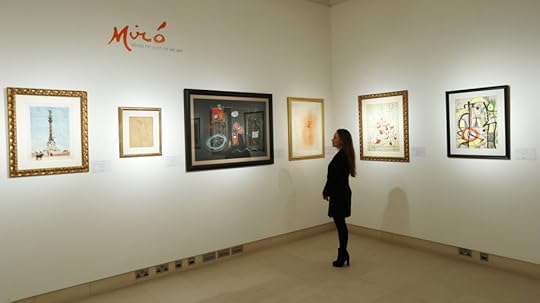
A Christie's employee looks at a selection of artworks by Joan Miro, which will be sold next week, at Christie's auction house in London January 30, 2014.
A Christie's employee looks at a selection of artworks by Joan Miro, which will be sold next week, at Christie's auction house in London January 30, 2014.
 Did our group every talk about the discovery in Munich a few months ago of a huge stash of 1400 paintings hoarded by Cornelius Gurlitt? The BBC just aired a two-part documentary about art stolen by the Nazis and Gurlitt (and the paintings) figured in the report.
 Germany has done as little as possible since the end of the war to return works that were stolen -- many of them from Jewish owners. One reason (but not the only one) is that many of these paintings now hang in German museums. In the case of the Gurlitt collection, it had been amassed by Cornelius's father, Hildebrand Gurlitt, an art dealer.
What was very interesting in the report is that these 1400 paintings were actually discovered 18 months before it was announced to the public. It was announced thanks to a leak. And to this day (more than two years after discovery) a definitive list of the paintings has not been made public. It seems clear that the German authorities don't want these paintings to be returned to their rightful owners (by now, mostly heirs) either.
The program is called The Art That Hitler Hated: The Sins of the Fathers.
 i admire the depth of the discussion on this thread;
not sure how relevant this is to your discussion. just came across this in YT;
http://youtu.be/14v4VH6paFQ
Stolen Art WWII - Hitler's European world class art centre in Linz
also, Inside Hitler’s Fantasy Museum in Linz:
http://www.thedailybeast.com/articles...
; '
Report of Nazi-Looted Trove Puts Art World in an Uproar - NYTimes.comThe Bavarian authorities swooped in on the home of Cornelius Gurlitt, now 80, seized about 1,500 works estimated to be worth $1.4 billion, according to the news magazine Focus. German officials said the raid occurred on Feb. 28, 2012.
http://www.nytimes.com/2013/11/05/art...
Just for fun. This is an artist who "steals" works by making meticulous charcoal "portraits" of high modernist American painting. (With permission.) He actually copies the brushstrokes and canvas textures.
"Robert Longo: I am an Image Thief"
Video:
http://channel.louisiana.dk/video/rob...
Wow!"Uzbekistan Museum Director Sold Artworks and Replaced Them With Fakes"
The director of the State Art Museum of Uzbekistan in Tashkent was sentenced today to nine years in prison....
http://hyperallergic.com/168595/uzbek...
This is a dramatization of the infamous self-dealing and looting conspiracy on the part of the trustees of the estate of Mark Rothko and the Rothko foundation. Warning: it's a pretty tragic story, his marriage came apart, his health deteriorated before his presumed suicide*. His advisor, Reis, had come to influence him so that he could seize control of the estate. The long saga involved his daughter battling to seize control of the paintings so that they could be handled in the way her father wished.
Second warning: the film quality is really bad, sorry about that.
https://www.youtube.com/watch?v=0qddc...
* some dispute that Rothko actually committed suicide, the death was too convenient--as you will see in the story, there were two other key suspicious deaths....
 @Luc:
@Luc:re: Raubkunst
I just watched Monument Men again and I got to wondering what was the resolution of the Cornelius Gurlitt trove of Raubkunst?
It has to be worth a billion dollars.
"The Devil and the Art Dealer"
http://www.vanityfair.com/news/2014/0...
http://www.lostart.de/Webs/EN/Datenba...
Apparently they're still studying the provenance of these works.
Hopefully they find some more and start restitution.
Sometimes truth is stranger than fiction. I think it will take a long time for them to work it all out. And I don't suppose they are in much of a hurry. The Austrian and German museums prefer just to keep the art rather than restore works to their rightful owners. But then, these are probably all stashed away in some police warehouse and not on display. I wonder....Gary wrote: "@Luc:
re: Raubkunst
I just watched Monument Men again and I got to wondering what was the resolution of the Cornelius Gurlitt trove of Raubkunst?
It has to be worth a billion dollars.
"The Devi..."
 Dvora wrote: "Did our group every talk about the discovery in Munich a few months ago of a huge stash of 1400 paintings hoarded by Cornelius Gurlitt? The BBC just aired a two-part documentary about art stolen by..."
I did not know there was a documentary about this on BBC, I'll try and track it down online. This case is so fascinating! And now that a team of 4 researchers have been tasked with finding the rightful owners, there may be headway made after all. I read today Switzerland is digitizing all of its art and museum-related archives in order to help facilitate the restitution research. I believe only 4 paintings have been returned so far. Slow going, but then it has been over 70 years.
Jennifer wrote: "I read today Switzerland is digitizing all of its art and museum-related archives in order to help facilitate the restitution research. I believe only 4 paintings have been returned so far. Slow going, but then it has been over 70 years. "That's good news, Jennifer! I hope by them digitizing all of the art they can track down and discover more. You're right, 'slow going', but I think it will develop more and be more productive in the very near future.
Ed wrote: "Rachel wrote: "In my art appreciation class, II use a short reading from a supplementary text (Ocvirk's Art Fundamentals) Art Fundamentals: Theory and Practice to introduce my studen..."This four steps to abstracting a cow by Theo van Doesberg is incredible! What a great find.
Heather wrote: "Jennifer wrote: "I read today Switzerland is digitizing all of its art and museum-related archives in order to help facilitate the restitution research. I believe only 4 paintings have been returne..."You're right, there is so much potential there! And the more collections digitalized, the more connections that can be found.
As promised, here is an update of the free Antiquities Trafficking and Art Crime course on FutureLearn.We just started week 3, but honestly I've just finished up week 1's course materials! I've never taken an online course before and find it quite easy to follow. If you only do the bare minimum, you'll probably spend about 4 hours a week on it. But I've found the discussions so intriguing, it's taking me more time to get through the materials!
It's a combination of videos, articles, online assignments and discussions. Week 1 is focused on antiquities trafficking, and I must admit I've learn quite a bit about both sides - the impact on the local population and the seller's market in Western countries.
If you join before it ends this weekend, you can access the materials until July 9. I recommend it, even if you don't really want to do all of the assignments (nothing is required and you can skip forwards through the course materials).
The second week is focused on looted art and I believe the last week is focused on forgeries.
I hope this helps!
https://www.futurelearn.com/courses/a...
 Great, I've seen that one, I've asked when FL is going to integrate with GR.
Jennifer wrote: "As promised, here is an update of the free Antiquities Trafficking and Art Crime course on FutureLearn.
Great, I've seen that one, I've asked when FL is going to integrate with GR.
Jennifer wrote: "As promised, here is an update of the free Antiquities Trafficking and Art Crime course on FutureLearn.We just started week 3, but honestly I've just finished up week 1's course materials! I've n..."
Thank you, Jennifer! That sounds fascinating! I would probably be like you and take more time to learn even what is taught only in the first week. When an interest grabs me, I want to know all that I can about the subject. And you have me very interested.
I look forward to more reports from you!
Heather wrote: "Jennifer wrote: "As promised, here is an update of the free Antiquities Trafficking and Art Crime course on FutureLearn.We just started week 3, but honestly I've just finished up week 1's course ..."
Thanks, Heather!
 Back in 1982, I was living in an artist studio near MIT. Several of my colleagues who also had studios there came back extremely excited as they were getting their first international show in Holland. I was enthused for them and wanted to get in on the action. The Dutch government had approached the Boston Visual Artists Union, (BVAU) a membership arts organization that had a small gallery and listings for artist opportunities. Their representatives had set up shop at the BVAU for the week and so I paid a visit. I was a little concerned because I found it a bit strange that all three of my colleagues had been accepted for a show in Amsterdam. So I made the necessary enquiries. One Dutch agent showed me a catalog of work that had comprised the previous year`s show. As it was in Dutch, I had no idea what was written. But what was the giveaway was that the work was not what we would consider curatorial quality but only commercially viable. There was no cutting edge work in the catalog, only impressionism and past movement arts-nothing current. I got suspicious and asked the agent her government credentials. She became very aggressive and asked me what were mine. I left immediately half realizing it was but a scam but still holding out hope for my friends.
 Two days later the true facts came out. It was indeed a scam to procure illegally art work for the black market. All the work was immediately warehoused by the perps. Senator Ted Kennedy´s office had had its own suspicions and tipped off the FBI to look into the matter. The trial and complications kept their artwork warehoused for 18 months. I never entered into the competition so there was no loss on my part. None of my friends wanted to talk about the matter and still don´t.
Geoffrey wrote: "Back in 1982, I was living in an artist studio near MIT. Several of my colleagues who also had studios there came back extremely excited as they were getting their first international show in Holla..."Wow! What a story, Geoffrey! What an experience! Was it all in the papers during the investigation or not released to the public?

Art Lovers
Books mentioned in this topic
Art Fundamentals: Theory and Practice (other topics)Art Fundamentals: Theory and Practice (other topics)
Art Fundamentals: Theory and Practice (other topics)
http://en.wikipedia.org/wiki/Art_theft