
Art Lovers discussion
Fame and Fave Females
>
Helen Frankenthaler
date newest »
newest »
 Pushing Past Abstraction
By ERIC GIBSON
The Wall Street Journal

'Nature Abhors a Vacuum' (1973)
n 1953 Helen Frankenthaler, who died this week at age 83, received a visit from Kenneth Noland and Morris Louis, two artists from Washington who were stuck in an Abstract Expressionist rut. In her studio they saw "Mountains and Sea," of the year before, a characteristically abstract work painted by pouring pigment onto a canvas laid on the floor.
The poured-paint technique had been pioneered by Jackson Pollock a few years earlier, but in this work the 24-year-old Frankenthaler made it her own. In place of the older artist's looping and whipping lines of gray, black and tan, her imagery consisted of spreading pools and washes of luxuriant pinks, blues and greens nudged here and there with a sponge. The painting was a revelation to the two men—a "bridge between Pollock and what was possible," Louis later said. Her novel technique, combined with a chromatic freedom and mastery unprecedented in recent American art, helped launch them, and others, on their own paths of color abstraction, thus ultimately changing the course of American art.
It's an oft-told tale and one that's true in every respect. Except that, to the extent that it's used to sum up Frankenthaler's achievement as one of the most important American artists of our time, it tells only part of the story. For over the course of a six-decade career, Frankenthaler jump-started American painting not once, but twice.
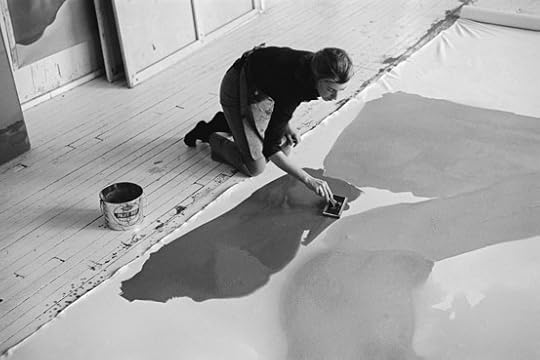
The artist at work in 1969.
Frankenthaler belonged to the second generation of the New York School, whose guiding light was the critic Clement Greenberg. Greenberg held that the essence of modern painting was the expunging of all references to the visible world and an emphasis on painting's purely formal elements—the flatness of the canvas support and the colors arrayed across it.
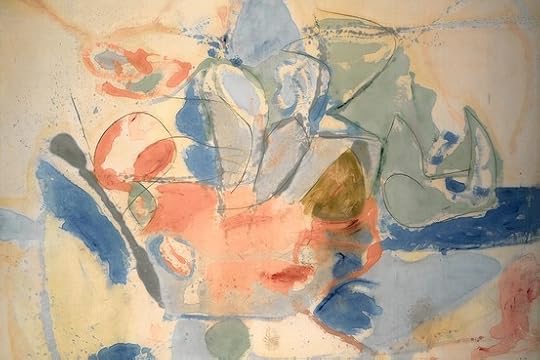
'Mountains and Sea' (1952)
More... http://online.wsj.com/article/SB10001...
Two Artists Who Embraced FreedomBy ROBERTA SMITH
The New York Times
It is strange that the sculptor John Chamberlain and the painter Helen Frankenthaler should have died within a week of each other — he on Dec. 21, and she on Tuesday — considering that they occupy such similar positions within the history of American art. Both emerged in the 1950s and provided crucial links between art styles, specifically helping to forge the transition from Abstract Expressionism to what lay beyond.
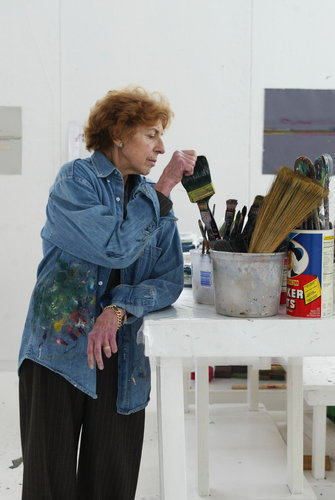 Suzanne DeChillo/The New York Times
The artist Helen Frankenthaler in her studio on Contentment Island in Darien, Conn., in 2003.
Both brought a new, unfettered approach to materials that pushed their respective mediums toward greater expressive freedom, unabashed physicality and a rough-edged, aggressively color-based beauty. These qualities became identifying hallmarks of American art, especially in the 1960s, but remain crucial to it even now.
Ms. Frankenthaler accomplished this in 1952 with “Mountains and Sea,” in which she in essence combined the drip technique of the Abstract Expressionist Jackson Pollock and the stately fields of saturated color deployed by his colleagues Barnett Newman and Mark Rothko. Using paint thinned with turpentine, she fused stained color, raw canvas and gesture, creating a freewheeling composition of blurry shapes, whiplash lines and splatters that looked forever elegantly unfinished, caught in the moment. The pastel palette of predominantly pink and blue were eminently girly; they introduced a persistently inspired and innovative colorist.
Meanwhile, the staining technique introduced in “Mountains and Sea” was quickly adopted by Kenneth Noland and Morris Louis and became fundamental to Color Field painting. (Those painters, who lived in Washington, were taken to Ms. Frankenthaler’s studio to see the work in 1953 by the eminent art critic Clement Greenberg, who was then Ms. Frankenthaler’s lover. That she was not present at the time of this historic, oft-cited visit continues to startle.)
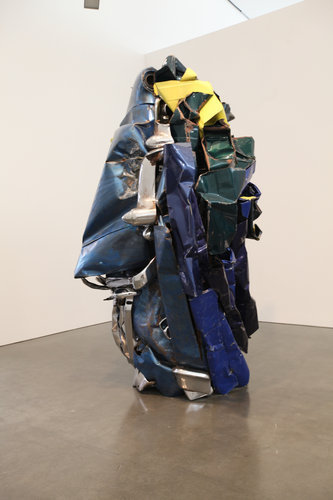 Chester Higgins Jr./The New York Times
“Peaudesoiemusic,” a metal sculpture by John Chamberlain.
The technique was also taken up by a host of other painters only tangentially associated with the movement, among them Paul Feeley, who had been Ms. Frankenthaler’s teacher at Bennington College, and Larry Poons, and was perpetuated with many variations in subsequent generations by painters as different as Alan Shields, Stephen Mueller, Moira Dwyer, Monique Prieto and Kelley Walker.
In the second half of the ’50s Mr. Chamberlain embraced scraps of discarded car bodies as sculptural material, attracted foremost by their pre-existing color. Further bending and crushing their often mangled shapes, he assembled them into abstract sculptures that offered three-dimensional versions of the dense, colorful enfolded spaces of Willem de Kooning’s Abstract Expressionist canvases.
These sculptures brought a new level of abstraction to assemblage and the notion of “junk sculpture.” They also helped set the stage for Minimalism’s use of industrial materials and its involvement with space itself. In addition, they brought bright color into three dimensions with a new ferocity and sense of possibility that proved especially important to the often intensely hued sculptures of Donald Judd.
More... http://www.nytimes.com/2011/12/29/art...
I had never heard of John Chamberlain and personally, I don't like it at all!And as far as "junk sculpture" goes, I think that Damien Hurst has a foot in that direction, too. I can't remember where his 'art' of all the literal garbage is posted, but I do think it is 'junk'!


I see that there are more posts regarding Frankenthaler since Ed's post about her recent passing. I found a couple of interesting articles and thought I would start a new thread on which we can further discuss her and her work, techniques, etc.