
The History Book Club discussion

This topic is about
John Paul Stevens
SUPREME COURT OF THE U.S.
>
#101 - ASSOCIATE JUSTICE JOHN PAUL STEVENS
date newest »
newest »
 More information, excerpted from wikipedia:
John Paul Stevens (born April 20, 1920) served as an Associate Justice of the Supreme Court of the United States from December 19, 1975 until his retirement on June 29, 2010. At the time of his retirement, he was the oldest member of the Court and the third-longest serving justice in the Court's history. He was nominated by President Gerald Ford to replace the Court's longest serving justice, William O. Douglas. Stevens is widely considered to have been on the liberal side of the Court. Ford praised Stevens in 2005: "He is serving his nation well, with dignity, intellect and without partisan political concerns." Asked in an interview in September 2007 if he still considers himself a Republican, Stevens declined to comment.
Stevens served with three Chief Justices (Warren E. Burger, William Rehnquist, and John G. Roberts).
Life and career
Early life, 1920–1947
Stevens was born on April 20, 1920, in Hyde Park,[5] Chicago, Illinois, to a wealthy family.[1] His paternal grandfather had formed an insurance company and held real estate in Chicago, while his great-uncle owned the Chas A. Stevens department store. His father, Ernest James Stevens, was a lawyer who later became a hotelier, owning two hotels, the La Salle and the Stevens Hotel. He lost ownership of the hotels during the Great Depression and was convicted of embezzlement (the conviction was later overturned).[1] (The Stevens Hotel was subsequently bought by Hilton Hotels and is today the Chicago Hilton and Towers.) His mother, Elizabeth Maude Street Stevens, a native of Michigan City, Indiana,[citation needed] was a high school English teacher. Two of his three older brothers also became lawyers.
As a boy, Stevens attended the 1932 World Series baseball game in Chicago's Wrigley Field, where he saw Babe Ruth call his shot. He later recalled: "Ruth did point to the center-field scoreboard. And he did hit the ball out of the park after he pointed with his bat. So it really happened."[6] He also had the opportunity to meet several notable people of the era, including the famed aviators Amelia Earhart and Charles Lindbergh, the latter of whom gave him a caged dove as a gift.[7] During his adolescent years, Stevens was a camper at Camp Highlands on Plum Lake near Sayner, Wisconsin.[citation needed]
The family lived in Hyde Park, and John Paul Stevens attended the University of Chicago Laboratory School. He subsequently obtained a Bachelor of Arts in English from the University of Chicago in 1941; while in college, Stevens also became a member of the Omega chapter of Psi Upsilon.
He began work on his master's degree in English at the university in 1941, but soon decided to join the United States Navy, He enlisted on December 6, 1941, one day before the attack on Pearl Harbor, and served as an intelligence officer in the Pacific Theater from 1942 to 1945. Stevens was awarded a Bronze Star for his service in the codebreaking team whose work led to the downing of Japanese Admiral Isoroku Yamamoto's plane in 1943.
Stevens married Elizabeth Jane Shereen in June 1942. Divorcing her in 1979, he married Maryan Mulholland Simon that December. He has four children: John Joseph (who died of cancer in 1996), Kathryn, Elizabeth and Susan.
With the end of World War II, Stevens returned to Illinois intending to return to his studies in English, but was persuaded by his brother Richard, who was a lawyer, to attend law school. Stevens enrolled in the Northwestern University School of Law in 1945 (the G.I. Bill mostly paying his way). He was a brilliant student, earning the highest GPA in the history of the law school.] He received his J.D. in 1947, graduating magna cum laude.
Legal career, 1947–1970
Given his stellar academic performance in law school, several prominent Northwestern faculty members recommended Stevens for a Supreme Court clerkship: he served as a clerk to Justice Wiley Rutledge during the 1947–48 term. (This service, Stevens has said, deeply inspired him, as evident from his Rutledgean focus on the careful interpretation of the facts in a case present in his opinions.)
Following his clerkship, Stevens returned to Chicago and joined the law firm of Poppenhusen, Johnston, Thompson & Raymond (which, in the 1960s, would become Jenner & Block). Stevens was admitted to the bar in 1949. He determined that he would not stay long at the Poppenhusen firm after he was docked a day's pay for taking the day off to travel to Springfield to swear his oath of admission. During his time at the Poppenhusen firm, Stevens began his practice in antitrust law.
In 1951, he returned to Washington, D.C. to serve as Associate Counsel to the Subcommittee on the Study of Monopoly Power of the Judiciary Committee of the U.S. House of Representatives. During this time, the subcommittee worked on several highly publicized investigation concerns in many industries, most notably Major League Baseball.
In 1952, Stevens returned to Chicago and, together with two other young lawyers he had worked with at the Poppenhusen firm, formed his own law firm, Rothschild, Stevens, Barry & Myers. They soon developed a successful practice, with Stevens continuing to focus on antitrust cases. His growing expertise in antitrust law led to an invitation to teach the "Competition and Monopoly" course at the University of Chicago Law School, and from 1953 to 1955, he was a member of the Attorney General's National Committee to Study Antitrust Law. At the same time, Stevens was making a name for himself as a first-rate antitrust litigator and was involved in a number of trials. He was widely regarded by colleagues as an extraordinarily capable and impressive lawyer with a fantastic memory and analytical ability, and authored a number of influential works on antitrust law.
In 1969, the Greenberg Commission, appointed by the Illinois Supreme Court to investigate Sherman Skolnick's corruption allegations leveled at former Chief Justice Ray Klingbiel and current Chief Justice Roy J. Solfisburg, Jr., named Stevens as their counsel, meaning that he essentially served as the commission's special prosecutor.[1] The Commission was widely thought to be a whitewash, but Stevens proved them wrong by vigorously prosecuting the justices, forcing them from office in the end. As a result of the prominence he gained during the Greenberg Commission, Stevens became Second Vice President of the Chicago Bar Association in 1970.
Judicial career, 1970–2010
Stevens's role in the Greenberg Commission catapulted him to prominence and was largely responsible for President Richard Nixon's decision to appoint Stevens as a Judge of the United States Court of Appeals for the Seventh Circuit on November 20, 1970.
President Gerald Ford then nominated him as an Associate Justice of the Supreme Court in 1975 to replace Justice William O. Douglas, who had recently retired, and he took his seat December 19, 1975, after being confirmed 98–0 by the Senate.
When Harry Blackmun retired in 1994, Stevens became the senior Associate Justice and thus assumed the administrative duties of the Court whenever the post of Chief Justice of the United States was vacant or the Chief Justice was unable to perform his duties. Stevens performed the duties of Chief Justice in September 2005, between the death of Chief Justice William Rehnquist and the swearing-in of new Chief Justice John Roberts, and presided over oral arguments on a number of occasions when the Chief Justice was ill or recused. Also in September 2005 Stevens was honored with a Symposium by Fordham Law School for his 30 years on the Supreme Court, and President Ford wrote a letter stating his continued pride in appointing him.
In a 2005 speech, Stevens stressed the importance of "learning on the job"; for example, during his tenure on the Court, Stevens changed his views on affirmative action (initially opposed), as well as on other issues.
As his seniority grew in the closing decade of the Rehnquist court, Stevens was often the senior justice on one side of a split decision and thereby entitled to assign the writing of the opinion. He almost always wrote a dissenting opinion when in dissent and wrote concurring opinions more often than most other justices historically.[citation needed] Additionally, he participated actively in questioning during oral arguments. Stevens was elected a Fellow of the American Academy of Arts and Sciences in 2008.
On January 20, 2009, Stevens administered the oath of office to Vice President Joe Biden per Biden's request. It is customary for the Vice President to be inaugurated by the person of their choice; Vice President Al Gore chose to be sworn in by Justice Byron White in 1993 and Justice Ruth Bader Ginsburg in 1997 while Vice President Dick Cheney was sworn in by Chief Justice William Rehnquist in 2001 and U.S. House Speaker Dennis Hastert in 2005.
Judicial philosophy
On the Seventh Circuit Court of Appeals, John Paul Stevens had a moderately conservative record. Early in his tenure on the Supreme Court, Stevens had a relatively moderate voting record. He voted to reinstate capital punishment in the United States and opposed race-based admissions programs such as the program at issue in Regents of the University of California v. Bakke, 438 U.S. 265 (1978). But on the more conservative Rehnquist Court, Stevens joined the more liberal Justices on issues such as abortion rights, gay rights and federalism. His Segal–Cover score, a measure of the perceived liberalism/conservatism of Court members when they joined the Court, places him squarely in the ideological center of the Court. However, a 2003 statistical analysis of Supreme Court voting patterns found Stevens the most liberal member of the Court.
Stevens's jurisprudence has usually been characterized as idiosyncratic. Stevens, unlike most justices, usually writes the first drafts of his opinions himself and reviews petitions for certiorari within his chambers instead of having his law clerks participate as part of the cert pool. He is not an originalist (such as fellow Justice Antonin Scalia) nor a pragmatist (such as Judge Richard Posner), nor does he pronounce himself a cautious liberal (such as Justice Ruth Bader Ginsburg). He has been considered part of the liberal bloc of the Court since the mid-1980s and he has been dubbed the "Chief Justice of the Liberal Supreme Court", though he publicly called himself a judicial conservative in 2007.
In 1985's Cleburne v. Cleburne Living Center, 473 U.S. 432 (1985), Stevens argued against the Supreme Court's famous "strict scrutiny" doctrine for laws involving "suspect classifications," putting forth the view that all classifications should be evaluated on the basis of the "rational basis" test as to whether they could have been enacted by an "impartial legislature". In Burnham v. Superior Court of California, 495 U.S. 604 (1990), Stevens demonstrated his independence with a characteristically pithy concurrence.
Stevens was once an impassioned critic of affirmative action; in addition to the 1978 decision in Bakke, he dissented in the case of Fullilove v. Klutznick, 448 U.S. 448 (1980), which upheld a minority set-aside program. He shifted his position over the years and voted to uphold the affirmative action program at the University of Michigan Law School challenged in 2003's Grutter v. Bollinger, 539 U.S. 306 (2003).
Stevens wrote the majority opinion in Hamdan v. Rumsfeld in 2006, in which he held that certain military commissions had been improperly constituted.
Books by and about: by
by
 John Paul Stevens
When he resigned last June, Justice Stevens was the third longest serving Justice in American history (1975-2010)--only Justice William O. Douglas, whom Stevens succeeded, and Stephen Field have served on the Court for a longer time.
In Five Chiefs, Justice Stevens captures the inner workings of the Supreme Court via his personal experiences with the five Chief Justices--Fred Vinson, Earl Warren, Warren Burger, William Rehnquist, and John Roberts--that he interacted with. He reminisces of being a law clerk during Vinson's tenure; a practicing lawyer for Warren; a circuit judge and junior justice for Burger; a contemporary colleague of Rehnquist; and a colleague of current Chief Justice John Roberts. Along the way, he will discuss his views of some the most significant cases that have been decided by the Court from Vinson, who became Chief Justice in 1946 when Truman was President, to Roberts, who became Chief Justice in 2005.
Packed with interesting anecdotes and stories about the Court, Five Chiefs is an unprecedented and historically significant look at the highest court in the United States.
 Bill Barnhart
 Kenneth A. Manaster
 Mod
Mod
Mod
Mod
Justice John Paul Stevens was nominated to the bench by President Gerald Ford. He has served as a Supreme Court Justice since 1975. He was preceded by Justice William O. Douglas. In this program, Justice Stevens takes us on a guided tour through the three distinct parts of his Chambers. He starts out in the area where his law clerks work, then takes us into the area where his assistants sit as he talks about many personal items on the walls. Finally, Justice Stevens takes us into his private chamber to talk about other personal items in his office as well as the role of a Supreme Court Justice and his thoughts on the process that unfolds at the Court.
http://supremecourt.c-span.org/Video/...
Source: C-Span - Supreme Court Week - Justices in their Own Words
 Six Amendments: How and Why We Should Change the Constitution
 by
by
 John Paul Stevens
Synopsis:
By the time of his retirement in June 2010, John Paul Stevens had become the second longest serving Justice in the history of the Supreme Court. Now he draws upon his more than three decades on the Court, during which he was involved with many of the defining decisions of the modern era, to offer a book like none other. SIX AMENDMENTS is an absolutely unprecedented call to arms, detailing six specific ways in which the Constitution should be amended in order to protect our democracy and the safety and wellbeing of American citizens.
Written with the same precision and elegance that made Stevens's own Court opinions legendary for their clarity as well as logic, SIX AMENDMENTS is a remarkable work, both because of its unprecedented nature and, in an age of partisan ferocity, its inarguable common sense.
Illinois Justice: The Scandal of 1969 and the Rise of John Paul Stevens by Kenneth A. Manaster (no photo)
Synopsis:
Illinois political scandals reached new depths in the 1960s and ’70s. In Illinois Justice, Kenneth Manaster takes us behind the scenes of one of the most spectacular. The so-called Scandal of 1969 not only ended an Illinois Supreme Court justice’s aspirations to the US Supreme Court, but also marked the beginning of little-known lawyer John Paul Stevens’s rise to the high court.
In 1969, citizen gadfly Sherman Skolnick accused two Illinois Supreme Court justices of accepting valuable bank stock from an influential Chicago lawyer in exchange for deciding an important case in the lawyer’s favor. The resulting feverish media coverage prompted the state supreme court to appoint a special commission to investigate. Within six weeks and on a shoestring budget, the commission mobilized a small volunteer staff to reveal the facts. Stevens, then a relatively unknown Chicago lawyer, served as chief counsel. His work on this investigation would launch him into the public spotlight and onto the bench.
Manaster, who served on the commission, tells the real story of the investigation, detailing the dead ends, tactics, and triumphs. Manaster expertly traces Stevens’s masterful courtroom strategies and vividly portrays the high-profile personalities involved, as well as the subtleties of judicial corruption. A reflective foreword by Justice Stevens himself looks back at the case and how it influenced his career.
Now the subject of the documentary Unexpected Justice: The Rise of John Paul Stevens, Manaster’s book is both a fascinating chapter of political history and a revealing portrait of the early career of a Supreme Court justice.
John Paul Stevens: Defender of Rights in Criminal Justice by Christopher E Smith (no photo)
Synopsis:
This book examines the judicial opinions and criminal justice policy impact of Justice John Paul Stevens, the U.S. Supreme Court s most prolific opinion author during his 35-year career on the nation s highest court. Although Justice Stevens, a Republican appointee of President Gerald Ford, had a professional reputation as a corporate antitrust law attorney, he immediately asserted himself as the Court s foremost advocate of prisoners rights and Miranda rights when he arrived at the Court in 1975.
In examining Justice Stevens's opinions on these topics as well as others, including capital punishment and right to counsel, the chapters of the book connect his prior experiences with the development of his views on rights in criminal justice. In particular, the book examines his relevant experiences as a law clerk to Justice Wiley Rutledge in the Supreme Court s 1947 term, a volunteer attorney handling criminal cases in Illinois, and a judge on the U.S. court of appeals to explore how these experiences shaped his understanding of the importance of rights in criminal justice.
For many issues, such as those affecting imprisoned offenders, Justice Stevens was a strong defender of rights throughout his career. For other issues, such as capital punishment, there is evidence that he became increasingly protective of rights over the course of his Supreme Court career.
The book also examines how Justice Stevens became increasingly important as a leading dissenter against the diminution of rights in criminal justice as the Supreme Court s composition became increasingly conservative in the 1980s and thereafter. Because of the nature and complexity of Justice Stevens's numerous and varied opinions over the course of his lengthy career, scholars find it difficult to characterize his judicial philosophy and impact with simple labels.
Yet in the realm of criminal justice, close examination of his work reveals that he earned a reputation and an enduring legacy as an exceptionally important defender of constitutional rights."
 Mod
Mod
April 26, 2014
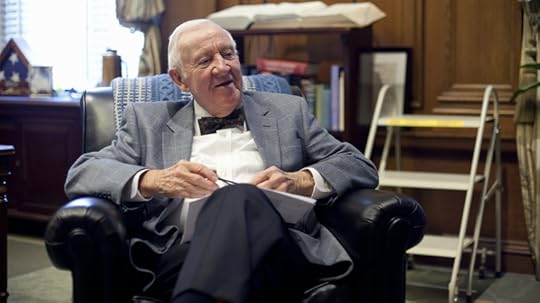
In a new book, former Supreme Court Justice John Paul Stevens says we should rewrite the Second Amendment, abolish the death penalty and restrict political campaign spending. J. Scott Applewhite/AP
Just a few words can hold a world of meaning. John Paul Stevens, the retired Supreme Court justice, has written a short new book in which he proposes a few words here and there that would create some sweeping changes.
The book, Six Amendments: How and Why We Should Change the Constitution, details the half-dozen ways Stevens thinks the Constitution could be improved, changes that he says are worth the trouble of the arduous amendment process.
To start, he proposes changing the First Amendment, the protection of free speech, so that it allows "reasonable limits" on the amount of money candidates for public office or their supporters can spend on election campaigns.
Stevens would add words to the Second Amendment to read, "the right of the people to keep and bear arms when serving in the militia shall not be infringed." He would also end the death penalty, adding it to the prohibitions on "excessive bail and cruel and unusual punishment."
"I think in time that what I have to say about each of these six issues will be accepted as being consistent with what the framers really intended in the first place," Stevens tells NPR's Scott Simon. "I think in time, reason will prevail."
Interview Highlights:
a) On whether the quality of free speech is different when it's directed in a political campaign than in the ordinary course of events
b) On the Supreme Court's ruling this week saying that voters could elect to end affirmative action programs
c) On whether marijuana use should be legal under federal law
d) On whether term limits should be imposed on Supreme Court justices
Read the remainder of the article at: http://www.npr.org/2014/04/26/3068376...
Other:
Link to NPR podcast: http://www.npr.org/2014/04/26/3068376...
 by
John Paul Stevens
by
John Paul StevensSource: National Public Radio
Mod
Mod
By BRIAN NAYLOR March 27, 2018
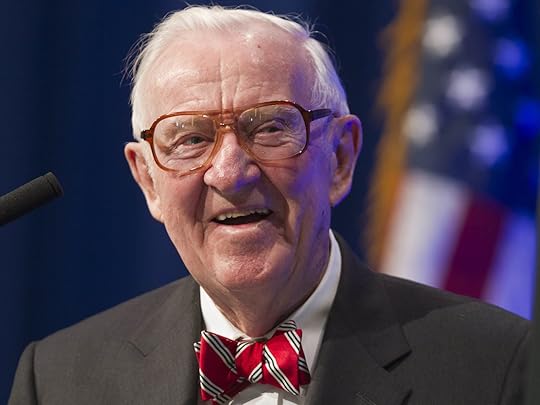
Former U.S. Supreme Court Justice John Paul Stevens said the Second Amendment is "a relic" and should be repealed.
Danny Johnston/AP
Retired Supreme Court Justice John Paul Stevens, responding to this past weekend's March For Our Lives events across the nation, is proposing what some might call a radical solution to prevent further gun violence — repealing the Second Amendment.
In an op-ed in Tuesday's New York Times, the 97-year-old Stevens writes that a constitutional amendment "to get rid of" the Second Amendment "would do more to weaken the N.R.A.'s ability to stymie legislative debate and block constructive gun control legislation than any other available option."
The Second Amendment states that "A well regulated Militia, being necessary to the security of a free State, the right of the people to keep and bear Arms, shall not be infringed." Stevens called that concern "a relic of the 18th century" and says repealing it would eliminate the only legal rule that protects sellers of firearms in the United States.
Stevens, who retired from the court in 2010, had two years earlier dissented in District of Columbia v. Heller, which determined the Second Amendment allowed an individual right to bear arms. Stevens says he remains convinced that decision was wrong and debatable and provided the National Rifle Association with "a propaganda weapon of immense power."
Stevens' call for repeal of the Second Amendment goes further than most gun control advocates, many of whom have called for banning certain types of weapons and establishing stricter background checks and age limits but for not changing the Constitution.
Stevens' proposal immediately lit up Twitter and social media.
Link to article: https://www.npr.org/2018/03/27/597259...
Other:
 by Bill Barnhart (no photo)
Source: National Public Radio
Mod
By LULU RAMADAN October 4, 2018
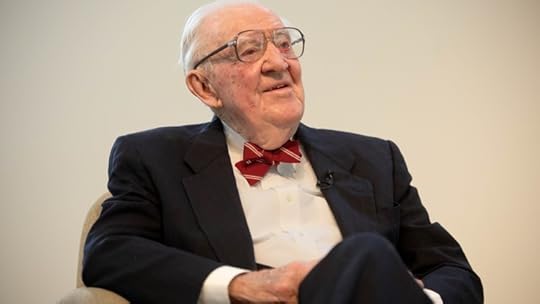
Retired Supreme Court Justice John Paul Stevens during his onstage interview with Palm Beach Post columnist Frank Cerabino at the Unitarian Universalist Fellowship of Boca Raton, October 4, 2018, in Boca Raton, Florida. (Greg Lovett / The Palm Beach Post)
BOCA RATON —Retired U.S. Supreme Court Justice John Paul Stevens on Thursday said that high court nominee Judge Brett M. Kavanaugh, who Stevens once lauded in one of his books, does not belong on the Supreme Court.
Speaking to a crowd of retirees in Boca Raton, Stevens, 98, said Kavanaugh’s performance during a recent Senate confirmation hearing suggested that he lacks the temperament for the job.
Stevens, a lifelong Republican who is known for falling on the liberal side of several judicial rulings, praised Kavanaugh and one of his rulings on a political contribution case in the 2014 book “Six Amendments: How and Why We Should Change the Constitution.”
“At that time, I thought (Kavanaugh) had the qualifications for the Supreme Court should he be selected,” Stevens said. “I’ve changed my views for reasons that have no relationship to his intellectual ability … I feel his performance in the hearings ultimately changed my mind.”
Commentators, Stevens said, have argued that Kavanaugh’s blistering testimony during a Sept. 27 hearing on sexual misconduct allegations demonstrated a potential for political bias should he serve on the Supreme Court.
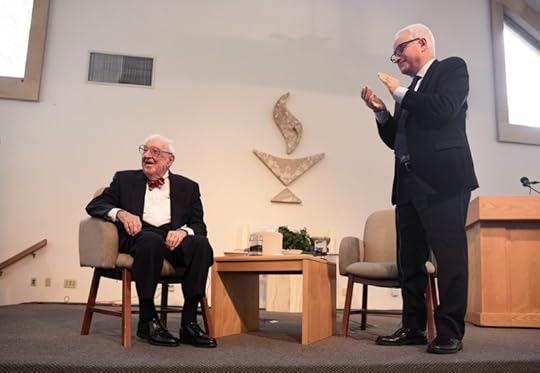
Retired Supreme Court Justice John Paul Stevens listens to applause after his onstage interview with Palm Beach Post columnist Frank Cerabino
"I think there’s merit to that criticism and I think the senators should really pay attention that,” Stevens said at a closed event hosted by retirement group, The Institute for Learning in Retirement.
Stevens, who retired in 2010 after 35 years on the bench, stands as one of the longest-serving justices in history. Nominated by President Gerald Ford, Stevens was unanimously confirmed by the Senate.
“That’s not happening any time soon,” moderator Frank Cerabino, of The Palm Beach Post, joked about a unanimous Senate confirmation.
Stevens decried the partisan politics that have shrouded the judiciary branch in recent years.
As a justice, Stevens was one of three dissenting votes in the Bush v. Gore case that ordered Florida to end the ballot recount in the disputed presidential election between George W. Bush and Al Gore, and effectively propelled Bush to the presidency.
“Although we may never know with complete certainty the identity of the winner of this year’s presidential election, the identity of the loser is clear,” Stevens wrote in the strongly worded dissent. “It is the nation’s confidence in the judge as impartial guardian of the rule of law.”
Stevens said political leaders and the court have failed to repair the nation’s confidence in the judicial branch’s separation from the president and the Legislature.
“I think it’s worse, I regret to say it,” he said.
Since his retirement, Stevens has penned a handful of opinion pieces for the New York Times calling for dramatic liberal reform. Following the Parkland high school shooting, Stevens, a Broward County resident, called for the repeal of the Second Amendment.
While Stevens has famously sided with Democratic colleagues on topics including Guantanamo Bay prisoner rights and political contributions, he’s far from ideologically pure.
He criticized the First Amendment flag-burning case in 1989, and Thursday stood by the stance that the act of flag-burning should be illegal.
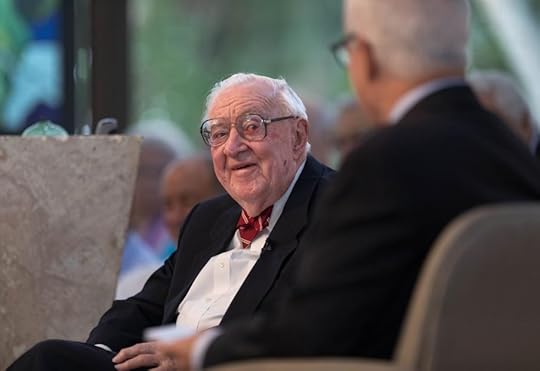
Retired Supreme Court Justice John Paul Stevens during his onstage interview with Palm Beach Post columnist Frank Cerabino at the Unitarian
When Cerabino asked Stevens why some justices, Stevens included, have sided with liberals despite being nominated by conservatives, Stevens replied that he’s never been “a political person.”
Many event attendees of opposite political affiliations said Stevens stands as a relic of a bygone era, when justices were not apparently beholden to the presidents who nominate them.
Read remainder of article: https://www.mypalmbeachpost.com/news/...
Other:
by
John Paul StevensSource: The Palm Beach Post
Mod
Let us hope he ages well on the bench.
Mod
The bow-tie-wearing justice gained influence over time as he evolved into the court’s most-liberal voice.
By DAVID COHEN July 16, 2019 - Updated July 17, 2019
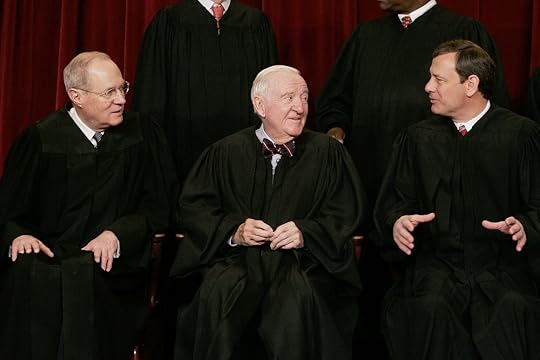
John Paul Stevens chats with John Roberts (right) and Anthony Kennedy (left) at the U.S. Supreme Court in March 2006. | Mark Wilson/Getty Images
John Paul Stevens, the third-longest serving justice in U.S. Supreme Court history and a court figure whose influence grew markedly over his tenure, has died.
He was 99. The Associated Press reported that he died Tuesday in Florida after suffering a stroke Monday.
The bow-tie-wearing Chicago Republican served from December 1975 to June 2010, a term on the court only eclipsed by those of William O. Douglas (1939-75) and Stephen Field (1863-97). At the age of 90, Stevens was the second-oldest justice ever at the time of his retirement, behind only Oliver Wendell Holmes.
“He was not a justice who sought to become a celebrity or to assume the role of legal oracle,” said George Washington Law School professor Jonathan Turley in a 2009 Northwestern University alumni magazine profile.
“He is the quintessential judge — someone who holds to that traditional view that the function of any judge or justice is to decide cases fairly and clearly. His opinions have a distinctly Midwestern character: strong, honest and direct.”
Stevens’ Supreme Court career came at a time of a distinct ideological shift. He was nominated in 1975 by President Gerald Ford as the court was moving away from its most-liberal period, one dominated by such figures as Earl Warren, Hugo Black, William Brennan, Thurgood Marshall and Douglas, the liberal firebrand whom Stevens replaced.
By the time of his retirement in 2010, liberals were hoping that President Barack Obama’s choice of Elena Kagan would help balance a conservative court that had been dominated in recent years by Chief Justice William Rehnquist and his successor, John Roberts, as well as Antonin Scalia, Clarence Thomas and Samuel Alito.
During those years, Stevens evolved from a centrist and pragmatist to someone who was often the court’s most-liberal voice. His later years were marked by a number of scathing dissents, including in Bush v. Gore, the case that decided the 2000 presidential election, and Citizens United v. FEC, the landmark 2010 election finance case. He also shifted to more liberal positions over the years on affirmative action and the death penalty
“He has served his nation well,” Ford wrote to Fordham Law School in 2005, “at all times carrying out his duties with dignity, intellect and without partisan political concerns. Justice Stevens has made me and our fellow citizens proud of my three-decade-old decision to appoint him to the Supreme Court.”
Even after his tenure ended, he made his voice heard. In 2018, he wrote a much-circulated column for the New York Times urging the repeal of the Second Amendment. He also spoke out against the confirmation of Brett Kavanaugh to the Supreme Court. In 2019, the 99-year-old went on the interview circuit to promote his newest book, The Making of a Justice: Reflections on My First 94 Years.
Roberts said Tuesday night of Stevens: “A son of the Midwest heartland and a veteran of World War II, Justice Stevens devoted his long life to public service, including 35 years on the Supreme Court. He brought to our bench an inimitable blend of kindness, humility, wisdom, and independence.“
“Justice Stevens was a remarkable man,” tweeted Sen. Ted Cruz (R-Texas). “He was the leading liberal on the Court & he was brilliant & full of grace & class. Having argued 9 cases before SCOTUS, I can tell you first-hand there was no more dangerous or effective questioner than Justice Stevens.“
President Donald Trump and first lady Melania Trump also offered condolences in a statement, noting “his passion for the law and our country.”
John Paul Stevens was born April 20, 1920, in Chicago. His father owned the Stevens Hotel, and the young Stevens often had contact there with the celebrities of the day, including aviators Charles Lindbergh and Amelia Earhart.
A lifelong Cubs fan, he was a boyhood witness to one of the most famous moments in baseball history, when Yankees icon Babe Ruth is supposed to have responded to heckling by the Cubs by pointing to the outfield stands and then clouting a World Series home run near that spot.
"Stevens recalled," the Chicago Tribune wrote in 2016, "hearing the heckling coming from the Cubs dugout — particularly the razzing from [pitcher Guy] Bush — and clearly seeing Ruth holding up two fingers in a gesture toward center field."
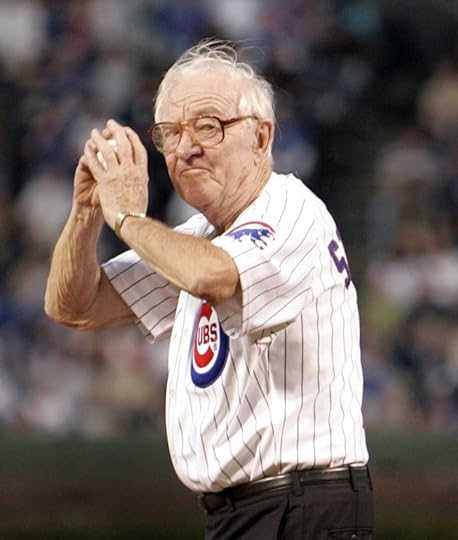
In 2005, John Paul Stevens throws out the first pitch at a Chicago Cubs game. The lifelong Cubs fan attended World Series games in 1932 and 2016. | Jeff Roberson/AP Photo
Stevens graduated from the University of Chicago in 1941 and Northwestern University Law School six years later, having served as a naval officer in in the interim and earning a Bronze Star during World War II.
After law school, he served as a clerk to Supreme Court Justice Wiley Rutledge, then went into private practice in Chicago. His reputation grew and in 1970, President Richard Nixon tabbed him for the Seventh Circuit Court of Appeals. “There was a consensus in the legal community,” wrote his biographers in The Supreme Court Justices: Illustrated Biographies, 1789-1995, “that Stevens was an unusually able jurist.”
In 1975, a vacancy occurred on the U.S. Supreme Court.
Douglas didn’t want to retire — he detested Ford and didn’t want him to pick his successor — but after a severe stroke in December 1974, his health declined sharply. According to The Brethren by Bob Woodward and Scott Armstrong, Ford had a list of 10 candidates. He narrowed it down to Stevens and Circuit Court Judge Arlin Adams before settling on Stevens.
“On the basis of a few moments of small talk,” Woodward and Armstrong wrote, “Ford had preferred Stevens. Stevens also seemed to have no partisan politics, no strict ideology. His anonymity would ensure a quick confirmation.”
The confirmation was indeed easy — Stevens was approved by a vote of 98-0. He was sworn in Dec. 19, 1975, little more than a month after Douglas retired. Stevens started quickly, writing the majority opinion in his first case, Hampton v. Mow Sun Wong, a jobs discrimination ruling.
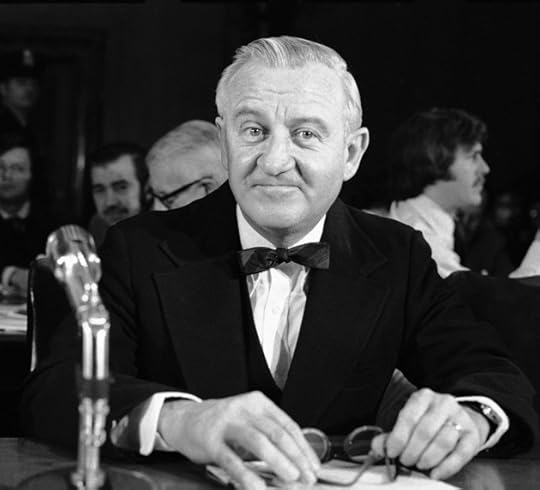
John Paul Stevens waits to testify Dec. 8, 1975, to the Senate. He was unanimously confirmed. | AP Photo
In 1976, he joined the majority in Gregg v. Georgia, a case that allowed the restoration of the death penalty in the United States. It overturned a 1972 verdict in which Douglas had voted the other way.
Two years later, he was part of a fractured majority in the Bakke case, which put the brakes on some affirmative action policies. That same year, he wrote the majority opinion for FCC vs. Pacifica Foundation, upholding an obscenity ruling revolving around the broadcast of a George Carlin comedy routine. In both cases, he voted with the court’s conservatives.
Gradually, though, Stevens became more and more associated with the court’s shrinking liberal wing, though it’s a matter of debate as to whether he changed or whether the court simply outflanked him on the right.
“I don’t think of myself as a liberal at all,” he was quoted as saying in the New York Times in 2007. “I think as part of my general politics, I’m pretty darn conservative.”
A number of his most-prominent opinions certainly can’t be considered liberal. In 1997, he wrote for a unanimous court in Clinton v. Jones, a case that allowed Paula Jones’s lawsuit against Bill Clinton to continue even though he was president. He also wrote the dissents in a pair of cases (Texas v. Johnson, U.S. v. Eichman) that upheld the right to burn an American flag.
Link to remainder of article: https://www.politico.com/story/2019/0...
More:
 by
John Paul Stevens
by
John Paul Stevens by
by
 Bob Woodward
Source: Politico
Mod

The History Book Club
Books mentioned in this topic
The Making of a Justice: Reflections on My First 94 Years (other topics)The Brethren: Inside the Supreme Court (other topics)
Six Amendments: How and Why We Should Change the Constitution (other topics)
John Paul Stevens: An Independent Life (other topics)
Six Amendments: How and Why We Should Change the Constitution (other topics)
More...
Authors mentioned in this topic
John Paul Stevens (other topics)Bob Woodward (other topics)
John Paul Stevens (other topics)
Bill Barnhart (other topics)
John Paul Stevens (other topics)
More...

Biography
John Paul Stevens was appointed to the Supreme Court in 1975. As the newest member of the Court, Stevens had the duty of keeping minutes and answering the door in the justices' closed conference. Stevens had to wait six years, until the appointment of Sandra Day O'Connor, before he relinquished his freshman spot. Today, Stevens is the most senior justice, both in age and years of service. In seniority, he is second only to Chief Justice John G. Roberts, Jr. Stevens now speaks second in conference after Roberts; and, Stevens can assign opinions in the event that he is in the majority and Roberts is in minority. Still, Stevens' influence remains uncertain. Many observers point to his quirky and unconventional jurisprudence as a constraint on his ability to lead the Court. They argue that Stevens' individualistic personality keeps him permanently outside the mainstream of the Court and that he lacks the characteristics of a coalition-builder. However, as the Court has turned further to the right with the appointments of Chief Justice Roberts and Justice Samuel A. Alito, Jr., Stevens has emerged as the voice of moderation on an increasing conservative bench.
John Paul Stevens was born on April 20, 1920, in Chicago, Illinois, as the youngest of Ernest and Elizabeth Stevens' four sons. Stevens grew up in a wealthy family. His father made a fortune in the insurance and hotel business and owned the Stevens Hotel, which has since become the Chicago Hilton. The Stevens lived near the University of Chicago campus and sent their sons to the university's laboratory school for preparatory education. Stevens attended college at the University of Chicago, following his father's footsteps, and joined his father's fraternity. He participated in a wide variety of campus activities and graduated Phi Beta Kappa in 1941. A year after his graduation, Stevens married Elizabeth Sheeren, with whom he had a son and three daughters.
Stevens enlisted in the Navy during World War II. In his position as part of a Navy code-breaking team, Stevens earned the Bronze Star. Following the war, he again followed his father's path and entered Northwestern University Law School to study law. Stevens distinguished himself at Northwestern by becoming editor-in-chief of the school's law review and graduating with the highest grades in the law school's history. After graduating, he served a term as law clerk to Supreme Court Justice Wiley Rutledge.
Stevens joined a prominent law firm in Chicago specializing in antitrust law and creating a reputation as a talented antitrust lawyer. He left the firm to start his own practice after three years and also began teaching law at Northwestern University and the University of Chicago law schools. His abilities in antitrust laws earned him positions with various special counsels to the House of Representatives and the U.S. Attorney General's office.
Stevens became known as a fair-minded and able counsel. Richard Nixon appointed him to the Unites States Court of Appeals for the Seventh Circuit in 1970. On the appeals court, Stevens continued to establish his reputation as a notable legal thinker. When Justice William Douglas stepped down from the Court in 1975. Attorney General Edward Levi proposed Stevens' appointment to the High Court. President Gerald Ford acted on Levi's advice and the Senate confirmed Stevens' appointment without controversy.
As a justice, Stevens has avoided simple conservative or liberal labels. As the Court moved toward the right during the Reagan and Bush presidencies, however, Stevens appeared more and more liberal relative to the make-up of the Court. Although Stevens is the difficult to predict, his approach to judicial decision-making can be summarized in a general sense. Stevens will typically examine the facts of each case carefully and on its own merits. He also seeks to defer to the judgments of others who he feels are better suited to decide. He has demonstrated considerable judicial restraint and deference to the Congress.
After 34 years, 6 months, and 11 days of service on the Court, Stevens stepped down on June 29, 2010. He is now tied with Justice Stephen J. Field for second place on the all-time list for continuous service, superseded only by Justice William O. Douglas. If Douglas is the Cal Ripken Jr. of the Supreme Court, that would make Stevens the Court's Lou Gehrig.
Personal Information
Born
Tuesday, April 20, 1920
Childhood Location
Illinois
Childhood Surroundings
Illinois
Religion
Protestant
Ethnicity
English
Father
Ernest J. Stevens
Father's Occupation
Businessman
Mother
Elizabeth Street
Family Status
Upper
Position
Associate Justice
Seat
6
Nominated By
Ford
Commissioned on
Tuesday, December 16, 1975
Sworn In
Thursday, December 18, 1975
Left Office
Tuesday, June 29, 2010
Reason For Leaving
retired
Length of Service
34 years, 6 months, 11 days
Home
Illinois
source: John Paul Stevens. The Oyez Project at IIT Chicago-Kent College of Law. 28 December 2011.
[image error]