
The History Book Club discussion
SUPREME COURT OF THE U.S.
>
#95 - ASSOCIATE JUSTICE ABE FORTAS
date newest »
newest »
 Abraham "Abe" Fortas (June 19, 1910 – April 5, 1982) was a U.S. Supreme Court associate justice from 1965 to 1969. Originally from Tennessee, Fortas became a law professor at Yale, and subsequently advised the Securities and Exchange Commission. He then worked at the Interior Department under Franklin D. Roosevelt, and subsequently Harry Truman appointed him to delegations that helped set up the UN. Later, in private practice, Fortas represented Lyndon Johnson in an electoral dispute, and formed close ties with the president-to-be. Fortas also represented Clarence Earl Gideon before the U.S. Supreme Court, in a case involving the right to counsel. As a Johnson appointee to the Court, Fortas maintained a close working relationship with the president, and in 1968 Johnson tried to elevate Fortas to the position of Chief Justice, but that nomination faced a filibuster due at least in part to ethics problems that later caused him to step down from the Court. Fortas returned to private practice, sometimes appearing before the judges with whom he had served.
Early years
Fortas was born in Memphis, Tennessee. He was the youngest of five children. His father, a native of Great Britain, was an Orthodox Jew who worked as a cabinetmaker. Abe Fortas acquired a life-long love for music from his father, who encouraged his playing the violin, and was known in Memphis as "Fiddlin' Abe Fortas". He attended public schools in Memphis, graduating from South Side High School in 1926. He then attended Southwestern at Memphis (now known as Rhodes College), graduating in 1930.
Fortas left Memphis to enroll in Yale Law School. He graduated second in his class in 1933 (second only to another Memphian, Luke Finlay) and was Editor in Chief of the Yale Law Journal. One of his professors, William O. Douglas, was impressed with Fortas and arranged for him to stay at Yale and become an assistant professor.
Shortly thereafter, Douglas left Yale to run the U.S. Securities and Exchange Commission (SEC) in Washington, D.C. Fortas commuted between New Haven and Washington both teaching at Yale and advising the SEC.
Personal life
In 1935, Fortas married Carolyn E. Agger, who would become a successful tax lawyer. They had no children and after he became a Supreme Court justice, they lived in Georgetown; they also had a summer home in Connecticut.
Fortas was an amateur musician who played the violin in a quartet, called the "N Street Strictly-no-refunds String Quartet" on Sunday evenings. It often included notable musicians passing through town, such as Isaac Stern.
Early career
He served as general counsel of the Public Works Administration and as Undersecretary of the Interior during the Franklin D. Roosevelt administration. While he was working at the Department of the Interior, the Secretary of the Interior, Harold L. Ickes, introduced him to a young congressman from Texas, Lyndon Johnson. In 1945, Fortas was granted a leave of absence from the Department of Interior to join the armed forces. However, according to his official biography, within a month, Fortas was discharged because of an arrested case of eye tuberculosis. Later in 1945, he was appointed by President Harry Truman as an advisor to the U.S. delegation during the organizational meeting of the UN in San Francisco and at the 1946 General Assembly meeting in London.
Private practice
After leaving government service, Fortas founded a law firm with Thurman Arnold in 1946, then known as Arnold & Fortas. Former FCC commissioner Paul A. Porter joined the firm in 1947, and after Fortas ascension to the Supreme Court the firm dropped his name and is now known as Arnold & Porter. For many years, it has been one of Washington's most influential law firms, and today is among the largest law firms in the world.
In 1948, Lyndon Johnson ran for the Democratic nomination for one of Texas' seats in the U.S. Senate. He won the primary by only 87 votes. His opponent, former Texas governor Coke R. Stevenson, convinced a federal judge to issue an order taking Johnson's name off of the general election ballot while the primary results were being contested; there were serious allegations of corruption in the voting process, including 200 Johnson votes that had been cast in alphabetical order. Johnson asked Fortas for help, and Fortas persuaded U.S. Supreme Court Justice Hugo Black to overturn the ruling. Johnson became a U.S. senator, winning the general election.
During the Red Scare of the late 1940s and early 1950s, Fortas came to widespread notice as the defense attorney for Owen Lattimore. In 1950, Fortas often clashed with Senator Joseph McCarthy when representing Lattimore before the Tydings Committee and later before the Senate Internal Security Subcommittee.
Durham v. United States
Fortas was known in Washington circles to have a serious interest in psychiatry, still a controversial science at the time. In 1953 this expertise led to his appointment to represent the indigent Monte W. Durham, whose insanity defense had been rejected at trial two years earlier, before the United States Court of Appeals for the District of Columbia Circuit. Durham's defense had been denied because the District Court had applied the M'Naghten Rules, requiring that the defense prove the accused didn't know the difference between right and wrong for an insanity plea to be accepted. Adopted by the British House of Lords in 1843, generations before modern psychiatry, this test was still in near universal use in U.S. jurisprudence over a century later. The effect of this standard was to exclude psychiatric and psychological testimony almost entirely from the legal process. In a critical turning point for U.S. criminal law, the Court of Appeals accepted Fortas' call to abandon the M'Naghten Rule and allow for testimony and evidence regarding defendants' mental state.
Gideon v. Wainwright
In 1963, Fortas represented Clarence Earl Gideon's appeal before the Supreme Court. Gideon, a poor man from Florida, had been convicted of breaking into a pool hall. He could not afford a lawyer, and none was provided for him. In its landmark ruling in Gideon v. Wainwright, the Supreme Court held for Gideon, ruling that state courts are required under the Sixth Amendment to provide counsel in criminal cases for defendants unable to afford their own attorneys or lawyers.
Associate Justice of the Supreme Court
In 1965, Lyndon Johnson, then President, persuaded Supreme Court Justice Arthur Goldberg to resign his seat to become Ambassador to the United Nations so that he could appoint Fortas, his longtime friend, to the Court.[6] Johnson thought that some of his Great Society reforms could be ruled unconstitutional by the Court, and he felt that Fortas would let him know if that was to happen. Johnson and Fortas did collaborate while Fortas was a justice; Fortas co-wrote Johnson's 1966 State of the Union speech.
On the Court, Fortas was particularly concerned with children's rights. Fortas dissented when the Court upheld some public intoxication laws.
In 1968, Fortas authored a book titled, Concerning Dissent and Civil Disobedience which was criticized by historian Howard Zinn in his book Disobedience and Democracy: Nine Fallacies on Law and Order.
Relationship with other justices
Fortas mostly had good working relations with his fellow justices, although they did worry that he talked to President Johnson too much. Fortas clashed with fellow Justice Hugo Black during much of his time on the Court. The two had been friends since the 1930s, and Black helped Fortas's wife Agger accept his appointment to the Court. However, once both were on the Court, they disagreed about the manner in which the Constitution should be interpreted and found themselves on opposing sides in opinions most of the time. In 1968, a Warren clerk called their feud "one of the most basic animosities of the Court".
Fortas's best relationship was with William O. Douglas, and was next-closest to William J. Brennan and Earl Warren. Brennan's offices were in the chambers next to those of Fortas. Fortas's wife recalled that Fortas "loved Warren". Fortas called John Harlan "one of my dearest friends, although we usually are on opposite sides of the issues here".
Fortas was critical of those justices (he specifically cited Thurgood Marshall) who frequently broke into attorneys' arguments to ask questions. As an attorney arguing before the Court, he had resented justices' intrusions, so as a justice himself he felt it best to let the lawyers give their arguments uninterrupted.
Children's and students' rights
During his time on the Court, Fortas led a revolution in U.S. juvenile justice, broadly extending the Court's logic on due process rights and procedure to legal minors and overturning the existing paradigm of parens patriae, in which the state had usurped the parental role. Authoring the majority decision in Kent v. United States (1966), the first Supreme Court case that evaluated a juvenile court procedure, Fortas suggested that the existing system might be "the worst of both worlds". At that time, the state was held to have a paternal interest in the child rather than a prosecutorial one, a concept that dispensed with the obligation to provide a child accused of a crime with the opportunity to make a defense. Yet the courts were empowered to decide, in the interests of the child, to have the child incarcerated for lengthy periods or otherwise severely punished.
Fortas elaborated on his critique the following year in the case of In re Gault (1967). The case concerned a 15-year-old who had been sentenced to almost six years (until his 21st birthday) in Arizona's State Industrial School for making an obscene phone call to his neighbor. Had he been an adult the maximum punishment he could have received was a $50 fine or two months in jail. Fortas used the case to launch a ferocious attack on the juvenile justice system and parens patriae. His majority opinion was a landmark, extending the Fourteenth Amendment guarantees of right to sufficient notice, right to counsel, right to confrontation of witnesses, and right against self-incrimination to certain juvenile proceedings.
Two years later, Fortas authored another landmark in children's rights with the decision in the case of Tinker v. Des Moines Independent Community School District, involving two high school students and one junior high school student who had been suspended for wearing black armbands to school to protest the Vietnam War. Extending First Amendment rights to school students for the first time, Fortas wrote that "neither students nor teachers shed their constitutional rights to freedom of speech or expression at the schoolhouse gate".
Epperson v. Arkansas
In 1968, Fortas convinced the court to accept the appeal of Little Rock Central High School teacher Sue Epperson who had challenged Arkansas' anti-evolution law with the support of the state teachers union. Epperson had won the case, but the Arkansas Supreme Court had overturned the ruling. Although the Court agreed quickly after hearing the case that the Arkansas ruling should be reversed, there was no consensus as to why, with most Justices favoring fairly narrow grounds. Fortas was the architect and author of the broader landmark majority opinion in Epperson v. Arkansas that eventually emerged banning religiously-based creation narratives from public school science curricula.
Presidential power
Fortas believed in an expanded executive branch and a less powerful legislative branch. He wrote: "The enormous growth of presidential power from FDR to Lyndon Johnson was a necessary and an inevitable adaptation of our constitutional system to national needs."
Nomination to be Chief Justice When Chief Justice Earl Warren announced his retirement in June 1968, Johnson nominated Associate Justice Fortas to replace Warren as Chief Justice. However, the Warren Court's form of jurisprudence had angered many conservative members of the United States Senate, and the nomination of Fortas provided the first opportunity for these senators to register their disenchantment with the direction of the Court; they planned to filibuster Fortas's nomination. Senate Judiciary Committee chair James Eastland told Johnson he "had never seen so much feeling against a man as against Fortas". Fortas was the first Chief Justice nominee ever to appear before the Senate, and he faced hostile questioning about his relationship with Lyndon B. Johnson. Johnson had consulted with Fortas about political matters frequently while Fortas was on the Court.
American University payments
Fortas's acceptance of $15,000 for nine speaking engagements at the American University Law School became a source of controversy. The money had not come from the university, but from private sources that represented business interests connected to 40 companies; Senator Strom Thurmond raised the idea that cases involving these companies might come to the Court and Fortas might not be objective. While not illegal, the size of the fee raised much concern about the Court's insulation from private interests, especially as it was funded by Fortas's former clients and partners. The $15,000 represented more than 40% of a Supreme Court justice's salary and was seven times what any other American University seminar leader had ever been paid.
Cloture vote
Upon learning of this problem, President Johnson decided to help Fortas win a majority vote, but only as a face-saving measure, according to Johnson aide Joseph Califano:
“"We won't withdraw the nomination. I won't do that to Abe." Though we couldn't get the two-thirds vote needed to shut off debate, Johnson said we could get a majority, and that would be a majority for Fortas. "With a majority on the floor for Abe, he'll be able to stay on the Court with his head up. We have to do that for him." Fortas also wanted the majority vote....On October 1, after a strenuous White House effort, a 45–43 majority of senators voted to end the filibuster, short of the 67 votes needed for cloture, but just barely the majority LBJ wanted to give Fortas. Later that day, Fortas asked the President to withdraw his nomination.”
The debate on Fortas's nomination had lasted for less than a week, led by Republicans and conservative southern Democrats, or so-called Dixiecrats. Several senators who opposed Fortas asserted at the time that they were not conducting a perpetual filibuster and were not trying to prevent a final up-or-down vote from occurring. The Senate web site now characterizes the debate as the first filibuster on a Supreme Court nominee.
In 1968, Senate rules required two-thirds of senators present to stop a debate (now 60% of the full Senate is needed). The 45 to 43 cloture vote to end the Fortas debate included 10 Republicans and 35 Democrats voting for cloture, and 24 Republicans and 19 Democrats voting against cloture. The 12 other senators, all Democrats, were absent.
The New York Times wrote of the 45 to 43 cloture roll call: "Because of the unusual crosscurrents underlying today's vote, it was difficult to determine whether the pro-Fortas supporters would have been able to muster the same majority in a direct confirmation vote." The next president, Richard Nixon, a Republican, would appoint Warren E. Burger as Chief Justice.
Ethics Scandal & Resignation
Fortas remained on the bench, but in 1969, a new scandal arose. Fortas had accepted a $20,000 retainer from the family foundation of Wall Street financier Louis Wolfson, a friend and former client, in January 1966. Fortas signed a contract with Wolfson's foundation; in return for unspecified advice, it was to pay Fortas $20,000 a year for the rest of Fortas's life (and then pay his widow for the rest of her life). Wolfson was under investigation for securities violations at the time and it is alleged that he expected that his arrangement with Fortas would help him stave off criminal charges or help him secure a presidential pardon; he did ask Fortas to help him secure a pardon from LBJ, which Fortas claimed that he did not do. Fortas recused himself from Wolfson's case when it came before the Court and had returned the retainer, but not until Wolfson had been indicted twice.
In 1970, after Fortas had resigned from the Court, Louis Wolfson surreptitiously taped a private telephone call with Fortas. The transcript of this call was disclosed by Wolfson's lawyer, Bud Fensterwald, to Washington Post reporter Bob Woodward in 1977. The Washington Post subsequently published several excerpts from the transcript, including language suggesting that Fortas might have indeed spoken with LBJ about a pardon for Wolfson, but there is no evidence that this intervention was a quid pro quo rather than a voluntary intervention for a friend. Wolfson was convicted of violating federal securities laws later that year and spent time in prison.
The new Richard Nixon administration became aware of the Wolfson deal when a Life reporter began investigating the story; FBI director J. Edgar Hoover also mentioned a "tax dodge" Fortas had entered into with other judges, and Nixon concluded Fortas should be "off of there". When Chief Justice Earl Warren was informed of the incident by the new Attorney General John N. Mitchell, he persuaded Fortas to resign to protect the reputation of the Court and avoid lengthy impeachment proceedings, which were in their preliminary stages; Fortas's judicial reputation was also affected by the previous Johnson consultation and American University scandals. Justice Hugo Black also urged Fortas to resign, but when Fortas said it would "kill" his wife, Black changed his mind and urged Fortas not to resign.[3] Fortas eventually decided resignation would be best for him and for his wife's legal career, and told his colleagues. William J. Brennan later said, "We were just stunned." Fortas later said he "resigned to save Douglas", another justice who was being investigated for a similar scandal at the same time.
President Nixon eventually appointed as his replacement Harry A. Blackmun, after the previous nominations of Clement F. Haynsworth and G. Harrold Carswell failed. The seat was vacant for nearly the entire 1969–70 term.
Later years
Rebuffed in the wake of his fall by the powerful Washington law firm he had founded, Fortas founded another firm, Fortas and Koven, and maintained a successful law practice until his death in 1982. However, his wife, Carolyn Agger, stayed at Fortas's original firm, in part due to the fact that Fortas had resigned in order to protect her job there. In the year following his resignation, he turned down an offer to publish his memoirs.
Founding the firm of Fortas & Koven in Washington, D.C., a year after his resignation, Fortas also kept two non-paying clients: Pablo Casals and Lyndon Johnson, with whom he remained great friends and visited in Texas.[3] Fortas was asked to donate his papers to Johnson's presidential library by Lady Bird Johnson, but he replied that his correspondence with Johnson had always been kept in strictest confidence. According to his law partner Howard Koven, Fortas once consulted with Martin Scorsese on the legality of language Scorsese wanted to use in a movie.
A portrait of him was placed in Yale Law School while he was still alive, underwritten by an anonymous donor. Fortas served as a longtime member of the board of directors of Carnegie Hall, including while he was on the Supreme Court. He also served on the board of the Kennedy Center since it opened in 1964.
The American Bar Association revamped its rules as a result of the Wolfson affair, revising circumstances under which judges should not accept outside income.
In the course of his return to private practice, Fortas sometimes appeared before his former colleagues at the Supreme Court. On the first occasion he did so, his successor, Harry Blackmun, recalled that his eyes met Fortas's: "[Fortas] kind of nodded... I wondered what was going through his mind." When Blackmun later questioned Fortas if he remembered the encounter, Fortas said he would "never forget it". Blackmun thought Fortas's attitude toward the new justice was remarkable, not showing "an ounce of antagonism or resentment".
Fortas's memorial service was held at the Kennedy Center, with Isaac Stern and Lady Bird Johnson in attendance.
source above two posts: wikipedia
books about: by
by
 Laura Kalman
 by Abe Fortas
Fortas: The Rise and Ruin of a Supreme Court Justice(no cover photo) by Bruce Allen Murphy
 Mod
Mod
https://www.youtube.com/watch?v=r4IN9...
LBJ and Abe Fortas talk about Warren Report and New York Times
Discussing nominations, etc. - In this discussion LBJ seems quite riled up.
Source: The LBJ Presidential Library.
Mod
Fortas remained on the bench, but in 1969, a new scandal arose. Fortas had accepted a US$20,000 (US$128,621 in 2015 dollars[16]) retainer from the family foundation of Wall Street financier Louis Wolfson, a friend and former client, in January 1966.
Fortas had signed a contract with Wolfson's foundation. In return for unspecified advice, it was to pay Fortas $20,000 a year for the rest of Fortas's life (and then pay his widow for the rest of her life). Wolfson was under investigation for securities violations at the time and it was alleged that he expected that his arrangement with Fortas would help him stave off criminal charges or help him secure a presidential pardon. He did ask Fortas to help him secure a pardon from LBJ, which Fortas claimed that he did not do. Fortas recused himself from Wolfson's case when it came before the Court and had earlier returned the retainer, but not until Wolfson had been indicted twice.
In 1970, after Fortas had resigned from the Court, Louis Wolfson surreptitiously taped a private telephone call with Fortas. The transcript of this call was disclosed by Wolfson's lawyer, Bud Fensterwald, to Washington Post reporter Bob Woodward in 1977.
The Washington Post subsequently published several excerpts from the transcript, including language suggesting that Fortas might indeed have spoken with LBJ about a pardon for Wolfson, but there is no evidence that this intervention was a quid pro quo rather than a voluntary intervention for a friend. Wolfson was convicted of violating federal securities laws later that year and spent time in prison.
The new Richard Nixon administration became aware of the Wolfson deal when a Life reporter began investigating the story. FBI director J. Edgar Hoover also mentioned a "tax dodge" Fortas had entered into with other judges, and Nixon concluded Fortas should be "off of there".
When Chief Justice Earl Warren was informed of the incident by the new Attorney General John N. Mitchell, he persuaded Fortas to resign to protect the reputation of the Court and avoid lengthy impeachment proceedings, which were in their preliminary stages.
Fortas's judicial reputation was also affected by the previous Johnson consultation and American University scandals.[7] Justice Hugo Black also urged Fortas to resign, but when Fortas said it would "kill" his wife, Black changed his mind and urged Fortas not to resign. Fortas eventually decided resignation would be best for him and for his wife's legal career, and told his colleagues. William J. Brennan later said, "We were just stunned". Fortas later said he "resigned to save Douglas", another justice who was being investigated for a similar scandal at the same time.
President Nixon eventually appointed as his replacement Harry Blackmun, after the previous nominations of Clement Haynsworth and G. Harrold Carswell failed. The seat was vacant for nearly the entire 1969–70 term. After Fortas' resignation, there was no Jewish justice until Ruth Bader Ginsburg was appointed in 1993.
Later years
Rebuffed in the wake of his fall by the powerful Washington law firm he had founded, Fortas founded another firm, Fortas and Koven, and maintained a successful law practice until his death in 1982. However, his wife, Carolyn Agger, stayed at Fortas's original firm, in part due to the fact that Fortas had resigned in order to protect her job there. In the year following his resignation, he turned down an offer to publish his memoirs.
At Fortas & Koven, Fortas also kept two non-paying clients: Pablo Casals and Lyndon Johnson, with whom he remained great friends and whom he visited in Texas. Fortas was asked to donate his papers to Johnson's presidential library by Lady Bird Johnson, but he replied that his correspondence with Johnson had always been kept in strictest confidence. According to his law partner Howard Koven, Fortas once consulted with Martin Scorsese on the legality of language Scorsese wanted to use in a movie.
A portrait of him was placed in Yale Law School while he was still alive, underwritten by an anonymous donor. Fortas served as a longtime member of the board of directors of Carnegie Hall, including while he was on the Supreme Court. He also served on the board of the Kennedy Center since its opening in 1964.
The American Bar Association revamped its rules as a result of the Wolfson affair, revising circumstances under which judges should not accept outside income.
In the course of his return to private practice, Fortas sometimes appeared before his former colleagues at the Supreme Court. On the first occasion he did so, his successor, Harry Blackmun, recalled that his eyes met Fortas's: "[Fortas] kind of nodded...I wondered what was going through his mind".
When Blackmun later questioned Fortas if he remembered the encounter, Fortas said he would "never forget it". Blackmun thought Fortas's attitude toward the new justice was remarkable, not showing "an ounce of antagonism or resentment."
Fortas died from a ruptured aorta in April 1982,[18] and his memorial service was held at the Kennedy Center, with Isaac Stern and Lady Bird Johnson in attendance.
Source: Wikipedia
 The Wars of Watergate: The Last Crisis of Richard Nixon
 by Stanley I. Kutler (no photo)
Synopsis:
This is the first truly comprehensive history of the political explosion that shook America in the 1970s and whose aftereffects are still being felt in public life today. Drawing on contemporary documents, personal interviews, memoirs, and a vast quantity of new material, Stanley Kutler shows how President Nixon's obstruction of justice from the WHite House capped a pattern of abuse that marked his entire tenure in office. He makes clear how the drama of Watergate is rooted not only in the tumultuous events of the 1960s but also in the personality and history of Richard Nixon.
The Path to Power: The Years of Lyndon Johnson by
by
 Robert A. Caro
Synopsis:
This is the story of the rise to national power of a desperately poor young man from the Texas Hill Country. The Path to Power reveals in extraordinary detail the genesis of the almost superhuman drive, energy, and ambition that set LBJ apart. It follows him from the Hill Country to New Deal Washington, from his boyhood through the years of the Depression to his debut as Congressman, his heartbreaking defeat in his first race for the Senate, and his attainment, nonetheless, at age 31, of the national power for which he hungered. In this book, we are brought as close as we have ever been to a true perception of political genius and the American political process.
Illinois Justice: The Scandal of 1969 and the Rise of John Paul Stevens by Kenneth A. Manaster (no photo)
Synopsis:
Illinois political scandals reached new depths in the 1960s and ’70s. In Illinois Justice, Kenneth Manaster takes us behind the scenes of one of the most spectacular. The so-called Scandal of 1969 not only ended an Illinois Supreme Court justice’s aspirations to the US Supreme Court, but also marked the beginning of little-known lawyer John Paul Stevens’s rise to the high court.
In 1969, citizen gadfly Sherman Skolnick accused two Illinois Supreme Court justices of accepting valuable bank stock from an influential Chicago lawyer in exchange for deciding an important case in the lawyer’s favor. The resulting feverish media coverage prompted the state supreme court to appoint a special commission to investigate. Within six weeks and on a shoestring budget, the commission mobilized a small volunteer staff to reveal the facts. Stevens, then a relatively unknown Chicago lawyer, served as chief counsel. His work on this investigation would launch him into the public spotlight and onto the bench.
Manaster, who served on the commission, tells the real story of the investigation, detailing the dead ends, tactics, and triumphs. Manaster expertly traces Stevens’s masterful courtroom strategies and vividly portrays the high-profile personalities involved, as well as the subtleties of judicial corruption. A reflective foreword by Justice Stevens himself looks back at the case and how it influenced his career.
Now the subject of the documentary Unexpected Justice: The Rise of John Paul Stevens, Manaster’s book is both a fascinating chapter of political history and a revealing portrait of the early career of a Supreme Court justice.
 Mod
Mod
393 U.S. 503 (1969)
Decision Date: February 24, 1969
Background:
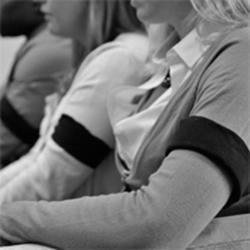
At a public school in Des Moines, Iowa, students organized a silent protest against the Vietnam War. Students planned to wear black armbands to school to protest the fighting but the principal found out and told the students they would be suspended if they wore the armbands. Despite the warning, students wore the armbands and were suspended. During their suspension the students' parents sued the school for violating their children's right to free speech. A U.S. district court sided with the school, ruling that wearing armbands could disrupt learning. The students appealed the ruling to a U.S. Court of Appeals but lost and took their case to the United States Supreme Court.
Decision:
In 1969 the United States Supreme Court ruled in a 7-2 decision in favor of the students. The high court agreed that students' free rights should be protected and said, "Students don't shed their constitutional rights at the school house gates."
Other:
Link to U.S. Courts podcast: http://www.uscourts.gov/about-federal...
Link to Supreme Court Oral Arguments: https://www.oyez.org/cases/1968/21
Facts of the case:
In December 1965, a group of students in Des Moines held a meeting in the home of 16-year-old Christopher Eckhardt to plan a public showing of their support for a truce in the Vietnam war. They decided to wear black armbands throughout the holiday season and to fast on December 16 and New Year's Eve. The principals of the Des Moines school learned of the plan and met on December 14 to create a policy that stated that any student wearing an armband would be asked to remove it, with refusal to do so resulting in suspension. On December 16, Mary Beth Tinker and Christopher Eckhardt wore their armbands to school and were sent home. The following day, John Tinker did the same with the same result. The students did not return to school until after New Year's Day, the planned end of the protest.
Through their parents, the students sued the school district for violating the students' right of expression and sought an injunction to prevent the school district from disciplining the students. The district court dismissed the case and held that the school district's actions were reasonable to uphold school discipline. The U.S. Court of Appeals for the Eighth Circuit affirmed the decision without opinion.
Question:
Does a prohibition against the wearing of armbands in public school, as a form of symbolic protest, violate the students' freedom of speech protections guaranteed by the First Amendment?
Conclusion:
7 -2 DECISION FOR TINKER
MAJORITY OPINION WRITTEN BY ABE FORTAS
Yes. Justice Abe Fortas delivered the opinion of the 7-2 majority. The Supreme Court held that the armbands represented pure speech that is entirely separate from the actions or conduct of those participating in it. The Court also held that the students did not lose their First Amendment rights to freedom of speech when they stepped onto school property. In order to justify the suppression of speech, the school officials must be able to prove that the conduct in question would "materially and substantially interfere" with the operation of the school. In this case, the school district's actions evidently stemmed from a fear of possible disruption rather than any actual interference.
In his concurring opinion, Justice Potter Stewart wrote that children are not necessarily guaranteed the full extent of First Amendment rights. Justice Byron R. White wrote a separate concurring opinion in which he noted that the majority's opinion relies on a distinction between communication through words and communication through action.
Justice Hugo L. Black wrote a dissenting opinion in which he argued that the First Amendment does not provide the right to express any opinion at any time. Because the appearance of the armbands distracted students from their work, they detracted from the ability of the school officials to perform their duties, so the school district was well within its rights to discipline the students. In his separate dissent, Justice John M. Harlan argued that school officials should be afforded wide authority to maintain order unless their actions can be proven to stem from a motivation other than a legitimate school interest.
Discussion Topics:
1. How did the landmark decision in Tinker v. Des Moines Independent School District shape our history and still impact us today?
2. Discuss the how the majority opinion felt about the importance of ensuring the First Amendment rights of free speech in young children in school.
Source(s): U.S. Federal Courts, Oyez
Mod
 by
by
 Laura Kalman
Synopsis:
Abe Fortas was a New Dealer, a sub-cabinet official, the founder of an eminent Washington law firm, a lose adviser to Lyndon Johnson, and a Supreme Court justice. Nominated by Johnson to be Chief Justice, he was rejected by Congress and resigned from the Court early in the Nixon administration under a cloud of impending scandal. This engrossing book—the first full biography of Abe Fortas—tells his dramatic story.
Drawing on Fortas’s previously unavailable personal papers, on numerous archives, and on extensive interviews with his family and associates, Laura Kalman, a historian and lawyer illuminates Fortas’s evolution from New Dealer to Washington lawyer to Great Society liberal, and in so doing also provides a unique view of American liberalism from the 1930s through the 1960s.
“There was no single Abe Fortas,” writes Kalman. “There was a variety of personae, and Fortas moved comfortably from one to another.”
Kalman describes Fortas’s various personae:
The boy who as “Fiddlin’ Abe” played the violin in dance bands to earn spending money and who grew to consider chamber music the love of his life; The Jew who cared more about Israel than Judaism; The civil libertarian who worked for irascible Harold Ickes as Under Secretary of the Interior during the New Deal, who defended those charged with disloyalty by Joseph McCarthy, and who promoted social justice on the Court; The urbane corporate lawyer whose friends became clients and whose clients became friends; The brilliant legal tactician who secured Lyndon Johnson’s Senate seat in 1948 and whose successful defense of the Gideon case was described by William O. Douglas as “the best single argument” he heard in all his years on the Supreme Court; The Supreme Court justice who willingly risked compromising his judicial integrity to advise President Johnson; The man who hobnobbed with the powerful yet was powerless to combat the attacks against him when he was a Supreme Court justice, and whose resignation from the Court contributed to the destruction of the liberal agenda for social reform.
Reflecting on the various aspects of Fortas’s enigmatic personality and the events of his life, Kalman creates a new portrait of the man that is more insightful and complete than any yet published. Engagingly written and superbly researched, this is the authoritative account of Fortas and the legal and political history he helped to shape.
Mod
Mod
Abe Fortas - Supreme Court Justice, Lawyer (1910–1982)

Nominated to replace Earl Warren as chief justice in 1968, Abe Fortas became the first nominee for that post since 1795 to fail to win Senate approval.
Synopsis
Born on June 19, 1910, in Memphis, Tennessee, Abe Fortas served as an associate justice of the Supreme Court of the United States from 1965 to 1969. Nominated to replace Earl Warren as chief justice by Lyndon B. Johnson in 1968, Fortas became the first nominee for that post since 1795 to fail to win Senate approval. The following year, he became the first Supreme Court justice to resign under threat of impeachment.
Early Life
Born in Memphis, Tennessee, on June 19, 1910, Abraham Fortas has the dubious distinction of being the first U.S. Supreme Court justice to resign in the midst of a scandal. Fortas came from modest beginnings. Both of his parents were Jewish immigrants who ran a store together, with his father also working as a cabinet maker. Fortas was the youngest of the couple's five children.
A bright student, Abe Fortas excelled at his studies. He graduated at the top of his class at Southwestern College (later renamed Rhodes College) in Memphis. After graduating in 1930, Fortas attended Yale Law School, where he served as editor of the university's law journal. He completed his law degree in 1933, joining the law school's faculty soon after. While teaching at Yale, Fortas also began work for the newly formed Securities and Exchange Commission. He would take a full-time post with the commission in the late 1930s.
Law Career
In 1939, Abe Fortas became general counsel for the Public Works Administrative. In 1941, he joined the Department of the Interior, becoming the government office's undersecretary the following year. Not long after World War II ended, Fortas went into private practice, co-founding the prominent Washington law firm of Arnold, Fortas & Porter.
Around this same time, Fortas befriended Texas politician Lyndon B. Johnson, to whom he became a trusted adviser when Johnson became president in 1963. Two years later, Johnson picked Fortas for the U.S. Supreme Court; he wanted Fortas to replace Arthur Goldberg, who resigned to become U.S. ambassador to the United Nations.
Controversial Supreme Court Justice
Fortas joined the court as an associate justice in 1965. The following year, he was among the judges who supported the landmark decision in Miranda v. Arizona, which made it mandatory for the police to inform suspects of their rights when being placed under arrest. In 1967, Fortas ruled in favor of upholding the rights of due process for juveniles in the famous Gault case.
Johnson nominated Fortas to take over for retiring Chief Justice Earl Warren in 1968. During a Congressional hearing on his nomination, Fortas found himself under intense scrutiny from conservative legislators. Some objected to him receiving $15,000 in speaking fees for lectures he gave at American University. The money for these talks had been raised through contributions from roughly 40 companies. Senator Strom Thurmond was among those that questioned whether Fortas would be able to be objective if these firms had cases in front of the Supreme Court.
The conservatives in the Senate refused to end the debate on Fortas, effectively filibustering the nomination. Fortas withdrew himself from consideration for the chief justice post, which was eventually filled by Warren E. Burger. He stayed on at the court as an associate justice, but he soon faced another controversy.
Fortas was later discovered to have accepted a dubious position from the Wolfson Foundation. In exchange for $20,000 per year for life, he was to provide counsel to the foundation, which was run by the family of Wall Street financial giant Louis Wolfson. After Wolfson was indicted on charges of securities violations, Fortas returned the one payment he received from the foundation. But this secret deal severely damaged Fortas's reputation and credibility. Under tremendous public pressure, he resigned from the court in May 1969.
Later Years
After resigning from the Supreme Court, Abe Fortas returned to private practice. He remained in Washington, D.C., for the remainder of his career, dying there on April 5, 1982, at the age of 71. He was survived by his wife, Carolyn Agger, a successful lawyer in her own right. The couple never had children.
Link to article: https://www.biography.com/people/abe-...
Other
by
Laura KalmanSource: Biography
Mod
Mod
Neil Gorsuch has a lot of friends in Washington. He should manage these relationships carefully.
By CIARRA TORRES-SPELLISCY February 6, 2018

Justice Abe Fortas/ Getty Images
In Washington, politics, as they say, can lead to strange bedfellows. And political friendships can span the branches of government. For instance, Justice Scalia and Vice President Cheney were hunting buddies. But this friendship later raised eyebrows and requests for recusal when a case involving Cheney came before the Supreme Court. Friendships can come back to haunt justices.
I started my career as an attorney at Arnold & Porter. I knew that the firm started as Arnold, Fortas & Porter. The “Fortas” was Abe Fortas, the one-time Supreme Court Justice who left the high court after just 4 years in ignominy. No one would really talk about Fortas at the firm.
And now I wonder if his cautionary tale might resonate for the Court’s newest member, Justice Neil Gorsuch, who has come under criticism for his relationships with sitting Senators. As Charles P. Pierce wrote in Esquire of a trip Justice Gorsuch took with Senate Majority Leader Mitch McConnell in Kentucky, “don’t even consider the propriety of a Supreme Court Justice being paraded around a state like a prize trout.”
What can we learn today from Justice Fortas’s fate? A lot. Abe Fortas’s career as a lawyer could not have had a more promising start as he graduated second in his class from Yale Law School and was promptly hired by Yale to teach. He worked as a lawyer throughout the expanding administrative state. And he was appointed by the Supreme Court to represent Clarence Gideon in the historic case of Gideon v. Wainwright in 1962. Mr. Fortas won the case for his indigent client 9-0, and in so doing, he helped establish that the Sixth Amendment's right to counsel in criminal cases extends to felony defendants in state courts. This allows for court appointed lawyers to criminal defendants throughout the land.
Then Abe Fortas’s political star was really on the rise. He was appointed to be an Associate Justice of the Supreme Court by President Lyndon Johnson in 1965. And then luck seemed to shine on him again when Chief Justice Warren decided to retire in 1968. President Johnson then nominated Associate Justice Fortas to become Chief Justice Fortas which required Senate approval. And that’s when everything went pear shaped.
Justice Fortas was known for his close relationship with LBJ, but it wasn’t until his confirmation hearings to be elevated to Chief Justice did the closeness of the relationship become fully examined in a public forum. As the U.S. Senate still notes the second Fortas nomination hearing revealed “[a]s a sitting justice, he regularly attended White House staff meetings; he briefed the president on secret Court deliberations; and, on behalf of the president, he pressured senators who opposed the war in Vietnam.”
And if all of that wasn’t bad enough, the hearings also revealed that his former law partner Paul Porter (the Porter of Arnold & Porter) set up a gig for Fortas to teach summer school at American University. That probably wouldn’t have been all that controversial, except Fortas’s salary wasn’t paid by American University. Rather former Arnold & Porter clients, many of whom had cases potentially heading to the Supreme Court paid the summer school salary to Fortas. The payment was $15,000 which doesn’t sound like much today, but was 40% of the salary he earned as a Supreme Court Justice. Conservative Senators with Strom Thurmond leading the charge, filibustered Fortas’s elevation until he was forced to withdraw his name.
Fortas remained on the Supreme Court for another year when another financial scandal sunk his career. He took $20,000 from the Wolfson Foundation, which was a family foundation of Louis Wolfson, who was indicted for securities fraud. Justice Fortas returned the money but his reputation was ruined and he stepped down from the Court in shame. His cautionary tale should teach all Justices that the appearance of impropriety can crush an otherwise stellar career.
The Abe Fortas problem isn’t new. Justice Clarence Thomas has repeatedly been chastised over the years for his taking money from conservative groups for various speaking engagements.
The newest addition to the Supreme Court, Justice Gorsuch has already kicked up controversy for his choices of speaking engagements. In September 2017, he gave a speech at the Trump International Hotel in DC. This hotel is the subject of multiple lawsuits alleging that the President’s continued indirect ownership of the hotel violates the Constitution. These lawsuits are likely headed straight to the Supreme Court.
Justice Gorsuch also spoke with Senate Majority Mitch McConnell at the University of Louisville’s McConnell Center (named after you guessed it Mitch McConnell) in September 2017 after McConnell held the late Justice Scalia’s seat open for a year for him. And then in January 2018, Justice Gorsuch apparently dined with Senators Cornyn and Alexander “to talk about important issues facing our country…” Senator Cornyn is presently number two in Senate Republican leadership.
Justice Gorsuch is allowed to have friends in DC — even friends is very high places like the Oval Office and the number one and two seats in the Senate. But Justice Fortas thought his powerful friendships were allowed too — until he crossed an invisible line where his friendships –and of course the money — made him look like he had lost his impartiality as a jurist.
Link to article: https://www.brennancenter.org/our-wor...
Other:
 by
Laura Kalman
by
Laura KalmanSource: Brennan Center for Justice

The History Book Club
Books mentioned in this topic
Abe Fortas: A Biography (other topics)Abe Fortas: A Biography (other topics)
Abe Fortas: A Biography (other topics)
Illinois Justice: The Scandal of 1969 and the Rise of John Paul Stevens (other topics)
The Path to Power (other topics)
More...
Authors mentioned in this topic
Laura Kalman (other topics)Laura Kalman (other topics)
Laura Kalman (other topics)
Kenneth A. Manaster (other topics)
Robert A. Caro (other topics)
More...

Biography
Abe Fortas was born and raised in Memphis, Tennessee, the son of an immigrant cabinetmaker. After graduating from Southwestern University in Memphis, Fortas attended Yale Law School. He joined the faculty there after graduation, but was quickly lured to the New Deal lawyers in Washington.
Fortas provided behind-the-scenes advice to Democratic politicians for years prior to his appointment to the Court in 1965 by President Lyndon Johnson. Fortas had represented Johnson when Johnson's eighty-four-vote victory in the 1948 Texas Democratic primary was challenged. During his years of private practice in Washington, Fortas found time to defend victims of McCarthyism and litigate important cases, including Gideon v. Wainwright which established the right of indigents to counsel in state criminal cases. In 1969, Life magazine revealed that Fortas had accepted and then returned a fee of $20,000 from a charitable foundation controlled by the family of an indicted stock manipulator. Fortas resigned from the bench in 1969 but denied any wrongdoing.
Personal Information
Born Sunday, June 19, 1910
Died Monday, April 5, 1982
Childhood Location Tennessee
Childhood Surroundings Tennessee
Religion Jewish
Ethnicity English
Father William Fortas
Father's Occupation Cabinetmaker
Mother Ray Berson
Family Status Lower-middle
Position Associate Justice
Seat 3
Nominated By Johnson, L.
Commissioned on Tuesday, August 10, 1965
Sworn In Sunday, October 3, 1965
Left Office Wednesday, May 14, 1969
Reason For Leaving Resigned
Length of Service 3 years, 7 months, 11 days
Home Tennessee
source: The Oyez Project at IIT Chicago-Kent College of Law. 01 April 2012. .