
Reading the Classics discussion

This topic is about
Ozymandias
Poetry
>
Ozymandias
date newest »
newest »
 I like this poem by Shelley for the weight of meaning he was able to convey with such brevity.
 This was a formative poem for me. It was this poem that helped me recognize that no matter how powerful or distinct we are in our own time, eventually we will all, the mighty and the small, will become one with the sands.
 For me, this poem acknowledges the insignificance of our greatest accomplishments as humans. Nothing we build is indestructible and neither are we. Over time, everything about our society will disappear into nothing but history.
 Superb poem, thank you for posting it!
All poems should be read aloud, and this poem especially. Read the last line aloud. There is no way to rush it. The structure and diction force the reader to go slowly, which enhances the feeling of desolation surrounding the fallen and fractured statue of the once-mighty king. "The lone and level sands stretch far away." Haunting!
I am sure you will enjoy hearing the actor M. Scott Momaday reciting this poem. Just click this link and scroll down to "Poetry Out Loud." You'll find many other fine readings of great poetry on the same page.
http://jstevensonstories.blogspot.com...
Tia wrote: "For me, this poem acknowledges the insignificance of our greatest accomplishments as humans. Nothing we build is indestructible and neither are we. Over time, everything about our society will disa..."Yup. "Sic transit gloria mundi." A fact kings and beggars alike must face.
 I always loved that poem. It stayed with me for years and I still think of it when tempted to think something material is more important than the spiritual or personal.
 Great poem. There was a reference to this in a recent episode of Inspector Lewis. Trying to find the identity of a crossword-puzzle creator known as "Oz", Lewis (or was it Hathaway) realized who it was when he noticed a sculpture of the broken legs in a professor's office. Being familiar with the poem, I realized it at the same time, before it was explained. It's nice to have a series set at Oxford that includes such cultural references!
 I love the irony of "Look on my works, ye mighty, and despair!" - meant as a warning by Ozymandias to his enemies that they can never beat him, but ultimately read by posterity as a sign that time will defeat everyone and everything.
 This ironic misalignment between original intention and later generations' interpretation is also taken up by Philip Larkin in his poem, "An Arundel Tomb":
AN ARUNDEL TOMB
Side by side, their faces blurred,
The earl and countess lie in stone,
Their proper habits vaguely shown
As jointed armour, stiffened pleat,
And that faint hint of the absurd -
The little dogs under their feet.
Such plainness of the pre-baroque
Hardly involves the eye, until
It meets his left-hand gauntlet, still
Clasped empty in the other; and
One sees, with a sharp tender shock,
His hand withdrawn, holding her hand.
They would not think to lie so long.
Such faithfulness in effigy
Was just a detail friends would see:
A sculptor's sweet commissioned grace
Thrown off in helping to prolong
The Latin names around the base.
They would not guess how early in
Their supine stationary voyage
The air would change to soundless damage,
Turn the old tenantry away;
How soon succeeding eyes begin
To look, not read. Rigidly they
Persisted, linked, through lengths and breadths
Of time. Snow fell, undated. Light
Each summer thronged the grass. A bright
Litter of birdcalls strewed the same
Bone-littered ground. And up the paths
The endless altered people came,
Washing at their identity.
Now, helpless in the hollow of
An unarmorial age, a trough
Of smoke in slow suspended skeins
Above their scrap of history,
Only an attitude remains:
Time has transfigured them into
Untruth. The stone fidelity
They hardly meant has come to be
Their final blazon, and to prove
Our almost-instinct almost true:
What will survive of us is love.
 Isn't Ozymandius supposed to have a connection with Rameses II? I thought I remembered studying that somewhere, that this statue exists in one of his former strongholds. (I started The Rise And Fall Of Ancient Egypt earlier this year, arguably the nerdiest thing I have ever done, and the amount of information in it is incredible, got me really thinking about Egypt and its effects on modern culture and government). Regardless, the imagery conveyed is remarkable and powerful.
 Loving the Larkin poem. Fantastic poet. I need to read this one a couple more times before commenting on it.
 All power will corrode and die. If you're a victim of torture today, it's irrelevant.
 @Alana:
Shelley was inspired to this poem by the colossal bust of Ramesses II. which arrived in London in 1818.
You can read more about it here:
http://www.britishmuseum.org/explore/...
 I know I'm resurrecting an old thread, but just have to thank you, Henry, for the British Museum link. When my brother and I went to Egypt, we sat by the broken granite statue of Ramses II at the Ramesseum (Mortuary Temple of Ramses II)--and read Ozymandias together.
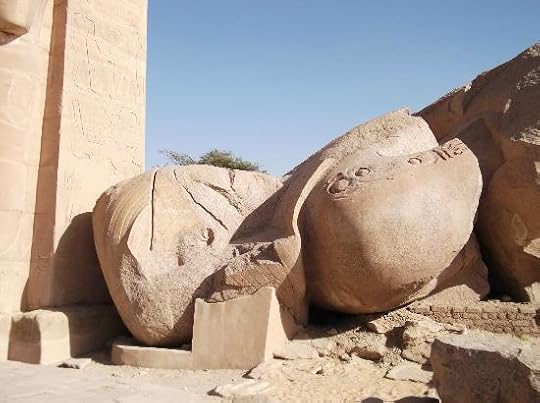 Thanks, Alana--and to think that this poem was chosen to end the TV show "Breaking Bad" shows that Shelley's sonnet is really in the public consciousness.
In fact, I like this youtube of Bryan Cranston reading the poem; his voice carries that sense of time passing. https://www.youtube.com/watch?v=T3dpg...
You're welcome Julia. I've just been yesterday at the British Museum again where the now installed a picture showing that their Ramesses is actually just one of the smaller ones at the Ramesseum. Amazing!
I envy you for having been there.
I haven't finished Breaking Bad yet, but will in a few weeks (or days?) and then I will watch your video.

Reading the Classics
Books mentioned in this topic
Ozymandias (other topics)The Rise and Fall of Ancient Egypt (other topics)
by Percy Bysshe Shelley