
 Sign in with Facebook


“So my antagonist said, "Is it impossible that there are flying saucers? Can you prove that it's impossible?" "No", I said, "I can't prove it's impossible. It's just very unlikely". At that he said, "You are very unscientific. If you can't prove it impossible then how can you say that it's unlikely?" But that is the way that is scientific. It is scientific only to say what is more likely and what less likely, and not to be proving all the time the possible and impossible.”
―
―

“But the reason I call myself by my childhood name is to remind myself that a scientist must also be absolutely like a child. If he sees a thing, he must say that he sees it, whether it was what he thought he was going to see or not. See first, think later, then test. But always see first. Otherwise you will only see what you were expecting.”
― So Long, and Thanks for All the Fish
― So Long, and Thanks for All the Fish

“Pseudoscience is almost always recognizable from a distance, and easy to confirm on close examination. Science is, however, not immune from hubris, and bad science can be tougher to spot. Those of us who make a living from science or science media must display scientific integrity. We must constantly test our assumptions and fight the siren song of consensus when our data tells us to be contrarian. We must remain independent of political or religious bias in evaluating our work. We must admit when we are wrong, and remain willing to evolve when verifiable data demands change. We must admit when we are uncertain, remain humble in advances, and offer courageous and independent advice grounded in science.”
―
―
“If you try and take a cat apart to see how it works, the first thing you have on your hands is a non-working cat.”
―
―
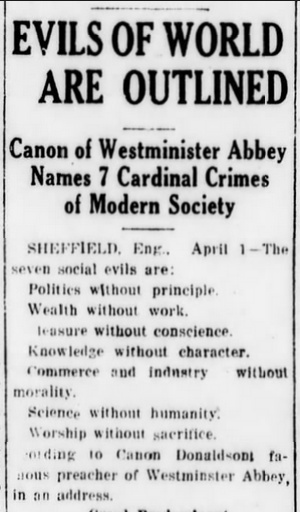
“The Seven Social Sins are:
Wealth without work.
Pleasure without conscience.
Knowledge without character.
Commerce without morality.
Science without humanity.
Worship without sacrifice.
Politics without principle.
From a sermon given by Frederick Lewis Donaldson in Westminster Abbey, London, on March 20, 1925.”
―
Wealth without work.
Pleasure without conscience.
Knowledge without character.
Commerce without morality.
Science without humanity.
Worship without sacrifice.
Politics without principle.
From a sermon given by Frederick Lewis Donaldson in Westminster Abbey, London, on March 20, 1925.”
―

Davidfaure’s 2024 Year in Books
Take a look at Davidfaure’s Year in Books, including some fun facts about their reading.

Polls voted on by Davidfaure
Lists liked by Davidfaure
