
Discover new books on Goodreads
Meet your next favorite book
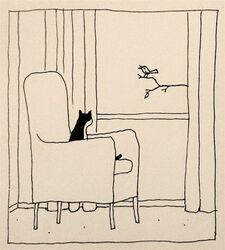


“There were times when the pressure to achieve happiness felt almost oppressive, as if happiness were something that everyone should and could attain, that any sort of compromise in its pursuit was somehow your fault.”
― A Little Life
― A Little Life
“As he soars, he thinks, suddenly, of Dr. Kashen. Or not of Dr. Kashen, necessarily, but the question he had asked him when he was applying to be his advisee: What's your favorite axiom? (The nerd pickup line, CM had once called it.)
"The axiom of equality," he'd said, and Kashen had nodded, approvingly. "That's a good one," he'd said.
The axiom of equality states that x always equals x: it assumes that if you have a conceptual thing named x, that it must always be equivalent to itself, that it has a uniqueness about it, that it is in possession of something so irreducible that we must assume it is absolutely, unchangeably equivalent to itself for all time, that its very elementalness can never be altered. But it is impossible to prove. Always, absolutes, nevers: these are the words, as much as numbers, that make up the world of mathematics. Not everyone liked the axiom of equality––Dr. Li had once called it coy and twee, a fan dance of an axiom––but he had always appreciated how elusive it was, how the beauty of the equation itself would always be frustrated by the attempts to prove it. I was the kind of axiom that could drive you mad, that could consume you, that could easily become an entire life.
But now he knows for certain how true the axiom is, because he himself––his very life––has proven it. The person I was will always be the person I am, he realizes. The context may have changed: he may be in this apartment, and he may have a job that he enjoys and that pays him well, and he may have parents and friends he loves. He may be respected; in court, he may even be feared. But fundamentally, he is the same person, a person who inspires disgust, a person meant to be hated. And in that microsecond that he finds himself suspended in the air, between ecstasy of being aloft and the anticipation of his landing, which he knows will be terrible, he knows that x will always equal x, no matter what he does, or how many years he moves away from the monastery, from Brother Luke, no matter how much he earns or how hard he tries to forget. It is the last thing he thinks as his shoulder cracks down upon the concrete, and the world, for an instant, jerks blessedly away from beneath him: x = x, he thinks. x = x, x = x.”
― A Little Life
"The axiom of equality," he'd said, and Kashen had nodded, approvingly. "That's a good one," he'd said.
The axiom of equality states that x always equals x: it assumes that if you have a conceptual thing named x, that it must always be equivalent to itself, that it has a uniqueness about it, that it is in possession of something so irreducible that we must assume it is absolutely, unchangeably equivalent to itself for all time, that its very elementalness can never be altered. But it is impossible to prove. Always, absolutes, nevers: these are the words, as much as numbers, that make up the world of mathematics. Not everyone liked the axiom of equality––Dr. Li had once called it coy and twee, a fan dance of an axiom––but he had always appreciated how elusive it was, how the beauty of the equation itself would always be frustrated by the attempts to prove it. I was the kind of axiom that could drive you mad, that could consume you, that could easily become an entire life.
But now he knows for certain how true the axiom is, because he himself––his very life––has proven it. The person I was will always be the person I am, he realizes. The context may have changed: he may be in this apartment, and he may have a job that he enjoys and that pays him well, and he may have parents and friends he loves. He may be respected; in court, he may even be feared. But fundamentally, he is the same person, a person who inspires disgust, a person meant to be hated. And in that microsecond that he finds himself suspended in the air, between ecstasy of being aloft and the anticipation of his landing, which he knows will be terrible, he knows that x will always equal x, no matter what he does, or how many years he moves away from the monastery, from Brother Luke, no matter how much he earns or how hard he tries to forget. It is the last thing he thinks as his shoulder cracks down upon the concrete, and the world, for an instant, jerks blessedly away from beneath him: x = x, he thinks. x = x, x = x.”
― A Little Life

“In a somer seson whan soft was the sonne
I shope me in shroudes as I a shepe were,
In habite as an heremite vnholy of workes,
Went wyde in þis worlde wondres to here.”
― Piers Plowman: Selections from the B-text
I shope me in shroudes as I a shepe were,
In habite as an heremite vnholy of workes,
Went wyde in þis worlde wondres to here.”
― Piers Plowman: Selections from the B-text
“Are you happy? he once asked Jude (they must have been drunk).
I don't think happiness is for me, Jude had said at last, as if Willem had been offering him a dish he didn't want to eat.
But it's for you, Willem.”
― A Little Life
I don't think happiness is for me, Jude had said at last, as if Willem had been offering him a dish he didn't want to eat.
But it's for you, Willem.”
― A Little Life
“I’m lonely,” he says aloud, and the silence of the apartment absorbs the words like blood soaking into cotton.
He is so lonely that he sometimes feels it physically, a sodden clump of dirty laundry pressing against his chest. He cannot unlearn the feeling.”
― A Little Life
He is so lonely that he sometimes feels it physically, a sodden clump of dirty laundry pressing against his chest. He cannot unlearn the feeling.”
― A Little Life

Lavinia’s 2025 Year in Books
Take a look at Lavinia’s Year in Books, including some fun facts about their reading.


Favorite Genres
Polls voted on by Lavinia
Lists liked by Lavinia