
 Sign in with Facebook
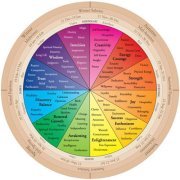


“Remember, it is not enough to be hit or insulted to be harmed, you must believe that you are being harmed. If someone succeeds in provoking you, realize that your mind is complicit in the provocation. Which is why it is essential that we not respond impulsively to impressions; take a moment before reacting, and you will find it easier to maintain control.”
― The Art of Living: The Classical Manual on Virtue, Happiness and Effectiveness
― The Art of Living: The Classical Manual on Virtue, Happiness and Effectiveness
“pure mind is like the empty sky,
without memory, supreme meditation;
it is our own nature, unstirring, uncontrived,
and wherever that abides is the superior mind,
one in buddhahood without any sign,
one in view free of limiting elaboration,
one in meditation free of limiting ideation,
one in conduct free of limiting endeavor,
and one in fruition free of limiting attainment.
vast! spacious!
released as it stands!
with neither realization nor non-realization;
experience consummate! no mind!
it is open to infinity.”
―
without memory, supreme meditation;
it is our own nature, unstirring, uncontrived,
and wherever that abides is the superior mind,
one in buddhahood without any sign,
one in view free of limiting elaboration,
one in meditation free of limiting ideation,
one in conduct free of limiting endeavor,
and one in fruition free of limiting attainment.
vast! spacious!
released as it stands!
with neither realization nor non-realization;
experience consummate! no mind!
it is open to infinity.”
―

“The Greek word for "return" is nostos. Algos means "suffering." So nostalgia is the suffering caused by an unappeased yearning to return. To express that fundamental notion most Europeans can utilize a word derived from the Greek (nostalgia, nostalgie) as well as other words with roots in their national languages: añoranza, say the Spaniards; saudade, say the Portuguese. In each language these words have a different semantic nuance. Often they mean only the sadness caused by the impossibility of returning to one's country: a longing for country, for home. What in English is called "homesickness." Or in German: Heimweh. In Dutch: heimwee. But this reduces that great notion to just its spatial element. One of the oldest European languages, Icelandic (like English) makes a distinction between two terms: söknuour: nostalgia in its general sense; and heimprá: longing for the homeland. Czechs have the Greek-derived nostalgie as well as their own noun, stesk, and their own verb; the most moving, Czech expression of love: styska se mi po tobe ("I yearn for you," "I'm nostalgic for you"; "I cannot bear the pain of your absence"). In Spanish añoranza comes from the verb añorar (to feel nostalgia), which comes from the Catalan enyorar, itself derived from the Latin word ignorare (to be unaware of, not know, not experience; to lack or miss), In that etymological light nostalgia seems something like the pain of ignorance, of not knowing. You are far away, and I don't know what has become of you. My country is far away, and I don't know what is happening there. Certain languages have problems with nostalgia: the French can only express it by the noun from the Greek root, and have no verb for it; they can say Je m'ennuie de toi (I miss you), but the word s'ennuyer is weak, cold -- anyhow too light for so grave a feeling. The Germans rarely use the Greek-derived term Nostalgie, and tend to say Sehnsucht in speaking of the desire for an absent thing. But Sehnsucht can refer both to something that has existed and to something that has never existed (a new adventure), and therefore it does not necessarily imply the nostos idea; to include in Sehnsucht the obsession with returning would require adding a complementary phrase: Sehnsucht nach der Vergangenheit, nach der verlorenen Kindheit, nach der ersten Liebe (longing for the past, for lost childhood, for a first love).”
― Ignorance
― Ignorance

“I am a Saturn who dreams of being a Mercury, and everything I write reflects these two impulses.”
― Six Memos for the Next Millennium
― Six Memos for the Next Millennium

“We teach girls to shrink themselves, to make themselves smaller. We say to girls, you can have ambition, but not too much. You should aim to be successful, but not too successful. Otherwise, you would threaten the man. Because I am female, I am expected to aspire to marriage. I am expected to make my life choices always keeping in mind that marriage is the most important. Now marriage can be a source of joy and love and mutual support but why do we teach girls to aspire to marriage and we don’t teach boys the same? We raise girls to see each other as competitors not for jobs or accomplishments, which I think can be a good thing, but for the attention of men. We teach girls that they cannot be sexual beings in the way that boys are.”
― We Should All Be Feminists
― We Should All Be Feminists

Aline’s 2025 Year in Books
Take a look at Aline’s Year in Books, including some fun facts about their reading.

447 books
|
37 friends

417 books
|
208 friends

226 books
|
79 friends

32 books
|
232 friends

581 books
|
96 friends

337 books
|
35 friends

2 books
|
88 friends

148 books
|
127 friends
More friends…

Favorite Genres
Polls voted on by Aline
Lists liked by Aline
