Goodreads helps you follow your favorite authors. Be the first to learn about new releases!
Start by following Fred Kiel.

Showing 1-14 of 14
“True character rises from a deeper well than religion. It is the internalization of the moral principles of a society, augmented by those tenets personally chosen by the individual, strong enough to endure through trials of solitude and diversity. The principles are fitted together into what we call … the integrated self, wherein personal decisions feel good and true. Character is in turn the enduring source of virtue. It stands by itself and excites admiration in others. It is not obedience to authority, and while it is often consistent with and reinforced by religious belief, it is not piety.2”
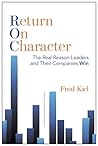
― Return on Character: The Real Reason Leaders and Their Companies Win
― Return on Character: The Real Reason Leaders and Their Companies Win
“Jim Collins describes his own version of Virtuoso leadership in what he calls the Level 5 leader, someone who “builds enduring greatness through a paradoxical blend of personal humility and professional will.”2 Collins tells us that, while he believes many individuals with the potential to be Level 5 leaders exist in our world, they’re difficult to spot because their humility prevents them from taking credit for the positive results of their superb leadership. He says, “Our research exposed Level 5 as a key component inside the black box of what it takes to shift a company from good to great.”
― Return on Character: The Real Reason Leaders and Their Companies Win
― Return on Character: The Real Reason Leaders and Their Companies Win
“By comparison, the Integrated Human model of human nature, in addition to the two elements of our previous model, includes: A conscious analytic system, known as the slow brain (where logic resides) A subconscious intuitive system, or fast brain The full range of motivational drives (of which the drive to acquire is only one) Basic ideas of moral behavior, or moral intuitions Distinguishing characteristics, or personality traits Together, these elements of our nature provide all of the fundamental functions necessary for living life as a complete, Integrated Human—and they are the springboard for the development of leadership character. As our research data has shown, the ability to leverage all of these areas influence leadership’s ability to achieve positive organizational outcomes.”
― Return on Character: The Real Reason Leaders and Their Companies Win
― Return on Character: The Real Reason Leaders and Their Companies Win
“We reveal our character all the time through observable behaviors: in the way we treat other people. As we mature, these character-driven behaviors become automatic reflexes, the character habits that express our guiding principles and beliefs.”
― Return on Character: The Real Reason Leaders and Their Companies Win
― Return on Character: The Real Reason Leaders and Their Companies Win
“The fast brain is where all of our subconscious intuitions, cravings, habits, and emotions reside. The fast brain’s primary purpose is to provide these subconscious “spurs” to drive behavior patterns aimed at bringing us safety, security, food, and social connection. We’re born with a fully operational fast brain, which begins functioning while we’re still in the womb. It is always on and running, constantly scanning to collect information and continually forming conclusions about what it observes. Those conclusions often are based in intuition, emotion, or cravings. Our fast brain also spurs behavior through habits—automatic responses such as putting our foot on the brake when we see a stop sign. Those habits that determine how we relate to others, such as a reflexive response to tell the truth or own up to our mistakes, become our character habits.”
― Return on Character: The Real Reason Leaders and Their Companies Win
― Return on Character: The Real Reason Leaders and Their Companies Win
“In essence, our behavior is a product of our genetic makeup and basic human nature filtered and honed through the environments, experiences, and relationships that form our life journey. Together, these factors—governed by both our nature and the nurturing we receive—help shape the belief system and moral habits that form our character, and in turn, trigger the habitual behaviors that express it.”
― Return on Character: The Real Reason Leaders and Their Companies Win
― Return on Character: The Real Reason Leaders and Their Companies Win
“Character habits and beliefs. All of us are guided by our subconscious minds—perhaps more than we think. Character habits, acquired during our early years and modified throughout our lifetime, are a large part of our inner world, even though they operate mostly at a subconscious level. As we saw earlier, many moral actions that define and express our character are the result of automatic response patterns that bypass rational thought. These character habits often appear as our reflexive response to a given situation—the unfiltered expression of our beliefs. Character habits, in combination with a leader’s beliefs—especially his or her aspirational beliefs for the organization—directly influence the individual’s decision-making skills and other leadership activities. For that reason, a leader’s character habits and moral beliefs matter a lot when it comes to value creation and business results. (In chapter 3, “The Journey from Cradle to Corner Office,” we examine what the research has to tell us about how life experiences shape leadership character.)”
― Return on Character: The Real Reason Leaders and Their Companies Win
― Return on Character: The Real Reason Leaders and Their Companies Win
“We humans are born with intuitions, drives, and personality traits that determine how we interact with the world around us. These dispositions—both inherited and acquired—lie at the very core of who we are as human beings.8”
― Return on Character: The Real Reason Leaders and Their Companies Win
― Return on Character: The Real Reason Leaders and Their Companies Win
“Our slow brain is where we do all our conscious and analytic work. It provides us with the tools of logic and reflection. When we engage it, our slow brain operates as a reflective, analytic thinking tool; it can gather data, analyze it, apply the rules of logic, and come to new conclusions. Our slow brain can call on a number of beliefs or rules and use them to guide a decision. It also can override the intuitions of our fast brain, a process we know as willpower. Our slow brain can also learn to identify and ignore erroneous signals from our fast brain, which is how we demonstrate self-awareness and wisdom. Unfortunately, our slow brain isn’t always engaged.”
― Return on Character: The Real Reason Leaders and Their Companies Win
― Return on Character: The Real Reason Leaders and Their Companies Win
“Wilson also makes a powerful point when he says that strong character leads to the integrated self—a joining of head and heart, where thoughts, feelings, and actions are in harmony, resulting in behavior that demonstrates the character of an individual who walks the talk of his or her belief system.”
― Return on Character: The Real Reason Leaders and Their Companies Win
― Return on Character: The Real Reason Leaders and Their Companies Win
“The work involved in exploring your own nature, identifying weaknesses in your character, and then working to overcome them can be difficult and even painful. But as with all transformative change, the outcomes can more than compensate for the work of achieving them. You may be the only person in your life who is unaware of the shortcomings in your character.”
― Return on Character: The Real Reason Leaders and Their Companies Win
― Return on Character: The Real Reason Leaders and Their Companies Win
“We’ll examine the results achieved by Virtuoso leaders, CEOs whose workforce ratings place them at the top of the Character Curve etched by integrity, responsibility, forgiveness, and compassion—principles that we discovered to be the Keystone Character Habits of leadership. And we’ll compare their organizational results with those of the Self-Focused leaders who fall at the other end of the curve. The stories of how the low-character leaders undermine the success of even the best business plan put to rest the “greed is good” myth.”
― Return on Character: The Real Reason Leaders and Their Companies Win
― Return on Character: The Real Reason Leaders and Their Companies Win
“As business consultants with many years’ experience working with CEOs and senior executives, we were convinced that character shapes leadership decisions, tactics, and workplace behavior—all of which play a direct role in business results. To map the connections between all of those factors, we structured a research project aimed at bringing crystalline clarity to our understanding of what constitutes character, how it’s formed, the role it plays in our self-concept, and how it shapes our interactions with the world. (See appendix A for a detailed description of the research design.) We may have been venturing into explosive territory, but we knew that beyond it lay the answer to the big question: Is the strength of a leader’s character an important driver of business success?”
― Return on Character: The Real Reason Leaders and Their Companies Win
― Return on Character: The Real Reason Leaders and Their Companies Win
“Each of us constantly makes decisions about how to interact with other people, and each of those decisions has the potential to either harm or enhance the other person’s well-being.”
― Return on Character: The Real Reason Leaders and Their Companies Win
― Return on Character: The Real Reason Leaders and Their Companies Win