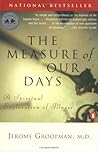
Goodreads helps you follow your favorite authors. Be the first to learn about new releases!
Start by following Jerome Groopman.

Showing 1-29 of 29
“To hope under the most extreme circumstances is an act of defiance that permits a person to live his life on his own terms. It is part of the human spirit to endure and give a miracle a chance to happen.”
―
―
“I feel that I have to do everything better just to be judged as okay. It is something I wish I could let go of. It's something that I wish just wasn't there.”
― How Doctors Think
― How Doctors Think
“Hope is one of our central emotions, but we are often at a loss when asked to define it. Many of us confuse hope with optimism, a prevailing attitude that "things turn out for the best." But hope differs from optimism. Hope does not arise from being told to "Think Positively," or from hearing an overly rosy forecast. Hope, unlike optimism, is rooted in unalloyed reality. Although there is no uniform definition of hope, I found on that seemed to capture what my patients had taught me. Hope is the elevating feeling we experience when we see - in the mind's eye- a path to a better future. Hope acknowledges the significant obstacles and deep pitfalls along that path. True hope has no room for delusion.”
― The Anatomy of Hope: How People Prevail in the Face of Illness
― The Anatomy of Hope: How People Prevail in the Face of Illness
“Certainly the primary imperative of a physician is to be skilled in medical science, but if he or she does not probe a patient's soul, then the doctor's care is given without caring, and part of the sacred mission of healing is missing.”
―
―
“Hope can be imagined as a domino effect, a chain reaction, each increment making the next increase more feasible... There are moments of fear and doubt that can deflate it.”
―
―
“Statistics cannot substitute for the human being before you; statistics embody averages, not individuals.”
― How Doctors Think
― How Doctors Think
“... omniscience about life and death is not within a physician's purview. A doctor should never write off a person a priori.”
― The Anatomy of Hope: How People Prevail in the Face of Illness
― The Anatomy of Hope: How People Prevail in the Face of Illness
“I had learned that every patient has the right to hope, despite long odds, and it was my role to help nurture that hope.”
―
―
“The cerebral processing of that visceral input as a signal of death was accurate. Without the kinds of therapy that had been developed over the decades, this cancer would have been fatal. Hope, then, is constructed not just from rational deliberation, from the conscious weighing of information; it arises as an amalgam of thought and feeling, the feelings created in part by neural input from the organs and tissues.”
― The Anatomy of Hope: How People Prevail in the Face of Illness
― The Anatomy of Hope: How People Prevail in the Face of Illness
“The freedom of patient speech is necessary if the doctor is to get clues about the medical enigma before him. If the patient is inhibited, or cut off prematurely, or constrained into one path of discussion, then the doctor may not be told something vital. Observers have noted that, on average, physicians interrupt patients within eighteen seconds of when they begin telling their story.”
―
―
“A book is an experiment, and as with all experiments, there is a sense of uncertainty about how it will turn out.”
― How Doctors Think
― How Doctors Think
“It took more than science to make hope real.”
―
―
“True hope has no room for delusion.”
― The Anatomy of Hope: How People Prevail in the Face of Illness
― The Anatomy of Hope: How People Prevail in the Face of Illness
“One of the difficulties I experienced in trying to learn about the biology of emotions was the definition of terms...How would [Prof. Richard Davidson], as an experimental psychologist, deconstruct [hope]?
"I understand hope as an emotion made up of two parts: a cognitive part and an affective part. When we hope for something, we employ, to some degree, our cognition, marshalling information and data relevant to a desired future event. If...you are suffering with a serious illness and you hope for improvement, even for a cure, you have to generate a different vision of your condition in your mind. That picture is painted in part by assimilating information about the disease and its potential treatments.
"But hope also involves what I would call affective forecasting--that is, the comforting, energizing, elevating feeling that you experience when you project in your mind a positive future. This requires the brain to generate a different affective, or feeling, state than the one you are currently in.”
― The Anatomy of Hope: How People Prevail in the Face of Illness
"I understand hope as an emotion made up of two parts: a cognitive part and an affective part. When we hope for something, we employ, to some degree, our cognition, marshalling information and data relevant to a desired future event. If...you are suffering with a serious illness and you hope for improvement, even for a cure, you have to generate a different vision of your condition in your mind. That picture is painted in part by assimilating information about the disease and its potential treatments.
"But hope also involves what I would call affective forecasting--that is, the comforting, energizing, elevating feeling that you experience when you project in your mind a positive future. This requires the brain to generate a different affective, or feeling, state than the one you are currently in.”
― The Anatomy of Hope: How People Prevail in the Face of Illness
“Despite education and knowledge and experience, when you are the patient--suffering, confused, and despairing--it is very, very hard to take matters into your own hands. I was not a George Griffin, able to stand alone and challenge the prevailing assumptions. I needed an external voice, strong and determined, to guide me.”
― The Anatomy of Hope: How People Prevail in the Face of Illness
― The Anatomy of Hope: How People Prevail in the Face of Illness
“This is the vicious cycle. When we feel pain from our physical debility, that pain amplifies our sense of hopelessness; the less hopeful we feel, the fewer endorphins and enkephalins and the more CCK we release. The more pain we experience due to these neurochemicals, the less able we are to feel hope.”
― The Anatomy of Hope: How People Prevail in the Face of Illness
― The Anatomy of Hope: How People Prevail in the Face of Illness
“also risks of taking statins. To be sure, seeing a person in front of you has a greater impact than hearing about side effects secondhand. But even secondhand stories affect the way people think. We have also observed in”
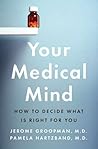
― Your Medical Mind: How to Decide What Is Right for You
― Your Medical Mind: How to Decide What Is Right for You
“While it is a convenient construct to divide hope into a cognitive and an affective component, the two are tightly coupled. Feelings and emotions mold logical thinking and eliberate decision making...True hope, then, is not initiated and sustained by completely erasing the emotions, like fear and anxiety, that are often its greatest obstacles. An equilibrium needs to be established, integrating the genuine threats and dangers that exist into the proposed strategies to subsume them. So when a person tells me that he doesn't want to know about the problems and risks, that he believes ignorance is necessary for bliss, I acknowledge that yes, yunbridled fear can shatter a fragile sense of hope. But I assert that he still needs to know a minimum amount of information about his diagnosis and the course of his problem; otherwise his hope is false, and false hope is an insubstantial foundation upon which to stand and weather the vicissitudes of difficult circumstances. It is only true hope that carries its companions, courage and resilience, through. False hope causes them to ultimately fall by the wayside as reality intervenes and overpowers illusion.”
― The Anatomy of Hope: How People Prevail in the Face of Illness
― The Anatomy of Hope: How People Prevail in the Face of Illness
“The probability that a diagnostic test will be positive if the disease is present (sensitivity), the probability that a test would be negative if the disease is absent (specificity).”
― How Doctors Think
― How Doctors Think
“Researchers are learning that a change in mind-set has the power to alter neurochemistry. Belief and expectation—the key elements of hope—can block pain by releasing the brain’s endorphins and enkephalins, mimicking the effects of morphine.”
― The Anatomy of Hope: How People Prevail in the Face of Illness
― The Anatomy of Hope: How People Prevail in the Face of Illness
“or she would choose the treatment option that the experts saw as “best,” in this case taking the medication. But in the Dartmouth study, this was not what happened. When given clearer information, the patients weighed the risks and benefits”
― Your Medical Mind: How to Decide What Is Right for You
― Your Medical Mind: How to Decide What Is Right for You
“to taking an action that could make life even worse. Psychologists call this “loss aversion.” Research in cognitive”
― Your Medical Mind: How to Decide What Is Right for You
― Your Medical Mind: How to Decide What Is Right for You
“Understanding statistics about the risks and benefits of a treatment is called “health literacy.” It”
― Your Medical Mind: How to Decide What Is Right for You
― Your Medical Mind: How to Decide What Is Right for You
“their preferences about starting medications for elevated blood pressure or a high cholesterol level. Although guidelines usually have fine print at the bottom asserting that the recommendations need to be molded to the preferences, values, and goals of the individual patient, we believe that this statement should be in large”
― Your Medical Mind: How to Decide What Is Right for You
― Your Medical Mind: How to Decide What Is Right for You
“Finding something may be satisfactory, but not finding everything is suboptimal. (Dr. Pat Croskerry)”
―
―
“This skewing of physicians' thinking leads to poor care. What is remarkable is not merely the consequences of a doctor's negative emotions. Despite research showing that most patients pickup on the physician's negativity, few of them understand its effect on their medical care and rarely change doctors because of it.”
―
―
“suffered muscle pain, the most common side effect of statins, or someone else who developed liver toxicity and gastrointestinal upset, which are less common”
― Your Medical Mind: How to Decide What Is Right for You
― Your Medical Mind: How to Decide What Is Right for You
“In the field of decision analysis, the utility or value that a person assigns to a particular outcome is termed his "preference." Researchers have found that patients often construct their preferences on the spot when the doctor gives a diagnosis and recommends a treatment. Such patients are something of a "blank slate" upon which the doctor can "write" his or her own preference. In this setting, the patient is especially susceptible to how the physician frames the pros and cons both the treatment. (p57)”
―
―