Goodreads helps you follow your favorite authors. Be the first to learn about new releases!
Start by following Harvey Sachs.

Showing 1-3 of 3
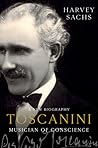
“But the maestro’s biggest project during the second half of the season was the first North American production of Paul Dukas’s Ariane et Barbe-bleue, on 29 March 1911. Ariane, a forward-looking, brilliantly orchestrated work, had had its premiere in Paris four years earlier, and had since been performed in Vienna, conducted by Alexander Zemlinsky and admired by Arnold Schoenberg, Alban Berg, and Anton Webern, among others. Toscanini,”
― Toscanini: Musician of Conscience
― Toscanini: Musician of Conscience
“… the conjunction of Beethoven’s last symphonic masterpiece with crucial works or events in the lives of so many other outstanding artists made 1824 a particularly fertile year…. The fact that the Ninth Symphony, Byron’s death, Pushkin’s Boris Gudunov and “To the Sea,” Delacroix’s Massacres at Chios, Stendhal’s Racine and Shakespeare, and Heine’s Harz Journey and North Sea Pictures all futhered, in one way or another, Romanticism’s rear-guard action against repression underlines the significance of that speck of time. And perhaps these brief glances at those artists and their states of being at that moment will have helped to remind readers—as they reminded this author—that spiritual and intellectual liberation requires endless internal warfare against everything in ourselves that narrows us down instead of opening us up and that replaces questing with certitude. Nearly two centuries later, the world still overflows with people who believe that truth not only exists but that it is simple and straightforward, and that their truths—be they political, religious, philosophical, moral, or social—constitute The Truth. Federico Fellini’s characterization, a generation ago, of the fascist mentality as “a refusal to deepen one’s individual relationship to life, out of laziness, prejudice, unwillingness to inconvenience oneself, and presumptuousness” describes the obedient adherents of most prefabricated beliefs, everywhere and at all times. The others—the disobedient, the nonadherents, those who think that the world is not easily explained and that human experience does not fit into tidy little compartments—are still fighting the eternally unwinnable War of Liberation. Until our sorry species bombs or gluts itself into oblivion, the skirmishing will continue, and what Beethoven and company keep telling us, from the ever-receding yet ever-present past, is that the struggle must continue (pp. 110-11).”
―
―
“We ought to take a deep breath—symbolically—with the singer, because we have, in a sense, “made it.” We have survived the first movement’s brutality and despair, participated in the second’s harsh struggle, and been purified by the third’s glowing acceptance of life as it is. What Beethoven wants us to experience now is all-embracing joy.”
― The Ninth: Beethoven and the World in 1824
― The Ninth: Beethoven and the World in 1824