Goodreads helps you follow your favorite authors. Be the first to learn about new releases!
Start by following Tom Goodwin.

Showing 1-20 of 20
“Uber, the world’s largest taxi company, owns no vehicles. Facebook, the world’s most popular media owner, creates no content. Alibaba, the most valuable retailer, has no inventory. And Airbnb, the world’s largest accommodation provider, owns no real estate. Something interesting is happening.”
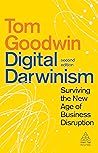
― Digital Darwinism: Survival of the Fittest in the Age of Business Disruption
― Digital Darwinism: Survival of the Fittest in the Age of Business Disruption
“I wonder sometimes if we need the opposite to agile. We need sudden leaps forward and then periods of stability. We need systems and processes designed in tandem with each other. We need to leap to create brand new entities based on the latest thinking and software, and periods of calm where we change little. It’s a bold new way to think about change, it’s countercultural, but it’s interesting to ponder.”
― Digital Darwinism: Survival of the Fittest in the Age of Business Disruption
― Digital Darwinism: Survival of the Fittest in the Age of Business Disruption
“It was 2006, and I was working with the Nokia Nseries marketing team. We were holding focus groups with prototype touchscreen phones, the like of which nobody had ever seen before. This was way before the iPhone. It was fair to say that not everyone saw the future that day. People almost without exception hated the new phones. They worried that the screens would smash even though we assured them that they would not. They hated the fact that the battery life was less than two days. They worried about strange things such as fingerprints making the screen greasy. Above all else, people couldn’t really see the point. For the outrageous trade-offs that had to be made – the large screen necessary to view photos that people were yet to share and to access apps that didn’t yet exist – the main takeaway was that it did more than they needed to. I remember more than anything else the proclamation that, ‘I like the internet, but I’ve already got it at home’. Even those companies who see the future more than most can find it very hard to change.”
― Digital Darwinism: Survival of the Fittest in the Age of Business Disruption
― Digital Darwinism: Survival of the Fittest in the Age of Business Disruption
“We need to accept imperfection. Good may be the enemy of the great but perfect is the enemy of getting stuff done. There is a vulnerability in many environments if you are to share things that are not quite perfect or perfectly thought through. The idea of presenting a new product without showing reams of research to show that it definitely will work is contrary to how most people think. The idea of not having an answer to every question that could be asked is scary, as is dreaming a little bigger or differently to others. Most companies feel like they need people who are professionals who can defend everything, who have thought through every single scenario. We need people to embrace messiness, to accept that real progress comes from things that are never done perfectly the first time. Young companies talk about the idea of a minimal viable product (MVP) which are ideas developed enough to see if there is something worth exploring further. Today we have processes like rapid prototyping or design sprints, or other ways to conceive, develop and test proposals far, far faster than a culture of perfection would ever allow. Arguably, the innovation process in China is by nature faster and bolder thanks to its spirit of chabuduo which means ‘it’ll do’ and meibanfa, aka ‘can’t be helped’. On the one hand it means things are never done perfectly, but on the other it allows rapid progress. Unlike in the West, people don’t freak out if something doesn’t work perfectly. China has a higher acceptance of imperfection, and that’s reassuring if you are trying things that may totally mess up!”
― Digital Darwinism: Survival of the Fittest in the Age of Business Disruption
― Digital Darwinism: Survival of the Fittest in the Age of Business Disruption
“The most successful companies today are the ones with the courage to challenge rules, who build themselves on different assumptions, who challenge the status quo, but do so based on the next paradigm, not the last. It is companies who hope to survive by making small incremental changes that now lose out to the ones that bet big on radical innovation and change.”
― Digital Darwinism: Survival of the Fittest in the Age of Business Disruption
― Digital Darwinism: Survival of the Fittest in the Age of Business Disruption
“I’d proffer the thought that this is all too common, that companies built for the past may offer glimpses into the incredible, but are mired in vulnerabilities in other places. Modern-day businesses are asymmetric constructs: a legacy of patches, quick fixes, hacks, workarounds, and hope.”
― Digital Darwinism: Survival of the Fittest in the Age of Business Disruption
― Digital Darwinism: Survival of the Fittest in the Age of Business Disruption
“Companies now need to look further ahead, to try to be not just agile, but predictive, to be comfortable being uncomfortable, and to be constantly finding ways to change the core essence of what they are. They need to embrace risk.”
― Digital Darwinism: Survival of the Fittest in the Age of Business Disruption
― Digital Darwinism: Survival of the Fittest in the Age of Business Disruption
“The barrier to disruptive innovation often isn’t knowing enough—it’s knowing way too much about how things have always been.”
― Digital Darwinism: Survival of the Fittest in the Age of Business Disruption
― Digital Darwinism: Survival of the Fittest in the Age of Business Disruption
“The best swordsman in the world doesn’t need to fear the second-best swordsman in the world; no, the person for him to be afraid of is some ignorant antagonist who has never had a sword in his hand before; he doesn’t do the thing he ought to do, and so the expert isn’t prepared for him. MARK TWAIN, 1889”
― Digital Darwinism: Survival of the Fittest in the Age of Business Disruption
― Digital Darwinism: Survival of the Fittest in the Age of Business Disruption
“We need to stop thinking of technology as a tattoo, a surface-level commitment best kept on a conspicuous but infrequently used part of the body. Instead, let’s think of it as oxygen: essential to the beating heart of your business.”
― Digital Darwinism: Survival of the Fittest in the Age of Business Disruption
― Digital Darwinism: Survival of the Fittest in the Age of Business Disruption
“An intolerance of bureaucracy Small companies feel different to big ones. I have worked at both. In large companies, if I am travelling for work I will be forced to use some admin staff to book a hotel with a corporate travel provider. Perhaps eight e-mails will be sent to me with various approval chains and updates, my boss will be asked to agree, a business reason is noted. Some systems will talk to others, and my assistant will orchestrate the whole thing. It will take perhaps 10 minutes of my time, 30 minutes of my assistant’s, and likely an hour of other people’s in back offices. All this to book a hotel stay for $200 that on the Hotel Tonight app I could book in around three seconds and for $100 cheaper. Why is it I can call an hour-long meeting with 20 people, costing perhaps $2,500 of time and nobody cares, but I need to ensure I use approved agents to get a hotel room? Every company, large and small, needs to reject bureaucracy and busy work. We worry a lot about seniority and protocol, but often it is an excuse. I love a memo sent out by Elon Musk, in which he says: ‘Anyone at Tesla can and should e-mail/talk to anyone else according to what they think is the fastest way to solve a problem for the benefit of the whole company. You can talk to your manager’s manager without his permission, you can talk directly to a VP in another department, you can talk to me.’ He goes on to say, while realizing the challenge and opportunity ahead and what they have against them, ‘We obviously cannot compete with the big car companies in size, so we must do so with intelligence and agility’ (Bariso, 2017). Get better at knowing when to call and when to e-mail, when to pop over for a chat, which partner meetings to never accept. A lack of bureaucracy doesn’t mean chaos, it’s about focusing on the best way to make a difference and sometimes that means anarchically barging into a meeting to get someone to make a decision. I often think teams are too big. We’ve long heard about two pizza teams, but let’s be more flexible. Tom Peters talks about the need to recruit the very best talent and pay the world’s best compensation. Steve Jobs was widely reported to have stated that a small number of A+ people can outperform any large teams of B players (Keller and Meaney, 2017). I see a lot of time and energy spent bringing people into the loop, people being part of things to look important and not adding clear value.”
― Digital Darwinism: Survival of the Fittest in the Age of Business Disruption
― Digital Darwinism: Survival of the Fittest in the Age of Business Disruption
“We took all the old-world systems and digitized them. Skeuomorphism, the design concept of making digital items resemble their real-world counterparts, was a way to aid the transition into the new era. Mail became e-mail, with ‘addresses’ and inboxes. We made ‘folders’ and ‘trash’ and ‘desktops’ as digital equivalents. PowerPoint had ‘slides’ like early slide projectors and floppy disks represented ‘saving’, which is wonderfully anachronistic, as is ‘return’ which stands for ‘carriage return’ from typewriters – and don’t even start me on ‘cc’ for carbon copy.”
― Digital Darwinism: Survival of the Fittest in the Age of Business Disruption
― Digital Darwinism: Survival of the Fittest in the Age of Business Disruption
“The role of IT has always been seen as a support function. Rather like the human resource department, it is behind the scenes and noticed only when it doesn’t do things well. We need to think of it in a different way: less as a support function and more as an investment vehicle for leading a path through change. IT should be one of the most vital departments of any company. It should be full of people excited about the future, investigating the latest software to do their expenses, enthusiastically testing new timesheet programs, or better ways to manage invoices. Many companies are let down by legacy systems that, even though they work, take up a lot of time.”
― Digital Darwinism: Survival of the Fittest in the Age of Business Disruption
― Digital Darwinism: Survival of the Fittest in the Age of Business Disruption
“Work like a start-up, but mean it With the culture in place, and a process for change in place, how hard can this be? Well, now you have to get people working like you. I’ve worked with a few large clients over the years, and while they loved the idea of working like a start-up, it was a bit like wanting to go to Glastonbury, but only if you got to avoid everything about a large music festival. The allure of working like start-ups, but in a sort of polite, 9–5, big corporate backing kind of way. They wanted to work like a start-up, but had $100 million to spend. They wanted to be agile and nimble, but with a complex approval process. We want to challenge everything, but with the data to support it. Let’s go crazy, but please use existing marketing partners, let’s break new ground but ‘our competitors haven’t done it yet’. ‘We’re going to act like a start-up’ is a new corporate mantra. What would the founders of Klarna do here? How would Spotify market this? How can we replicate WeWork’s approach? Yet it never works that way. Spreadsheets need to be filled in showing target user numbers, someone back-fills profitability requirements, someone calculates projected revenue, and automatically an investment level is found. All with no idea that this is all the antithesis of start-ups. Start-ups hustle, they ask favours, and they use the limitation of money to force themselves to try risky things.”
― Digital Darwinism: Survival of the Fittest in the Age of Business Disruption
― Digital Darwinism: Survival of the Fittest in the Age of Business Disruption
“Change requires companies to step change rather than incrementally improve. The world’s best candle-makers continually made better candles, but they never invented the lightbulb. Today companies need to leap to new business models and rethink fundamentals and what they stand for, not slowly tweak what has worked before.”
― Digital Darwinism: Survival of the Fittest in the Age of Business Disruption
― Digital Darwinism: Survival of the Fittest in the Age of Business Disruption
“In two years of research the best example of self-disruption I can find is Netflix. Netflix’s transition to streaming from DVD rental by mail was not nearly as smooth as many would like to remember it, but in hindsight it appears genius. Netflix was founded in 1997 as a DVD mail service and pretty rapidly rose to take huge market share from local video stores who could not compete with its vast range of titles. People soon appreciated the appeal of no late fees, the ability to have several movies out at the same time, as well as its unlimited consumption tariff. Always keen to keep abreast of the latest technology, in 2007 Netflix spent about $40 million to build data centres and to cover the cost of licensing for the initial streaming titles (Rodriguez, 2017). When internet speeds allowed, it introduced streaming as an additional service for its existing subscribers. Monthly fees remained the same, but those with more expensive tariffs were given access to more hours of streamed content. While it added something for free, it also helped give people a reason to upgrade to more expensive plans. Growth was impressive, the video libraries of streamed content rose, the share price rose impressively from $3 in 2007 to over $42 in 2011, and life was good. In September 2011 Netflix made a very bold move. It created two tariffs, and moved all its US subscribers onto two separate plans: the original DVD-by-mail service was to be called Qwikster; the other was a streaming service for a lower monthly fee. The market was shocked, and by December the stock price was below $10 and the company was in pieces. The company rapidly lost higher revenue DVD subscribers and within nine months profits were down by 50 per cent (Steel, 2015). And yet slowly things changed. First, the lower prices suddenly appealed to a much wider market, bringing in far more paying customers, allowing Netflix to buy more content and to slowly raise prices. Then Netflix started making its own original content, clearing out global streaming rights, and then at a flick of a switch it was able to expand globally. If Netflix had not disrupted itself it would be a very different company. It would rely on a massive physical distortion system, with very high costs. It would probably have lost out massively to YouTube and would have withered away as a mail-order DVD supplier. Instead, Netflix’s share price is now nearly $200, five times more than it was when it bravely self-disrupted, it operates in 190 countries, makes nearly $9 billion in revenue from over 110 million customers (Feldman, 2017). Today DVDs represent only 4 per cent of Netflix’s users. It seems that in 2011, when Wall Street was demanding the resignation of Reed Hastings for reinventing the business, they were wrong. From this you can see the pressure this approach places on leaderships, the confidence you need to have, the degree to which this antagonizes the market and everyone around you. This move takes balls. The confidence, conviction, and aggression, to change before you have to create your own future, is remarkable.”
― Digital Darwinism: Survival of the Fittest in the Age of Business Disruption
― Digital Darwinism: Survival of the Fittest in the Age of Business Disruption
“The key way to think about power in the home was that it had many phases. First, an era of people discovering and refining a technology so that it could be used. Then a period when it was only for the rich, when its possibilities were hard to recognize, when we added power to old items to improve their functionality. Finally, a period when the technology plummeted in price, became far more accessible to all, but above all else, this was when new items were created around the potential of the technology.”
― Digital Darwinism: Survival of the Fittest in the Age of Business Disruption
― Digital Darwinism: Survival of the Fittest in the Age of Business Disruption
“Our role is to forget everything that went before us – not to apply technology to existing solutions, but to rethink how we’d create businesses today in this context of the post-digital age.”
― Digital Darwinism: Survival of the Fittest in the Age of Business Disruption
― Digital Darwinism: Survival of the Fittest in the Age of Business Disruption
“The idea of Digital Darwinism is that, like any species, companies are designed to improve slowly over time, to optimize, to breed selectively, to become better via rather slow but consistent and well-proven evolution. This has worked for large and small businesses alike, but things are different now. The pace of technological and societal change has now become so fast that the background for business changes faster than any company can. Natural adaptation and typical agility are no longer enough.”
― Digital Darwinism: Survival of the Fittest in the Age of Business Disruption
― Digital Darwinism: Survival of the Fittest in the Age of Business Disruption
“So while I believe in the ‘many steps’ theory, I think the ultimate goal of heads of innovation is the same as a head of digital in 2010 or a head of computerization in 1995 or a head of electricity in 1940: it’s to make themselves redundant. To create a culture of innovation in everyone. The first step in that journey is to show everyone your intentions, to employ such a figurehead, but with the clear goal of moving out of the way and behind everyone. We see lots of companies really failing to make alterations at a deep enough level. They tend to give up. For example, many banks or insurance companies will create a digital bank subsidiary. It’s clearly the easiest step to undertake because it’s moving everything messy to one side, but it’s the integration that’s hard – the politics, the interfaces between data on old systems and new. The other approach often seen is building a newer digital facade onto the old structure and company. We see airlines with amazing snazzy new mobile apps, that look very slick, but won’t allow you to change flights because that relies on the back end to be rebuilt.”
― Digital Darwinism: Survival of the Fittest in the Age of Business Disruption
― Digital Darwinism: Survival of the Fittest in the Age of Business Disruption