Goodreads helps you follow your favorite authors. Be the first to learn about new releases!
Start by following Stephen Houlgate.

Showing 1-8 of 8
“Hegel was an unsalaried lecturer at the University of Jena, and, as he later told his friend, the philosopher F. W. J. Schelling, he ‘actually completed the final draft in the middle of the night before the Battle of Jena’ (which took place on 14 October 1806 and in which Napoleon’s troops comprehensively defeated the Prussians).1 Furthermore, Hegel had to entrust the last sheets of his manuscript to a courier who rode through French lines to take them to the publisher in Bamberg.”
― Hegel's 'Phenomenology of Spirit': A Reader's Guide
― Hegel's 'Phenomenology of Spirit': A Reader's Guide
“In the Logic, Hegel states that this ‘unity’ of thought and being constitutes the ‘element’ or ‘principle’ of logic.7 Logic thus starts from the idea that being is known by pure thought to be intelligible to pure thought.”
― Hegel's 'Phenomenology of Spirit': A Reader's Guide
― Hegel's 'Phenomenology of Spirit': A Reader's Guide
“Kantian philosophical caution is thus not actually as cautious as it pretends to be, for it rests on assumptions that it takes for granted.”
― Hegel's 'Phenomenology of Spirit': A Reader's Guide
― Hegel's 'Phenomenology of Spirit': A Reader's Guide
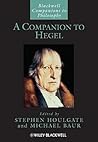
“the reader must him– or herself attend to experiencing simply this moment, now. What Hegel notes in his description of this experience is that the now is itself not experienced as an isolated instant, but is experienced as a passage: it is experienced as coming into being and passing away in a temporal flow. 10 But the notion of “passage” is more complex than the notion of “is” – it is becoming, a motion defined as “from … to,” and not just an unqualified immediacy of being. What we see here is that, if we try to describe experience simply in the terms of unqualified immediacy – if we use a simple term such as “is” or “now” or “here” – we under – represent the character of that experience, and the experience of the “now” itself reveals this. Our approach to receptiveness – our attempt to describe the experience without introducing an intervening interpretation – allows our object to reveal itself to us in such a way that it demonstrates the insufficiency of our own initial approach to it, demonstrating that it is becoming and not simply being as our initial apprehension implies. The project of phenomenology seems initially to demand a “hands off” approach, but, in enacting that project, we find out from the object that this attitude is inadequate to it. The “hands off” approach is in fact a tacit presumption that the object must be simple “being,” and does not allow the object to appear on its own terms as becoming: apprehending the object as becoming goes hand in hand with a transformation of perspective, a transformation in what one is prepared to recognize.”
― A Companion to Hegel
― A Companion to Hegel
“Whereas Spinoza begins with contestable definitions of substance, attribute and mode, Hegel begins with the utterly indeterminate thought of pure ‘being’.”
― Hegel's 'Phenomenology of Spirit': A Reader's Guide
― Hegel's 'Phenomenology of Spirit': A Reader's Guide
“For Hegel, therefore, all truly critical philosophy in the wake of Kant is governed by the following imperative: all ‘presuppositions or assumptions must equally be given up when we enter into science’. Science – that is to say, philosophy – should thus be ‘preceded by universal doubt, i.e.,”
― Hegel's 'Phenomenology of Spirit': A Reader's Guide
― Hegel's 'Phenomenology of Spirit': A Reader's Guide
“In Hegel’s view, an uncritical, or inadequately critical, approach to the categories takes a certain understanding of them on authority – be it the authority of past philosophers, tradition, common sense or formal logic.”
― Hegel's 'Phenomenology of Spirit': A Reader's Guide
― Hegel's 'Phenomenology of Spirit': A Reader's Guide
“In Hegel’s view, Kant is the father of the critical era in philosophy to which we all now belong. He contends, however, that Kant himself did not carry out a sufficiently profound critique of the categories. What Kant did, in Hegel’s view, was – mistakenly – restrict their range of validity: he argued that they should be employed to understand only possible objects of experience, but not things ‘in themselves’.”
― Hegel's 'Phenomenology of Spirit': A Reader's Guide
― Hegel's 'Phenomenology of Spirit': A Reader's Guide