Goodreads helps you follow your favorite authors. Be the first to learn about new releases!
Start by following Liz Fosslien.

Showing 1-30 of 115
“Success depends on psychological safety. At Google, members of teams with high levels of psychological safety were less likely to leave their jobs, brought in more revenue, and were rated effective twice as often by executives. MIT researchers who studied team performance came to the same conclusion: simply grouping smart people together doesn’t guarantee a smart team. Online and off, the best teams discuss ideas frequently, do not let one person dominate the conversation, and are sensitive to one another’s feelings.”
― No Hard Feelings: The Secret Power of Embracing Emotions at Work
― No Hard Feelings: The Secret Power of Embracing Emotions at Work
“Work provides us with a sense of purpose and can offer instant gratification in the form of praise, raises, and promotions. But the more we tie who we are to what we do, the more we emotionally attach to our jobs.”
― No Hard Feelings: Emotions at Work and How They Help Us Succeed
― No Hard Feelings: Emotions at Work and How They Help Us Succeed
“Create psychological safety by encouraging open discussion, answering questions without condescension, and making it okay to take risks and admit mistakes. Don’t shy away from task conflict. Instead, create structures that prevent creative clashes from becoming personal. For relationship conflict, listen to the other person and calmly share your perspective. Get rid of (or if you can’t, contain) bad apples to preserve psychological safety on your team.”
― No Hard Feelings: The Secret Power of Embracing Emotions at Work
― No Hard Feelings: The Secret Power of Embracing Emotions at Work
“Constant happiness is unattainable (or at least we have yet to experience it personally). We usually describe ourselves as “happy” when we get more than we already had or when we find out we are a little better off than those around us. Neither of these are permanent states. Contentedness, on the other hand, can be more emotionally stable. The most content people craft their ups and downs into redemption stories: something bad happened, but something good resulted.”
― No Hard Feelings: The Secret Power of Embracing Emotions at Work
― No Hard Feelings: The Secret Power of Embracing Emotions at Work
“Psychologists who study stress have identified three primary factors that make us feel awful: a lack of control, unpredictability, and the perception that things are getting worse.[4] In other words: uncertainty.”
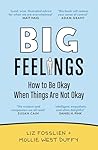
― Big Feelings: How to Be Okay When Things Are Not Okay
― Big Feelings: How to Be Okay When Things Are Not Okay
“Your plans and answers don’t need to be highly detailed, so avoid getting swept up in analysis paralysis. The goal is just to build your confidence in the idea that you would be able to handle the situation.”
― Big Feelings: How to Be Okay When Things Are Not Okay
― Big Feelings: How to Be Okay When Things Are Not Okay
“While big feelings are uncomfortable—at times they can even feel unbearable—they aren’t inherently positive or negative. When we take the time to understand them, big feelings like anger and regret can serve us. Anger can fuel us to advocate for what matters. And regret can provide us with insight into how to craft a more meaningful”
― Big Feelings: How to Be Okay When Things Are Not Okay
― Big Feelings: How to Be Okay When Things Are Not Okay
“A great way to make critiques generative is to ask people to share ideas that are either quick fixes, small steps that make a meaningful impact, or a way to rethink the entire thing.”
― No Hard Feelings: The Secret Power of Embracing Emotions at Work
― No Hard Feelings: The Secret Power of Embracing Emotions at Work
“We don’t resist change,” organizational psychologist Dr. Laura Gallaher told us. “We resist loss.”
― Big Feelings: How to Be Okay When Things Are Not Okay
― Big Feelings: How to Be Okay When Things Are Not Okay
“The key to success is practice, which involves errors, failure, and asking questions. It’s far better to share an early draft and get feedback”
― Big Feelings: How to Be Okay When Things Are Not Okay
― Big Feelings: How to Be Okay When Things Are Not Okay
“When we keep everything we’re feeling bottled up, we suffer in silence—and miss out on the chance to connect with others and to let them support us.”
― Big Feelings: How to Be Okay When Things Are Not Okay
― Big Feelings: How to Be Okay When Things Are Not Okay
“Focus less on your own importance and more on those around you. Compassion helps us become resilient: it improves our immune response, reduces our stress levels, and is associated with the pleasure networks in our brains. One way to practice compassion is to ask a colleague, “What’s on your mind and how can I help?” Of course, if you consistently put someone else’s needs ahead of your own, you’ll eventually be utterly drained and resentful. Make sure you’re aware of your emotional limits to avoid compassion fatigue.”
― No Hard Feelings: The Secret Power of Embracing Emotions at Work
― No Hard Feelings: The Secret Power of Embracing Emotions at Work
“You need to learn to navigate two main types of conflict: task conflict (the clash of creative ideas) and relationship conflict (personality-driven arguments). Task and relationship conflict are often related: it’s hard not to take disagreement over ideas personally.”
― No Hard Feelings: The Secret Power of Embracing Emotions at Work
― No Hard Feelings: The Secret Power of Embracing Emotions at Work
“Instead of beating yourself up for feeling anxious or for not knowing what will come next, reframe the situation. When we tell ourselves, “I am a person who is learning to ______,” instead of “I can’t do this” or “I need to have this all figured out already,” we start to see ourselves as empowered agents of change.”
― Big Feelings: How to Be Okay When Things Are Not Okay
― Big Feelings: How to Be Okay When Things Are Not Okay
“Every person on a team knows something that no one else knows. That’s why teams exist: you need more than one person’s set of ideas and skills to solve a problem.”
― No Hard Feelings: The Secret Power of Embracing Emotions at Work
― No Hard Feelings: The Secret Power of Embracing Emotions at Work
“The most content people craft their ups and downs into redemption stories: something bad happened, but something good resulted”
― No Hard Feelings: Emotions at Work and How They Help Us Succeed
― No Hard Feelings: Emotions at Work and How They Help Us Succeed
“Not belonging or a sense of isolation is among the strongest predictors of turnover.”
― No Hard Feelings: The Secret Power of Embracing Emotions at Work
― No Hard Feelings: The Secret Power of Embracing Emotions at Work
“If we know what the bad thing is, we can plan for it. But when we don’t know what’s going to happen, we spiral.”
― Big Feelings: How to Be Okay When Things Are Not Okay
― Big Feelings: How to Be Okay When Things Are Not Okay
“Researchers differentiate between strategic optimists and defensive pessimists (like Liz): strategic optimists envision best possible outcomes and try to make them happen whereas defensive pessimists tend to focus on what could go wrong and then work hard to avoid those situations. In studies, these groups perform equally well except when defensive pessimists are forced to cheer up.”
― No Hard Feelings: The Secret Power of Embracing Emotions at Work
― No Hard Feelings: The Secret Power of Embracing Emotions at Work
“WHAT EVERYONE SHOULD KNOW ABOUT YOU: What are some honest, unfiltered things about you? What drives you nuts? What are your quirks? What qualities do you particularly value in people who work with you? What are some things that people might misunderstand about you that you should clarify? HOW TO WORK WITH YOU: What’s the best way to communicate with you? What hours do we want to work together? Where and how do we want to work? (Same room, what kinds of meetings, what kinds of file sharing?) What are our goals for this team? What are our concerns about this team? How will we make decisions? What types of decisions need consensus? How will we deal with conflict? How do we want to give and receive feedback? (One-on-one, in a group, informally, or during a specified time each week—like at a retrospective?)”
― No Hard Feelings: The Secret Power of Embracing Emotions at Work
― No Hard Feelings: The Secret Power of Embracing Emotions at Work
“Perfectionism gives us a sense of control, which can offer short-term emotional relief. We tell ourselves that if we do everything right, we can avoid rejection and abuse. Psychologists refer to this as magical thinking, when we believe that one thing causes another when there isn’t an obvious link. But, of course, perfect is impossible. And no matter what you do in life, bad things might still happen.”
― Big Feelings: How to Be Okay When Things Are Not Okay
― Big Feelings: How to Be Okay When Things Are Not Okay
“anger is evolution’s way of telling us “Do something about this!” When you feel yourself getting angry, “that’s automatic, you cannot control that,” explains neuroscientist R. Douglas Fields. “Your unconscious mind has taken in enormous amounts of data and has determined that you are in a situation that is threatening and is preparing you to respond physically. . . . The only way this circuitry communicates to our awareness is through emotion.”[4] Think of anger as a nonspecific alarm intended to move you out of harm’s way.”
― Big Feelings: How to Be Okay When Things Are Not Okay
― Big Feelings: How to Be Okay When Things Are Not Okay
“Studies of day-to-day conversations show that people talk about regret more than any other emotion except love, and that regret is the uncomfortable emotion we feel most often.[4]”
― Big Feelings: How to Be Okay When Things Are Not Okay
― Big Feelings: How to Be Okay When Things Are Not Okay
“A family friend also reminded her that life has one deadline: when you die. Every other marker or timeline is something you set up for yourself.”
― Big Feelings: How to Be Okay When Things Are Not Okay
― Big Feelings: How to Be Okay When Things Are Not Okay
“Focus less on your own importance and more on those around you.”
― No Hard Feelings: Emotions at Work and How They Help Us Succeed
― No Hard Feelings: Emotions at Work and How They Help Us Succeed
“When you think of your childhood, what meal comes to mind and why?”
― No Hard Feelings: The Secret Power of Embracing Emotions at Work
― No Hard Feelings: The Secret Power of Embracing Emotions at Work
“This person has beliefs, perspectives, and opinions, just like me. This person has hopes, anxieties, and vulnerabilities, just like me. This person wants to feel respected, appreciated, and competent, just like me.”
― No Hard Feelings: The Secret Power of Embracing Emotions at Work
― No Hard Feelings: The Secret Power of Embracing Emotions at Work
“While perfectionism can show up in many small, private ways, it tends to present along similar lines of all-or-nothing thinking:”
― Big Feelings: How to Be Okay When Things Are Not Okay
― Big Feelings: How to Be Okay When Things Are Not Okay
“While big feelings are uncomfortable—at times they can even feel unbearable—they aren’t inherently positive or negative. When we take the time to understand them, big feelings like anger and regret can serve us.”
― Big Feelings: How to Be Okay When Things Are Not Okay
― Big Feelings: How to Be Okay When Things Are Not Okay
“The greatest weapon against stress is our ability to choose one thought over another.”
― No Hard Feelings: The Secret Power of Embracing Emotions at Work
― No Hard Feelings: The Secret Power of Embracing Emotions at Work