Goodreads helps you follow your favorite authors. Be the first to learn about new releases!
Start by following Mike Rucker.

Showing 1-8 of 8
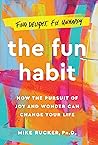
“Dr. Frode Stenseng, who has studied both the benefits and potential harms of escapism, would describe as self-expansion, the "good" kind of escapism.
When you're in an escapist state, as described by Stenseng, you (1) become completely absorbed in whatever it is you're doing, aka nowness.
You (2) might temporarily dis-sociate, which, experienced positively, can feel like being liberated from your identity, reaching what you might call oneness.
And finally, for a few beautiful moments of time, you (3) stop judging yourself-in Hadfield's description supplanted by a reverence for "something so much bigger than you." For anyone whose mind is frequently engaged in a litany of self-critique, you know the sweet relief of such an experience. Curiosity is a form of self-expansion, also.”
― The Fun Habit
When you're in an escapist state, as described by Stenseng, you (1) become completely absorbed in whatever it is you're doing, aka nowness.
You (2) might temporarily dis-sociate, which, experienced positively, can feel like being liberated from your identity, reaching what you might call oneness.
And finally, for a few beautiful moments of time, you (3) stop judging yourself-in Hadfield's description supplanted by a reverence for "something so much bigger than you." For anyone whose mind is frequently engaged in a litany of self-critique, you know the sweet relief of such an experience. Curiosity is a form of self-expansion, also.”
― The Fun Habit
“Much about fun remains mysterious. Scientific knowledge about its origins is largely speculative. One theory is that early in our evolution we figured out having fun supports our brain's development. Having fun with others taught humans how to cooperate and develop mutual agreements that set the stage for future social norms and consensus. As our ancestors engaged in fun and play, they developed rewarding relationships and beneficial, prosocial agreements that are the underpinning of modern group dynamics.”
― The Fun Habit
― The Fun Habit
“Dr. Barbara Fredrickson (and others after her) have made a compelling case that expanding and documenting our positive emotions have long-term adaptive benefits. Researchers from MIT found that activating positive memories can help suppress depression. Fun memories, it seems, are more than pleasant anecdotes at cocktail parties. They help us build enduring intellectual, social, and psychological resources. When life is not so fun, they offer emotional resilience. As such, when we cultivate fun and extend the habit's benefit through the practice of deliberate reminiscing, we increase our probability of a better future.”
― The Fun Habit
― The Fun Habit
“The truth is no one knows fun's evolutionary origins for sure or why having fun is so useful in helping us thrive. But unlike happiness, a subjective construct defined by human perception, fun is demonstrable, observable, real, and immediately in our grasp. It is primal and universal, operating at a level deeper than culture-a fact that's readily evident when you remember that many animals seek fun, not just humans. Fun is as simple as two dogs playing and as complex as the pathway accredited to some of Albert Einstein's most significant discoveries.”
― The Fun Habit
― The Fun Habit
“When you establish a reminiscing routine through acknowledging gratitude for past experiences, it keeps you mindful that fun is abundant. Put into practice, reminiscing in this manner mitigates feelings of regret and deprivation by giving you a concrete prompt to fully appreciate life's pleasurable experiences. A habit of acknowledging the pleasure in your life naturally increases your overall sense of gratitude, amplifying fun's positive effects.”
― The Fun Habit
― The Fun Habit
“The seed I would like to plant is that The Mystery, self-transcendence itself, might simply be the skill of truly having fun. Finding wisdom from a much deeper well than what we can create on our own. Being able to lose yourself in an experience, being able to savor the moment without attributing any context. Joy for joy's sake.”
― The Fun Habit
― The Fun Habit
“For those of you who are inevitably asking themselves, Okay, but how much time should I be seeking to spend on fun? Here's a starting place: two bours a day. This recommendation is grounded from two empirical sources: first, research from Dr. Marissa Sharif, Dr. Cassie Mogilner Holmes, and Dr. Hal Hershfield that suggests the "Goldilocks" sweet spot for leisure time is between two to five hours a day (more than five hours and the weight of being non productive has a negative effect.)”
― The Fun Habit
― The Fun Habit
“The way we believe we are staying happy these days is doing little to enrich our lives; it is simply effort that gets lost in the void of the Nothing. We work hard at being happy for little lasting reward, and when happiness is elusive, we are left wondering why.
To all this, fun is the antidote - maybe even literally, neurochemically. You see, fun shared with others is connected to a second, equally important feel-good hormone that we don't talk about enough: oxytocin. We earn some of our oxytocin through prosocial interactions and engaging in experiences that connect us to others. Oxytocin gives us that real sweetness of something larger than ourselves, while dopamine is metaphorically feel-good saccharin.”
― The Fun Habit
To all this, fun is the antidote - maybe even literally, neurochemically. You see, fun shared with others is connected to a second, equally important feel-good hormone that we don't talk about enough: oxytocin. We earn some of our oxytocin through prosocial interactions and engaging in experiences that connect us to others. Oxytocin gives us that real sweetness of something larger than ourselves, while dopamine is metaphorically feel-good saccharin.”
― The Fun Habit