Goodreads helps you follow your favorite authors. Be the first to learn about new releases!
Start by following Caleb Gayle.

Showing 1-16 of 16
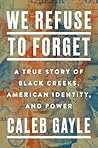
“We are all beautifully complex, and there’s nothing more American than struggling to fit all that complexity into boxes you did not create in the first place.”
― We Refuse to Forget: A True Story of Black Creeks, American Identity, and Power
― We Refuse to Forget: A True Story of Black Creeks, American Identity, and Power
“As a white man elected to the U.S. Senate who was given the responsibility of determining what the relationship between the federal government and Native Nations should be going forward, [Dawes] gave many nonwhites identities that we never asked for but that white supremacy required.”
― We Refuse to Forget: A True Story of Black Creeks, American Identity, and Power
― We Refuse to Forget: A True Story of Black Creeks, American Identity, and Power
“When we give people names that they did not give themselves, we erase the identity they and their ancestors fought for. The labels we give them come preloaded with definitions limited by our imaginations.”
― We Refuse to Forget: A True Story of Black Creeks, American Identity, and Power
― We Refuse to Forget: A True Story of Black Creeks, American Identity, and Power
“You cannot abolish bonds of kinship cemented in faith, religion, culture, tradition, and laws. But a nation? A nation can be destroyed.”
― We Refuse to Forget: A True Story of Black Creeks, American Identity, and Power
― We Refuse to Forget: A True Story of Black Creeks, American Identity, and Power
“Colonizers often tell themselves stories that the places they have colonized were in desperate need of saving—that their colonizing was redemptive.”
― We Refuse to Forget: A True Story of Black Creeks, American Identity, and Power
― We Refuse to Forget: A True Story of Black Creeks, American Identity, and Power
“Not one to let a critique hang in the air, Garnet rose again. All he had done, he explained, was advise that the enslaved “go to their masters and tell them they wanted their liberty, and had come to ask for it; and if the master refused it, to tell them, then we shall take it, let the consequence be what it may.”
― Black Moses: A Saga of Ambition and the Fight for a Black State
― Black Moses: A Saga of Ambition and the Fight for a Black State
“Over two decades before the country—at least the Union—declared the issue of slavery settled, two Black men, Frederick Douglass and Henry Highland Garnet, both formerly enslaved, had a vigorous debate in a northern church in 1843. The question before them: “How can we be truly free?” That question animated the next sixty years of debates—what ought we to do with the Black people enslaved before Emancipation and, most important, after it? And it took nearly forty years for Edward McCabe to answer this question with his own innovation: escape the North as vigorously as a Black person would want to escape the South and begin again on the western frontier. Beginning again for McCabe would mean establishing a state run by Black people for Black people, with their white counterparts tolerated only at a minimum.”
― Black Moses: A Saga of Ambition and the Fight for a Black State
― Black Moses: A Saga of Ambition and the Fight for a Black State
“...white supremacy's true goal is to violently disrupt lives where there is money to be made and to erase from our collective cultural and political memories any path to becoming American that white men did not create.”
― We Refuse to Forget: A True Story of Black Creeks, American Identity, and Power
― We Refuse to Forget: A True Story of Black Creeks, American Identity, and Power
“Since at least 1865,” W. E. B. DuBois wrote in 1934, “we have been holding back the Negro to keep him from getting beyond the white man.”
― Black Moses: A Saga of Ambition and the Fight for a Black State
― Black Moses: A Saga of Ambition and the Fight for a Black State
“Hawkins and the U.S. government knew that the concept of private property must take hold. They knew that communalism among the Creeks provided strength, but you can divide and conquer a nation more easily with private property if you pit family estate against family estate.”
― We Refuse to Forget: A True Story of Black Creeks, American Identity, and Power
― We Refuse to Forget: A True Story of Black Creeks, American Identity, and Power
“Remember that you are FOUR MILLIONS! Your dead fathers speak to [you] from their graves. Heaven, as with a voice of thunder, calls on you to arise from the dust. Let your motto be resistance! RESISTANCE! No Oppressed people have ever secured their liberty without resistance.”
― Black Moses: A Saga of Ambition and the Fight for a Black State
― Black Moses: A Saga of Ambition and the Fight for a Black State
“Douglass thought this request was too likely to lead to an insurrection. By one vote, Garnet’s resolution was voted down, and then twice more when the president of the convention, Amos Beman, lodged his strong dissent, citing “moral” reasons, just as Douglass had, for his opposition. But for McCabe, it was an invitation to find liberation and abundance for Black people in an innovative way—one not bestowed by his white peers, but one designed for and by Black people, even if it meant using the tools his white predecessors had used to colonize the country.”
― Black Moses: A Saga of Ambition and the Fight for a Black State
― Black Moses: A Saga of Ambition and the Fight for a Black State
“Perhaps Douglass hadn't been aggrieved enough yet. Perhaps this country that once permitted his slavery hadn't let him down enough yet. Because twenty years from publicly opposing Garnet - even insinuating he was immoral - Douglass found himself where Garnet had been. In an editorial in his monthly circular, Douglass told his readers, "Men of Color! To Arms! To Arms!," detailing that "when the war is over, the country is saved, peace is established, and the black man's rights are secured, as they will be, history with an impartial hand will dispose of that and sundry other questions. Action! Action! not criticism is the plain duty of this hour. Words are now useful only as they stimulate to blows.”
― Black Moses: A Saga of Ambition and the Fight for a Black State
― Black Moses: A Saga of Ambition and the Fight for a Black State
“We let our simplistic misconceptions about race triumph rather than allow identities to be beautifully complex.”
― We Refuse to Forget: A True Story of Black Creeks, American Identity, and Power
― We Refuse to Forget: A True Story of Black Creeks, American Identity, and Power
“The gross inconsistency of a people holding slaves, who had themselves ‘ferried o’er the wave’ for freedom’s sake, was too apparent to be entirely overlooked,” Garnet said. He castigated the people who argued that the founding of the United States was based on a legacy of freedom from their oppressor.”
― Black Moses: A Saga of Ambition and the Fight for a Black State
― Black Moses: A Saga of Ambition and the Fight for a Black State
“From Nat Turner, whose 1831 revolt sent shivers down the spines of enslavers who never anticipated the degree of success he’d inspire; to Joseph Cinqué, whom Garnet lauded for his rebellion as an enslaved man against the Spanish aboard the ship La Amistad; to Madison Washington, whose rebellion aboard the ship Creole just two years prior resulted in the liberation of 128 enslaved people and catalyzed heated debates between the United States and Great Britain over diplomacy and slavery; to Denmark Veazie (Vesey), whose execution was triggered by his decision to spark a rebellion in Charleston in 1822; to even McCabe’s eventual nicknamesake, Moses—Garnet called upon these abolitionists from different eras and told the crowd, “Brethren, arise, arise! Strike for your lives and liberties.”
― Black Moses: A Saga of Ambition and the Fight for a Black State
― Black Moses: A Saga of Ambition and the Fight for a Black State