Goodreads helps you follow your favorite authors. Be the first to learn about new releases!
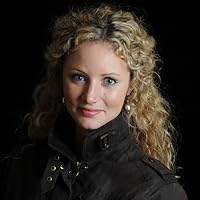
Start by following Suzannah Lipscomb.
Showing 1-19 of 19
“Carr borrowed aspects of social science to suggest that the interpretive historian is not so much discovering as always ‘in a relation with’ the facts.”
― What Is History, Now?
― What Is History, Now?
“Not the past of the select few, but the past of the many, in order to demonstrate, share – shout from the rooftops – that history belongs to us all.”
― What Is History, Now?
― What Is History, Now?
“it’s about refusing to accept a censored version of history that glorifies certain people and erases others.”
― What Is History, Now?
― What Is History, Now?
“Coloro che accusavano gli altri di stregoneria cercavano a loro volta spiegazioni soprannaturali alle disgrazie.”
― A History of Magic, Witchcraft, and the Occult
― A History of Magic, Witchcraft, and the Occult
“British history, if judged by the publishing marketplace, might be thought to consist of only three epochs: the Tudors, the First World War and the Second World War.”
― What Is History, Now?
― What Is History, Now?
“it is when we persist in viewing the tainted past uncritically that we continue to sully the present.”
― What Is History, Now?
― What Is History, Now?
“As George Orwell put it in 1984, ‘who controls the past controls the future; who controls the present controls the past’.”
― What Is History, Now?
― What Is History, Now?
“What any culture chooses to make official and takes as a given about itself and its history is as telling as what it fails to notice or repudiates; reading between the lines reveals that there is meaning in the gaps in our histories as well as in the printed pages.”
― What Is History, Now?
― What Is History, Now?
“Statues … are not really about history at all, but are about how we see ourselves reflected in history: pride versus shame, good versus bad, heroes versus villains. Statues are not a record of history but of historical memory. They reflected what somebody at some point thought we should think.”
― What Is History, Now?
― What Is History, Now?
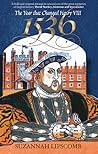
“it is not the king’s deed but the deed of Crumwell, and if we had him here we would crum him and crum him so that he was never so crummed’ (a play on words of Cromwell’s name),”
― 1536: The Year that Changed Henry VIII
― 1536: The Year that Changed Henry VIII
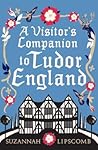
“Fruit and vegetables were not thought to agree with man’s digestion. The Book of Keruynge [Carving] of 1508 warned its readers to ‘beware of green salads and raw fruits for they will [make] your souerayne [stomach] sick’, and Sir Thomas Elyot had the same message in his book from 1541, The Castle of Health. ‘All fruits generally,’ he wrote, ‘are noyfull [harmful] to man and do”
― A Visitor's Companion to Tudor England
― A Visitor's Companion to Tudor England
“Carr wrote: ‘by and large, the historian will get the kind of facts he wants. History means interpretation.”
― What Is History, Now?
― What Is History, Now?
“Empires’, then, can be marked on a map. ‘Imperialism’, by contrast, involves a set of coercive relationships that may exist even in the absence of direct rule.”
― What Is History, Now?
― What Is History, Now?
“facts are served as the historian wishes to serve them and that history is by and large interpretive.”
― What Is History, Now?
― What Is History, Now?
“This book intends to prove the opposite: that history can be flexible, malleable, colourful and without bias – that history is, above all, interpretation. This is why this volume hosts a multiplicity of voices.”
― What Is History, Now?
― What Is History, Now?
“It has been suggested that it was not even conceptually possible to be an atheist in the sixteenth century.”
― 1536: The Year that Changed Henry VIII
― 1536: The Year that Changed Henry VIII
“Labels like ‘antiquity’, ‘the Middle Ages’ or ‘early modern’ are not entirely unproblematic for historians of the West; but they are meaningless for vast parts of the world.”
― What Is History, Now?
― What Is History, Now?
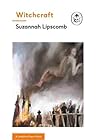
“What the Reformation did was create an atmosphere of apocalyptic angst: people believed that they were living in the end days, and this brought the Devil to their minds.”
― Witchcraft: A Ladybird Expert Book
― Witchcraft: A Ladybird Expert Book
“Which stories we tell about history, who we celebrate and the ideas and values they embody determine the world we live in today.”
― What Is History, Now?
― What Is History, Now?