Goodreads helps you follow your favorite authors. Be the first to learn about new releases!
Start by following Paul McLaughlin.

Showing 1-5 of 5
“Bertrand Russell, writing during World War I, castigates intellectuals for exactly this tendency: ‘In modern times, philosophers, professors, and intellectuals generally undertake willingly to provide their respective governments with those ingenious distortions and those subtle untruths by which it is made to appear that all good is on one side and all wickedness on the other.’ Thus ‘learned men’ seem ‘as incapable of justice as any cheap newspaper [and] as full of special pleading and garbled history’.9 Or, in other words, academia and CNN are on a par in times like these.”
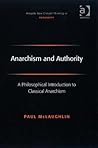
― Anarchism and Authority: A Philosophical Introduction to Classical Anarchism
― Anarchism and Authority: A Philosophical Introduction to Classical Anarchism
“The familiar claim – or ‘moral’ exhortation – that ‘if you don’t vote, you’ve no right to complain’ surely has it the wrong way around. Is it not true to say that if you do play the game, you’ve no right to complain about the rules or the result subsequently? Might it be that up to half the adult population (excluding those who vote with almost no faith whatsoever in the process7) is dissatisfied with the game itself? Might it be that this game does not satisfy their ‘desire for recognition’, that it is not ‘completely satisfying’? Might it be that the game is seen as nothing but an expensive sideshow put on by the few who can afford it and have a vested interest in it to pacify or placate the on-looking majority? And might it be that neither the tinkering of political scientists nor the ‘good intentions’ of liberal reformers can remedy the inherent ills of this game? Anarchists voice precisely such doubts about political democracy. Fundamentally, they are sceptical about the authority claimed by democratic politicians, authority which is now – in practice – recognized by fewer and fewer citizens of democratic states.”
― Anarchism and Authority: A Philosophical Introduction to Classical Anarchism
― Anarchism and Authority: A Philosophical Introduction to Classical Anarchism
“Political democracy, judged on its own terms (as a basic political value in itself), is not to be judged (consequentially) in terms of its outcomes (successful or otherwise), but in terms of engagement. This is obviously reflected, quite basically, in electoral turnout figures (which, according to the International Institute for Democracy and Electoral Assistance, are in global decline); but it is also reflected in related elements such as levels of public debate, competition for and accessibility of office, accountability of representatives, and so on. In other words, if people do not engage seriously or, at a minimum, even bother to vote at all, then the political system has failed and those who claim a democratic mandate lack popular legitimacy – lack authority.”
― Anarchism and Authority: A Philosophical Introduction to Classical Anarchism
― Anarchism and Authority: A Philosophical Introduction to Classical Anarchism
“Then there are spurious intellectual discussions about ‘voter apathy’ and so on, as if such factors could possibly explain and somehow justify massive disengagement from our political processes. Indeed, such discussion is hugely insulting to those who choose to abstain from the political lottery on principle or out of plain disgust (and who, incidentally, might participate in dramatic numbers if a ‘none of the above’ option were offered on the ballot, a solution to the turnout problem that has been vigorously thwarted since it would make an implicit rejection of the political process as it stands more explicit). We cannot simply assume that half the eligible population is too bored or too lazy to participate in political life, say, once every four years; that demands a pretty extreme assumption of disinterest and lethargy. There is little doubt that a great number feel that the mode of ‘participation’ available to them is inauthentic6 – and that the ‘choice’ they might be a party to would make them culpable for its consequences. As such, non-participation can be seen as a very modest form of moral revolt, since it undermines the legitimacy of those who exercise political authority and the very institutions that embody this authority.”
― Anarchism and Authority: A Philosophical Introduction to Classical Anarchism
― Anarchism and Authority: A Philosophical Introduction to Classical Anarchism
“The provision of news and information, for example, has been ‘dumbed down’ to a previously unimaginable degree, and the line between Hollywood fiction and journalistic fact is increasingly blurry. Between the latest action blockbuster and a Fox News ‘embedded’ exclusive – or, at an ‘advanced’ level, between some sentimental Oscar-bait and a John Simpson BBC news report – locating the line is no easy task.20 In search of the facts, sceptical and curious citizens turn to the web for scraps of truth, and struggle to separate the journalistic wheat from the chaff. But their eagerness to educate themselves and their hostility to the mainstream, corporate- and state-owned media assures us that the rational pursuit of objective reality hasn’t been forsaken in a world of hyper-propaganda and philosophical relativism.”
― Anarchism and Authority: A Philosophical Introduction to Classical Anarchism
― Anarchism and Authority: A Philosophical Introduction to Classical Anarchism