Goodreads helps you follow your favorite authors. Be the first to learn about new releases!
Start by following Ian Bogost.

Showing 1-30 of 33
“Boredom is the secret to releasing pleasure. Once something becomes so tedious that its purpose becomes secondary to its nature, then the real work can start.”
― Play Anything: The Pleasure of Limits, the Uses of Boredom, and the Secret of Games
― Play Anything: The Pleasure of Limits, the Uses of Boredom, and the Secret of Games
“Play isn’t doing what we want, but doing what we can with the materials we find along the way.”
― Play Anything: The Pleasure of Limits, the Uses of Boredom, and the Secret of Games
― Play Anything: The Pleasure of Limits, the Uses of Boredom, and the Secret of Games
“games aren’t the opposite of work, but experiences that set aside the ordinary purposes of things.”
― Play Anything: The Pleasure of Limits, the Uses of Boredom, and the Secret of Games
― Play Anything: The Pleasure of Limits, the Uses of Boredom, and the Secret of Games
“The ultimate lesson games give is not about gratification and reward, nor about media and technology, nor about art and design. It is a lesson about modesty, attention, and care. Play cultivates humility, for it requires us to treat things as they are rather than as we wish them to be. If we let it, play can be the secret to contentment. Not because it provides happiness or pleasure—although it certainly can—but because it helps us pursue a greater respect for the things, people, and situations around us.”
― Play Anything: The Pleasure of Limits, the Uses of Boredom, and the Secret of Games
― Play Anything: The Pleasure of Limits, the Uses of Boredom, and the Secret of Games
“She was having fun, but her fun emerged from misery. Fun isn’t pleasure, it turns out. Fun is the feeling of finding something new in a familiar situation. Fun almost demands boredom: you need the sense that nothing good could possibly arise from an experience in order for the experience of finding something there to smolder with the hot pleasure of surprise. Likewise,”
― Play Anything: The Pleasure of Limits, the Uses of Boredom, and the Secret of Games
― Play Anything: The Pleasure of Limits, the Uses of Boredom, and the Secret of Games
“Boredom sends up a flare: meaning exists here, boredom beckons, but stranded meaning. Meaning that requires rescue.”
― Play Anything: The Pleasure of Limits, the Uses of Boredom, and the Secret of Games
― Play Anything: The Pleasure of Limits, the Uses of Boredom, and the Secret of Games
“The German sociologist Niklas Luhmann once observed that the simple act of asking yourself, “Where did I put my keys?” performs unexpected magic: it transforms the world into a catalog of possible key locations.1 Under the couch, somewhere the dog or the baby moved”
― Play Anything: The Pleasure of Limits, the Uses of Boredom, and the Secret of Games
― Play Anything: The Pleasure of Limits, the Uses of Boredom, and the Secret of Games
“Art has done many things in human history, but in the last century especially, it has primarily tried to bother and provoke us. To force us to see things differently. Art changes. Its very purpose, we might say, is to change, and to change us along with it.”
― How to Do Things with Videogames
― How to Do Things with Videogames
“Perhaps in another few thousand years, the aliens who take over our planet will note the quaint and weird sport of Association Football, an ancient forerunner to whatever becomes their modern foot-and-ball game. Perhaps it will be played with the heads of vanquished humans.”
― How to Talk about Videogames (Electronic Mediations Book 47)
― How to Talk about Videogames (Electronic Mediations Book 47)
“Irony keeps reality at a distance. It has become our primary method for combatting the external world’s incompatibility with our own desires. Today’s irony uses increasingly desperate efforts to hold everything in between welcome embrace and sneering mockery. Irony is the great affliction of our age, worthy of its own disorder.”
― Play Anything: The Pleasure of Limits, the Uses of Boredom, and the Secret of Games
― Play Anything: The Pleasure of Limits, the Uses of Boredom, and the Secret of Games
“Yet once we are done nodding earnestly at Whitehead and Latour, what do we do? We return to our libraries and our word processors. We refine our diction and insert more endnotes. We apply "rigor," the scholarly version of Tinker Bell's fairy dust, in adequate quantities to stave off interest while cheating death. For too long, being "radical" in philosophy has meant writing and talking incessantly, theorizing ideas so big that they can never be concretized but only marked with threatening definite articles ("the political," "the other," "the neighbor," "the animal"). For too long, philosophers have spun waste like a goldfish's sphincter, rather than spinning yarn like a charka. Whether or not the real radical philosophers march or protest or run for office in addition to writing inscrutable tomes - this is a question we can, perhaps, leave aside. Real radicals, we might conclude, make things.”
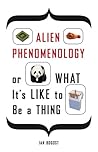
― Alien Phenomenology, or What It’s Like to Be a Thing
― Alien Phenomenology, or What It’s Like to Be a Thing
“Children aren’t only less inhibited than adults; they are also less powerful, and smaller too. They may or may not be more open-minded and liberated than grown-ups, but they are forced to live in a world that wasn’t designed for them, and one that is not primarily concerned with their desires and their welfare. And so children are constantly compromising, constantly adjusting to an environment that is clearly not theirs, not yet. That’s wisdom, not innocence.”
― Play Anything: The Pleasure of Limits, the Uses of Boredom, and the Secret of Games
― Play Anything: The Pleasure of Limits, the Uses of Boredom, and the Secret of Games
“But games aren’t magic, and the most special thing about them isn’t unique to them anyway—their artificial, deliberately limited structures teach us how to appreciate everything else that has a specific, limited structure. Which is just to say, anything whatsoever. Play isn’t our goal, but a tool to discover and appreciate the structures of all the malls and fishbowls we encounter. Once”
― Play Anything: The Pleasure of Limits, the Uses of Boredom, and the Secret of Games
― Play Anything: The Pleasure of Limits, the Uses of Boredom, and the Secret of Games
“Irony keeps reality at a distance. It has become our primary method for combatting the external world’s incompatibility with our own desires. Today’s irony uses increasingly desperate efforts to hold everything in between welcome embrace and sneering mockery. Irony is the great affliction of our age, worthy of its own disorder. I”
― Play Anything: The Pleasure of Limits, the Uses of Boredom, and the Secret of Games
― Play Anything: The Pleasure of Limits, the Uses of Boredom, and the Secret of Games
“A WHILE BACK, a game designer friend of mine named Phil Fish made a plea on Twitter, “Hey bloggers, no more ‘blank rebuilt in Minecraft’ posts, please. We get it. You can make things in Minecraft. Thanks.” Fish was referring to the popular online game Minecraft, in which players hunt for resources that are used to construct models and apparatuses with the game’s characteristic, cubical visual style. The Internet being what it is, given such tools extreme fans do insane things, like elaborately reconstructing the city King’s Landing from Game of Thrones using nothing but this square matter mined from Minecraft. Seeing Fish’s tweet, an enterprising ironoiac recreated the form of the embedded tweet itself inside Minecraft, a fact that the tech blog VentureBeat then dutifully blogged about, thus completing not one but two cycles of an ironoia self-treatment the environmental philosopher Timothy Morton names “anything you can do I can do meta.”14 In a futile attempt to prevent further metastasis, the blogger concluded his post with the line, “Yes, we’re fully aware of the irony of this post.”15 But rather than satisfying anyone, such a provocation only further irritated the ironoiac itch. Fish tweeted a link to the blog post covering the Minecraft construction of a model of Fish’s tweet protesting blog posts about Minecraft constructions, which one of his followers one-upped by observing the fact that Fish had in fact “tweeted about somebody blogging about somebody making [his] tweet about Minecraft in Minecraft.” Another chimed in, “How long ’til someone recreates that blog post in Minecraft?” Each step represents an attempt to overcome the absurdity of the last by fixing it in a new voice, even though each ironic gesture was evanescent, quickly replaced by yet another layer of buffer from yet another desperate ironoiac. Why do we do it, then? Today, satisfaction is more elusive than ever. In part, the precarity of life after the 2008 global financial collapse and the Great Recession that followed it (and whose effects still linger) makes every transaction with the world feel suspect and risky. We fear that things might turn on us, because we have good evidence that they can, and do. But”
― Play Anything: The Pleasure of Limits, the Uses of Boredom, and the Secret of Games
― Play Anything: The Pleasure of Limits, the Uses of Boredom, and the Secret of Games
“The Blue Shell is everything that’s wrong with America.”
― How to Talk about Videogames (Electronic Mediations Book 47)
― How to Talk about Videogames (Electronic Mediations Book 47)
“By manipulating the physical configuration of [any situation], you make it produce a subset of the infinite pattern of [possibilities]. And even if you don't know how to play [above situation], you can still play with it.”
― Play Anything: The Pleasure of Limits, the Uses of Boredom, and the Secret of Games
― Play Anything: The Pleasure of Limits, the Uses of Boredom, and the Secret of Games
“Turkle recounts the story of Marcia, a tenth grader she interviewed about Sim City. Marcia had developed a set of guidelines for playing the game, including this one: "Raising taxes always leads to riots."46 Turkle worries gravely about Marcia's inability to conceive of a simulation in which the rules would differ, in which, for example, "increased taxes led to increased productivity and social harmony."" Turkle calls for a new kind of literacy that would teach Marcia and her peers how to develop a reading competency of simulation.”
― Unit Operations: An Approach to Videogame Criticism
― Unit Operations: An Approach to Videogame Criticism
“fun isn’t the experience of pleasure, but the outcome of tinkering with a small part of the world in a surprising way. Think”
― Play Anything: The Pleasure of Limits, the Uses of Boredom, and the Secret of Games
― Play Anything: The Pleasure of Limits, the Uses of Boredom, and the Secret of Games
“Wagnerian Gesamtkunstwerk-flavored chewing gum.”
― How to Talk about Videogames (Electronic Mediations Book 47)
― How to Talk about Videogames (Electronic Mediations Book 47)
“Second, writing is dangerous for philosophy—and for serious scholarly practice in general. It’s not because writing breaks from its origins as Plato would have it, but because writing is only one form of being. The long-standing assumption that we relate to the world only through language is a particularly fetid, if still bafflingly popular, opinion.”
― Alien Phenomenology, or What It's Like to Be a Thing
― Alien Phenomenology, or What It's Like to Be a Thing
“Even if kids had time left after all of this regulation, they’re increasingly unable to partake in the world outside their schools and homes anyway. The 1950s hunter-gatherer childhood of Gray’s memory is partly a nostalgic myth in the spirit of Thoreau, for one part. For another, kids are largely prohibited from meandering on their own or in groups today. Writing in the Daily Mail, David Derbyshire contrasts a contemporary eight-year-old schoolboy (Edward), with his great-grandfather (George) of the same age.5 In 1926, George was able to meander some six miles to a pond to fish. Eighty years later, Edward is driven everywhere, even to safe, predetermined venues for bike riding. This shift didn’t happen all at once. Edward’s grandfather Jack was afforded a mile of freedom from his house at age eight, in the 1950s. His mother, Vicky, was allowed to wander about a half-mile away, to the local pool, in the late 1970s. By 2007, little Ed was permitted to stray less than three hundred yards from his door, as far as the end of the street.”
― Play Anything: The Pleasure of Limits, the Uses of Boredom, and the Secret of Games
― Play Anything: The Pleasure of Limits, the Uses of Boredom, and the Secret of Games
“Is there really any difference, the writer Jeb Boniakowski once asked, between highly engineered and processed foods like the kind you find at McDonald’s, and molecular gastronomy, the application of food science to cooking that became popular in modernist haute cuisine establishments like elBulli and Alinea? Boniakowski draws a powerful conclusion that should be obvious in retrospect: “I’ve often thought that a lot of what makes crazy restaurant food taste crazy is the solemn appreciation you lend to it.” But we tend to limit our indulgence of that appreciation. Boniakowski offers a delightful thought experiment to illustrate the point: If you put a Cheeto on a big white plate in a formal restaurant and serve it with chopsticks and say something like, “It is a cornmeal quenelle, extruded at a high speed, and so the extrusion heats the cornmeal ‘polenta’ and flash-cooks it, trapping air and giving it a crispy texture with a striking lightness. It is then dusted with an ‘umami powder’ glutamate and evaporated-dairy-solids blend.” People would go nuts for that.20 Even”
― Play Anything: The Pleasure of Limits, the Uses of Boredom, and the Secret of Games
― Play Anything: The Pleasure of Limits, the Uses of Boredom, and the Secret of Games
“To treat things with respect and intrigue, we don’t need to understand their motivations and inner lives—whatever knowing the inner life of a tangelo or a floor tile would mean.4 We just need to pay enough attention to discover what they do and how they work—to discover what they obviously and truly are—and then to make use of them in gratifyingly novel ways. And”
― Play Anything: The Pleasure of Limits, the Uses of Boredom, and the Secret of Games
― Play Anything: The Pleasure of Limits, the Uses of Boredom, and the Secret of Games
“If we take seriously the idea that all objects recede interminably into themselves, then human perception becomes just one among many ways that objects might relate. To put things at the center of a new metaphysics also requires us to admit that they do not exist just for us. The Computer”
― Alien Phenomenology, or What It's Like to Be a Thing
― Alien Phenomenology, or What It's Like to Be a Thing
“If adults also don’t live in a world designed for us. Climate, entropy, accident, crowds, happenstance, erosion, heartbreak—we are fools to think that we are in control of the universe. Children are right to allow the humility of their smallness to rule the day. My misery gives way to fun when you take an object, event, situation, or scenario that wasn’t designed for you, that isn’t invested in you, that isn’t concerned in the slightest for your experience of it, and then treat it as if it were.”
― Play Anything: The Pleasure of Limits, the Uses of Boredom, and the Secret of Games
― Play Anything: The Pleasure of Limits, the Uses of Boredom, and the Secret of Games
“The density of being makes it promiscuous, always touching everything else, unconcerned with differentiation. Anything is thing enough to party.”
― Alien Phenomenology, or What It's Like to Be a Thing
― Alien Phenomenology, or What It's Like to Be a Thing
“Videogames require critical interpretation to mediate our experience of the simulation, to ground it in a set of coherent and expressive values, responses, or understandings that constitute effects of the work. In this process, the unit operations of a simulation embody themselves in a player's understanding. This is the place where rules can be grasped, where instantiated code enters the material world via human players' faculty of reason. In my mind, it is the most important moment in the study of a videogame.”
― Unit Operations: An Approach to Videogame Criticism
― Unit Operations: An Approach to Videogame Criticism
“The Blue Shell is the cruel tax of gaming, the welfare queen of kart racing. God damn you kids today. We used to have to win a race to win it.”
― How to Talk about Videogames (Electronic Mediations Book 47)
― How to Talk about Videogames (Electronic Mediations Book 47)
“My daughter showed us the key: misery gives way to fun when you take an object, event, situation, or scenario that wasn't designed for you, that isn't invested in you, that isn't concerned in the slightest for your experience of it, and then treat it as if it were. ...this is what play means.”
― Play Anything: The Pleasure of Limits, the Uses of Boredom, and the Secret of Games
― Play Anything: The Pleasure of Limits, the Uses of Boredom, and the Secret of Games